"Independent dispute resolution companies" means two different things in No Surprises Act work. The first are the arbiters: the certified IDR entities that decide federal surprise-billing payment disputes, 17 of them as of September 2026, each certified by the Departments of Health and Human Services, Labor and the Treasury and paid a fee that the losing side bears. The second are the companies that work disputes on one party's behalf, against which a health plan weighs its own in-house desk. The full cost of a dispute to a plan is mostly not the fees either kind of company charges; it is the award, the awards lost by default and the analyst hours. Botminds' No Surprises Act Dispute Management is built to move those three lines.
What one sample batch costs the plan above its initial payment, by outcome
What are independent dispute resolution companies?
In federal law they are certified IDR entities: organisations certified jointly by the three Departments to decide out-of-network payment disputes under the No Surprises Act. Each must show, in CMS's words, "sufficient background and experience in arbitration and claims administration of health care services, managed care, billing and coding, medical and legal expertise", the ability to avoid conflicts of interest and to protect sensitive information (CMS, 12 June 2025). Certification lasts five years, and the Departments published recertification FAQs in July 2026.
The number has grown with the volume. CMS certified two more entities in June 2025, taking the count from 13 to 15, a sixteenth in January 2026 and a seventeenth on 11 September 2026, each time citing throughput (CMS notices). Since the 2025 third- and fourth-quarter public use files, released in July 2026, each determination line also names the entity that made it, so a plan can see how each arbiter has ruled.
The certified IDR entity, from the plan's side: what it does and what it costs
| Question | Answer for disputes initiated now | Source |
|---|---|---|
| How is it chosen? | The initiating party names one; the other side has 3 business days to object and propose another. If they do not agree, the Departments pick at random within 6 business days. | 45 CFR 149.510(c)(1) |
| What does it decide? | Eligibility first, then which of the two offers best represents the value of the service. | 45 CFR 149.510(c)(1), (c)(4) |
| Its fee for one dispute | $200 to $840, fixed by each entity within the range. | 88 FR 88494 |
| Its fee for a batch | $268 to $1,173, plus $75 to $250 for each further 25 lines from the 26th. | 88 FR 88494 |
| Who pays it | Both sides pay with their offers; the winner is refunded within 30 business days. | 45 CFR 149.510(d)(1) |
| The Departments’ administrative fee | $15 per party per dispute, non-refundable, for disputes initiated on or after 11 June 2026. | 91 FR 33900 |
| If the parties settle | Half of each side’s entity fee is returned; the administrative fee is not. | 45 CFR 149.510(c)(2)(ii) |
How many certified IDR entities are there?
Seventeen, since CMS announced the certification of Physio Solutions, LLC (doing business as medlitix) on 11 September 2026. The Departments framed each addition as capacity: expanding to 17 "is expected to increase IDR throughput". The capacity has shown up in the numbers. In the second half of 2025 the entities closed 1,449,900 disputes, 6% more than were initiated, and made 62% of payment determinations within 30 business days, up from 37% in the first half (CMS).
For a plan the count matters less than the conflict rules and the selection clock. An entity may not be a plan, an issuer or a provider, or an affiliate of one, or of a trade association representing them, and its reviewers may not have a material familial, financial or professional relationship with a party (45 CFR 149.510(a)(2)). A plan that wants a say in which entity hears its disputes has three business days from the initiation date to object.
How much does an IDR dispute cost a health plan?
The fees are the small part. For a single dispute initiated today the plan pays $15 to the Departments and, if it loses, the entity's fee of $200 to $840; for a batch, $268 to $1,173 and more for long batches. The award is the large part: the difference between what the plan already paid and the offer the arbiter selects, due within 30 calendar days of the determination.
National fee totals show the scale. In 2024, when the administrative fee was $115, parties paid $718 million in fees, $559 million to IDR entities and $159 million to the Departments, the Congressional Research Service calculated (CRS R48738). The 2026 operations rule cut the administrative fee to $15 by dividing the Departments' estimated annual cost of running the process, $119.4 million, by an estimated 6.9 million administrative fees a year (91 FR 33900). Lower fees lower the cost of filing, for providers as much as plans.
The full cost of one federal dispute to a plan
Fees
$15 administrative fee + entity fee × chance the plan loses
Single $200–$840; batch $268–$1,173 plus tiers. Small per dispute, large in total.
Set by rule and by the entity
Award above the payment
(Selected offer − initial payment) × lines
The largest term. It depends on the offer the plan chooses and the evidence behind it.
The analyst who sets the offer
Defaults
Chance of a missed offer or fee × (provider’s offer − plan’s offer) × lines
A missed offer or unpaid fee hands the dispute to the other side.
Whoever keeps the calendar
People
Hours per dispute × loaded hourly rate, or the service’s fee
Reading, matching, eligibility, evidence, the explanation and sign-off.
The desk or the outside company
What does losing by default cost?
The whole gap between the two offers. If one party fails to submit an offer or pay its fees and the other does both, the entity "must rule in favor of the party that submitted an offer and paid their fees", as CMS's report on the second half of 2025 puts it (CMS). Default decisions were 17% of payment determinations in that half-year, down from 22%, and 90% of them went to providers, facilities and air ambulance providers.
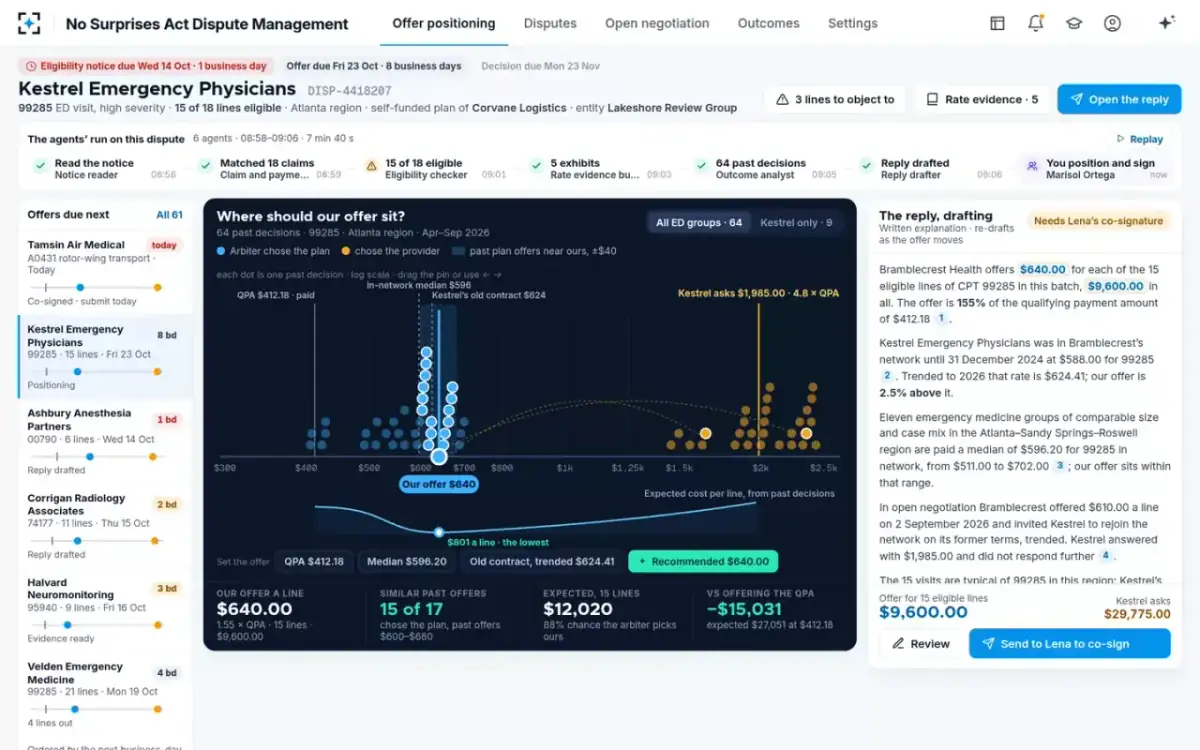
Take the sample batch behind the chart above, as it runs through the solution: Kestrel Emergency Physicians, a fictional emergency group, disputes 15 eligible lines of CPT 99285 with Bramblecrest Health, a fictional plan that paid $412.18 a line, the qualifying payment amount. Kestrel asks $1,985.00 a line, $29,775.00 in all. If the plan misses its offer deadline, it owes $23,592.30 more than it paid. If it submits at $640.00 and wins, it owes $3,417.30 more. One missed deadline on this one batch costs $20,175.00, before fees.
Defaults have also distorted the headline. The CRS found that providers' improved success in 2024 "was largely attributable to an increased number of determinations in which the insurer defaulted", and that in the fourth quarter of 2024, 26% of disputes were resolved by default. A plan that stops defaulting changes its own win rate before it changes a single offer; how to win the disputes that are actually argued starts earlier, at the open negotiation notice.
When is it cheaper not to go to IDR at all?
When the plan can settle in open negotiation at a price close to what it would expect to pay after a determination. A settlement before initiation costs neither side an administrative fee or an arbiter's fee, and it saves the analyst hours. A settlement after initiation still helps: the agreed amount becomes the out-of-network rate, the plan pays any balance within 30 business days of the agreement, and the arbiter returns half of each side's fee, though the $15 administrative fees are gone (45 CFR 149.510(c)(2)).
The comparison has to be honest about the alternative. If past decisions for the code and region show the plan rarely chosen at the offers it can defend, the expected award, not the fee, is the number to settle against. The CRS found that providers won about 85% of non-default determinations in both 2023 and 2024, so for many codes the expected cost of arguing is closer to the provider's number than the plan's.
Is it cheaper to outsource IDR?
Sometimes, and the answer turns on volume and on who holds the evidence, not on the fee. An outside company spreads its staff across many clients, which helps a plan with a few hundred disputes a year. It cannot easily use what only the plan holds: a departed provider's old contract, the plan's comparable in-network rates, and the plan's own history of where arbiters landed for each code and region. Those are the inputs that decide the award, the largest term in the formula.
Three ways to staff a federal IDR desk, costed line by line
Outside company or in-house by hand: The same federal and entity fees either way; some services add a per-dispute charge or a share of savings.
Agents with the plan's analysts: The same federal and entity fees; software cost instead of a per-dispute charge.
Outside company or in-house by hand: Depends on the method; offers benchmarked to the QPA have mostly lost.
Agents with the plan's analysts: Offer set by a named analyst beside past decisions for the code and region, the QPA and the provider’s former contract.
Outside company or in-house by hand: Depends on whose calendar and how a miss is reported.
Agents with the plan's analysts: One queue by next business-day deadline, warnings at three days and escalation at one; design target of zero defaults.
Outside company or in-house by hand: Botminds’ estimate: about 10 analyst hours for a typical batch worked by hand.
Agents with the plan's analysts: Botminds’ estimate: about 2.5 hours, most of it choosing the offer and signing.
Outside company or in-house by hand: Summaries, unless the contract returns the files.
Agents with the plan's analysts: Every exhibit, signature and decision in the plan’s own systems.
Expected cost at every possible offer, before the analyst picks one
How many IDR disputes can an analyst handle?
No public source measures it, so a plan has to work it out from hours. If a batched dispute takes about ten analyst hours by hand, which is Botminds' estimate, one full-time analyst finishes roughly four a week. At about two and a half hours with the reading and drafting done by agents, the same analyst finishes about sixteen. A plan that knows its weekly initiation count can size the desk from those two figures and its own measured hours.
National volume makes the sizing urgent. Disputes initiated each month rose from 248,452 in January 2026 to 390,602 in September, CMS reports, and the most frequent non-initiating party was named in around 30% of emergency and non-emergency disputes in each quarter of 2024, according to the CRS. Desks sized for 2023 volumes are now short by a multiple, not a margin.
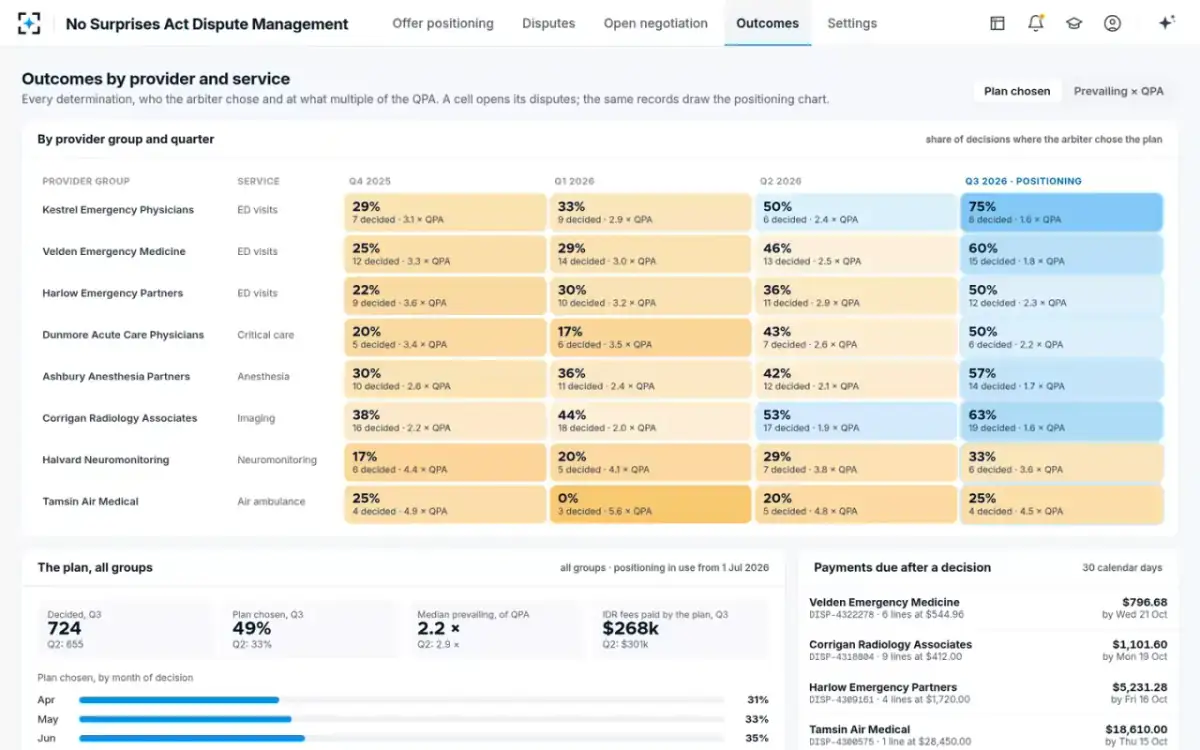
Outcomes and fees by provider group and quarter, in one view
What to ask an independent dispute resolution company before you sign
Whether the company would decide disputes or work them for the plan, the contract should answer the questions below in writing. They are the terms that move the four lines of the cost formula.
Contract questions for an IDR service, priced by the cost line they move
- Fees: who pays the entity fee on a loss, and is it passed through at cost?
The losing side bears it; a service that adds a margin turns every loss into revenue.
- Award: how is the offer chosen, and who signs it?
Ask for the past determinations behind a sample recommendation, and the name of the person at the plan who approves it.
- Defaults: what happens when you miss an offer or a fee?
Ask for the count in the last twelve months and whether the contract makes the service whole.
- People: what is priced per dispute, and what per line?
Batches can run to 50 lines for disputes whose open negotiation starts on or after 1 November 2026.
- Data: do the exhibits and decisions come back to us?
Every file, in a form the plan can use for the next dispute and for an audit.
- Gateway: is your organisation signed up?
From 13 November 2026 federal web forms move into the IDR Gateway; a plan that uses another organisation must make sure it has signed up.
No Surprises Act Dispute Management sits on the right-hand side of the comparison: the plan's analysts decide, and six agents do the reading, matching, checking, evidence and drafting. It does not replace counsel, it never submits to the federal portal, and its figures on this page are sample data and estimates, not a customer's results. For the people the model assumes, see who staffs a health plan's dispute desk.
Questions people ask
What is the IDR administrative fee in 2026?
$15 per party per dispute for disputes initiated on or after 11 June 2026, under the federal IDR operations final rules published on 4 June 2026. Disputes initiated from 22 January 2024 to 10 June 2026 carry the earlier $115 fee.
What are certified IDR entity fees?
Each entity sets a fixed fee within ranges set by rule: $200 to $840 for a single determination and $268 to $1,173 for a batch, with $75 to $250 more for each further 25 lines from the 26th. The ranges apply to disputes initiated on or after 22 January 2024 and stay until changed by rulemaking.
Can a plan choose its IDR entity?
Partly. The initiating party proposes one; the other side may object within three business days and propose another, and if they cannot agree the Departments select one at random from entities charging within the fee range.
Do IDR entities' decisions bind the plan?
Yes. A determination binds both parties in the absence of fraud or intentional misrepresentation and is not subject to judicial review except on the Federal Arbitration Act's narrow grounds. The plan must pay within 30 calendar days.
Are the arbiters' decisions published?
Yes. CMS publishes each payment determination in quarterly public use files, and from the 2025 third- and fourth-quarter files, released on 22 July 2026, each line names the certified IDR entity that decided it.