IDR management services are outside firms that work federal independent dispute resolution (IDR) cases under the No Surprises Act for one side: logging notices, checking eligibility, filing offers, paying fees and tracking awards. A health plan weighing IDR management services is really deciding who does each of about fifteen tasks, and only four of those are decisions that change the outcome: whether to settle in open negotiation, which lines to object to, what number to offer, and when to pay. The rest is reading, matching, counting business days and drafting, and that is the work Botminds' No Surprises Act Dispute Management gives to agents, so a plan's own analysts keep the four decisions without drowning in the rest.
The grid below takes one dispute from the provider's open negotiation notice to the refund of the arbiter's fee. The clocks are the ones in force for disputes now under way; several change once the Departments switch on the 2026 operations rule's portal features.
Fifteen tasks in one federal IDR dispute: the clock and who should hold each
| Task | Clock | Who should do it | Why |
|---|---|---|---|
| Log the open negotiation notice | 30 business days of negotiation start on the day it is sent | Agents draft | Reading and dating a notice is mechanical; missing one starts a clock nobody is watching. |
| Decide whether to settle | Before the 30 business days end | Plan’s people | A settlement is a price; it belongs with whoever holds settlement authority. |
| Log the initiation notice | Initiation date is the day the Secretary receives it | Agents draft | Every later deadline counts from this date. |
| Agree or object to the arbiter | 3 business days | Service or plan | A conflict-of-interest check against a list; a person confirms. |
| Tell the portal a line is ineligible | With the notice of selection, 1 business day after the 3-day selection period | Agents draft · Plan’s people sign | Drafting the reason is mechanical; the legal call is not. |
| Pay the administrative fee | When the arbiter is selected | Service or plan | $15 per party since 11 June 2026; non-refundable. |
| Match every line to its claim and remittance | Before the offer | Agents draft | Claim number, member, date of service and code; read-only on claims. |
| Check eligibility line by line | Before the offer | Agents draft | Coverage, state law, timing, batching and cooling-off are rule tests. |
| Build the rate evidence | Before the offer | Agents draft | Assembling the QPA, prior contracts and comparables is search and arithmetic. |
| Choose the offer | 10 business days after selection | Plan’s people | The one number that decides the dispute. |
| Write the explanation | With the offer | Agents draft · Plan’s people sign | Every statement should point to an attached document. |
| Pay the arbiter’s fee and submit | With the offer | Plan’s people | An offer counts as received only once fees are paid. |
| Answer the arbiter’s questions | As the arbiter asks | Agents draft · Plan’s people sign | Usually documents the plan already holds. |
| Pay the award | 30 calendar days after the decision | Plan’s people | Money leaves the plan; a person releases it. |
| Reconcile fees and refunds | Refund within 30 business days of the decision | Service or plan | The winner’s fee comes back; someone has to check it did. |
What are IDR management services?
They are companies that run some or all of the federal IDR workflow on a party's behalf, under the party's authority. On the provider side they have grown fast: the Congressional Research Service found that third-party representatives among the top ten initiating parties brought 13% of emergency and non-emergency disputes in the first quarter of 2024 and 22% in the fourth, and one of them, HaloMD, led all initiators in that quarter (CRS R48738). By the second half of 2025 HaloMD, Team Health and SCP Health together brought about 38% of all disputes, according to CMS.
On the plan side the same work is done by third-party administrators, by the plan's own payment integrity teams, or by outside services. The federal system recognises the arrangement. CMS's notice on the new IDR Gateway says that if a party "uses a third-party administrator or another organization to process disputes, the party does not need to sign up for the IDR Gateway but must ensure the third-party administrator or organization responsible for managing dispute activities signs up" (CMS, 14 October 2026). The responsibility stays with the plan.
Who decides the offer in an IDR dispute?
The plan does, and it should stay that way whoever does the rest. The offer is final-offer arbitration's only lever: the certified IDR entity picks one of the two numbers whole, the determination binds both sides, and it is not open to judicial review except on the narrow Federal Arbitration Act grounds (45 CFR 149.510(c)(4)(vii)). A service can recommend; the number should be signed by someone who answers to the plan.
The federal data show why the choice deserves a person's attention. Insurers' offers were at or below the qualifying payment amount (QPA) in about 47% of 2024 disputes, the CRS found, while in the second half of 2025 the prevailing offer was higher than the QPA in about 87% of determinations, CMS reported. CMS also observed that plans "often benchmarked their offers to the QPA" while providers benchmarked to past out-of-network payments and past in-network rates. An offer chosen by reflex, by anyone, tends to lose.
Where the decisions sit when a plan divides IDR work three ways
Outsourced end to end
- Service assembles and files · 73%
- Service recommends, plan approves · 27%
In-house analysts
- Analysts assemble · 73%
- Analysts decide · 27%
Agents with analysts
- Agents assemble · 73%
- Analysts decide · 27%
What IDR tasks can be automated, and which should not be?
The reading, matching, date-counting, rule-checking and drafting can be automated; the settlement, the objection, the offer and the payment should not. The line is not about difficulty. Checking whether a claim's open negotiation ended within four business days of initiation is fiddly but mechanical. Deciding to tell an arbiter that a Georgia law, not federal IDR, governs a claim is a legal statement in the plan's name.
The rules themselves give the mechanical tasks a precise shape, which is why they automate well. Open negotiation runs 30 business days from the notice. Initiation must fall "during the 4-business-day period beginning on the 31st business day after the start of the open negotiation period". Batched items must share a provider identifier, a payer and a 30-business-day window. A machine can test every line against those words and show its working; a tired person on line 14 of 18 may not.
Some tasks look automatable but carry judgement. Answering an arbiter's request for information is usually a matter of attaching documents the plan holds, but what the plan says alongside them is evidence, so the draft should be signed. Fee reconciliation is arithmetic, but a refund that never arrives is a dispute with the entity, and someone has to chase it.
What does an IDR vendor do for payers?
Typically some combination of four things: notice handling and deadline tracking, eligibility review and objections, offer preparation and filing, and reporting on outcomes. The differences that matter are not in the list but in three places: who signs, what the plan can see, and how the service decides the number.
An outside IDR service and agents with the plan's analysts, row by row
Outside IDR management service: The service, under the plan’s authority, often approved by exception.
Agents with the plan's own analysts: A named analyst at the plan; a legal reviewer co-signs above a threshold the plan sets.
Outside IDR management service: Often held in the service’s portal, with a summary for the plan.
Agents with the plan's own analysts: Attached to the offer in the plan’s own system, each statement pointing to its exhibit.
Outside IDR management service: The service’s own method, which the plan may not see.
Agents with the plan's own analysts: Past determinations for the same code and region placed beside the QPA and the provider’s former contract; the analyst sets it.
Outside IDR management service: The service’s calendar; unless reported, the plan learns of a miss from the decision.
Agents with the plan's own analysts: One queue ordered by the next business-day deadline, federal holidays removed, with warnings before the last day.
Outside IDR management service: Whatever the service reports, often win rates by month.
Agents with the plan's own analysts: Every decision by provider, code, quarter and multiple of the QPA, from its own disputes and the federal public use files.
Outside IDR management service: Per-dispute fees or a share of savings; no public benchmark.
Agents with the plan's own analysts: Software and the plan’s own analyst time.
Should a health plan outsource IDR?
Outsource where the work is volume and the plan has no stake in the method; keep in-house where the plan's own knowledge decides the outcome. A plan that sees a few hundred disputes a year on one or two codes can reasonably buy the whole process. A large carrier is in a different position: the most frequent non-initiating party took part in around 30% of all emergency and non-emergency disputes in each quarter of 2024, the CRS found, which at 2026 volumes would mean tens of thousands of disputes a month. Outsourcing all of that pays someone else to learn the plan's own book.
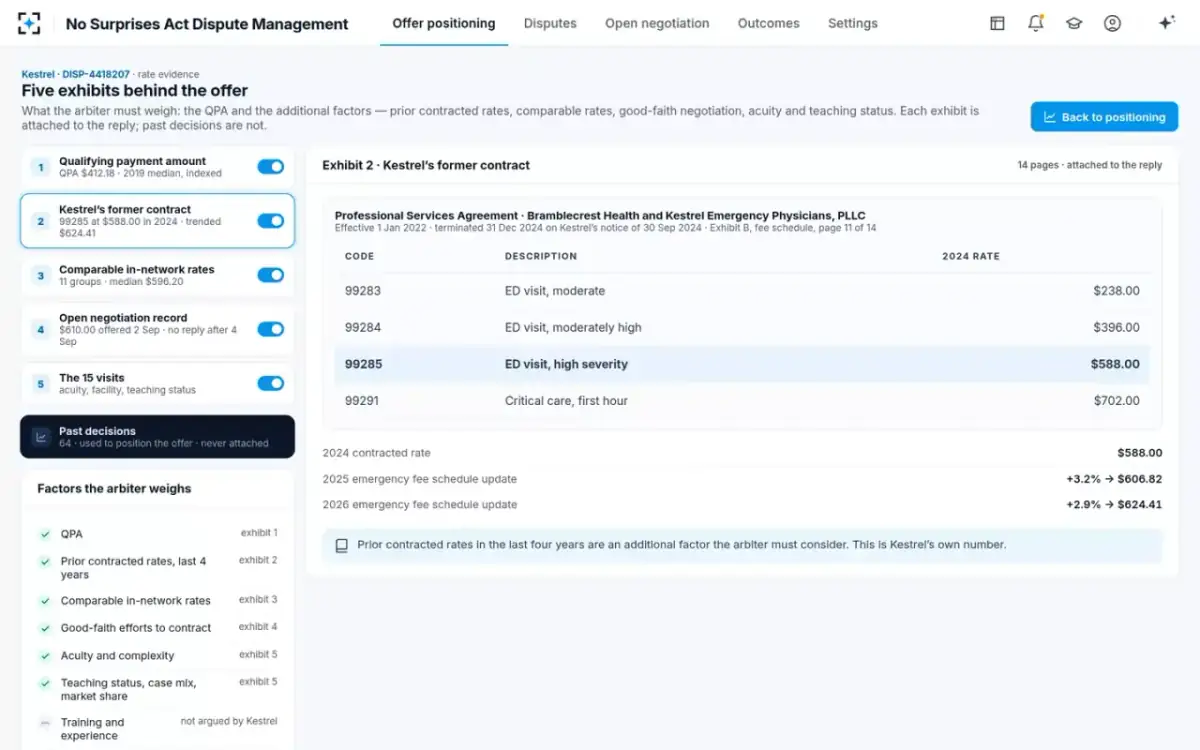
Three things tip the balance. First, the plan holds the best evidence: its own contract with a provider that left the network is a factor the arbiter must consider, as "contracted rates between the provider or facility ... and the plan or issuer ... during the previous 4 plan years" in the statute's words, and that contract sits in the plan's library, not the service's. Second, defaults are costly and visible: default decisions were 17% of payment determinations in the second half of 2025 and 90% of them went to providers (CMS), so whoever holds the calendar holds real money. Third, the determinations are public: CMS publishes each payment determination in its public use files, and since the 2025 third- and fourth-quarter files each line also names the certified IDR entity that decided it. A plan that keeps its own analysis can see where each arbiter has landed.
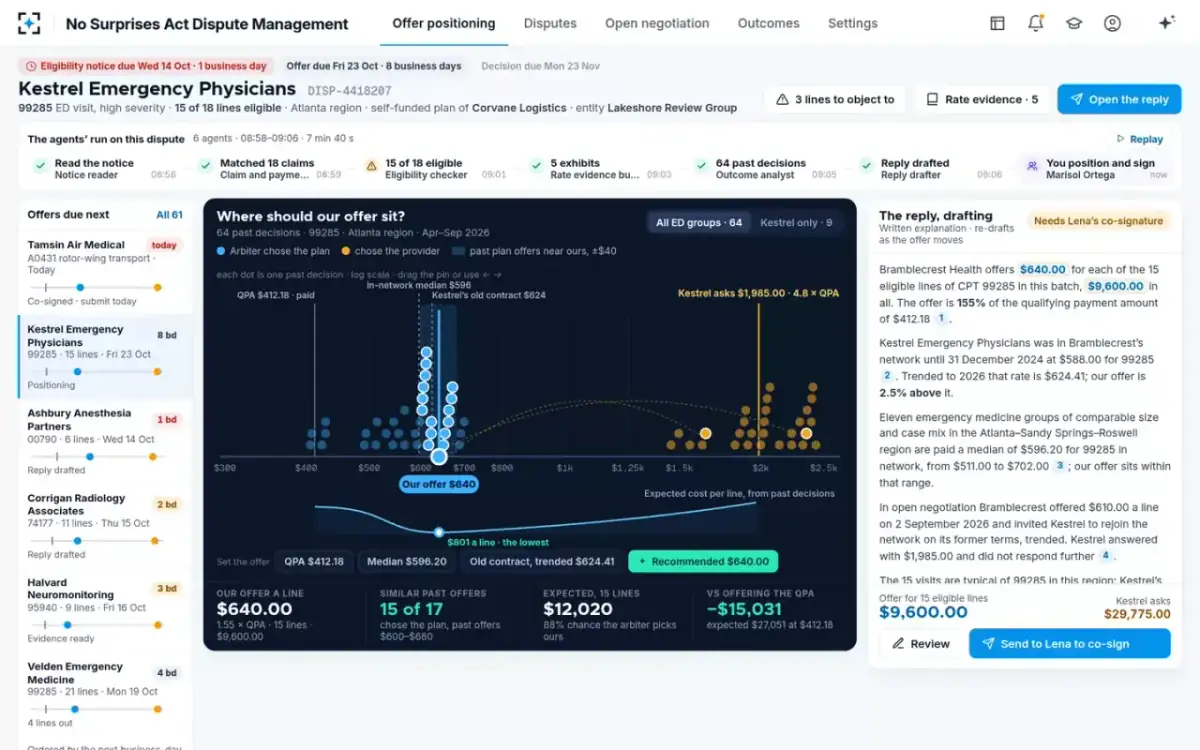
One case, the evidence and the past decisions on a single screen
How much do IDR services cost?
No public source reports what IDR management services charge, so the honest comparison is built from the plan's own numbers. The federal fees are known and small per dispute: a $15 administrative fee per party for disputes initiated on or after 11 June 2026, and an arbiter's fee of $200 to $840 for a single determination or $268 to $1,173 for a batch, paid by the losing side. In 2024, with the administrative fee at $115, parties paid $718 million in fees, $559 million of it to IDR entities (CRS).
The larger costs are the ones a service's price does not show: the awards above what the plan would have paid at a better-positioned offer, the awards lost by default, and the analyst hours spent assembling evidence. A full comparison of those lines, per dispute and per year, is set out in independent dispute resolution companies vs in-house: the full cost.
Can AI prepare IDR offers?
It can prepare almost everything around the offer, and it can recommend a number; it should not choose or submit one. The tasks are well suited to software that reads and cites: notices have a fixed content list, the QPA calculation is defined in regulation, and the arbiter's factors are listed in statute. The risk is not that the software cannot draft; it is that nobody checks what it drafted before it binds the plan.
Evidence on outcomes is thin across health-plan AI generally. A 2026 systematic review of AI in prior authorization, the nearest field with published studies, found that most studies measured model accuracy and few showed operational gains (J Manag Care Spec Pharm, Sept 2026). A plan should therefore judge IDR software by what it can show on the plan's own disputes, and by whether every statement it drafts points to a document a reviewer can open.
Five exhibits, each mapped to a factor the arbiter must weigh
Questions to put to any IDR management service or software
Whichever model a plan chooses, the same questions separate a service it can defend from one it has to trust. Ask them of an outside firm and of software alike.
Before you buy IDR management services or IDR software
- Who signs the offer, the objection and the payment?
Name the person at the plan for each, and what the service may do without them.
- Can we open every document behind every statement?
In our own system, not only in your portal, so an examiner or a court can see it.
- How do you choose the number?
Show the past determinations for this code and region and how the recommendation moved with them.
- Which calendar do you count on?
Business days excluding federal holidays, and which time zone closes the day.
- How many offers or fees have you missed, and what happened?
A default hands the dispute to the other side; ask for the count, not the policy.
- Are you ready for the IDR Gateway?
From 13 November 2026 the federal web forms move into the Gateway, and organisations that process disputes must sign up; outside the Gateway, all but the resubmission form end on 15 January 2027.
- What changes when the 2026 rule’s features switch on?
New batching limits from 1 November 2026, and new notice and eligibility steps as the Departments announce them.
Where No Surprises Act Dispute Management fits is the right-hand column of the comparison: six agents that read, match, check, assemble and draft, and a queue that keeps every clock in one place, with the plan's analysts deciding and signing. It does not replace a plan's lawyers, it never submits to the federal portal, and it never drafts an offer below the QPA. In a pilot the first job is to connect it to the plan's claims, remittance, contract and eligibility data; how a plan can stage that over ten weeks is set out in IDR software for payers.
Questions people ask
Do IDR management services represent providers or plans?
Both exist. On the provider side, third-party representatives grew from 13% to 22% of emergency and non-emergency dispute initiations among the top ten initiators during 2024, the Congressional Research Service found; plans more often use their third-party administrator or their own payment integrity staff.
Does using an outside service change the plan's legal responsibility?
No. The determination binds the plan, and the plan pays the award within 30 calendar days. CMS's Gateway notice puts it practically: a party that uses another organisation must make sure that organisation signs up, so the access and the duty both trace back to the plan.
What is the first task to take off an analyst's desk?
Notice intake and deadline counting, because that is where disputes are lost without being argued. Default decisions were 17% of payment determinations in the second half of 2025, according to CMS.
Can a service settle disputes for the plan?
Only within authority the plan gives it. Parties may agree a rate at any point before the arbiter decides; the agreed amount becomes the out-of-network rate, payment is due within 30 business days of the agreement, and half of each side's arbiter fee is returned.
Is IDR software the same as an IDR management service?
No. Software runs inside the plan and its people do the work with it; a service does the work for the plan. Some plans combine them, using software for intake and evidence and an outside firm for overflow.