A provider contract management system, for a health plan, is the software that holds provider agreements, amendments, fee schedules and payment policies and makes them usable by the people who pay and explain claims: at minimum it stores and finds contracts; at best it answers what a contract pays for a provider, code and date of service, with the page that sets the rate, and checks paid claims against that answer. The way to tell which kind you are buying is to test it on disputes your analysts have already settled, because each one is a question with a known, cited answer. Botminds' Provider Contract Management is built for exactly that test: five agents read the contracts, answer the rate in force on the date of service, check every paid claim each night, audit the claims system's setup and draft dispute responses, while analysts sign and the configuration lead approves every change.
Screens and figures from the solution are sample data on a fictional health plan; the pilot design and pass marks are our proposal, not a standard.
Seven things a provider contract management system should do for a health plan
- Answer a dated question
Given a provider, a code, a setting and a date of service, return the rate in force on that date, not today's rate, with the amendment that set it.
- Show its arithmetic and its page
Schedule amount, year, locality, percentage, payment policies and the lesser-of test, each linked to the clause, exhibit row or policy it came from.
- Ignore what is not in force
Unsigned drafts and amendments effective after the date of service are visible but never applied.
- Compare with what was paid
Check paid claims against the contract rate, in both directions, and look back to the date a gap began.
- Name the cause in the claims system
Point to the setup row that differs from the signed term, with the exact change, so configuration can fix it once.
- Draft, never decide
Prepare dispute responses and change requests for a named person to sign or approve; never adjust a claim or change setup itself.
- Keep members out of it
Contract questions need claim numbers, not member detail; minimum member data on every screen.
What is a provider contract management system?
A provider contract management system is the software a health plan uses to keep its provider agreements and their payment terms in a form that contracting, claims, configuration, dispute and provider service staff can all use. The term covers products that do very different jobs. Some manage the contract as a document: drafting, routing, signature, storage and renewal reminders. Others model what contracts pay, usually for negotiation. A smaller set answers what a signed contract pays on an actual claim and checks the claims system against it.
Plans need all three jobs done somewhere. The test on this page is aimed at the third, because it is the one that touches payment accuracy, interest and provider disputes, and the one most easily oversold. How the categories compare is set out in contract management software for healthcare: store it or answer it.
How do health plans manage provider contracts today?
At most plans the contract lives in three places that do not talk to each other. The signed PDF sits in a contract repository owned by network contracting. A translation of it sits in the claims system, keyed by configuration analysts. And a third version lives in the heads and spreadsheets of the dispute analysts and claims examiners who answer questions the first two cannot. When the three disagree, the provider's revenue cycle team is often the first to notice.
Disputes are where that disagreement becomes visible. In the HHS Office of Inspector General's review of Medicare Advantage payment denials from June 2019, "For 6 percent of payment denials, MAOs initially denied payment requests that met Medicare coverage rules and MAO billing rules, and later reversed these denials within 3 months and paid the claims," some after a provider's dispute showed the plan its own error (HHS-OIG, OEI-09-18-00260). Each settled dispute is therefore a small, documented case of the plan's three versions disagreeing, with the right answer worked out by hand.
Why test on disputes you already settled?
Settled disputes are the best test set a plan owns because each one comes with a question, a known answer and the evidence behind it. The provider stated what it thought the contract paid; the analyst found the governing clause, did the arithmetic and decided. A system that reaches the analyst's answer, from the contracts alone, on most of last year's disputes, can answer this year's. One that cannot is a repository.
Disputes also over-sample the hard cases. They concentrate on the amendments, schedule-year changes, carve-outs and payment policies that cause wrong payments, which is where a vendor demonstration built on a clean sample contract never goes. And they let the plan measure something no demonstration can: whether the system would have found the problem before the provider did.
How do you test contract management software? A four-week pilot
A useful pilot fits in four weeks if the plan prepares the inputs in advance. The design below uses 50 to 100 settled disputes, chosen to cover every rate method the plan uses, and the full contract files for the providers involved, drafts included.
A four-week pilot on settled disputes
- Prepare, set pass marksweek 0
- No answers seen, no help givenweeks 1–2
- Compare with outcomesweek 3
- Decideweek 4
- Not startedweek 0
- Load every documentweek 1
- Answer blindweek 2
- Paid vs contract, 90 daysweeks 3–4
Three design choices make the result trustworthy. Give the system the claim, not the dispute: it should answer from the contracts, not from the provider's argument. Include the drafts and the amendments signed but not yet effective, because a system that applies them will look right on some disputes and be wrong on the rest. And write the pass marks down in week zero, before anyone sees an answer.
What are the pass marks?
The pass marks below measure the three things that matter: whether the answer is right, whether it can be checked, and whether it would have prevented the dispute. Set the thresholds for your own plan; the numbers in the right column are a starting proposal.
Pass marks for a provider contract management system pilot
| Measure | How to score it | Proposed pass mark |
|---|---|---|
| Rate agreement | System rate equals the settled rate within your claims tolerance | At least 95% of disputes, with every miss explained by a document the plan can show |
| Citation | Every answer names the clause, exhibit row or policy, and it opens | 100%; an uncited answer counts as wrong |
| Drafts and future amendments | Answers on dates where a draft or later amendment exists | None applied |
| Date sensitivity | Re-ask each disputed claim one day before the governing effective date | Answer changes to the earlier term every time |
| Arithmetic | Schedule amount, year, locality, policies and lesser-of shown and correct | Every step reproducible by an analyst |
| Same-cause claims | For each dispute the plan upheld, other paid claims found with the same cause | Matches or exceeds what analysts found by hand |
| Prevention | Paid-versus-contract run on the period before each dispute arrived | Flags the claim before the provider's letter date |
| False alarms | Flags on claims an analyst confirms were paid correctly | Low enough that the team reads every flag |
Can a contract system answer the rate for a claim?
It can if it holds the contract as dated terms rather than as documents, and if it reads the same reference data the contract points to. "Answer the rate" means four things: find the latest signed term in force on the date of service, apply the right Medicare schedule year and locality where the term is a percentage of one, apply the payment policies the contract applies and only those, and test the result against billed charges where the contract has a lesser-of clause. A system that skips any of the four will agree with analysts on easy disputes and fail on the expensive ones.
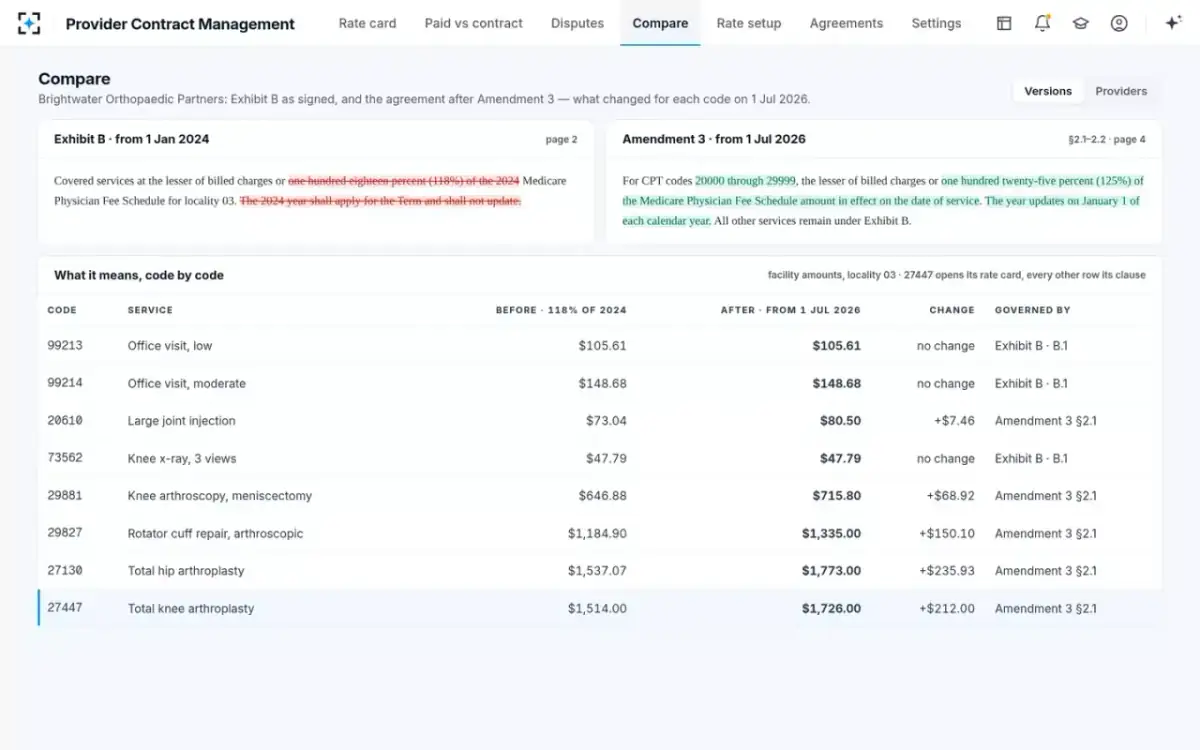
What changed for each code when an amendment took effect
What data does a provider contract system need?
Five feeds, all of which a plan already holds. The contract repository, with agreements, amendments, exhibits and drafts. The Medicare fee schedules the contracts reference, by year, locality and setting. The plan's payment policies with their revision history. The claims system's pricing setup, exported. And the paid-claims file. Without the last two, a system can answer questions but cannot find the claims that paid differently, which is most of the value.
The setup export deserves a word of warning. Systems that only see contracts will report what the plan should pay; only a comparison with the live setup shows why it did not. Configuration teams sometimes work around system limits with settings that pay slightly differently from the contract, and CMS's out-of-network guidance shows how far that can bind a plan. Asked whether a Medicare Advantage plan that "intentionally pays a higher amount for any type of service in order to facilitate their payment processes, such as working around their payment system limitations, can the plan recoup the overpayments at a later time?", CMS answered: "No." (CMS, MA Payment Guide for Out of Network Payments, Q&A 4).
Where one underpayment dispute's hours go, by hand and with the solution
By hand · 5.5 hours (estimate)
- Finding the agreement and amendments · 14%
- Rate and arithmetic · 9%
- Other claims paid short for the same reason · 36%
- Cited response and interest · 18%
- Telling configuration which row · 18%
- Review and signature · 5%
With the solution · 0.8 hours (estimate)
- Reading what the agents found · 25%
- Editing the drafted response · 31%
- Review and signature · 31%
- Configuration request · 13%
How long does it take to implement provider contract management?
The reading is the quick part; the connections set the pace. The agents read agreements, amendments and exhibits as documents, so nobody has to re-key a contract before the pilot. Connecting the setup export and the paid-claims file depends on the plan's claims platform and its data team, and that is the step to plan for. A sensible sequence is the pilot above on a sample, then the nightly paid-versus-contract check for the providers with the most disputes, then the rest of the network.
Plans with commercial business have a dated reason to move. The revised Transparency in Coverage rule, published on 6 October 2026, makes its changes to the in-network rate file apply from March 6, 2027, and requires a plan or issuer to attest for each file that "the information encoded is true, accurate, and complete as of the date in the file" (Departments of the Treasury, Labor and HHS, final rule, 91 FR 63748). Those files are built from the same contract terms and configuration this pilot tests.
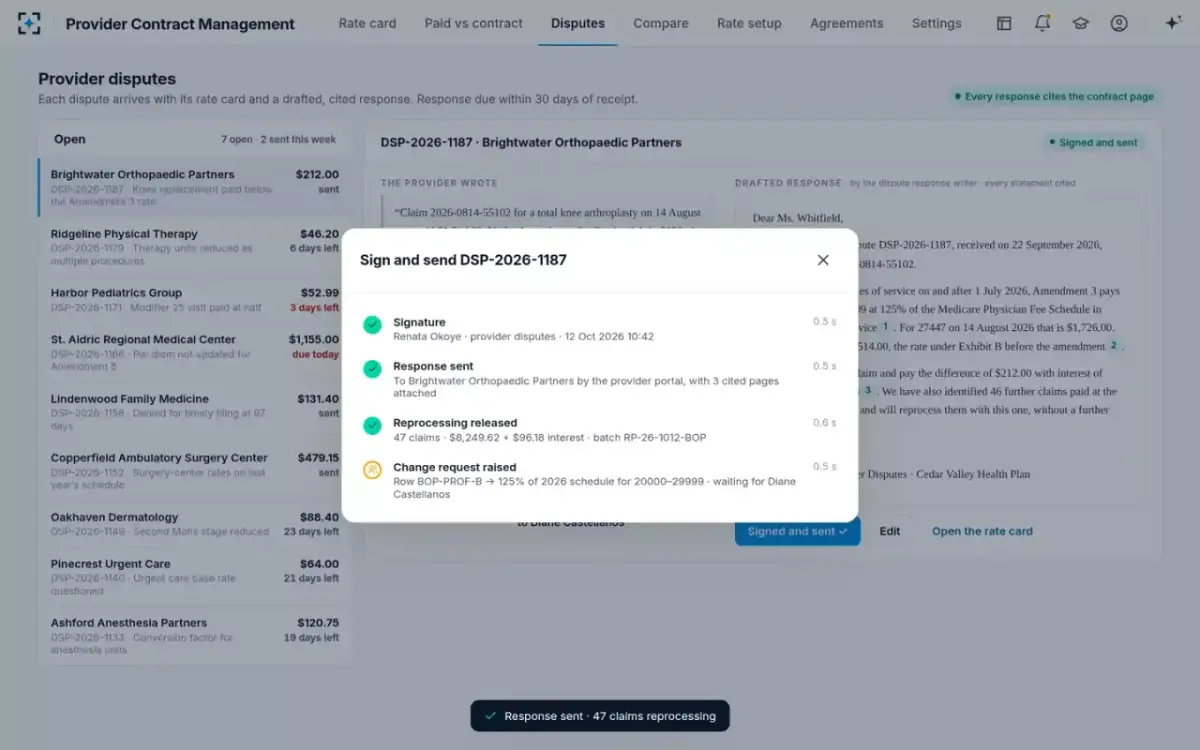
One signature sends the cited response, releases reprocessing and raises the setup change
Where Provider Contract Management fits among contract systems
Botminds' Provider Contract Management is the third kind of system: it answers and checks. It reads the contract repository, fee schedules, payment policies, setup export and paid-claims file; it does not draft or route contracts for signature, and it does not replace the claims system or the configuration team. Its agents never adjust, reprocess or recover a claim, never change setup and never apply a draft; reprocessing over a threshold the plan sets needs a second approval. On its sample plan, the nightly check covered 96,214 paid claims in 90 days and found 573 paid off contract at eight providers; the design target is every paid claim checked against its contract every night.
The honest way to find out whether that holds for your contracts is the pilot on this page, run on your own settled disputes. If the system cannot reach your analysts' answers with citations, do not buy it. If it can, the prevention row of the pass marks tells you what it is worth. The claim-by-claim mechanics it is tested on are in claims repricing, traced and the fee schedule lookup guide; to see the screens together, start from Provider Contract Management.
Questions people ask
How many disputes are enough for a pilot?
Enough to cover every rate method and every kind of error the plan has seen: percent-of-Medicare, fixed fee schedules, per diems, case rates, carve-outs, payment policies and timely-filing terms. Fifty to one hundred settled disputes usually does that; fewer than twenty rarely does.
Should a pilot use live claims or past claims?
Past claims first, because their right answers are known. Live claims belong in the second stage, where the nightly comparison runs alongside the existing process and every flag is checked by an analyst before anything changes.
What should a health plan ask a contract management vendor?
Ask it to answer five of your settled disputes blind, from your contracts, with the page for each number; to re-answer them one day before each governing amendment took effect; and to show what it does with an unsigned draft. Then ask who signs, who approves setup changes, and whether its software can change a claim on its own.
Does a provider contract management system replace contract modeling?
No. Modeling projects what a proposed contract would pay across past claims, for negotiation. A plan-side contract system answers what a signed contract pays on a specific claim and checks what was paid. The second makes the first more reliable, because models built on wrongly configured history mislead.
Who should own the system at a health plan?
Usually network operations or payment integrity, with configuration and provider disputes as its main users. The owner needs authority over the comparison between what was signed and what is live, which neither contracting nor configuration has on its own.