Contract management software for healthcare is any software that helps an organization handle its contracts, and for a health plan it falls into three categories that are easily confused: contract lifecycle management (CLM) software, which drafts, negotiates, routes, signs, stores and renews agreements; contract modeling software, which projects what proposed terms would pay across past claims; and contract-to-claim software, which answers what a signed contract pays for a provider, code and date of service and checks the claims system against it. Most buying conversations start with the first category because it is the most familiar, but a plan's costliest contract problems, wrong payments, interest, reprocessing and provider disputes, sit in the third. Botminds' Provider Contract Management is built for that third job: five agents read the agreements, answer the rate in force with the page that sets it, check every paid claim each night, audit the claims system's setup and draft dispute responses, while people sign and approve every change.
No product is named or ranked on this page. Screens from the solution show its fictional sample plan.
Contract lifecycle management and contract-to-claim answers do different jobs
Contract lifecycle management (CLM): Where is the contract, who must approve it, when does it renew?
Contract-to-claim answers: What did this contract pay for this provider, code and date of service, and did the claim pay that?
Contract lifecycle management (CLM): The document and its workflow
Contract-to-claim answers: The rate term, its effective date and its page
Contract lifecycle management (CLM): Contracting, legal, procurement
Contract-to-claim answers: Claims examiners, dispute analysts, configuration, provider service
Contract lifecycle management (CLM): Not usually; a percentage of Medicare is text
Contract-to-claim answers: Yes: a percentage of a schedule is arithmetic with a year and a locality
Contract lifecycle management (CLM): No
Contract-to-claim answers: Compares the setup and the paid claims with the signed terms
Contract lifecycle management (CLM): Say what a claim should have paid
Contract-to-claim answers: Run negotiations, signature routing or obligations tracking
What is healthcare contract management software?
Healthcare contract management software is software that keeps an organization's contracts organized, enforceable and usable, with features adapted to health care: provider and payer agreements, amendments and fee schedule exhibits, credentialing and regulatory attachments, and renewal tracking. On the provider side, the same phrase often means payer contract management for hospitals and physician groups, which checks whether payers paid what was agreed. On the plan side, it means provider contract management.
The plan-side problem is shaped by how contracts are written. A provider agreement rarely states a dollar amount per code; it states a method, a percentage of a Medicare schedule for a named year, a per diem, a case rate, with carve-outs and payment policies, and amends them over time. Any software that holds such a contract as a document, however well organized, leaves the payment question to a person.
Do health plans use contract lifecycle management?
Plans use lifecycle tools for the life of the document, and they are good at it: templates, clause libraries, approval routing, electronic signature, a searchable repository and renewal alerts. Federal and state rules make some of that discipline mandatory. Medicare Advantage plans must put a prompt payment provision in every provider agreement (42 CFR 422.520(b)), and Virginia requires that a provider contract include or attach its fee schedule or payment method when it is presented for signature, and that amendments reach providers 60 days before they take effect (Va. Code § 38.2-3407.15).
What a lifecycle tool does not do is connect the signed document to the claim. It can tell a dispute analyst that an amendment exists and where it is stored; it cannot tell the analyst that the amendment governed a claim on its date of service, that the claim paid from last year's schedule, and that dozens of other claims did the same.
Six people who manage provider contracts, and which kind of software serves each
Today
Negotiates, routes and signs agreements; needs renewal dates and clause history.
With agents
Served by lifecycle software for the document, and by contract-to-claim checks to see whether what was signed is what is paid.
Still theirs: Owns every agreement.
Today
Approves language and exceptions.
With agents
Served by lifecycle software: clause libraries, redlines, approvals.
Still theirs: Approves non-standard terms.
Today
Projects the cost of proposed rates on past claims.
With agents
Served by modeling software, whose output is only as reliable as the paid-claims history it models.
Still theirs: Owns the projections.
Today
Keys signed terms into the claims system and hears about errors from disputes.
With agents
Served by contract-to-claim software that names the setup row that differs from the contract and the exact change.
Still theirs: Approves every setup change.
Today
Rebuilds the rate in force on the date of service from PDFs for each dispute.
With agents
Served by contract-to-claim software: the rate, the arithmetic, the page and a drafted response.
Still theirs: Signs every response.
Today
Cannot answer a rate question while the provider is on the phone.
With agents
Served by contract-to-claim software: the rate for the caller's code and date, with the amendment that applied.
Still theirs: Owns the conversation.
What is contract modeling in healthcare?
Contract modeling is the projection of what a proposed or existing contract would pay, applied to a history of claims, so a negotiator can compare scenarios: 120 percent of Medicare against 125 percent, a case rate against a per diem, a new carve-out against none. Providers use it to value a payer's offer; plans use it to price a renewal or a network. It answers "what would this pay in aggregate" rather than "what did this pay on this claim."
Modeling inherits two weaknesses from its inputs. If the history was paid from configuration that did not match the contracts, the model projects the errors forward. And if the model reads contract terms differently from the claims system, the negotiated rate and the paid rate diverge from the first claim. A contract-to-claim check is what keeps a model honest.
What is the difference between CLM and contract modeling?
CLM manages the contract as a document through its life; contract modeling estimates the money a contract's terms would move. Neither, on its own, answers what a particular claim should have paid. The table sets the three categories side by side on the questions a health plan actually asks.
Three kinds of contract management software for healthcare, on the questions a health plan asks
| Question | Lifecycle (CLM) | Modeling | Contract-to-claim |
|---|---|---|---|
| Where is the signed amendment, and who approved it? | Yes | No | Shows the page and its signatures |
| What would a 5-point increase cost next year? | No | Yes | No; it answers signed terms |
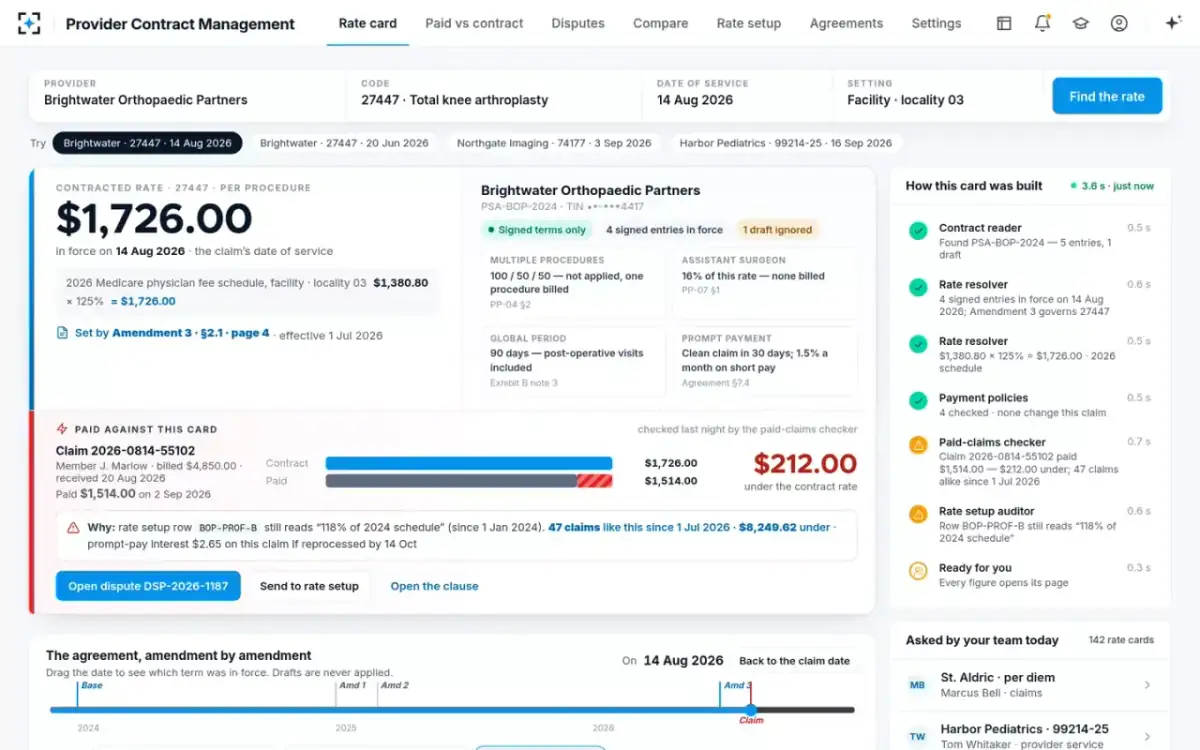
| What did the contract pay for this code on 14 August? | No | Sometimes, as an estimate | Yes, with the arithmetic and the page |
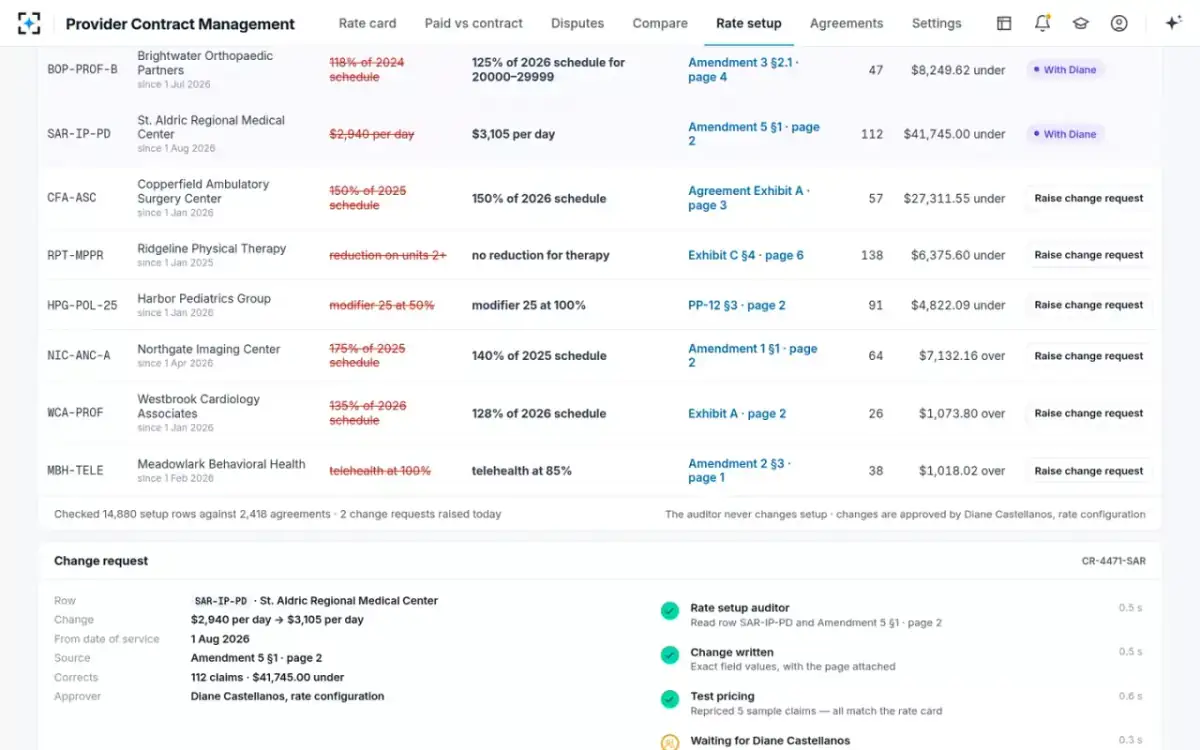
| Which paid claims differ from the contract, and why? | No | No | Yes, in both directions, with the setup row behind each |
| Draft the response to this provider dispute | No | No | Drafted for a person to sign |
| When does this agreement renew? | Yes | No | Shows renewal dates; does not route renewals |
Can contract management software calculate payments?
Some can, if they hold contracts as dated rate terms rather than as documents and read the reference data those terms point to. Calculating a contract payment needs the signed term in force on the date of service, the Medicare schedule year, release and locality it names, the payment policies it applies, carve-outs and the lesser-of test. A product that calculates without one of those will agree with the claims system and disagree with the contract.
The pressure to get this right is now public. The revised Transparency in Coverage rule requires plans and issuers to attest that their in-network rate files are accurate, and the Departments estimated the one-time burden of the revised in-network rate file requirements at a "combined total one-time burden of 636,979 hours on the low end and 675,584 hours on the high end" across plans and issuers (Transparency in Coverage final rule, 6 October 2026). Commenters on the rule explained how scattered payment logic can be, noting that at some plans "this logic is held by payment integrity vendors instead of the plan or issuer." Hospitals face the mirror duty and, since 1 January 2026, attest in their own files that "This hospital has included all payer-specific negotiated charges in dollars that can be expressed as a dollar amount" (45 CFR 180.50). Both sides now publish what the contract pays; the plan that cannot calculate it from its own contracts will see the provider's file first.
A dated question answered from the contract, with the paid claim checked against it
What features matter in healthcare contract software?
For a health plan buying for payment accuracy, the features that matter are the ones that let a person verify an answer and act on it without leaving the screen. The checklist below is written for that buyer; a buyer whose main need is negotiation workflow should weigh lifecycle features more heavily.
Nine features that matter in contract management software for a health plan's payment teams
- Answers by date of service
Provider, code, setting and date in; the rate in force that day out, not today's.
- Cites every number
Each figure opens the clause, exhibit row or policy page that set it.
- Stacks amendments by effective date
And shows drafts and future amendments without ever applying them.
- Reads the schedules contracts point to
Medicare fee schedules by year, release, locality and setting.
- Applies payment policies, carve-outs and lesser-of as worded
Including order of operations and line or claim level.
- Checks paid claims, both directions
Every paid claim against its contract rate, with a tolerance the plan sets.
- Names the cause in the claims system
The setup row, the exact change and the claims it corrects, test-priced.
- Drafts, never decides
Dispute responses and change requests go to named people; the software never adjusts a claim or changes setup.
- Minimum member data
Contract answers need claim numbers, not member detail.
How do payers manage provider contracts across these tools?
The practical architecture at a health plan is a chain: lifecycle software holds the signed document; the claims system holds a configured translation of it; and a contract-to-claim layer reads both, compares them, and answers questions from the document rather than from the translation. Modeling sits beside the chain and draws on the paid claims it produces. Each link has an owner, and the comparison between document and translation needs one too.
Where plans run into trouble is the gap between the first two links. The people who load contracts, and the errors that follow when a load is late or wrong, are described in the claims configuration analyst guide; the audit that tests configuration against contracts is in the claims system configuration guide.
What is the best contract management software for healthcare?
The best contract management software for a health plan is the one that answers the plan's most expensive contract question on its own contracts, with evidence. For a plan whose disputes turn on rates, that question is what a signed contract pays on a claim, because the answer drives disputes, interest, reprocessing and the accuracy of public rate files. A product that cannot answer last year's settled disputes from your contracts, with a page for every number, is not the best choice for that job however good its workflow.
That test is set out step by step in the provider contract management system pilot. It works for any vendor, including Botminds.
Provider Contract Management is contract-to-claim software, not lifecycle software
Botminds' Provider Contract Management is contract-to-claim software for health plans. It reads the contract repository, Medicare fee schedules by year, locality and setting, payment policies with their revision history, the claims system's setup export and the daily paid-claims file; it answers rates by date of service with citations, checks every paid claim against its contract each night, audits setup row by row and drafts dispute responses. On its sample plan it holds 2,418 agreements, 6,930 amendments and 11,204 fee schedule exhibits, and in 90 days checked 96,214 paid claims and found 573 paid off contract.
Paid-claims findings turned into setup changes for the configuration lead
It is not a lifecycle tool: it does not draft agreements, route approvals or collect signatures, and a plan that needs those should keep or buy one. It is not a modeling tool for negotiations, though it compares providers' rates code by code on the same date. And it is not a claims system: its agents never adjust, reprocess or recover a claim, never change setup and never apply a draft. To see where it sits in the chain, start from Provider Contract Management.
Questions people ask
Is payer contract management software the same as provider contract management software?
The words are used both ways. "Payer contract management" is mostly used by hospitals and physician groups managing their contracts with payers, and checking whether payers paid what was agreed. "Provider contract management" is the plan-side mirror: the plan managing its contracts with providers and checking its own payments against them.
Can a CLM system be extended to calculate claim payments?
It can store rate tables as attachments or fields, but calculating a payment also needs the Medicare schedules contracts reference, the plan's payment policies and the claims data. A lifecycle tool would need all of them, and the dated logic that combines them, before its numbers could be put in a dispute response.
Do hospitals publish what health plans pay them?
Yes. Hospital price transparency rules require hospitals to publish payer-specific negotiated charges, and from 1 January 2026 to attest that they have included every negotiated charge that can be expressed as a dollar amount; where a charge is a percentage or algorithm, they must describe it. A plan can compare those files with its own contracts and payments.
Where should a health plan start?
With its settled disputes. They show which contract questions cost the most, and they are a ready-made test set for any software that claims to answer them. If the disputes cluster on amendments and schedule years, the gap is contract-to-claim; if they cluster on missing documents and signatures, it is lifecycle.
Does contract-to-claim software replace payment integrity vendors?
It answers a narrower question: whether payment matched the signed contract. Payment integrity programs also review coding, medical necessity and billing; a contract-to-claim check complements them by covering the contract terms they may not see, and it finds underpayments as well as overpayments.