"Lesser of billed charges" means the payer pays whichever is lower: the provider's billed charge for the service or the amount the contract sets, so the contract rate is a ceiling the provider's own price can undercut. Medicare works the same way for fee schedule services, paying "the lesser of the actual charge or the applicable fee schedule amount," and most commercial and Medicare Advantage provider contracts copy the clause into their rate exhibits, whether the contract amount is a percentage of a Medicare schedule, a fixed fee, a case rate or a per diem. The arithmetic is easy; the reading is not, because the clause rarely says whether the test runs per line or per claim, or before or after payment policies, and each reading pays a different amount. Botminds' Provider Contract Management applies the clause exactly as each contract words it, shows the arithmetic beside the page it came from, and checks every paid claim against that result.
The claim below is invented and its schedule amounts are illustrative, not CMS figures. Screens from the solution show its fictional sample plan.
One invented claim through a lesser-of clause, line by line
Line 1 · office visit
Billed$95.00
Contract rate130% × $92.00 = $119.60
After policy100% → $119.60
Lesser of$95.00billed charge is lower
Line 2 · primary procedure
Billed$640.00
Contract rate130% × $317.20 = $412.36
After policy100% → $412.36
Lesser of$412.36contract is lower
Line 3 · second procedure
Billed$250.00
Contract rate130% × $210.00 = $273.00
After policy50% → $136.50
Lesser of$136.50test after the reduction
What does lesser of billed charges mean?
It means the contract sets a maximum, and the provider's charge can set a lower one. For each service, the payer computes the contract amount, compares it with what the provider billed, and allows the smaller. A provider whose chargemaster price for a service is below the contract rate is paid its own price.
The clause protects the payer from paying more than the provider asked, which matters for inexpensive services, for providers that set some charges low, and for contracts written as a percentage of a schedule that can rise above a provider's charge. It also makes the provider's charge a live input to every payment, so a chargemaster change can move what the plan pays without any change to the contract.
Does Medicare pay the lesser of billed charges?
For services paid on a fee schedule, yes. The rule is one sentence of federal regulation.
"Medicare payment is based on the lesser of the actual charge or the applicable fee schedule amount."
42 CFR 414.21, Medicare payment basis
Medicare's claims manual builds the test into its payment policies. For multiple surgeries it ranks the procedures by fee schedule amount and bases payment for each "on the lower of the billed amount" and 100 percent of the fee schedule amount for the highest valued procedure, or "50 percent of the fee schedule amount for the second through the fifth highest valued procedures"; for a bilateral procedure it says "Base payment on the lower of the billed amount or 150 percent of the fee schedule amount" (Medicare Claims Processing Manual, chapter 12, §§40.6–40.7). In Medicare's own method, the test is applied line by line, after the payment policy.
Prospective payment works differently. For hospital inpatient stays CMS's out-of-network guide notes that "Submitted charges are used for the calculation of outlier payments. Otherwise, original Medicare generally pays the IPPS amount even if the submitted charge is lower" (CMS, MA Payment Guide for Out of Network Payments). So a contract that pays "the lesser of billed charges or 120% of the Medicare DRG amount" is doing something Medicare itself does not do for inpatient stays.
How is the lesser of charges calculated?
The lesser-of amount is calculated in four steps: compute the contract amount for the service, apply the payment policies that reduce it, compare the result with the billed charge for the same unit of comparison, and allow the smaller. The contract decides two things the formula leaves open: the unit of comparison (line, claim or case) and whether policies come before or after the comparison.
In the claim above, the office visit's billed charge, $95.00, is below the contract's $119.60, so the provider's price wins. The primary procedure pays the contract's $412.36. The second procedure is reduced to $136.50 by the multiple-procedure policy and then tested against its $250.00 charge, which it is below. The claim allows $643.86 on $985.00 billed.
Per line or per claim, before or after the reduction: three readings of one clause
The same clause produces three different payments depending on how it is read, and contracts frequently do not say which reading applies. Read per line, after policies, the claim above pays $643.86. Read per claim, comparing total billed with total contract, it pays $668.46, because the office visit's low charge is absorbed by the other lines. Read per line but before the multiple-procedure reduction, the second procedure becomes the lesser of $250.00 and $273.00, then halved to $125.00, and the claim pays $632.36.
One claim, one lesser-of clause, three readings: $36.10 apart
None of the readings is wrong in the abstract; each is wrong for a contract that says otherwise. The risk is that the claims system applies one reading by default, the provider's revenue cycle team expects another, and the dispute analyst has to find the words that decide it. Where the contract is silent, Medicare's order (per line, after the policy) is a defensible default, but it is a default to agree in writing, not to assume.
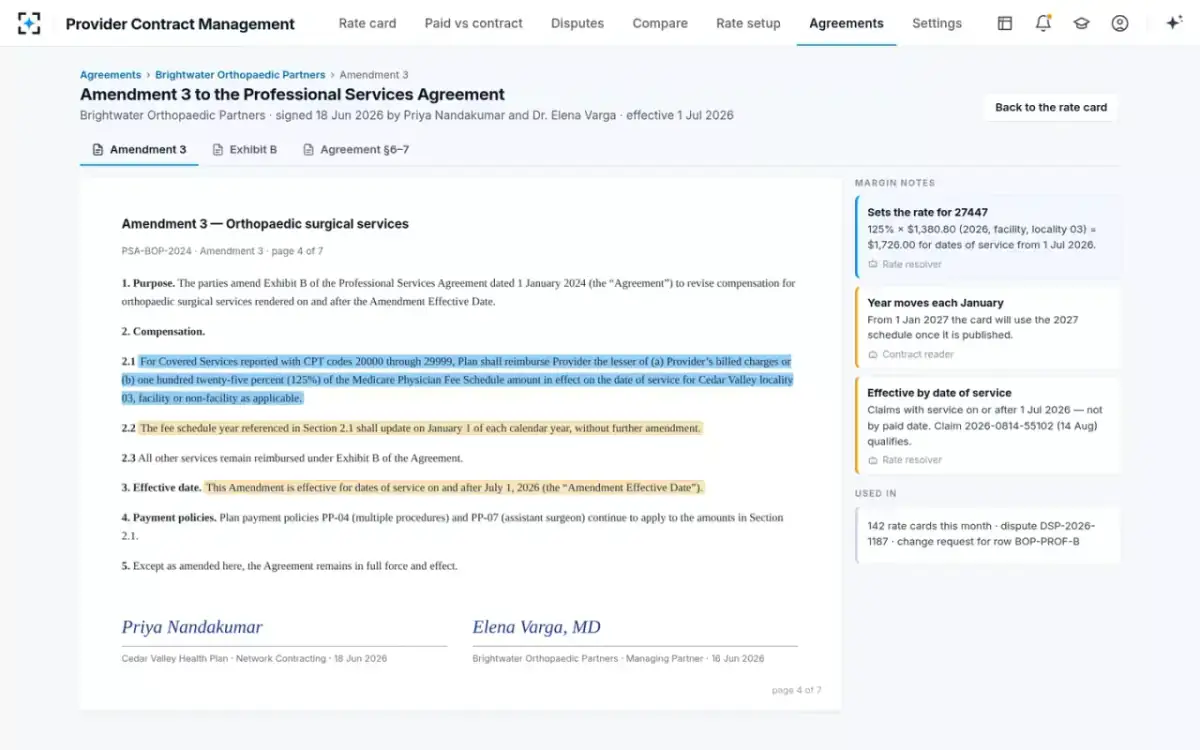
The lesser-of clause on its page, with the arithmetic in the margin
What is percent of Medicare reimbursement?
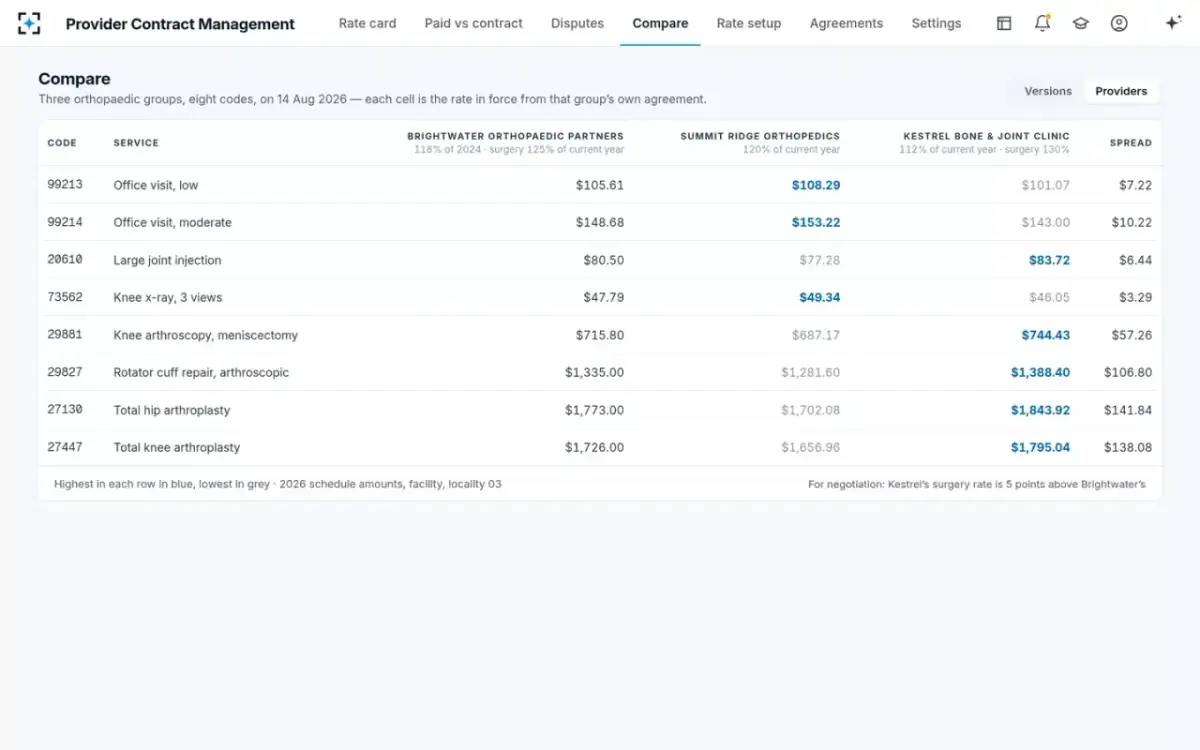
Percent of Medicare reimbursement is a contract method that pays a stated percentage of what Medicare would pay for the same service, such as 125 percent of the Medicare Physician Fee Schedule amount for the plan's locality. It ties a private rate to a public schedule, so the contract does not need its own price for every code. It does need to say which year's schedule, which locality and setting, and whether the year moves each January or stays fixed.
It is common but not universal. A study of 2008–2011 claims from three large insurers, published in the Quarterly Journal of Economics, estimated that "no more than 57% of cases are on contracts where prices are prospectively set as a percentage of Medicare payment rates" for hospital inpatient care, and found "that about 23% of hospitals' inpatient cases have prices set as a share of hospitals' charges" (Cooper, Craig, Gaynor and Van Reenen, 2019). Contracts also mix methods: a peer-reviewed review of 524 hospital-insurer contracts found that "most of the contracts in our sample contained multiple contracting methodologies (eg, both fixed fee and percentage of charges)" (Henderson and Mouslim, American Journal of Managed Care, 2024).
Three groups' percent-of-Medicare rates on the same date, code by code
What are case rates and per diems, and how does lesser-of apply to them?
A case rate pays one amount for a whole episode, such as a delivery or a joint replacement; a per diem pays a fixed amount for each day of an inpatient or residential stay. With either, the lesser-of comparison has to be made at the same level as the rate: the case rate against the total charges for the episode, the per diem total against the total charges for the stay. Comparing a per diem with one day's charges, or a case rate with a single line, gives an answer the contract never meant.
How the lesser-of test applies under each contract method
| Contract method | Contract amount | Compared with | Where it goes wrong |
|---|---|---|---|
| Percent of a Medicare schedule | Percentage × schedule amount for the named year, locality and setting | The line's billed charge, usually after payment policies | Wrong schedule year; rounding the schedule amount before the percentage |
| Fixed fee schedule | The exhibit's amount for the code | The line's billed charge | An exhibit replaced by amendment but still in setup |
| Case rate | One amount for the episode | Total billed charges for the episode | Comparing with one line; missing carve-outs paid on top |
| Per diem | Daily rate × covered days | Total billed charges for the stay | Counting the discharge day; an updated daily rate not loaded |
| Percent of billed charges | Percentage × the charge | Usually no lesser-of: it is always lower | Paying from a chargemaster version other than the one billed |
Medicare itself uses a lesser-of inside some of its add-on payments. Its new technology add-on payment for hospital stays is the lesser of "65 percent of the costs of the new medical service or technology" or 65 percent of the amount by which the case's costs exceed the standard payment (42 CFR 412.88). Contracts that pay separately for implants or new technology on top of a case rate need the same care about which amount is tested against what; those separate payments are the subject of the carve out contract guide.
Why do contracts use lesser of charges?
Payers use the clause so that no service pays more than the provider asked, and because Medicare does. Without it, a percentage-of-Medicare contract can pay above a provider's own charge on services the provider prices low. With it, the payer's exposure on each line is capped at the lower of two numbers it can see on the claim.
The clause matters more as price transparency rules tie public files to contract terms. The revised Transparency in Coverage rule requires plans and issuers to report in-network rates as dollar amounts, except that "For contractual arrangements under which a group health plan or health insurance issuer agrees to pay an in-network provider a percentage of billed charges and is not able to assign a dollar amount to an item or service prior to a bill being generated, plans and issuers must report a percentage number" (Transparency in Coverage final rule, 6 October 2026). Hospitals face the mirror requirement: where a negotiated charge is based on a percentage or algorithm, their file "must also describe the percentage or algorithm that determines the dollar amount" (45 CFR 180.50).
Where analysts get the lesser-of test wrong, and how the solution applies it
Five misreadings recur wherever a lesser-of clause is applied by hand or by a default setting: testing per claim when the contract says per line, or the reverse; testing before a payment policy that the contract applies first; comparing a case rate or per diem with a single line; using a charge other than the one billed, such as a charge from an earlier chargemaster; and applying the test to lines the contract carves out to a separate payment. Each is a reading of the contract, not an arithmetic slip, which is why the fix starts from the clause.
Botminds' Provider Contract Management reads each lesser-of clause with the rest of the rate terms and applies it at the level and in the order the contract states, showing every step beside the page. Its rate resolver never rounds a schedule amount before the percentage and never applies a draft; its paid-claims checker compares every paid claim with the result each night. On the solution's sample plan, one group's agreement pays "the lesser of billed charges or" 125 percent of the current-year schedule for surgical codes, and the solution prices each of its claims from that clause. To trace a full claim from contract to allowed amount, see claims repricing, traced; to see the clause, the arithmetic and the paid claim together, start from Provider Contract Management.
Questions people ask
Is "lesser of" the same as "lower of"?
Yes. Medicare's regulation says "lesser of the actual charge or the applicable fee schedule amount," and its claims manual says "lower of the billed amount" in the same sense. Contracts use either; what matters is the unit and the order of the test.
Does the lesser-of test apply to Medicare Advantage claims from providers with no contract?
Where Original Medicare applies it, yes, because a plan owes a non-contracted provider what Original Medicare would pay. Professional services on the physician fee schedule are paid at the lesser of the actual charge and the fee schedule amount; hospital inpatient stays under the prospective payment system generally are not capped at the submitted charge.
What happens to the lesser-of test when a provider raises its charges?
Lines that were capped at the charge start paying more, up to the contract amount; lines already at the contract amount do not change. A plan that tracks which lines pay at the charge can see the effect of a chargemaster increase before the next contract negotiation.
Does lesser of billed charges apply to units?
It applies to whatever the contract compares, usually the line, which carries all its units. Comparing per unit gives the same result only when the charge and the rate scale with units in the same way, which a per-unit reduction for second and later units breaks.
Is lesser-of logic the same in every claims system?
No. Claims platforms can apply the test at line or claim level and before or after reductions, and the setting chosen at configuration time decides it for every contract that uses the default. That is why the setting should be checked against each contract's wording, not set once for all.