Prompt pay interest is the interest a health plan owes a provider when it pays a clean claim after the deadline that federal rule, state law or the provider contract sets. For Medicare Advantage plans paying providers with no contract, the deadline is 30 days for 95 percent of clean claims and the interest follows Medicare's own rule, at the Treasury's prompt payment rate, 4.75 percent a year for July to December 2026; for contracted providers, the contract sets both the clock and the rate, and state laws add their own for commercial coverage. Interest is usually the smallest cost of a late or short payment, but it is the one that runs every day, and it starts on claims held for a rate question or paid from the wrong rate. Botminds' Provider Contract Management is built to remove both causes: it answers the contract rate for any provider, code and date of service with the page that sets it, and checks every paid claim against that rate each night.
Figures from the solution on this page are sample data on a fictional health plan. The worked examples are invented and labelled; the rules are quoted from their sources.
A prompt pay interest calculator: Medicare's formula, any rate
Interest owed$3.90
Per day$0.13
$1,000.00 × 4.75% × 30 ÷ 365 = $3.90
What is prompt pay interest?
Prompt pay interest is a statutory or contractual charge on a payer that pays a clean claim late. It exists to make delay cost the party that controls it: once a claim is complete, the plan holds the money, and each day it holds it past the deadline accrues interest to the provider. The deadline, the rate, the start date and whether interest is simple or compounded all come from the rule that applies, so the first question is always which rule.
There are three sources. Federal rules govern Medicare Advantage payments to providers without a contract. State prompt pay laws govern most fully insured commercial and many Medicaid managed care claims, and differ widely. And the provider contract governs everything else, including Medicare Advantage payments to contracted providers, where federal rules hand the terms to the parties.
Do Medicare Advantage plans pay prompt pay interest?
Yes, on clean claims from providers without a contract. The plan's contract with CMS must provide that it "will pay 95 percent of the “clean claims” within 30 days of receipt" for services "not furnished under a written agreement between the organization and the provider", and "must pay interest on clean claims that are not paid within 30 days in accordance with sections 1816(c)(2)(B) and 1842(c)(2)(B)" of the Social Security Act. Claims from non-contracted providers that are not clean "must be paid or denied within 60 calendar days from the date of the request" (42 CFR 422.520(a)).
Those sections of the Act are Medicare's own prompt payment rules, so a Medicare Advantage plan paying a provider with no contract inherits Original Medicare's clock, rate and arithmetic. What the plan pays such a provider in the first place, the Original Medicare amount, is the subject of the Medicare Advantage out of network payment guide.
How many days a health plan has to pay, under three rules
- Payment window30 days
- Interest accrues dailyfrom day 31
- Pay or deny60 calendar days
- No interest15 working days
- Interest at 6% a year accruesto day 40
- Late, interest still accruesafter day 40
What is the prompt pay interest rate?
For Medicare and for Medicare Advantage plans paying providers with no contract, the rate is the one the Treasury sets under the Prompt Payment Act. The Bureau of the Fiscal Service states that "The Prompt Payment interest rate for July 1– December 31, 2026 is 4.75%" (Bureau of the Fiscal Service). The statute ties Medicare's interest to "the rate used for purposes of section 3902(a) of title 31," running "for the period beginning on the day after the required payment date and ending on the date on which payment is made" (42 U.S.C. 1395h(c)(2)(C)).
Two details from Medicare's manual change the answer on real claims. The rate "is determined by the applicable rate on the day of payment," not the day the claim arrived, and the Treasury resets it "on a 6-month basis, effective every January and July 1." A claim received in December and paid late in January takes January's rate for the whole period (Medicare Claims Processing Manual, ch. 1, §80.2.2).
State and contract rates are usually higher. Virginia's legal rate, which its insurance code applies to claim proceeds, is "an annual rate of six percent" (Va. Code § 6.2-301). Some provider agreements set interest as a monthly percentage, such as 1 or 1.5 percent a month, which is 12 or 18 percent a year. The difference is large enough to change which claims a plan should reprocess first.
What $10,000 paid 30 days late costs at four interest rates
How is prompt pay interest calculated?
Medicare's formula is simple interest: "Payment amount x rate x days divided by 365 (366 in a leap year) = interest payment." Interest runs from the day after payment was due to the day of payment, and Medicare's contractors apply it "to the net payment amount after all applicable deductions are determined (e.g., deductible, copayment, and/or MSP)," rounded to the nearest penny (Medicare Claims Processing Manual, ch. 1, §80.2.2–80.2.2.1).
Take an invented clean claim from a non-contracted provider to a Medicare Advantage plan: $1,000 net payment, received 1 September 2026, due by 1 October, paid 31 October. Thirty days late at 4.75 percent: $1,000 × 0.0475 × 30 ÷ 365 = $3.90. The calculator above repeats that arithmetic for any amount, rate and number of days.
Manual rules also exclude some claims. Medicare does not pay interest on claims needing external development, on claims with no payment due, on full denials, and on clean claims "initially processed to denial and on which payment is made subsequent to the initial decision as a result of an appeal request." State laws and contracts may not share those exclusions; Virginia, for example, requires a carrier whose claim denial is overturned in its dispute process to treat the affected claims as clean claims "on the day the decision to overturn is made" (Va. Code § 38.2-3407.15(B)(12)).
What is a clean claim?
A clean claim is a claim the payer can pay without asking anyone for more. The Social Security Act defines it as "a claim that has no defect or impropriety (including any lack of any required substantiating documentation) or particular circumstance requiring special treatment that prevents timely payment from being made on the claim." Medicare's manual adds working examples: claims that pass all edits, need no external development, and "Have all basic information necessary to adjudicate the claim, and all required supporting documentation."
The definition matters for contract disputes because a rate question is not a defect in the claim. If a claim is complete and the plan holds it while staff work out which amendment applies, the claim is still clean and the clock is still running. Uncertainty about the plan's own contract is the plan's problem, not the provider's, which is why the rate needs to be known before the claim arrives.
"a claim that has no defect or impropriety (including any lack of any required substantiating documentation) or particular circumstance requiring special treatment that prevents timely payment"
Social Security Act § 1816(c)(2)(B)(i), defining a clean claim for Medicare
How many days does a health plan have to pay a claim?
It depends on who the provider is and which law governs the coverage. A Medicare Advantage plan has 30 days for clean claims from providers without a contract and 60 days to pay or deny the rest; for contracted providers, the contract decides. Virginia gives carriers 40 days, with a 30-day window to tell the provider what makes a claim unclean. Other states use different numbers, and some distinguish electronic from paper claims.
Prompt pay rules compared: the clock, the rate and who sets them
| Situation | Payment clock | Interest | Source |
|---|---|---|---|
| Medicare Advantage, provider without a contract, clean claim | 95% within 30 days of receipt | Medicare's rule: Treasury prompt payment rate, simple, from the day after the due date | 42 CFR 422.520(a); SSA §§ 1816(c)(2), 1842(c)(2) |
| Medicare Advantage, provider without a contract, other claims | Paid or denied within 60 calendar days | Not specified in § 422.520(a)(3) | 42 CFR 422.520(a)(3) |
| Medicare Advantage, contracted provider | Whatever the contract says | Whatever the contract says | 42 CFR 422.520(b) |
| Virginia, carrier and contracted provider | Within 40 days of receipt; defects notified within 30 days | Legal rate (6% a year), computed daily from 15 working days after proof of loss; paid with the claim or within 60 days | Va. Code §§ 38.2-3407.15, 38.2-3407.1, 6.2-301 |
| Contract term (illustrative) | Clean claims in 30 days | 1% or 1.5% a month on late or short payment | The provider agreement |
Does prompt pay apply to contracted providers?
In Medicare Advantage, yes, but on the contract's terms. Federal rule requires every written agreement between a plan and a provider to "contain a prompt payment provision, the terms of which are developed and agreed to by both the MA organization and the relevant provider," and states that the plan "is obligated to pay contracted providers under the terms of the contract" (42 CFR 422.520(b)). There is no federal default rate for contracted providers; the agreement is the rule.
That makes the prompt payment clause a contract term like any rate, with the same risk of being misread or never configured. In commercial coverage, state prompt pay laws can apply to contracted claims as well, as Virginia's does to claims under provider contracts, so a contract clause and a statute may both set a rate. A dispute analyst computing interest therefore needs three things on the same screen: the clause, the governing state rule, and the dates.
Short payments: interest on the difference, from the date it was due
Interest is not only owed on claims paid late; a short payment is a late payment of the difference. When a claim is paid on time but at the wrong rate, the underpaid amount was due on the same day as the rest, and interest on it runs from that date until the plan pays it. Medicare's manual applies the same logic in the other direction: when a claim is later partly denied, interest is recalculated on the reduced amount using the original elapsed days.
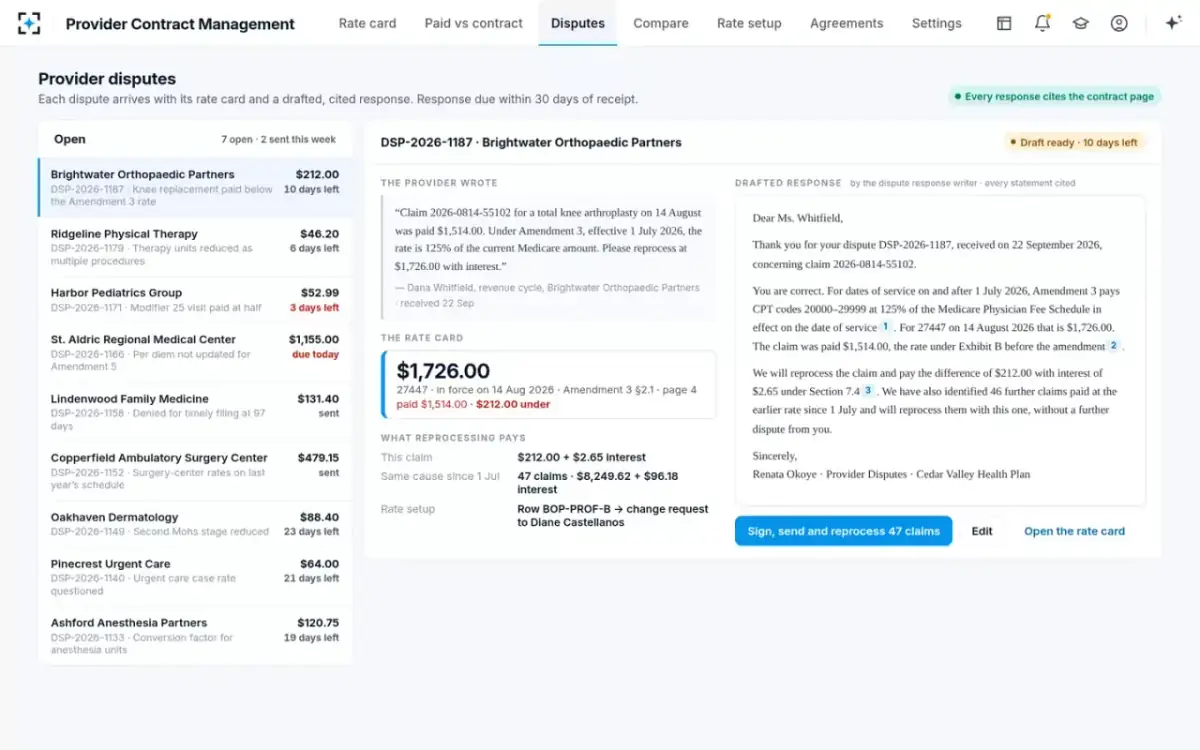
Consider an invented contract that pays clean claims in 30 days and charges 1 percent a month on any late or short payment. A $480 underpayment on a claim received on 2 March and paid on 25 March was due by 1 April; if the plan finds it in September and pays on 30 September, interest runs for six months: $480 × 1% × 6 = $28.80. Small on one claim; across every claim paid from the same stale setup row since the amendment took effect, it is a line in the budget.
A drafted response with the difference, the interest under the contract and every other claim with the same cause
Why the rate has to be known before the claim arrives
Interest is the visible cost of a late or short payment; the larger costs are the work around it. Botminds estimates that an underpayment dispute handled by hand takes about five and a half hours of analyst and configuration time: finding the agreement and amendments in force, working the arithmetic, finding other claims paid short for the same reason, drafting the cited response with interest, telling configuration which row is wrong, and review. Its estimate for the same dispute with the solution is under an hour, most of it the analyst's review and signature.
Two habits keep the clock from running. First, a pended claim should never wait on a rate question: if a claims examiner can ask for the rate by provider, code and date of service and get the clause and the arithmetic, the claim pays inside the window. Second, short payments should be found by the plan, not the provider, so interest stops at the first night rather than at the provider's follow-up. The solution's paid-claims checker compares every paid claim with its contract rate each night; how a plan can test whether that holds on its own contracts is the subject of the provider contract management system pilot guide.
The plan's own clocks and interest terms, set once and applied to every dispute
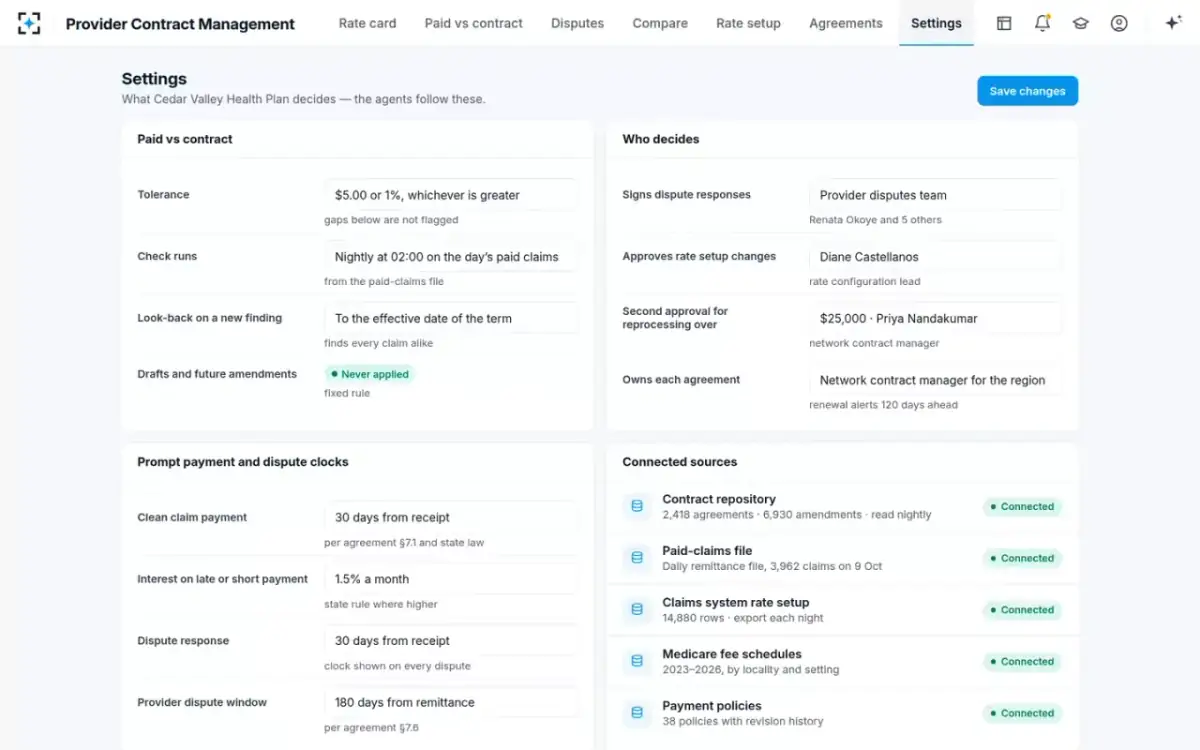
Interest is also why configuration matters to finance. A missed amendment that pays short for a quarter is a quarter of interest at the contract's rate on every affected claim, plus reprocessing. The errors behind those payments, and the audit that finds them, are set out in the claims system configuration guide. To see the rate, the clause and the nightly check together, start from Provider Contract Management.
Questions people ask
Is prompt pay interest simple or compound?
Medicare's rule is simple interest: payment amount × rate × days ÷ 365. State laws and contracts may use a monthly percentage or a different day count, so the clause should be read rather than assumed; on $10,000 held 30 days, 1.5 percent a month costs almost four times the Treasury rate.
When does prompt pay interest start?
Under Medicare's rule, on the day after the payment was due, and it ends on the day of payment; a clean claim received on 1 March is due by the end of 31 March. Some state laws start interest earlier than their payment deadline; Virginia computes interest from fifteen working days after the insurer receives proof of loss.
Does a plan owe interest if it asks the provider for more information?
Generally the clock stops only for a genuine defect in the claim. Medicare excludes claims requiring external investigation or development, and Virginia requires carriers to notify the provider of any defect within 30 days. A plan's own uncertainty about its contract rate is not a defect in the claim.
Do Medicaid managed care plans pay prompt pay interest?
The federal rule for Medicaid managed care sets the clock, not an interest rate: the state's contract with a managed care organization must require it to pay 90 percent of clean claims from practitioners within 30 days of receipt and 99 percent within 90 days, unless the plan and its providers agree an alternative schedule in their contract (42 CFR 447.46 and 447.45). Interest, where owed, comes from state law or the contract.
Where can I find the current federal prompt payment rate?
The Treasury's Bureau of the Fiscal Service publishes it every six months; for 1 July to 31 December 2026 it is 4.75 percent. Medicare applies the rate in effect on the day of payment.