A fee schedule lookup tool is a search over a published schedule of payment amounts by procedure code: CMS's Physician Fee Schedule Look-Up Tool for Medicare, a state Medicaid agency's fee schedule search, or a health plan's provider portal. It answers "what does this schedule pay for this code," usually for the current period. A provider dispute, a pended claim or a reprocessing decision asks a different question: what did this provider's contract pay for this code on this date of service, after every amendment, the schedule year the contract names and the payment policies it applies, ignoring drafts that were never signed. The two answers disagree whenever any of those changed, which is often. Botminds' Provider Contract Management answers the dated question: name a provider, a code, a setting and a date of service, and it returns the rate in force that day with the arithmetic and the amendment page that sets it.
The provider and amounts in the worked example are invented and illustrative, not CMS figures. Screens from the solution show its fictional sample plan.
One code, three rates: which term and which schedule applied on each date
- Base agreement: 110% of the 2025 schedule, year fixed2025: $165.00
- Amendment 1: 112% of the current-year schedule2026: $171.81
- Draft 115%unsigned
- 2025 schedule$150.00
- Januaryrelease A
- Aprilrelease B
- Julyrelease C
- Octoberrelease D
What is a fee schedule in health insurance?
A fee schedule is a list of maximum payment amounts by service code that a payer uses to price claims. Medicare's Physician Fee Schedule computes each amount from relative value units for work, practice expense and malpractice, each adjusted by a geographic index for the locality, and multiplied by a conversion factor. CMS explains the geographic step plainly: "We apply the GPCIs in the calculation of a fee schedule payment amount by multiplying the RVU for each component times the GPCI for that component" (CMS, PFS Look-Up Tool overview).
Health plans' own fee schedules are often built on Medicare's, as a percentage of it for a stated year, or are standard schedules the plan offers every provider of a type. A federal appeals court described the practice in 2026: "insurers often present providers with form contracts that include a default fee schedule for all covered services," and providers negotiate the rates for the services they expect to provide (Texas Medical Association v. HHS, 5th Cir. en banc, 11 August 2026). The contract, not the schedule, decides which amount applies to a given provider.
What is a fee schedule lookup tool?
A fee schedule lookup tool is a search interface over a schedule: enter a code, a locality or contractor, and a year, and it returns the payment amount and related indicators. CMS's tool "gives Medicare payment information on more than 10,000 services," including pricing, relative value units and payment policies such as assistant-at-surgery rules and modifier applicability. It also carries a warning worth repeating to any team that quotes from it: "For the official and definitive CMS PFS payment files, contact your MAC."
A plan's internal lookup tool usually does the same over the plan's schedules, and sometimes over the claims system's configured rates. That second kind is the risky one: it shows what the claims system will pay, which is the very thing a dispute is questioning. A lookup that reads configuration cannot tell you whether the configuration matches the contract.
Why does the fee schedule not match the contract?
A fee schedule and a contract disagree because the contract modifies the schedule and the schedule moves on its own calendar. Seven differences explain the usual mismatches, and a dispute analyst should rule each in or out before quoting a rate.
Seven reasons a fee schedule lookup and the contract give different rates
| Difference | What the lookup shows | What the contract may say |
|---|---|---|
| Percentage | The schedule amount | A percentage of it, such as 112% or 125%, by code range |
| Schedule year | The current or selected year | A fixed year ("2025, the year is fixed") or the year in effect on the date of service |
| Mid-year revisions | The latest release | Silent, so the release in effect on the date of service applies, or a named release |
| Conversion factor | One of Medicare's two 2026 factors | Which one, or neither, if the contract predates the split |
| Locality and setting | The locality searched, facility or non-facility | The plan's own locality definition and the setting on the claim |
| Amendments | Nothing about them | A changed percentage, method or code range from an effective date |
| Payment policies and lesser-of | The full amount for one unit | Multiple-procedure, modifier and bilateral rules, then a cap at billed charges |
How often does the Medicare fee schedule change?
Medicare's physician schedule changes every January through the annual rule, and again through quarterly revisions. In 2026 CMS published four versions of its relative value file, named RVU26A to RVU26D and described as the "Physician Fee Schedule - January 2026 release," and the April, July and October 2026 releases (CMS, PFS relative value files). A contract that pays a percentage of "the Medicare Physician Fee Schedule amount in effect on the date of service" therefore has up to four amounts for a code in one year.
The annual change is larger. For 2026 CMS estimated two conversion factors, $33.5675 for qualifying alternative payment model participants and $33.4009 for others, against "the current conversion factor of $32.3465" in 2025 (CY 2026 PFS final rule). A contract written before the split, paying a percentage of "the" Medicare amount, leaves a question the analyst cannot answer alone; it belongs to the contract manager, in writing.
How do you find the rate in effect on a date of service?
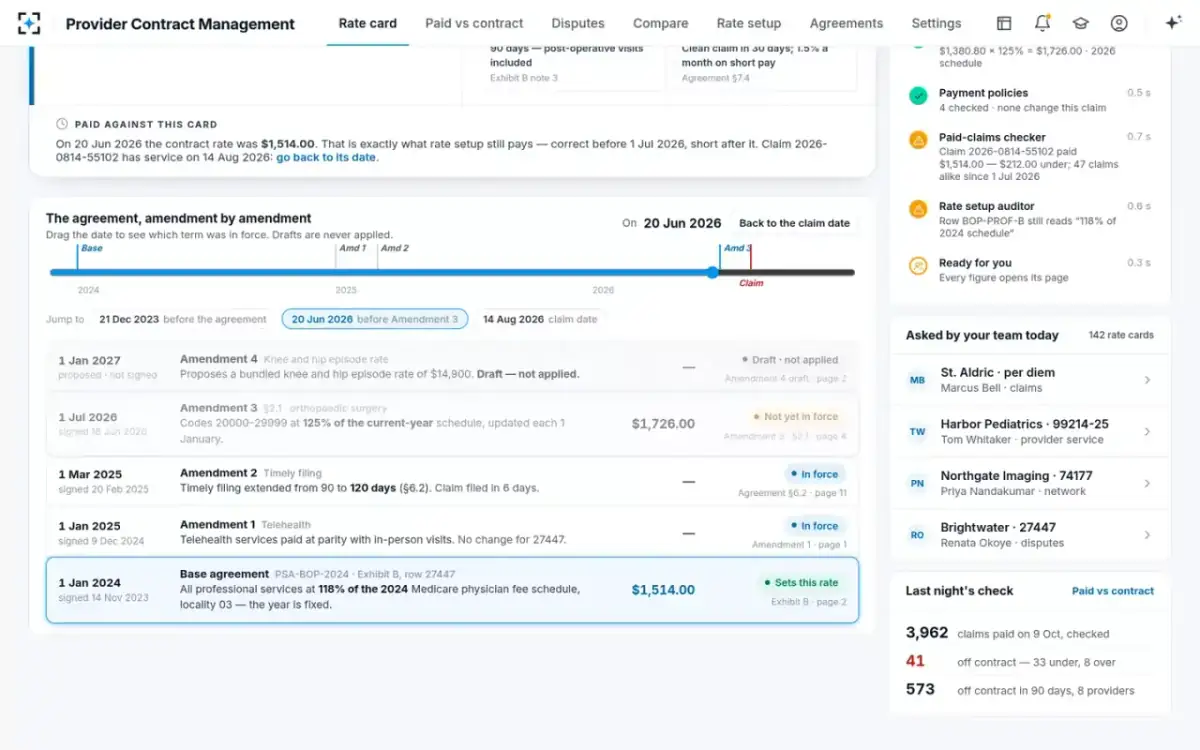
To find the rate in effect on a date of service, list every signed term for the provider in effective-date order, discard any term effective after the date of service and any document that was never signed, and take the latest remaining term that governs the code. Then apply that term's method with the schedule year, release, locality and setting it names, then the payment policies it applies, then the lesser-of test.
In the example above, a claim with service on 15 December 2025 falls under the base agreement: 110 percent of the 2025 schedule amount of $150.00, or $165.00. A claim with service on 15 March 2026 falls under Amendment 1: 112 percent of the 2026 amount in effect on that date. The unsigned Amendment 2 governs nothing, even for a claim processed after the date it proposes. A lookup run today would have returned $171.81 for both claims, and been wrong for the first.
Drag the date back, and the earlier term sets the rate again
What happens when a contract amendment is unsigned?
An unsigned amendment is a proposal, not a term, and a claim should never be priced from it. The risk is practical: drafts sit in the same folder as signed amendments, often with the same title and a future effective date, and a lookup or a configuration analyst working from the folder can pick the wrong one. The rule that keeps disputes clean is that only fully signed documents are terms, and that a signed amendment governs only from its own effective date.
State law can add conditions. In Virginia an amendment to a provider contract, schedule or policy is not effective unless the provider received it at least 60 calendar days before its effective date, and the provider did not give notice of termination within 30 days (Va. Code § 38.2-3407.15(B)(10)). A plan operating there needs the notice date as well as the signatures before it treats an amendment as in force.
A fee schedule lookup and a contract answer by date of service
Fee schedule lookup tool: What does this schedule pay for this code?
Contract answer by date of service: What did this provider's contract pay for this code on this date?
Fee schedule lookup tool: Current, or a year the user selects
Contract answer by date of service: The date of service, with the release in effect that day
Fee schedule lookup tool: Not visible
Contract answer by date of service: Signed terms stacked by effective date; drafts shown, never applied
Fee schedule lookup tool: Usually not applied
Contract answer by date of service: Applied as the contract words them, with the arithmetic
Fee schedule lookup tool: The schedule entry
Contract answer by date of service: The clause, exhibit row or policy page that sets each number
Who maintains a health plan's fee schedules?
Responsibility is usually split: network contracting negotiates the schedules and percentages, a configuration or reimbursement team loads them and Medicare's updates into the claims system, and provider service publishes what providers can see. The split is why a plan can have three versions of one schedule. Some states make the contract carry it: Virginia bars any provider contract that fails to "include or attach at the time it is presented to the provider for execution (i) the fee schedule, reimbursement policy, or statement as to the manner in which claims will be calculated and paid."
From March 6, 2027, plans and issuers in commercial coverage will also post revised in-network rate files quarterly and attest to their accuracy under the revised Transparency in Coverage rule (final rule, 6 October 2026). Those files publish the plan's own answer to the fee schedule question for every provider and code, which makes a gap between the schedule the plan publishes and the rate it pays a public one. The people who keep the claims system in step are described in the claims configuration analyst guide.
What to look for in a fee schedule lookup tool
If a plan is choosing a lookup tool for claims, dispute and provider service staff, the test is whether it can answer the dated contract question, not whether it can search a schedule. The checklist below separates the two.
Eight questions to ask of any fee schedule lookup tool before staff quote from it
- Does it take a date of service?
And return the rate in force on that date, not today's?
- Does it read the provider's contract, or only a schedule?
A schedule lookup cannot apply a percentage, an amendment or a carve-out.
- Which Medicare release does it use for a given date?
January, April, July or October, and which conversion factor in 2026.
- What does it do with drafts?
It should show them and never apply them, and say so on the screen.
- Does it show the arithmetic?
Schedule amount, percentage, policies, lesser-of, each with its source.
- Does every number open its page?
A rate without a clause cannot be put in a dispute response.
- Does it read the claims system's configuration or the contract?
If configuration, it repeats any error a dispute is about.
- Can it check paid claims against its answer?
A lookup answers one question; a comparison finds the claims nobody asked about.
Where Provider Contract Management fits
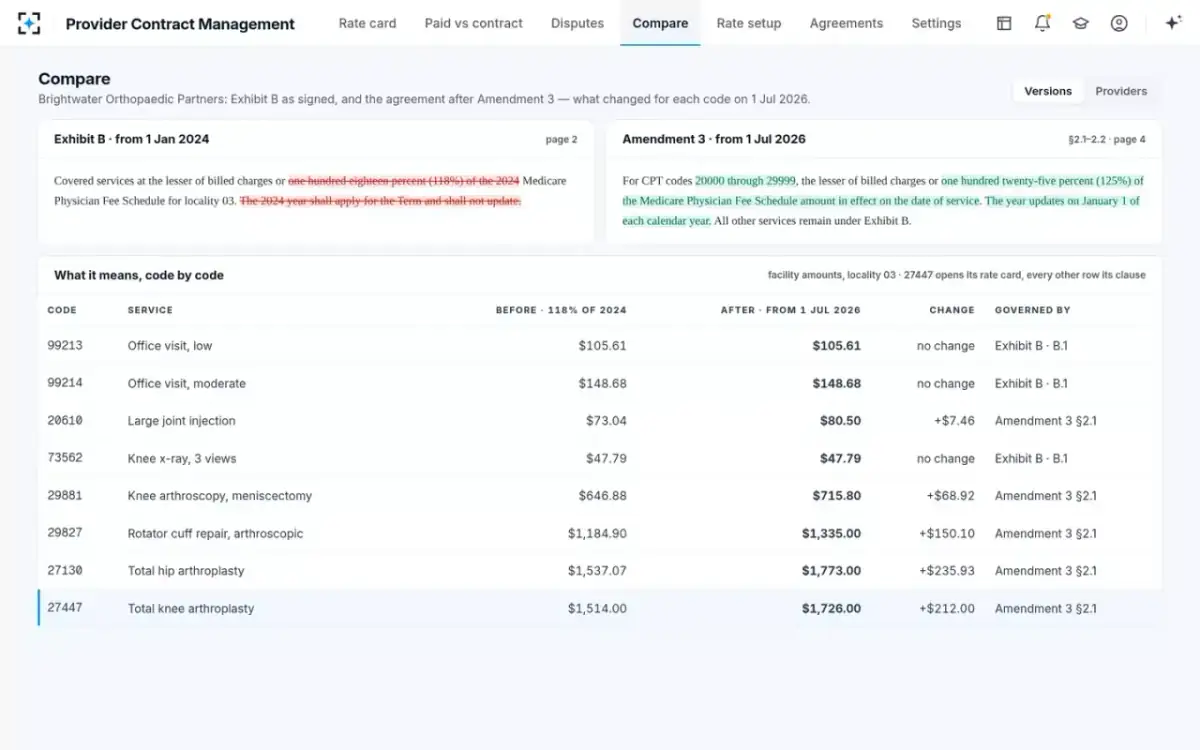
Botminds' Provider Contract Management is a lookup built on the contract. Its contract reader turns every agreement, amendment, fee schedule exhibit and payment policy into terms with their pages; its rate resolver takes the signed terms whose effective date is on or before the date of service, applies the schedule year, locality and policies they name, and shows the arithmetic and the governing page. Medicare fee schedules by year, locality and setting are one of its inputs, so a percentage-of-Medicare term is priced from the schedule the contract names rather than the current one. A dispute analyst can drag the date back and watch the governing term change.
Exhibit B as signed beside the amendment that replaced it, code by code
It is not a replacement for CMS's tool or a Medicaid agency's schedule search, which remain the sources for public amounts. It does not publish rates to providers or produce price transparency files. What it adds is the step between the public schedule and the payment: the contract. To see how a dated answer becomes a repriced claim, read claims repricing, traced; to test it on your own disputes, use the provider contract management system pilot; to see the screens together, start from Provider Contract Management.
Questions people ask
How do I look up a provider's fee schedule?
For Medicare amounts, use CMS's Physician Fee Schedule Look-Up Tool by code and locality, or the files CMS publishes for each release. For what a health plan pays a specific provider, the answer is in that provider's contract and amendments, which the plan's contracting or provider service team holds; a portal lookup shows the plan's configured rate, which can lag the contract.
Is the Medicare fee schedule the same everywhere?
No. Amounts vary by payment locality through geographic practice cost indices applied to each component's relative value units, and by setting, facility or non-facility. A contract written as a percentage of Medicare should name the locality and setting it uses.
Which Medicare release applies to a claim?
For Medicare itself, the release in effect on the date of service. For a contract written as a percentage of Medicare, whatever the contract says: a fixed year, the year in effect on the date of service, or a named release. If it says nothing, agree the reading with the provider in writing before it becomes a dispute.
Can a plan change its fee schedule without an amendment?
That depends on the contract and state law. A contract may allow schedule updates on notice; Virginia, for one, makes changes to a schedule, exhibit or policy ineffective unless the provider received them at least 60 days before the effective date.
Why does the plan's portal rate differ from the remittance?
The portal usually shows a schedule amount for one unit, while the remittance applies the contract's percentage, payment policies, units and the lesser-of test to the claim as billed. If the two still differ after those, the claims system's configuration may not match the contract.