A claims configuration analyst is the person at a health plan who translates provider contracts, amendments, fee schedules and payment policies into the pricing rules the claims system applies to every claim, and who tests that those rules pay what was signed. The role is hard because the contract is written in prose and percentages while the claims system needs exact rows, and because everyone downstream waits on the load: a rate that is signed but not configured pays the old amount on every claim until someone notices. Botminds' Provider Contract Management exists for that gap. Its agents read each agreement into terms with their page, answer any rate for a provider, code and date of service, and check every paid claim against the contract each night, while the configuration lead still approves every change to the claims system.
The examples on this page that come from the solution are sample data on a fictional health plan and fictional providers. The rules and research figures come from federal and state sources, linked where they appear.
From signature to payment: the claims configuration analyst sits in the middle
A person decides
Network contract manager signsNegotiates and signs the agreement or amendment: a rate method, a percentage, a schedule year, an effective date and the payment policies that apply.
A person decides
Claims configuration analyst loadsReads the signed pages and keys the terms into the claims system: provider and tax ID links, fee schedule rows, percentages, effective dates, reductions and exceptions.
A person decides
Configuration lead tests and approvesPrices test claims against the new rows, compares them with the contract arithmetic and releases the change.
Agent
Claims system pricesApplies whatever rows are live on the day the claim is processed, keyed to the claim's date of service.
Never: know what the contract says; it knows only what was loaded
A person decides
Claims, disputes, provider service answerExplain the payment to the provider, price pended claims by hand and settle disputes when the payment and the contract disagree.
What does a claims configuration analyst do?
A claims configuration analyst builds and maintains the provider pricing and benefit rules inside a health plan's claims system, so that each claim pays the contracted amount without a person touching it. In practice the job splits into three kinds of work: reading signed contracts into exact terms, keying those terms into the system's provider, fee schedule and pricing tables, and testing the result before it goes live.
Job titles vary. Plans advertise the role as claims configuration analyst, configuration specialist, benefits and pricing analyst or provider reimbursement analyst, and the same desk often owns benefit configuration as well as provider pricing. The common thread is that the analyst is the only person in the chain who has to understand both the contract's language and the claims system's tables.
The reading is the slow part. A single agreement can carry a base fee schedule exhibit, several amendments, and payment policies for multiple-procedure reductions, modifiers, assistant surgeons and global periods. A peer-reviewed study of 524 hospital-insurer contracts in public price transparency files found a median of 9 contract elements per contract but a mean of 1,285, because a few contracts are enormous (Henderson and Mouslim, American Journal of Managed Care, 2024). What that complexity means for the software a plan buys is a separate question; for the analyst it means that no two loads look alike.
A signed contract pays nothing until it is loaded
The claims system does not read contracts. It prices each claim from the rows that are live when the claim is processed, matched to the claim's date of service. If an amendment is signed in June and effective on 1 July, but its rows go live on 20 August, every claim with service on or after 1 July that is processed before 20 August pays the old rate. Nothing in the claim edits will flag it, because the old rate is still a valid rate.
That is why the effective date and the load date are different facts, and why both have to be watched. The contract decides the effective date. The configuration team decides the load date. The gap between them is the window in which claims pay wrong, and its cost grows with every claim that passes through it.
The window that pays wrong: effective on 1 April, loaded on 9 May
- Signed, waiting for effective date29 days
- In force: new rate owed38 days
- Old rate, correct29 days
- Old rate, now wrong38 days
Who waits on the load: contracting, claims, disputes, provider service and finance
Five teams depend on the configuration analyst, and each experiences a late or wrong load differently. Network contracting signed a rate and expects it paid. Claims examiners see a system price that disagrees with the provider's letter and price pended claims by hand. The provider dispute analyst receives the underpayment complaint weeks later and has to rebuild what the contract said on the date of service. Provider service takes the phone call while the provider is still on the line. Finance books interest and reprocessing it did not plan for.
Five people who wait on one contract load, and what changes when the reading is done for them
Today
Signs an increase in March and hears in May that claims still pay the old rate. Cannot see which agreements have setup that differs from what was signed.
With agents
Sees, agreement by agreement, whether the live setup matches the signed terms, with the rows that differ.
Still theirs: Negotiates and signs every agreement.
Today
Reads each amendment page by page, keys rows by hand, and learns about a missed term from a dispute.
With agents
Receives each change as the exact row, the exact new value, the contract page and five test-priced claims.
Still theirs: Owns the claims system; nothing changes there without the configuration lead.
Today
Prices pended claims from PDFs when the system price and the provider's letter disagree.
With agents
Asks for the rate for a provider, code and date of service and gets the arithmetic and the clause.
Still theirs: Decides the claim.
Today
Spends most of each dispute finding which amendment was in force on the service date.
With agents
Opens the dispute with the rate in force, the cause and a cited draft response.
Still theirs: Signs every response and releases reprocessing.
Today
Promises a call back because the answer is in a contract nobody on the phone can open.
With agents
Pulls the rate for the caller's code and date and shows which amendment applied when.
Still theirs: Owns the conversation with the provider.
The dependency also runs the other way. A configuration analyst with a backlog cannot see which pending load carries the most money, because the claims that will pay wrong have not been processed yet. The analyst learns which load mattered when the dispute arrives, which is the slowest possible feedback loop for the person who could have prevented it.
How are provider contracts loaded into a claims system?
A provider contract is loaded by decomposing each signed term into the fields the claims system prices from, linking those fields to the right provider identifiers, and dating them to the contract's effective date. The steps are the same in most core claims platforms, even when the screen names differ.
What a contract load contains: each contract term becomes a configured row
| Contract term | What the analyst configures | What goes wrong when it is missed |
|---|---|---|
| Who the agreement covers | Tax ID, billing and rendering NPIs, locations and specialties linked to the pricing arrangement | An in-network claim prices as out-of-network, or under the wrong group's rates |
| Rate method | Percent of a Medicare schedule, fixed fee schedule, per diem, case rate or percent of charges, by code range and setting | A whole code range pays under the wrong method |
| Schedule year | Which year's Medicare schedule the percentage applies to, and whether it moves each January | Last year's schedule keeps pricing a year after the contract moved |
| Effective and end dates | Start and stop dates on every row, keyed to date of service | An amendment applies by paid date instead of service date, or never |
| Payment policies | Multiple-procedure, bilateral, assistant-surgeon and modifier reductions; carve-outs and exceptions | A reduction the contract waives is applied anyway |
| Lesser-of clause | Whether payment is capped at billed charges, and at line or claim level | Payments exceed billed charges, or are cut where the contract does not cut them |
The order matters. Provider links come first, because a correct rate attached to the wrong tax ID is never reached. Then the method and its dates, then the reductions. A useful habit is to load the dates before the rates: a row with the right percentage and the wrong effective date is harder to spot than a blank one. The pricing arithmetic behind the method row is worked through in the lesser of billed charges guide.
What happens when a contract is configured wrong?
A wrong configuration repeats on every claim it touches until it is found. The HHS Office of Inspector General's review of Medicare Advantage denials from one week in June 2019 described the pattern: among the payment denials that met Medicare and plan billing rules, it traced causes to manual review errors and to systems that were programmed or updated incorrectly. One of its cases is a contract change that never reached the system.
"the MAO acknowledged that the contract had been updated and the ambulance ride should have been covered."
HHS-OIG, OEI-09-18-00260 (April 2022), case D116, an ambulance claim denied by a Medicare Advantage plan
That case was a denial, not an underpayment, and the sample is 2019. The mechanism is the same for a rate: a contract changes, the configuration does not, and the claims system keeps doing what it was told. CMS reached a similar conclusion in its 2025 Parts C and D audit and enforcement report, which says that such errors "are not due to a misunderstanding of CMS requirements, but a breakdown in operational controls, system testing, or ongoing monitoring" (CMS, CY 2025 program audit and enforcement report). The audit that tests a configuration against the contract itself is described in claims system configuration: passes every edit, pays the wrong rate.
For contracted providers in Medicare Advantage there is no federal clock that forgives a late load. Plans must pay contracted providers on the contract's terms, and the prompt payment terms are whatever the contract says (42 CFR 422.520(b); what a late payment then costs is worked through in prompt pay interest). A load that lags its effective date is a breach of the plan's own promise from the first claim.
Who checks a contract load, and against what?
A contract load should be checked by someone other than the person who keyed it, against the signed contract rather than against the analyst's notes. The strongest check prices a handful of real claim shapes through the new rows and compares each result with the contract arithmetic done by hand: a code at the boundary of a range, a claim with two procedures, a claim with a modifier, a date of service just before and just after the effective date.
Most plans do some version of this at go-live and very little afterwards. The gap is the second half of the problem: a load that was right in July can become wrong in January, when a "current-year" schedule moves and a fixed-year one does not, or when a payment policy is revised. A check that runs only when a row changes cannot catch a contract that changed without the row.
Every setup row read against the signed terms, with the exact change and its page
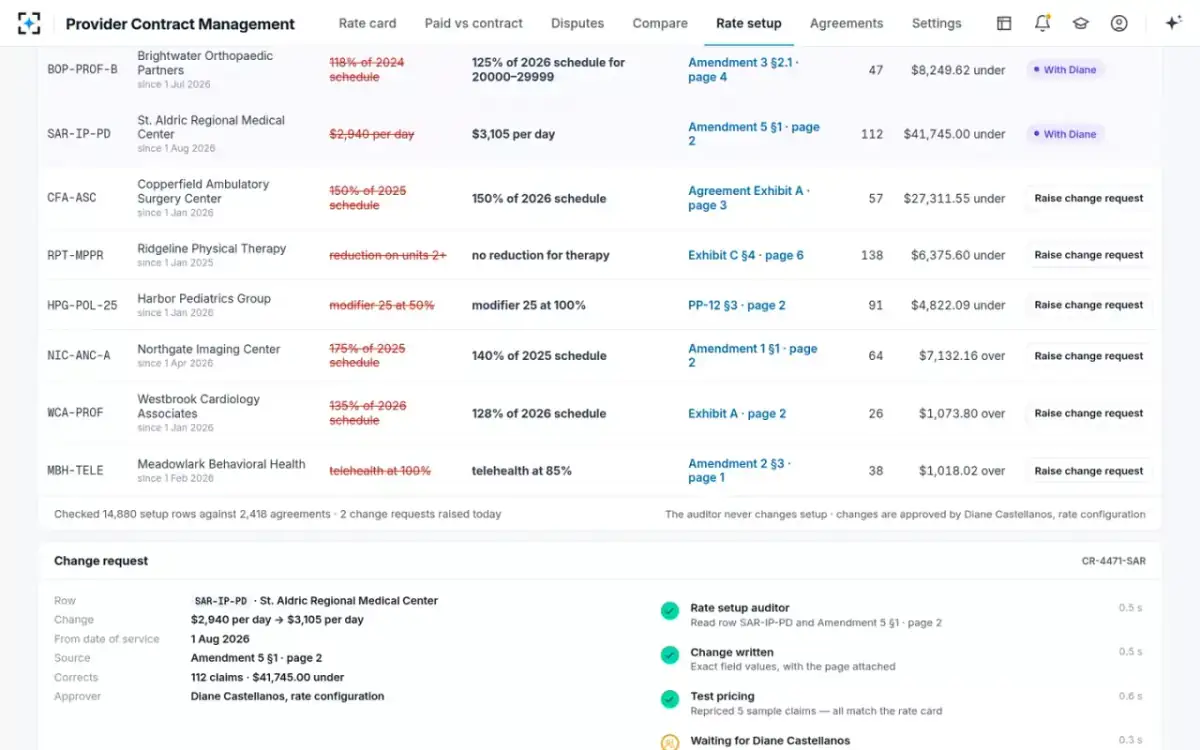
How long does a contract load take? The calendar before the first claim
The keying itself can take minutes; the calendar around it rarely does. The analyst needs the fully signed document, any exhibits it references, the schedule year it points to, and confirmation of which provider identifiers it covers. Each of those can arrive late, and the effective date does not move to wait for them.
State law sometimes sets the floor. In Virginia, an amendment to a provider contract, schedule or policy is not effective "unless the provider has been provided with the applicable portion of the proposed amendment ... at least 60 calendar days before the effective date" (Va. Code § 38.2-3407.15(B)(10), version in force until 1 January 2027). For a plan, that 60-day notice period is also the natural window to build and test the load, so a load that is not ready on the effective date has usually had two months.
A practical service level is to have every signed amendment configured and tested before its effective date, and every exception reported to the contract manager by name. Where the effective date is retroactive, as it often is at renewal, the load has to come with a reprocessing list: every claim already paid in the retroactive window.
What skills does a claims configuration analyst need?
The role needs four skills that rarely sit together: reading contract language precisely, knowing the claims platform's pricing tables, understanding Medicare's payment systems well enough to apply a percentage of them, and testing. The last is the one most often missing from job descriptions and most often decisive.
The federal statistics do not count the role separately. The Bureau of Labor Statistics' nearest occupation, claims adjusters, examiners and investigators, held about 376,100 jobs in 2025, 7 percent of them at direct health and medical insurance carriers, where the median annual wage was $59,800 in May 2025 against $78,000 for the occupation as a whole (BLS Occupational Outlook Handbook). Configuration analysts are counted somewhere inside or beside that group, so plans hiring for the role generally benchmark against their own claims and IT job families.
The scarcer skill is judgment about ambiguity. A contract that says "125% of the Medicare Physician Fee Schedule" without naming the year, the locality or which of Medicare's two 2026 conversion factors applies needs a decision, and the analyst should not be the one making it alone. The right habit is to send the question back to the contract manager in writing and load only what both agree the contract says.
Where Provider Contract Management takes the reading off the desk
Botminds' Provider Contract Management does not replace the claims system or the configuration team. It reads the contract repository, the fee schedules, the payment policies, the claims system's setup export and the daily paid-claims file, and does three things the analyst currently does by hand or not at all. A contract reader turns every agreement and amendment into terms with their page and paragraph; a rate setup auditor reads each setup row against those terms and writes the exact change; a paid-claims checker compares every paid claim with the rate the contract sets for its date of service, each night.
Every agreement, its basis and renewal date, and whether the live setup matches
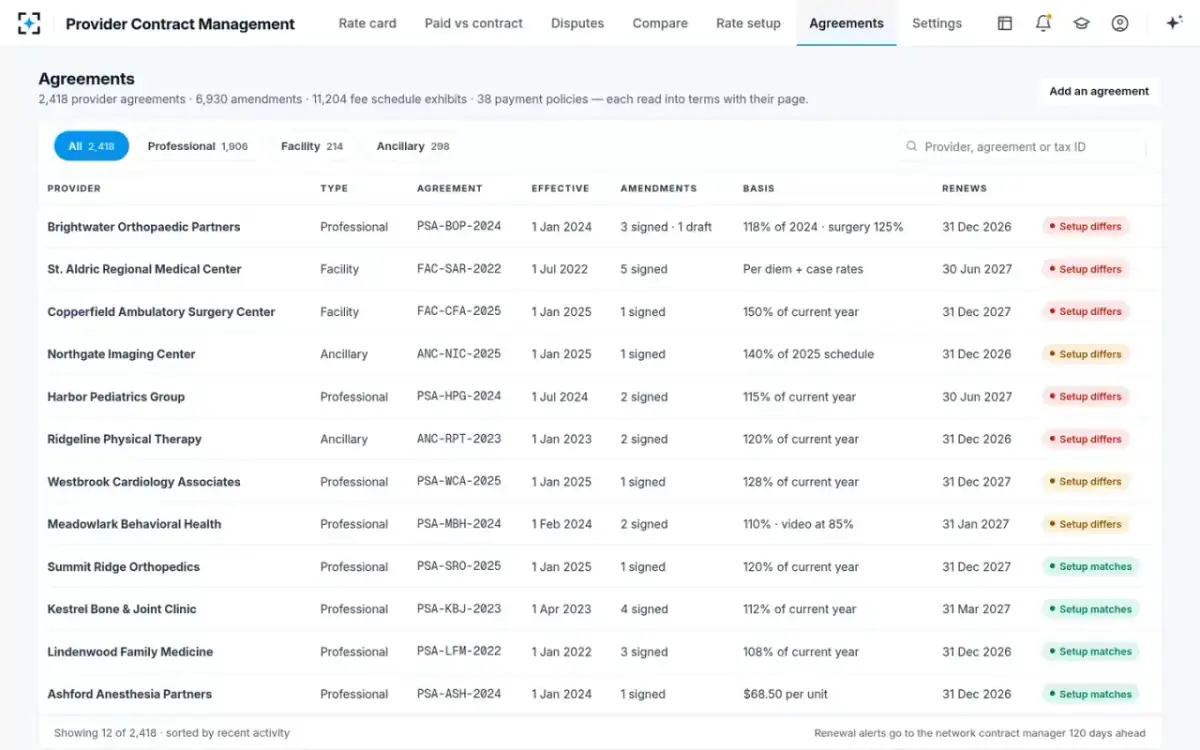
The limits are as important as the reach. The agents never change the claims system's setup, never adjust or reprocess a claim, and never apply an unsigned draft or an amendment not yet in force. Every change request names its approver; every dispute response is signed by a person. On the sample plan the nightly check covered 96,214 paid claims in 90 days and found 573 paid off contract at eight providers, the largest cause being an amendment signed but never loaded. The design target is every paid claim checked against its contract every night, and how to test a provider contract management system on disputes you already settled is the way to see whether it holds on your own contracts. To see the screens together, start from Provider Contract Management.
Questions people ask
What is claims configuration in a health plan?
Claims configuration is the set-up of a claims system's benefit, provider and pricing rules so that claims adjudicate and pay without manual work. Provider pricing configuration is the part that turns contracts into fee schedule rows, percentages, reductions and effective dates; benefit configuration sets deductibles, copays and coverage rules from the plan documents.
Is a claims configuration analyst the same as a claims examiner?
No. A claims examiner reviews individual claims after they are submitted; the Bureau of Labor Statistics describes examiners as reviewing claims "to make sure claimants and adjusters followed proper guidelines." A configuration analyst sets up the rules that price thousands of claims automatically, so one configuration error can reach every claim an examiner would otherwise see one at a time.
How often should a contract load be re-tested?
At go-live, at every amendment, and at every 1 January for any rate tied to a "current-year" Medicare schedule, because the schedule moves even when the contract does not. A nightly comparison of paid claims with the contract catches the cases in between, such as a payment policy revision that changes how an unchanged row pays.
What should a contract load request include?
The fully signed pages, every exhibit and policy they reference, the provider identifiers covered, the effective date by date of service, the schedule year and locality, and the contract manager's written answer to any ambiguity. In Virginia, the law already requires the fee schedule or the method of calculating payment to be attached to the contract when it is presented for signature.
Who is accountable when a claim pays the wrong contract rate?
The health plan is, whatever its internal split of duties: in Medicare Advantage the plan must pay its contracted providers on the contract's terms (42 CFR 422.520(b)). Internally, a clear model gives the contract manager ownership of what was signed, the configuration lead ownership of what is live, and a named person ownership of the comparison between the two.