A nostro reconciliation system is the software a bank uses to prove, every day, that the statements from each of its correspondent banks agree with its own mirror accounts in the general ledger, and to explain and clear every line that does not. That sounds like bank reconciliation, and in method it is; but most products sold as AI for bank reconciliation are built for a company reconciling its own bank account against its accounting books, and a nostro desk's job differs in scale, in evidence and in control. A nostro system reads correspondents' MT950, MT940 and camt.053 statements, works across many currencies, explains breaks from the bank's own payment messages, drafts messages to other banks, and keeps the separation of duties examiners test. Botminds' Nostro Reconciliation is built for that job: it keeps the bank's matching engine and adds agents that check, match and explain every break, with people accepting and approving everything that moves.
The comparison below is between categories, not products. General-purpose reconciliation tools do their own job well; the question for a bank is which job it is buying for.
Two categories that share a word: what each is built to reconcile
Bank reconciliation AI, built for a company's account: A few operating accounts, one company’s.
A nostro reconciliation system, built for a bank's correspondents: Dozens of nostro accounts at correspondents abroad, plus vostro accounts other banks hold with you.
Bank reconciliation AI, built for a company's account: Bank feeds or downloaded files, usually in one format.
A nostro reconciliation system, built for a bank's correspondents: MT950, MT940 and ISO 20022 camt.053, often all three at once, each proved before matching.
Bank reconciliation AI, built for a company's account: Mostly one, with occasional foreign payments.
A nostro reconciliation system, built for a bank's correspondents: Many, each account kept in two currencies and revalued.
Bank reconciliation AI, built for a company's account: Invoices, receipts and the company’s own entries.
A nostro reconciliation system, built for a bank's correspondents: Payment messages, the SWIFT gateway log, the payments hub and the correspondent’s replies.
Bank reconciliation AI, built for a company's account: An accounting entry.
A nostro reconciliation system, built for a bank's correspondents: A recall, claim or query to another bank in its message standard, and a posting approved by a second person.
Bank reconciliation AI, built for a company's account: The company’s own policies.
A nostro reconciliation system, built for a bank's correspondents: Examiner-tested separations: reconcilers away from cash, drafts and foreign exchange dealing; preparer never approver.
Bank reconciliation AI, built for a company's account: The month-end close.
A nostro reconciliation system, built for a bank's correspondents: Funds-transfer law, examiner review lines and, in India, two- and three-year rules.
What is a nostro reconciliation system?
It is the combination of statement intake, matching, break investigation, correspondence, approval and certification that a bank runs over its correspondent accounts. In many banks those pieces live in different places: a matching engine, a shared mailbox for queries, a spreadsheet of aged items and approvals by email. A system worth the name joins them so that each break has one history, from the statement line to the closing entry, with the people and evidence along the way.
The volume is what makes it a system rather than a task. The OCC's handbook on due-from accounts puts it plainly: "all foreign currency transactions, except over-the-counter cash trades, are settled through nostro accounts. Therefore, the volume of activity in those accounts may be substantial, and the accounts must be properly controlled" (OCC, Comptroller's Handbook, Due from Banks). In the fictional sample bank used in this guide, one morning's statements for 46 nostro accounts carried 58,214 lines.
The scale one sample bank's nostro reconciliation system handles
46
nostro accounts in 19 currencies, plus 12 vostro accounts
58,214
statement lines for one value date
24 of 46
correspondents still sending MT950; the rest send camt.053
182
new breaks that morning, 177 explained before the analysts arrived
What is the difference between bank reconciliation and nostro reconciliation?
In method, very little; the OCC says nostro accounts "are handled in the same manner as due from domestic bank accounts, except that the balances due are denominated in foreign currency". Both compare a statement with the books, list what does not offset, and prove the two balances. The differences are in what surrounds the method. A nostro is the bank's own money at another bank, so the evidence for a break is the bank's own payment trail and the fix often needs another bank's agreement. And foreign currency brings revaluation, foreign exchange positions and the separation of reconcilers from dealers.
Reconciliation of a bank's custodial and operating accounts raises yet another set of questions, about whose money each balance is; that comparison is drawn in account reconciliation vs bank reconciliation.
Can bank reconciliation AI tools reconcile nostro accounts?
They can match lines; most are not built to do the rest of the job. Matching a statement line to a book entry by amount, date and reference is the same problem everywhere, and good tools do it well. A nostro desk then needs things a company-account tool rarely has: statement proofs across MT and ISO 20022 formats, matching that repairs references truncated between them, investigation that reads payment messages and gateway logs rather than invoices, drafting in correspondents' message standards, and approval routing that matches a bank's separation of duties and limits.
Better data will make the matching easier for everyone. The FSB notes that harmonising the data carried in cross-border payment messages "can support increased straight-through processing (STP), automated reconciliation and more efficient implementation of AML/CFT and sanctions controls" (FSB, consolidated progress report, October 2025). It will not remove the breaks a resend, a charge or a correspondent's cut-off creates, and those breaks are where the categories part ways.
What should a nostro reconciliation system handle?
Everything between the correspondent's statement and the month-end certification, with people deciding at each point that moves money or the books. The checklist is a minimum for a bank's evaluation; nostro reconciliation software turns it into demonstration questions and a way to price the work.
What a nostro reconciliation system has to handle
- Statement intake with proofs
MT950, MT940 and camt.053; sequence, opening against last close, entries against the close, duplicates, late arrivals.
- Matching around your engine
Splits, netted charges, truncated references and rounding, never across accounts or currencies.
- Breaks explained from the payment trail
Statement, books, payments hub, message archive, gateway log and replies, each cited.
- Correspondence in each bank’s standard
Recalls, claims and queries drafted for approval, with replies linked back to the break.
- Foreign currency
Two-currency accounts, revaluation differences and foreign exchange breaks routed to the right approver.
- Separation of duties, enforced
Preparer never approver; limits that bring in the controller above thresholds.
- Aging and certification
Escalation by the bank’s clocks and a month-end pack built as the work is done.
- Evidence for examiners
Every person’s and agent’s action, with version and evidence, exportable and unchangeable.
What a nostro system's morning looks like: the summary in Nostro Reconciliation
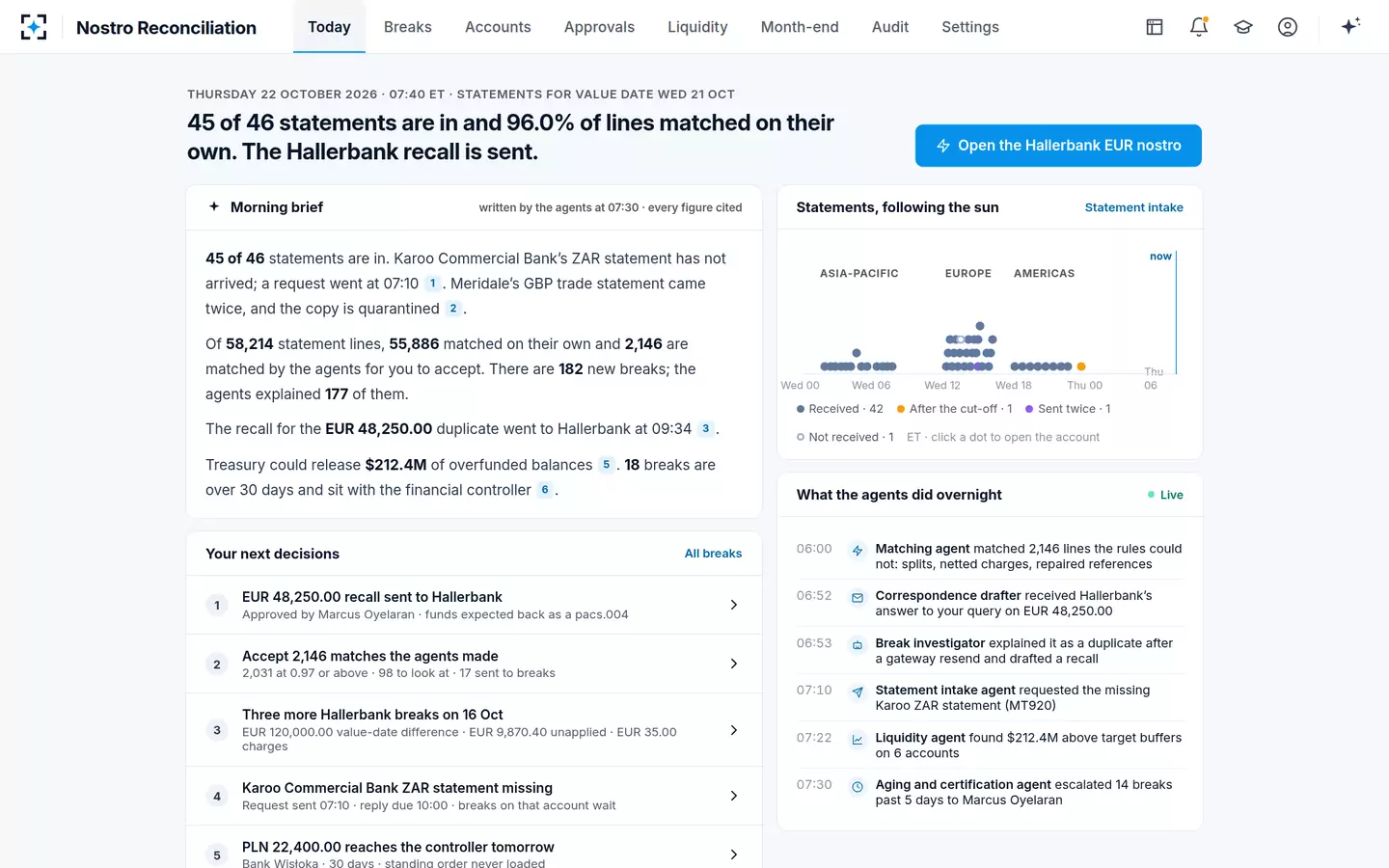
Do AI reconciliation tools meet bank controls?
A tool meets bank controls only if the bank can show who prepared and who approved each action, and on what evidence, and can test the tool's work. The OCC's questions for due-from accounts expect reconcilers to be kept away from cash, drafts and foreign exchange dealing, reconcilements to be reviewed and approved by an officer or supervisor, and reconcilement duties to rotate. An AI tool that matches and closes items without a named preparer and approver fails those questions however accurate it is; the separations are set out in bank reconciliation segregation of duties.
The standard-setters add two expectations of AI itself. The Wolfsberg Group's principles for AI in financial crime compliance ask that results be explainable or provable from the data that went in, and that institutions run a programme of ongoing testing, validation and re-configuration (Wolfsberg Group, 2022). And the federal banking agencies' April 2026 model risk guidance leaves generative and agentic AI outside its scope (OCC Bulletin 2026-13), so each bank sets its own testing for them. A nostro system using agents should therefore cite every point it relies on and be testable on the bank's own closed breaks. How AI fits a different reconciliation, custodial accounts for fintech partners, is covered in AI for bank reconciliation.
Foreign exchange: where nostro reconciliation stops being generic
Every nostro is two balances: the foreign currency amount at the correspondent and its value in the bank's reporting currency. The OCC's questions ask for separate general ledger or subsidiary accounts showing both, monthly revaluation with profit or loss entries, and review of each revaluation by an officer who did not prepare it. A break can therefore be a foreign currency difference that no amount of matching will clear, because it is a rate question, not a missing entry.
The sample bank's open items show how often this reaches approvers. One break about to pass 30 days, on a Danish krone account, was an FX difference; an approval waiting on the same morning was a write-off of BRL 78,400.00, an FX loss on a returned payment, which needed both a team lead and the financial controller. Neither belongs in a tool that assumes one currency.
Breaks a nostro system meets that a company-account tool rarely does
| Break | Why it is a nostro problem | Example in the sample bank |
|---|---|---|
| Duplicate after a gateway resend | The bank’s own gateway created a second payment the correspondent executed | EUR 48,250.00 at Hallerbank AG, recalled with camt.056 |
| Correspondent charges | Another bank took a fee from the account | EUR 35.00 at Hallerbank; SEK 4,960.00 written off when refund was refused |
| Value-date difference across statements | The correspondent booked the payment on a later statement with an earlier value | EUR 120,000.00 on the next statement; CAD back-value interest claimed |
| Inflow sent to the wrong nostro | A payer used another of the bank’s correspondents | HKD 156,000.00 at Victoria Peak |
| Foreign exchange difference | Rate, not entry | DKK 18,900.00 at Kattegat |
| Missing or duplicate statement | The evidence itself failed to arrive, or arrived twice | ZAR statement requested; GBP copy quarantined |
Who buys a nostro reconciliation system?
Usually the head of payments or cash operations, with treasury, the controller and internal audit as co-signers of the decision, because each owns a part of what the system produces. Technology owns the connections, and the reconciliation team lead owns whether it works on a Tuesday morning. The figure shows what each of them should look for.
Who decides on a nostro reconciliation system, and what each should test
Today
Owns the desk’s aging, staffing and the correspondent relationships it strains.
With agents
Tests whether breaks arrive explained and whether the same-day number can be measured.
Still theirs: The business case and the go-live decision
Today
Approves from emails and screenshots and owns breaks past the first escalation.
With agents
Tests whether an item can be approved from one screen with cited evidence.
Still theirs: Approval of postings, recalls and claims
Today
Funds from balances it cannot see behind.
With agents
Tests whether reconciled balances and buffers reach it each morning.
Still theirs: Funding and releases
Today
Certifies from a pack assembled at the end of the month.
With agents
Tests whether aged items carry reasons and two signatures as they happen.
Still theirs: Write-off limits and the certification
Today
Rebuilds who decided what from email.
With agents
Tests whether every action, by people and agents, is in an unchangeable trail.
Still theirs: Independence, and the right to test the agents
Can one system reconcile MT950 and camt.053 statements?
It has to, for some years yet. In the sample bank, 22 of 46 correspondents send camt.053 and 24 still send MT950, and the system tracks the format per correspondent. The harder part is not reading both but matching across them: a payment sent as ISO 20022 and reported on an MT statement can lose part of its reference on the way, and a system that cannot repair that will report breaks that are not real. In Nostro Reconciliation the matching agent proposes such repairs and an analyst accepts them in bulk.
Separation of duties in a nostro system: Nostro Reconciliation's approval screen
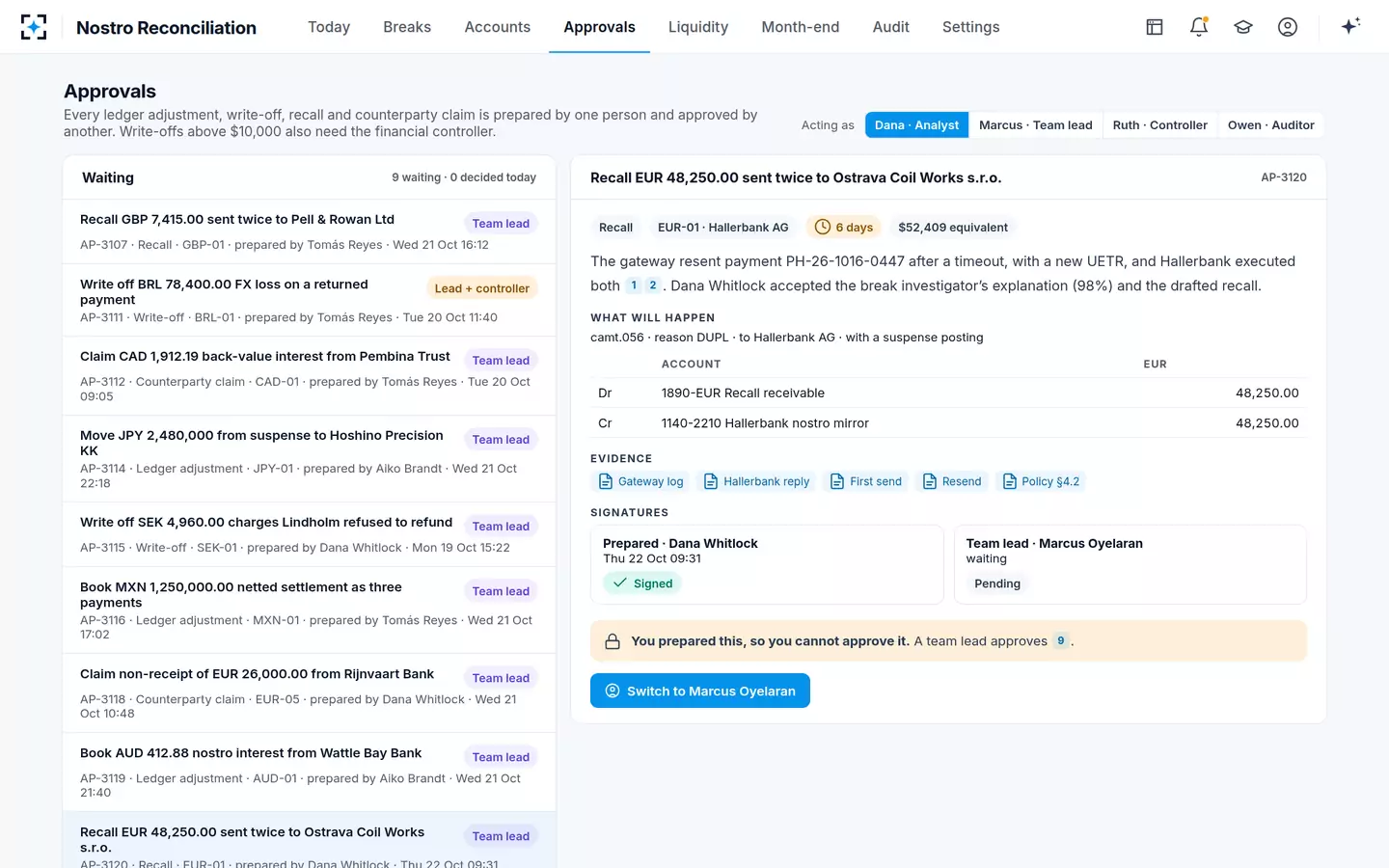
Is a nostro system the same as a cash management system?
No. A cash or treasury management system forecasts and positions the bank's money; a reconciliation system proves that the money is where the books say. They meet at the balance: treasury needs a reconciled number to fund from, and reconciliation needs the forecast to tell an idle balance from a needed one. Nostro Reconciliation bridges them with a liquidity agent that compares each nostro's balance with a buffer built from the treasury forecast and proposes releases for treasury to approve, as set out in nostro liquidity management.
Questions people ask
Can accounting-software reconciliation reconcile nostro accounts?
It can match lines from a statement file, but it is built for a company's books, not a bank's: it does not read MT950 or camt.053 with balance proofs, investigate from payment messages, draft recalls to correspondents or enforce a bank's maker-checker limits. Banks use it, if at all, for their own corporate accounts, not their nostros.
Does a nostro reconciliation system need a matching engine?
It needs matching, and most banks already own an engine that does it well. Nostro Reconciliation keeps the bank's engine as a connection and works on what it leaves, which avoids re-proving years of rules in a parallel run.
Can one nostro system also reconcile vostro accounts?
Yes, and it should, since the method is the same in the other direction. The sample bank reconciles 12 vostro accounts alongside its 46 nostros, against the statements it sends its respondents.
Is AI in reconciliation covered by model risk guidance?
Partly. The agencies' April 2026 guidance excludes deterministic rule-based processes from what it calls a model, and leaves generative and agentic AI outside its scope. Banks using agents should still test them on their own closed breaks and keep the evidence, because the Wolfsberg principles hold the institution responsible for decisions that rely on AI.
What does a nostro reconciliation system cost?
Prices are rarely published. The useful comparison is with the analyst hours spent searching for causes, the idle balances an unreconciled view hides, and the cost to integrate and validate the system, a method set out with sample numbers in the nostro reconciliation software guide.