The Reserve Bank of India's guidelines on nostro reconciliation, as they stand in October 2026, are paragraph 20 of the Reserve Bank of India (Commercial Banks – Financial Statements: Presentation and Disclosures) Directions, 2025, issued on 28 November 2025 and updated as on 1 July 2026. A bank must keep strong control over reconciliation with "a system of real-time reconciliation, which provides for immediate escalation of differences", top management must monitor pending nostro items at short intervals, unreconciled debits outstanding for more than two years need 100 per cent provision, and unreconciled credits outstanding for more than three years go to a Blocked Account (RBI, 2025 Directions). The work behind those lines is the same daily matching and break-clearing any nostro desk does; Botminds' Nostro Reconciliation does it with agents that explain each break and people who approve each action, and it keeps the aging and certification evidence either the Indian or the US rulebook expects.
The RBI's 2009 circular on nostro reconciliation, with its USD 2,500 threshold, was the instruction in force for twelve years and is no longer. It was repealed in 2021, its instructions were consolidated into a Master Direction, and for commercial banks that Master Direction was itself replaced in November 2025. The figures below are the ones in force.
The RBI's nostro reconciliation rules in force in 2026
Real-time
reconciliation, with immediate escalation of differences
Para 20(1)
2 years
after which unreconciled nostro debits need 100% provision
Para 20(5)
3 years
after which unreconciled nostro credits go to a Blocked Account
Para 20(3); counted for CRR and SLR
USD 2,500
a legacy line: small credits from before April 2002, written back in 2009, whose claims must still be honoured
Para 20(6)
What are the RBI guidelines on nostro reconciliation?
They are six short clauses. Paragraph 20 of the 2025 Directions says the bank "shall take steps to have a strong control over reconciliation and put in place a system of real-time reconciliation, which provides for immediate escalation of differences, if any"; that "There shall be close monitoring of pending items in Nostro accounts by top management at short intervals"; that unreconciled credit entries outstanding for more than three years are transferred to a Blocked Account and shown as outstanding liabilities, with the Blocked Account balance reckoned for CRR and SLR; and that a bank "shall make 100 per cent provision in respect of all unreconciled debit entries in the Nostro accounts, which are outstanding for more than two years". The sixth clause deals with the legacy USD 2,500 write-backs.
A separate paragraph closes a door that aged credits sometimes go through: unreconciled credit balances in any transitory account representing unclaimed balances "shall not be transferred to the profit and loss account or to any reserves" (paragraph 27). An Indian bank's old nostro credit is a liability to be found an owner, not income.
Which RBI document applies in 2026?
For commercial banks, the 2025 Directions above. They apply to banking companies other than regional rural banks, small finance banks, payments banks and local area banks, plus the corresponding new banks and the State Bank of India, and they came into force immediately on issue. Other kinds of bank have their own Directions: the payments banks' version, issued the same day, carries the same nostro paragraph as its paragraph 19 (RBI, Payments Banks Directions, 2025). For commercial banks, the 2025 Directions repeal the existing directions and instructions on financial statements, the body of rules in which the 2021 Master Direction had carried the nostro clauses as paragraphs 15 and 16.
Five RBI instructions on nostro reconciliation since 1999, each drawn for the years it stood
- In force1999–2001
- In force2001–2009
- In force2009–2021
- In force2021–25
- In force
Is the 2009 RBI circular on nostro reconciliation still valid?
No. Circular DBOD.BP.BC.No.133/21.04.018/2008-09 of 11 May 2009, "Reconciliation of nostro account and treatment of outstanding entries", is listed among the circulars repealed by the 2021 Master Direction, which mapped it to its paragraphs 15 and 16 (RBI, Master Direction, 2021). Those paragraphs are now paragraph 20 of the 2025 Directions. Any page that still cites the 2009 circular as current is out of date.
The circular still explains where today's rules came from. Responding to banks' "practical difficulties and involvement of substantial expenditure in the elimination of outstanding entries in nostro accounts after the lapse of certain time", it shortened the provisioning line for debits to "more than two years (instead of three years as at present)", allowed a one-time clean-up of small old entries, and advised banks to "minimize the number of nostro accounts" and to "leverage technology to avoid building up of such unreconciled balances" (RBI circular, 11 May 2009). Its "system of fast reconciliation" became, in 2021, a system of real-time reconciliation.
What is the USD 2,500 rule for nostro accounts?
It was a one-time clean-up, and today it survives only as a duty to honour old claims. In 2009 the RBI told banks to keep trying to reconcile outstanding entries of USD 2,500 or more, and allowed them to take small credit entries, under USD 2,500 and originated up to 31 March 2002, to profit and loss, appropriated to the general reserve and not available for dividends, and to write off similarly small and old debit entries against provisions already held. The 2025 Directions keep only the consequence: a bank that once made such transfers "shall ensure that any future claims in respect of these entries are honoured", and the amount appropriated to the general reserve is still not available for dividends.
There is no current USD 2,500 threshold for chasing or writing off new nostro entries. An Indian bank's thresholds today are its own policy, inside the two-year and three-year lines.
How are old nostro entries treated in India?
By side and by age. Debits, money that left the account without a matching entry in the bank's books, are provided for in full once they are more than two years old. Credits, money that arrived without a matching entry, move to a Blocked Account after three years and stay a liability, counted for the cash reserve and statutory liquidity ratios, and they are never taken to income. Neither rule closes the item: the provision recognises a probable loss and the Blocked Account parks a liability, and both stay open for recovery or a rightful claim.
The same distinction appears in the history. The 2001 circular permitted adjustments from the Blocked Accounts only with the authorisation of two officials, one of them from outside the branch concerned, preferably from the controlling or head office where the amount exceeded one lakh rupees (RBI circular, 24 August 2001). The two-person principle that governs reconciliation postings today has a long Indian pedigree.
India writes the outer limits down: two years for a debit, three for a credit. The United States leaves the limits to each bank's policy and lets its examiners test them.
What are the US rules for nostro reconciliation?
There is no US equivalent of paragraph 20. US expectations come from three places. The OCC's Comptroller's Handbook on due-from accounts, which includes nostro accounts, gives examiners their questions and procedures: whether reconcilements are prepared at least monthly, whether foreign currency accounts are "balanced to the general ledger on a daily basis", and whether items large, unusual or older than two months should be charged off under the bank's own policy (OCC, Due from Banks). Article 4A of the Uniform Commercial Code, state law where it governs a funds transfer, supplies the clocks: a reasonable time of at most 90 days to report an erroneous order after notice (UCC § 4A-205), and one year after which a customer may not dispute a debit (UCC § 4A-505). And the Bank Secrecy Act regulations require records they cover to be kept for five years (31 CFR 1010.430).
The difference in style matters for a bank with operations in both. India sets day counts and accounting treatment for aged items. The US sets examination questions and leaves the day counts to policy, which examiners then test. A bank that runs one reconciliation process across both should configure its escalation to the shorter of the two sets of lines and keep the evidence the stricter rulebook asks for. Aged items in reconciliation sets all the clocks on one chart.
Do US regulators require daily nostro reconciliation?
Not in a single sentence, but their tests assume it for active accounts. The OCC's written minimum for bank reconcilements is at least monthly; its questions on foreign currency work ask for a daily report of settlements and daily balancing of the nostro accounts to the general ledger, and its verification procedure checks that wire transfers appear on the correspondent's statement the same day they are entered on the bank's books. India's real-time requirement is stricter in wording, and the G20's target of same-day reconciliation by end-2027 points the same way; the nostro reconciliation process measures a desk against it.
Nostro reconciliation rules in India and the United States, side by side
| Question | India (RBI, 2025 Directions) | United States |
|---|---|---|
| Where the rule lives | Paragraph 20 of the Commercial Banks Directions, binding on the banks they cover | OCC examination guidance, state law (UCC Article 4A) and BSA recordkeeping rules |
| How often to reconcile | Real-time, with immediate escalation of differences | At least monthly in the OCC’s questions; daily in practice and in its foreign currency questions |
| Old debits | 100% provision after two years | The bank’s charge-off policy; examiners review items over two months |
| Old credits | To a Blocked Account after three years; never to income | The bank’s accounting policy |
| Who watches | Top management, at short intervals | An officer or supervisor reviews and approves; examiners test |
| Legal clocks on payment errors | Not in paragraph 20 | UCC 4A: 90 days to report after notice; one year to object |
| Evidence | Not set in paragraph 20 | Five years for BSA records; otherwise the bank’s retention policy |
What does real-time reconciliation mean for an RBI-regulated bank?
The Directions do not define it, so a bank has to, and an inspector will read the definition against the practice. A defensible reading has three parts: statements and intraday reports are taken in as they arrive rather than in a monthly batch; differences are raised to someone with authority as they are found, which the paragraph calls immediate escalation; and pending items are reported to top management often enough to act on, which it calls short intervals. A desk that matches overnight and reviews breaks monthly would struggle to show any of the three.
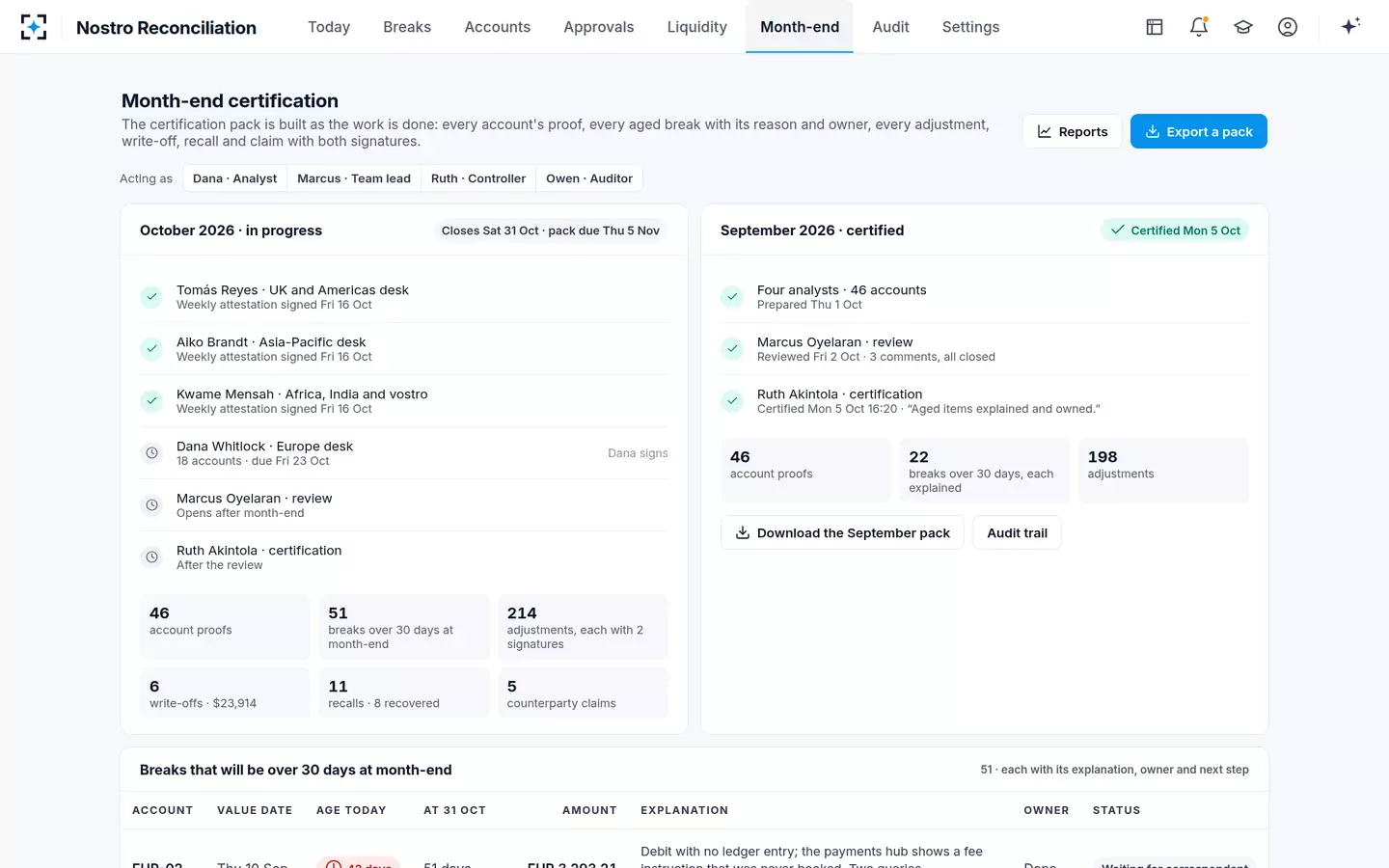
Evidence is what turns the definition into something an auditor can test. In Nostro Reconciliation each break carries its age, cause, owner and next step from the moment it is found; escalations run on the bank's own clocks; and a month-end pack is built as the work is done, so the "top management at short intervals" view exists every morning rather than at quarter-end.
Month-end certification in Nostro Reconciliation: the management view, kept current
What an RBI-regulated nostro desk should be able to show
An inspection will test paragraph 20 the way any examiner tests a control: by asking for evidence. The checklist turns each clause into something a desk can produce on request.
Evidence for each clause of the RBI's paragraph 20
- Real-time reconciliation
Arrival and match times for statements and intraday reports, by account.
- Immediate escalation
For each difference, when it was found and when someone with authority saw it.
- Top management at short intervals
The pending-items report, its frequency and who received it.
- Credits over three years
The Blocked Account balance, its entries, and its inclusion in CRR and SLR.
- Debits over two years
The 100% provision, entry by entry, with recovery efforts noted.
- Legacy write-backs
Any claims received on pre-2002 entries taken to reserve, and how they were honoured.
- No credits to income
Proof that no unclaimed transitory balance went to profit and loss or reserves.
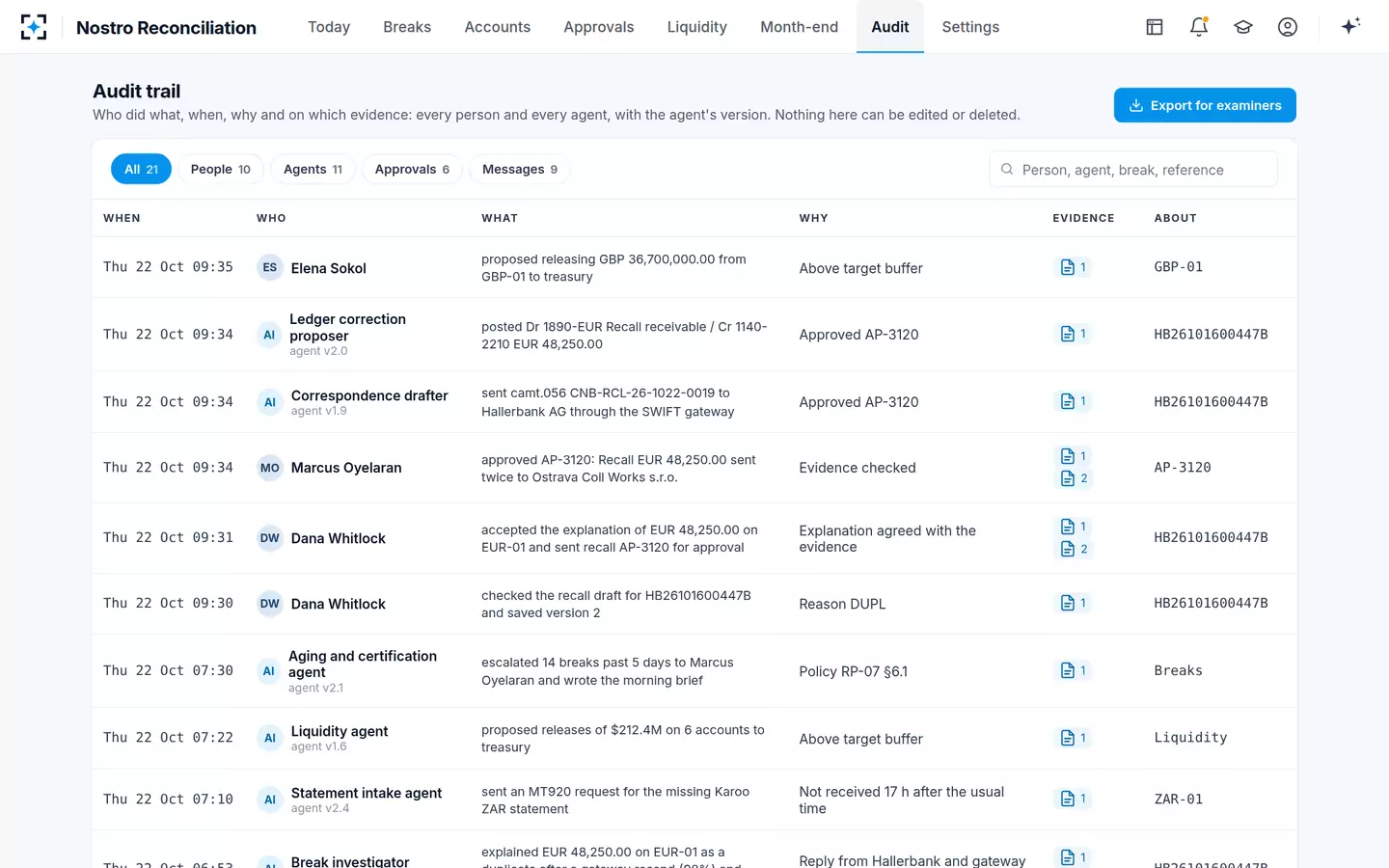
The audit trail in Nostro Reconciliation: who escalated what, when, on which evidence
Questions people ask
What is a Blocked Account for nostro credits?
An account to which an Indian bank transfers unreconciled nostro credit entries outstanding for more than three years, shown as outstanding liabilities. Its balance counts for the cash reserve and statutory liquidity ratios, and the money stays available for the rightful claimant.
Does the RBI require daily nostro reconciliation?
It requires more: a system of real-time reconciliation with immediate escalation of differences, under paragraph 20 of the 2025 Directions. The Directions do not define real-time, so each bank's definition and its evidence are what an inspection will examine.
Do the RBI rules cover vostro accounts?
Paragraph 20 speaks only of nostro accounts. Vostro accounts, which other banks hold with the Indian bank and which sit on its own books as liabilities, are not mentioned in it; the bank's own reconciliation policy has to cover them.
What are nostro and mirror accounts in the RBI circulars?
The nostro account is the bank's account with the foreign correspondent; the mirror account is the bank's own copy of it in its books. The 2009 circular's clean-up applied to small unreconciled entries "in nostro and mirror accounts", because an item can sit unmatched on either side.
Should an Indian bank still limit its number of nostro accounts?
The 2009 advice to minimise the number of nostro accounts did not carry into the 2025 Directions' text, but its logic stands: every account adds a statement to prove and a correspondent to chase. Fewer, busier accounts are easier to reconcile in real time.