A nostro reconciliation example is easiest to follow on a single account and a single value date: take the correspondent bank's statement, take the bank's own mirror account in the general ledger, match every line that agrees, and explain every line that does not until the two closing balances are proved equal. In the example below, a euro nostro is out by EUR 158,414.60 across four open items, and one of them, a EUR 48,250.00 debit, turns out to be a payment the bank's own gateway sent twice. Finding that takes reading five systems; proving it takes the payment's own messages. Botminds' Nostro Reconciliation does the reading with agents and leaves the proof, and every decision, to people.
The bank and every name and figure in this example are fictional sample data, as it runs through the solution: Corvane National Bank, its euro account at Hallerbank AG in Frankfurt, and value date Friday 16 October 2026. The method is the one the OCC's examiners use to test a due-from reconcilement, and the message names are those the BIS Committee on Payments and Market Infrastructures uses for cross-border payments.
The Hallerbank account on 16 October, reconciled in the OCC's four columns
| Line | OCC column | EUR |
|---|---|---|
| Hallerbank’s closing balance on the camt.053 statement | Their balance to our credit | 41,276,310.62 |
| Payment to Ostrava Coil Works s.r.o., debited twice | They debit, we do not credit | + 48,250.00 |
| Hallerbank’s charges, not booked by Corvane | They debit, we do not credit | + 35.00 |
| Incoming payment from Brenner Maschinenbau GmbH, booked for 16 Oct, on Hallerbank’s 19 Oct statement | We debit, they do not credit | + 120,000.00 |
| Credit for “TORVIK LOGISTIK”, naming no Corvane customer | They credit, we do not debit | − 9,870.40 |
| Corvane’s mirror account in the general ledger | Our balance to their debit | 41,434,725.22 |
How does nostro reconciliation work, step by step?
Nostro reconciliation works in three passes: prove that each statement is complete, match its lines against the bank's mirror account, and explain whatever is left until the two balances agree. The OCC's examination procedure for a due-from reconcilement sets out the third pass in detail (OCC, Comptroller's Handbook, Due from Banks). Write down the bank's balance and the correspondent's balance with their dates. Check that the statement opens where the last one closed. Clear the items left open last time against later statements. Offset every general ledger entry since the last reconcilement against a statement entry, and list what does not offset under one of four headings: we debit and they do not credit, we credit and they do not debit, they debit and we do not credit, they credit and we do not debit.
Then total both sides. In the handbook's own words: "Proof is established when the two balances agree." A reconcilement that does not prove has an item missing from the list, and the list is worthless until it does.
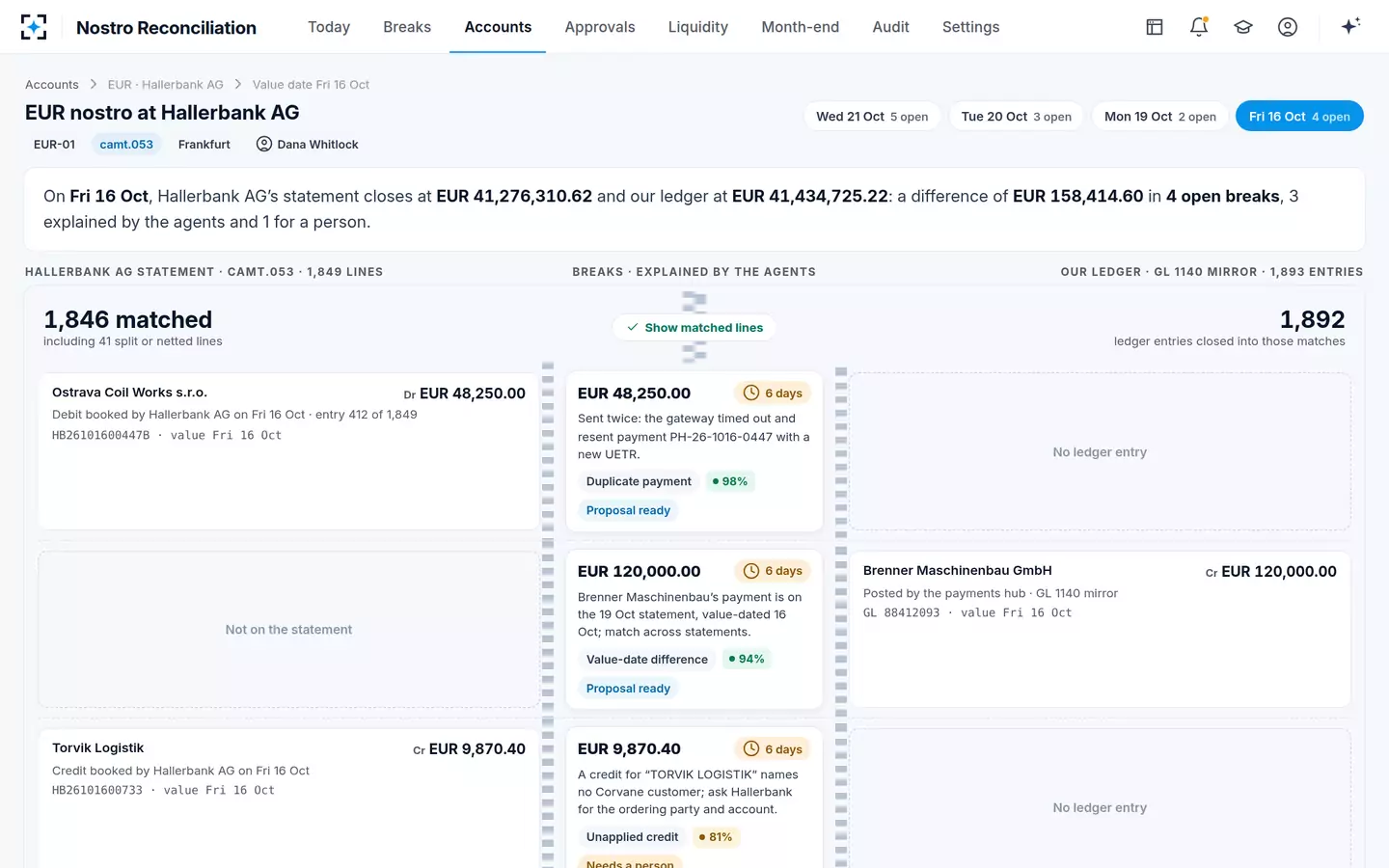
Modern desks do the matching in an engine, by amount, value date and reference, and only see the remainder. On this statement the engine and the agents together matched 1,846 of Hallerbank's 1,849 lines, 41 of them split or netted lines, against 1,892 of Corvane's 1,893 entries. Three statement lines and one general ledger entry were left. Those four are the reconciliation.
The Hallerbank account in Nostro Reconciliation: statement left, books right, breaks between
The payment: a duplicate made in 38 seconds
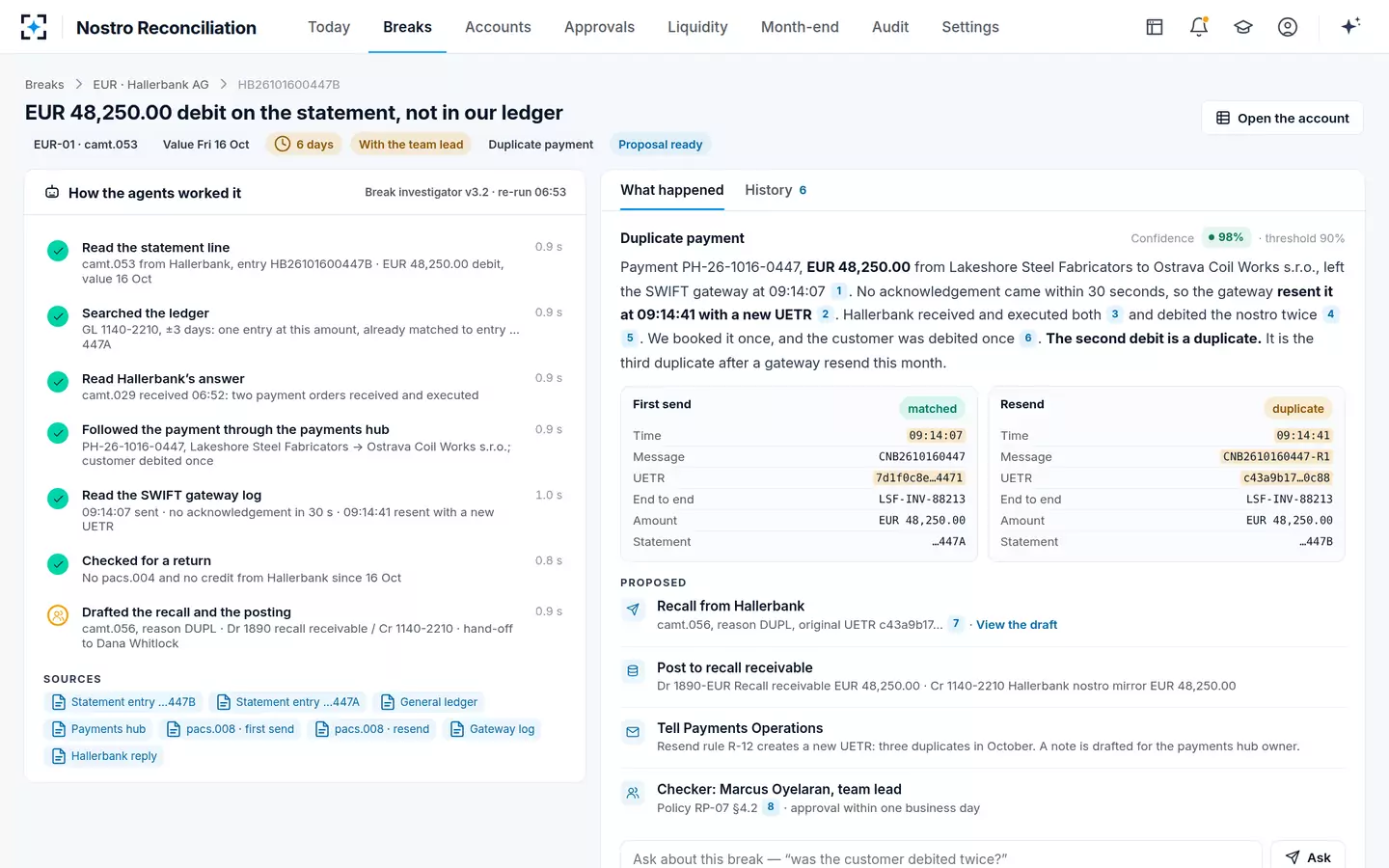
The EUR 48,250.00 break began on the morning of 16 October, in Corvane's SWIFT gateway. Payment PH-26-1016-0447, from Corvane's customer Lakeshore Steel Fabricators to Ostrava Coil Works s.r.o., left as an ISO 20022 pacs.008 customer credit transfer at 09:14:07. No acknowledgement came within 30 seconds, so under the gateway's resend rule the payment went again at 09:14:41 with a new unique end-to-end transaction reference (UETR). The resend was acknowledged a second later; the original's acknowledgement arrived late, at 09:14:44. Both had reached Hallerbank.
From first send to late acknowledgement: 37.8 seconds, drawn to scale
- Waiting for an acknowledgement30.0 s
- Timeout to resend, new UETR4.3 s
- Resend acknowledged, 0.6 s
- Original acknowledged, late2.8 s
Hallerbank executed both orders and debited Corvane's account twice. Corvane's payments hub had debited its customer once and booked one payment to the mirror account. Hallerbank's camt.053 statement for 16 October carried two EUR 48,250.00 debits; one of them, entry 447A, was matched to Corvane's booking and the second, 447B, was left with nothing to match. On the OCC's form it is a they-debit, we-do-not-credit item: money gone from the account that the bank's books say never left.
Hop by hop: where a match can go wrong
A payment crosses five or six systems between the customer's instruction and the line on the statement, and every crossing is a place where a match can fail or, worse, succeed wrongly. The table follows this payment hop by hop. The right-hand column is the point: each hop has its own evidence, and an explanation that does not cite it is a guess.
One payment's path, and the evidence that settles each hop
| Hop | What it holds | What can break the match | Evidence that settles it |
|---|---|---|---|
| Payments hub | Payment PH-26-1016-0447; customer debited once | A payment booked twice, or not at all | The hub’s payment and the customer’s account entry |
| Outbound message | pacs.008 with UETR 7d1f0c8e…4471 and end-to-end id LSF-INV-88213 | Two messages for one payment | Both messages side by side: times, UETRs, end-to-end id, amount |
| SWIFT gateway | Timeout at 30 seconds; resend under rule R-12 | A resend with a new UETR looks like a new payment | The gateway’s outbound log for the day |
| Correspondent | Two orders received, two executed | The correspondent treats each message as a payment | Hallerbank’s camt.029 reply, received 06:52 on 22 Oct |
| Statement | Two debits, entries 447A and 447B | References cut short, charges netted, value dates moved | The camt.053 lines with their own references |
| General ledger | One booking to the Hallerbank mirror account | Booked to the wrong account, date or amount | A search of the mirror account, ±3 days, at that amount |
Matched on the end-to-end id, both debits would have looked like the customer's one payment. Matched on the UETR, the second debit is a payment nobody asked for.
What is an MT950, and what is camt.053?
Both are the statement a correspondent sends for the account it keeps for the bank. MT950 and MT940 are SWIFT MT formats, the older message family that ISO 20022 is replacing; camt.053 is the ISO 20022 bank-to-customer statement. The BIS's payments committee lists camt.053 alongside camt.052, the bank-to-customer account report, and camt.054, the debit and credit notification, as the standard ISO 20022 account reporting messages that "play an important role in cross-border payment reporting" (CPMI, Harmonised ISO 20022 data requirements, February 2026).
Most banks receive both families at once. In the sample bank, 22 of 46 correspondents send camt.053 and 24 still send MT950, and the intake agent checks each one the same way before matching: sequence, opening balance against the previous close, entries against the closing balance, duplicates and arrival time. Hallerbank is one of the camt.053 senders.
camt.053 vs MT940 and MT950: what changes for matching
The difference that matters for matching is how much of the original payment survives onto the statement line. The CPMI's harmonised requirements ask that every cross-border payment carry a UETR, so that each party can follow and reconcile the payment end to end, and that remittance information travel unaltered: up to 140 characters unstructured, or structured information of up to 9,000 characters (CPMI, February 2026). A matching rule that can read the UETR on a camt.053 line can tell two payments apart even when the amount, date and end-to-end id are identical, as they were here.
MT statements carry less, and conversion between the two standards loses detail. The BIS staff brief on ISO 20022 migrations notes that structured data "helps to resolve STP and truncation issues", and that converters between MT and ISO 20022 have drawbacks as a permanent solution (CPMI Brief No 11, April 2026). For a reconciliation team the drawback is concrete: a reference shortened on the way through a converter no longer equals the reference in the bank's books, and a rule that matched yesterday fails today.
Why do payment references get truncated?
Because a field in one format is longer than the matching field in another, and something has to give when a message crosses between them. The CPMI describes the problem from the customer's side: proprietary standards often limit the size of remittance information, which "can create problems such as data truncation and reconciliation difficulties between end customers". Between banks, the same thing happens to references and names whenever a payment passes from ISO 20022 into an MT leg or back. In Nostro Reconciliation, repairing references truncated between MT and ISO 20022 is one of the rules the matching agent applies to lines the engine could not match, for an analyst to accept in bulk.
How do bank charges create reconciliation breaks?
A correspondent's fee is money taken from the account that the bank did not instruct, so it appears on the statement with nothing to match it until someone books it. Some correspondents deduct the fee from the payment itself, so the statement shows a netted amount that no longer equals the booking; others debit it as a separate line, like Hallerbank's EUR 35.00 here. The sample bank's matching rules accept netted charges up to EUR 50.00 against the payment they belong to and leave separate charge lines as breaks for a person to book. That threshold is the bank's policy setting, and an auditor will ask who approved it.
The evidence to see before accepting the duplicate
A recall sent on a wrong diagnosis costs money and goodwill, so the explanation has to prove more than that two debits look alike. The checklist below is what the break investigator gathered and cited in this example, and what an analyst should be able to open before accepting any duplicate.
Before calling a nostro debit a duplicate, see each of these
- Two statement debits, same amount and value date
Entries 447A and 447B, EUR 48,250.00 each, value 16 October.
- Only one booking in the general ledger
A search of the mirror account within three days finds one entry at that amount, already matched to 447A.
- The customer was debited once
The payments hub shows one payment and one customer debit.
- Two messages for one instruction
Same end-to-end id LSF-INV-88213, different UETRs, 34 seconds apart.
- The cause in the gateway log
No acknowledgement within 30 seconds, then a resend with a new UETR under rule R-12.
- The correspondent’s confirmation
Hallerbank’s reply that it received two orders and executed both.
- No return since
No pacs.004 payment return and no credit from Hallerbank since 16 October.
The break investigator's work in Nostro Reconciliation, step by step, each source cited
Closing the item: recall, posting and the reconcilement after
The fix has three parts, and in the sample bank they travel as one approval. The correspondence drafter prepared a camt.056 cancellation request to Hallerbank with the original UETR, the amount, the value date and the reason code DUPL, keeping the MT 192 equivalent for correspondents still on MT. The correction proposer prepared a posting moving the amount into a recall receivable, so the mirror account reflects the money that left. The analyst accepted at 09:31; the team lead approved at 09:34; then the recall went out and the posting was made. What happens if Hallerbank refuses is a matter for the recall's own process, described in the payment investigation process.
After the posting, Corvane's mirror account closed at EUR 41,386,475.22 for 16 October, and the difference fell to EUR 110,164.60 in three open items. Each has its own route: the EUR 120,000.00 clears by matching across statements once the 19 October line is accepted; the EUR 35.00 needs a booking for charges; and the Torvik Logistik credit needs a query to Hallerbank for the ordering party and account. The OCC's form is the same at the end as at the start, only shorter.
One duplicate, start to finish, in the sample bank
37.8sec
from the first send to the late reply that left two payments in flight
6days
old when the break was explained and the recall prepared
98%
the break investigator’s confidence, against a 90% threshold
3min
from the analyst’s acceptance to the team lead’s approval
The clocks that start on a break like this one, from five funds-transfer business days to a year, are set out in aged items in reconciliation; the routes for the other three items are in reconciliation exception management.
Questions people ask
How do you reconcile nostro accounts in a spreadsheet?
The same way, with more risk: put both balances at the top, match the lines, and list the unmatched ones under the four headings until the totals prove. The weakness is evidence, not arithmetic: a spreadsheet holds the conclusion but rarely the messages and logs that justify it, and the OCC expects reconcilements to be safeguarded against alteration.
What is a nostro mirror account?
It is the account in the bank's own general ledger that shadows its balance at the correspondent, so the two can be compared line by line. In this example it is account 1140-2210, the Hallerbank mirror, which held one booking where the statement held two debits.
What does UETR stand for?
Unique end-to-end transaction reference. The CPMI's harmonised requirements ask for one on every cross-border payment, defined by the RFC 4122 version 4 standard, because the transaction identification commonly used is not unique enough across all payments and parties.
What is camt.029?
In the CPMI's core message set it is the Payment Cancellation Response, the ISO 20022 answer to a camt.056 cancellation request. In this example Hallerbank also used it to answer the analyst's earlier query, confirming it had received and executed two orders.
What is the difference between nostro and vostro reconciliation?
Nostro reconciliation compares the correspondent's statement with the bank's own books for an account the bank holds abroad. Vostro reconciliation runs the other way, for accounts other banks hold with you, against the statements you send them; the method and the four headings are the same.
How long does a nostro reconciliation take?
For the matched lines, minutes in an engine overnight. For the breaks, it depends on the evidence: Botminds estimates 20 to 30 minutes of searching per break by hand, plus the days a correspondent can take to reply, against a few minutes to check an explanation whose sources are already cited.