The nostro reconciliation process is the daily cycle by which a bank proves that each correspondent bank's statement agrees with its own mirror account in the general ledger: statements come in and are checked, lines are matched, the breaks left over are explained and cleared, corrections are approved by a second person, and the month is certified. It is hard because the matching is the easy part; the breaks need evidence from systems the statement never sees, and they arrive every day. Botminds' Nostro Reconciliation runs that cycle around the bank's existing matching engine, with agents doing the searching and drafting and people doing the deciding. This guide walks the process step by step and then measures it against the one outcome target that exists for it: the G20's goal that cross-border wholesale payments be reconciled by the end of the day on which they are credited.
That target is real and dated, and it has no published data behind it. The Financial Stability Board, which monitors the G20's cross-border payments roadmap, defines a key performance indicator for it and reports, for that indicator, that there is no source.
Wholesale cross-border payments are fast; whether they are reconciled the same day is unmeasured
93.2%
of wholesale cross-border payments credited within one business day, 2025
FSB KPI 2; payments of USD 100,000 or more
54.6%
credited within one hour of initiation, 2025
FSB KPI 1
None
published figure for payments reconciled by the end of the day credited
FSB KPI 4: no source available
End-2027
the G20 date for same-day reconciliation
G20 wholesale target
What is the nostro reconciliation process?
It is the check that the messages a bank exchanged with its correspondents ended up as the entries they should have. The BIS's payments committee describes correspondent banking at its simplest as accounts plus messages: "At the most basic level, correspondent banking requires the opening of accounts by respondent banks in the correspondent banks' books and the exchange of messages to settle transactions by crediting and debiting those accounts" (CPMI, Correspondent banking, 2016). Reconciliation tests that sentence every day: every message that should have moved the account did, once, for the right amount and value date, and nothing else did.
The process runs in seven steps. Statements arrive as each correspondent's day closes and are proved complete. The bank's matching engine matches what its rules can. Harder matches (splits, netted charges, references cut short between formats) are proposed for an analyst to accept. What remains is explained, break by break, from the payment's trail. Corrections, queries and recalls are drafted. A person accepts each explanation and a second person approves each action. And the month's results are certified. The flow below shows how Nostro Reconciliation divides those steps between agents and people.
The nostro reconciliation process in Nostro Reconciliation: agents prepare, people decide
Agent
Statement intake agentReceives MT950, MT940 and camt.053 statements; checks sequence, opening against last close, entries against the close; quarantines duplicates; requests late statements.
Never: edits a statement, or loads one whose balances do not prove.
Agent
Matching agentAfter the bank’s own engine runs its rules, proposes the matches rules miss: splits, netted charges, truncated references, rounding.
Never: matches across accounts or currencies; below 0.97 it waits for a person.
Agent
Break investigatorExplains each remaining break from the statement, the books, the payments hub, the message archive, the gateway log and the correspondent’s replies, citing each.
Never: posts or contacts a customer; below 0.90 it hands the break to a person.
Agent
Correspondence drafter and correction proposerDraft the query, claim or recall in the correspondent’s standard and the balanced posting, routed by amount to the right approver.
Never: send or approve anything.
A person decides
AnalystAccepts, edits or rejects each explanation with a reason, and sends actions for approval.
A person decides
Team lead, and the controller above limitsApproves postings, recalls and claims; the controller also approves larger write-offs and certifies month-end.
Never: approves an item they prepared.
Agent
Aging and certification agentRuns the escalation clocks, writes the morning summary and keeps the month-end pack current.
Never: closes a break or signs.
How often should nostro accounts be reconciled?
Every business day for an active nostro, though the written floor is lower. The OCC's internal control questionnaire for due-from accounts asks: "Are bank reconcilements prepared promptly at least once a month?" (OCC, Comptroller's Handbook, Due from Banks). The same handbook expects more for foreign currency work: it asks whether there is a daily report of settlements and other receipts and payments affecting the nostro accounts, and whether the foreign currency accounts are balanced to the general ledger daily. For the bank's Federal Reserve account it asks whether the account is reconciled on a daily basis.
In practice the frequency is set by volume. A nostro that settles a bank's foreign exchange business sees hundreds or thousands of lines a day, and a monthly reconciliation of it would be an archaeology project. India's central bank has gone furthest in writing: its 2025 Directions require banks to have a system of real-time reconciliation with immediate escalation of differences, set out in the RBI's nostro reconciliation guidelines.
Is daily nostro reconciliation required?
Not in so many words for US nostro accounts, but the examiner's tests assume it for wire activity. Among the OCC's verification procedures is this instruction: "Determine that wire transfers appear on the correspondent statement the same day as entered on the bank's books. Determine the reason for any exceptions." A bank that only reconciles monthly can still answer that question, but only weeks after the money moved, when the evidence is cold and the clocks on any error have been running. Daily reconciliation is the practical way to meet a same-day test.
What is the G20 target for cross-border payment reconciliation?
It is the last clause of the G20's wholesale speed target. The FSB's published targets set out that 75% of cross-border wholesale payments should be credited within an hour of initiation, and the rest within one business day, and then add: "Payments to be reconciled by end of the day on which they are credited, by end-2027" (FSB, G20 targets for enhancing cross-border payments). Wholesale here means payments of USD 100,000 or more.
The FSB's methodology turns that clause into wholesale KPI 4: "Percentage of cross-border wholesale payments reconciled by the end of the day on which they are credited" (FSB, methodology document, 2025 update). Its October 2025 progress report then lists the data sources for the wholesale KPIs and states: "No source currently available for KPIs 3 and 4" (FSB, consolidated progress report for 2025). The speed of payments is measured from network data; whether anyone reconciled them that day is not, because only the banks holding the accounts know.
The target does not bind any bank directly. The FSB states that its activities and decisions "shall not be binding or give rise to any legal rights or obligations". What it does is set the bar a bank's correspondents, regulators and corporate clients will increasingly measure against, and a bank that can report its own number before anyone asks for it is ahead of the conversation.
Why the statement cycle decides the same-day number
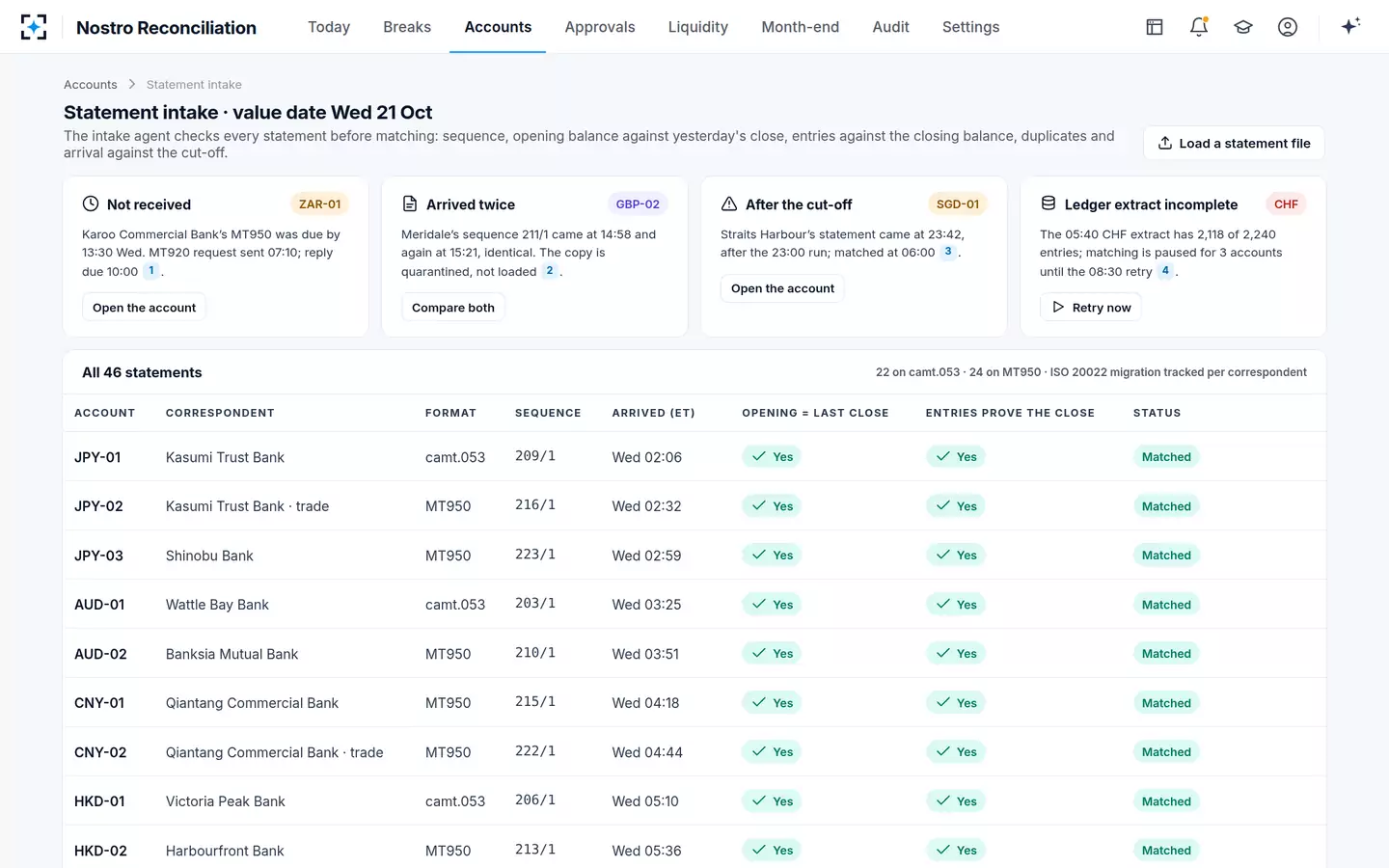
Because a payment cannot be reconciled before the statement or notification that proves it arrives, and statements arrive as each correspondent's day ends. In the fictional sample bank used in this guide, statements for value date Wednesday 21 October came in across Wednesday in Eastern Time: Japanese and Australian correspondents from about 02:00, Europe around midday, the Americas through the evening. The 23:00 matching run reconciled everything that had arrived, on the value date by the bank's own clock. One Singapore statement came at 23:42, after the run, and its lines were matched at 06:00 on Thursday; the day's new breaks were explained by the 07:30 summary. Neither counts as same day.
Value date Wednesday 21 October on the sample bank's clock: what can still count as same day
- Value day, midnight to the 23:00 run: statements arrive and are matched23 h
- Value day: statement not yet in, or break not yet explained24 h
- Matched at 06:00, explained by 07:307.5 h
The clock question matters more than it looks. The FSB's indicator speaks of the end of "the day on which they are credited" without saying whose day, and a bank in New York reconciling a yen nostro at 23:00 is reconciling it the next morning in Tokyo. A bank that wants a number it can defend should report it on one clock, say which, and show the accounts where the choice changes the answer.
Meeting the target reliably needs data during the day, not just a statement after it. ISO 20022 already defines the messages: the CPMI lists camt.052, the bank-to-customer account report, and camt.054, the debit and credit notification, alongside the camt.053 statement as the standard account reporting messages for cross-border payments (CPMI, February 2026). Whether a bank receives them intraday depends on what its correspondents offer and what it has asked for. Nostro Reconciliation as shown here works from the statements correspondents send; a bank measuring itself should count separately the accounts whose only evidence arrives after the value day has ended.
How do banks measure same-day reconciliation?
By timestamping two events for every credited wholesale payment, the credit and the reconciliation, and counting how many pairs fall on the same day. The FSB defines the ratio but not the timestamps, so a bank has to choose and write down its own definitions: when a credit counts as known (an intraday notification, or only the statement), and when a payment counts as reconciled (matched by a rule, or also accepted by a person if it needed one). The formula below is a starting point.
A same-day reconciliation rate a bank can compute for itself
Payments in scope
credited cross-border payments of USD 100,000 or more, by value date
The FSB’s wholesale threshold; include both nostro and vostro sides if you report both
Payments operations
Reconciled same day
those matched or explained and accepted before the end of their value date
Use the correspondent’s value date and your own time zone, and say which
Reconciliation team
Same-day rate
reconciled same day ÷ payments in scope
Report by correspondent and currency: the laggards are usually the statement formats
Head of payments operations
Not counted
payments credited without intraday data
Show them separately; they cannot be reconciled the same day by construction
Treasury and correspondent relationships
What steps does an examiner check in a reconciliation?
The OCC's examination procedure for a due-from reconcilement is a step-by-step test any bank can run on itself. Examiners can direct bank staff to perform the reconcilements under supervision and then test them, so the steps are worth knowing exactly; a nostro reconciliation example applies them to one account and value date.
The steps an examiner checks in a due-from reconcilement
- Both balances, with dates
The bank’s general ledger balance and the correspondent’s balance on the cut-off statement.
- The last reconcilement still adds up
Its arithmetic is checked, and its balances agree with the general ledger and the statement of that date.
- No gap between statements
Each statement opens at the previous closing balance and date.
- Old open items checked for clearance
Items open last time are found on later statements or in later general ledger entries.
- Every entry offset or listed
Each general ledger entry since the last reconcilement is offset by a statement entry, or listed as open on the correct side.
- Timing compared
Similar items should take similar times to clear; wire transfers should appear the same day.
- Proved
The two columns total to the same balance.
- Reasons for non-clearance
Determined, validated and documented; material unresolved items go to the examiner in charge.
Where the process stalls: the breaks, every morning
On a good morning most of the process is finished before anyone arrives; what is left is the part that needs judgement. In the sample bank's Thursday, 45 of 46 statements were in by 07:40 and one had been requested again. Of 58,214 lines, 55,886 had matched on their rules (96.0%) and 2,146 had been matched by agents for the analysts to accept. There were 182 new breaks, and the agents had explained 177 of them. A duplicate GBP statement had been quarantined, and 18 breaks over thirty days sat with the financial controller.
The morning summary in Nostro Reconciliation, every figure cited
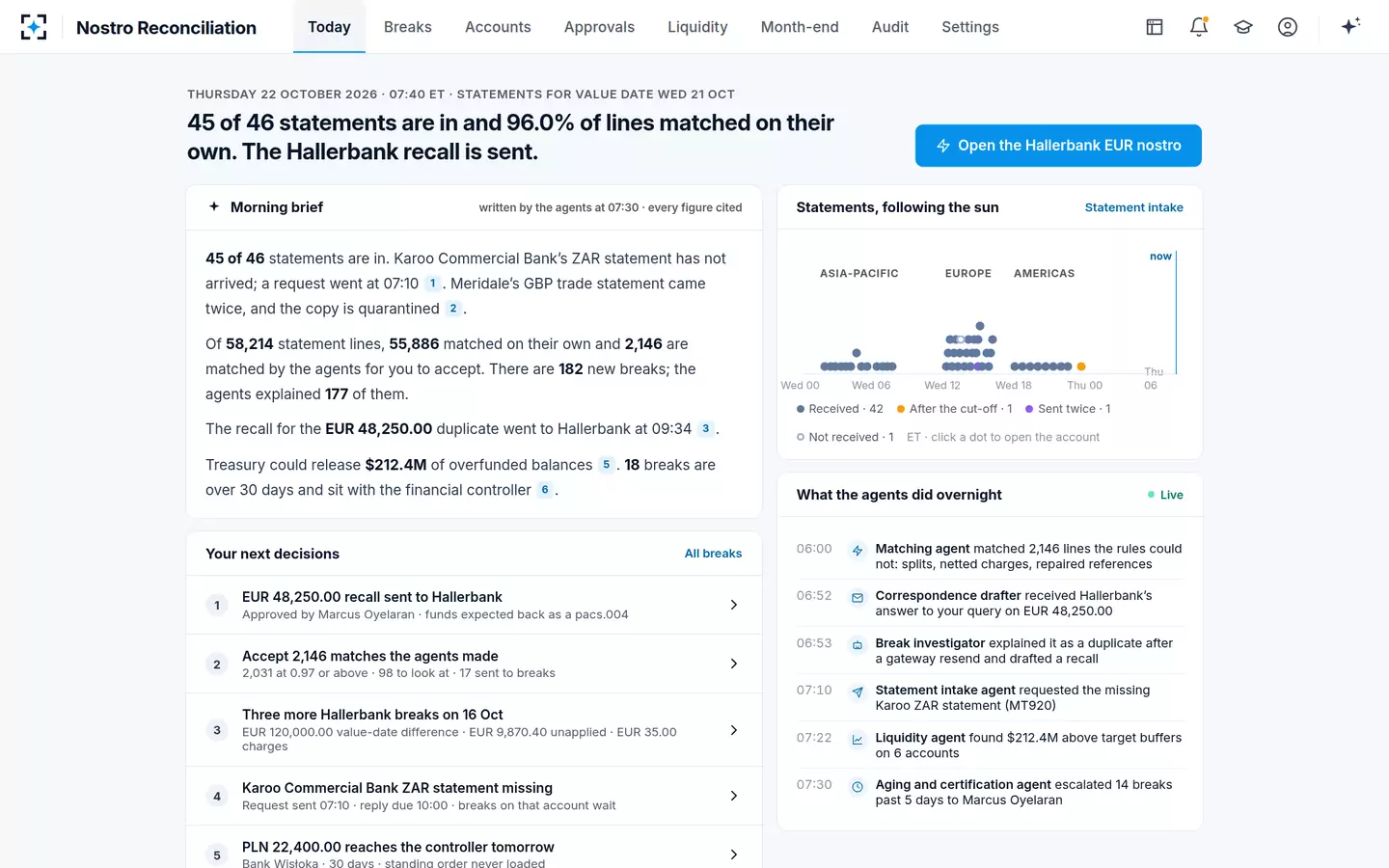
That is where same-day reconciliation is won or lost. A break explained before the analyst arrives can be decided in minutes, and one that waits for a search can wait days. The routes for each kind of break, and the evidence each one needs, are in reconciliation exception management.
Statement intake: the first step of the process, proved before matching
Who should own the same-day number?
The head of payments operations, with treasury and the correspondent relationship managers as contributors, because the number depends on what correspondents send as much as on what the reconciliation team does. A bank that reports it by correspondent will find that the worst performers are not its busiest accounts but its slowest statements, and that the fix is often a conversation with the correspondent about intraday reporting rather than more staff.
Questions people ask
What are the steps of nostro reconciliation?
Receive and prove each statement, match lines by rule, match the harder lines, explain every break from its evidence, draft the correction or message, have a person accept and a second person approve, and certify the month. The OCC's examination procedure covers the same ground from the examiner's side, ending with proof that the two balances agree.
What time do nostro statements arrive?
As each correspondent's business day closes, so the time depends on its time zone and cut-off. In the fictional sample bank, statements for a Wednesday value date arrived across Wednesday in Eastern Time, from about 02:00 for Japanese correspondents to late evening for the Americas, and one that arrived at 23:42, after the 23:00 run, waited for the 06:00 run.
What is a cut-off statement?
In the OCC's procedures it is the correspondent's statement as of the examination's cut-off date, which examiners copy before handing to bank staff so it cannot be altered. In daily operations the same idea applies to the statement closing each value date.
What happens when a statement is missing?
The accounts it covers cannot be proved, so matching on them should wait and the statement should be requested. In the sample bank, a ZAR statement due by 13:30 the previous day had not arrived by 07:10, a request went out, and breaks on that account waited for the reply.
Is the G20 same-day reconciliation target a regulation?
No. It is a target of the G20's cross-border payments roadmap, monitored by the FSB, whose decisions the FSB says are not binding. It is still the benchmark correspondents and supervisors are converging on, with an end-2027 date.