A reconciliation analyst's roles and responsibilities on a nostro desk come down to four duties: prove each correspondent bank's statement against the bank's own mirror account in the general ledger, explain every line that does not agree, prepare the correction, query or recall, and hand it to someone else to approve. The job is hard because the reason for a break is rarely on the statement; it sits in the payments hub, the message archive, the SWIFT gateway log or a correspondent's inbox, and the analyst has to find it before the break ages. Botminds' Nostro Reconciliation exists for that part of the work: it keeps the bank's matching engine, puts agents on the lines the engine leaves behind, and gives the analyst each break already explained, with the evidence cited, to accept or reject.
The responsibilities are not invented by job boards. They are written, almost line by line, into the questions the Office of the Comptroller of the Currency tells its examiners to ask about a bank's due-from accounts, of which nostro accounts are the foreign-currency kind (OCC, Comptroller's Handbook, Due from Banks). Read those questions and the analyst's job description follows. Read the hours, and it becomes clear where the job actually goes.
Two thirds of an analyst's minutes on a break go to finding out why it broke
By hand: about 26 minutes a break
- Finding the statement line and its entries · 12%
- Searching the payments hub and message archive · 31%
- Reading the gateway log, tracker and replies · 23%
- Drafting the query or recall · 19%
- Preparing the posting for a second signature · 15%
Checking the agents’ cited explanation: about 4 minutes
- Finding the line · 13%
- Searching · 12%
- Reading the cited sources · 25%
- Checking the draft · 25%
- Sending for approval · 25%
What does a reconciliation analyst do on a nostro desk?
A nostro reconciliation analyst owns a set of accounts the bank holds with correspondent banks abroad and proves, value date by value date, that the correspondent's statement and the bank's mirror account agree. Where they do not, the analyst finds out why, decides what the evidence shows, and prepares the action: a posting, a query to the correspondent, a claim, a recall or, for an old item, a proposed write-off. The analyst does not approve that action; a team lead or controller does.
The volume is set by the currency business, not by the reconciliation team. The OCC's handbook notes that all foreign currency transactions other than over-the-counter cash trades settle through nostro accounts, so a bank's foreign exchange, trade payments and customer wires all land on the same handful of statements. Most lines match by rule overnight. The analyst's day is the remainder: in a fictional sample bank used throughout this guide, 182 new breaks arrived on one Thursday morning out of 58,214 statement lines.
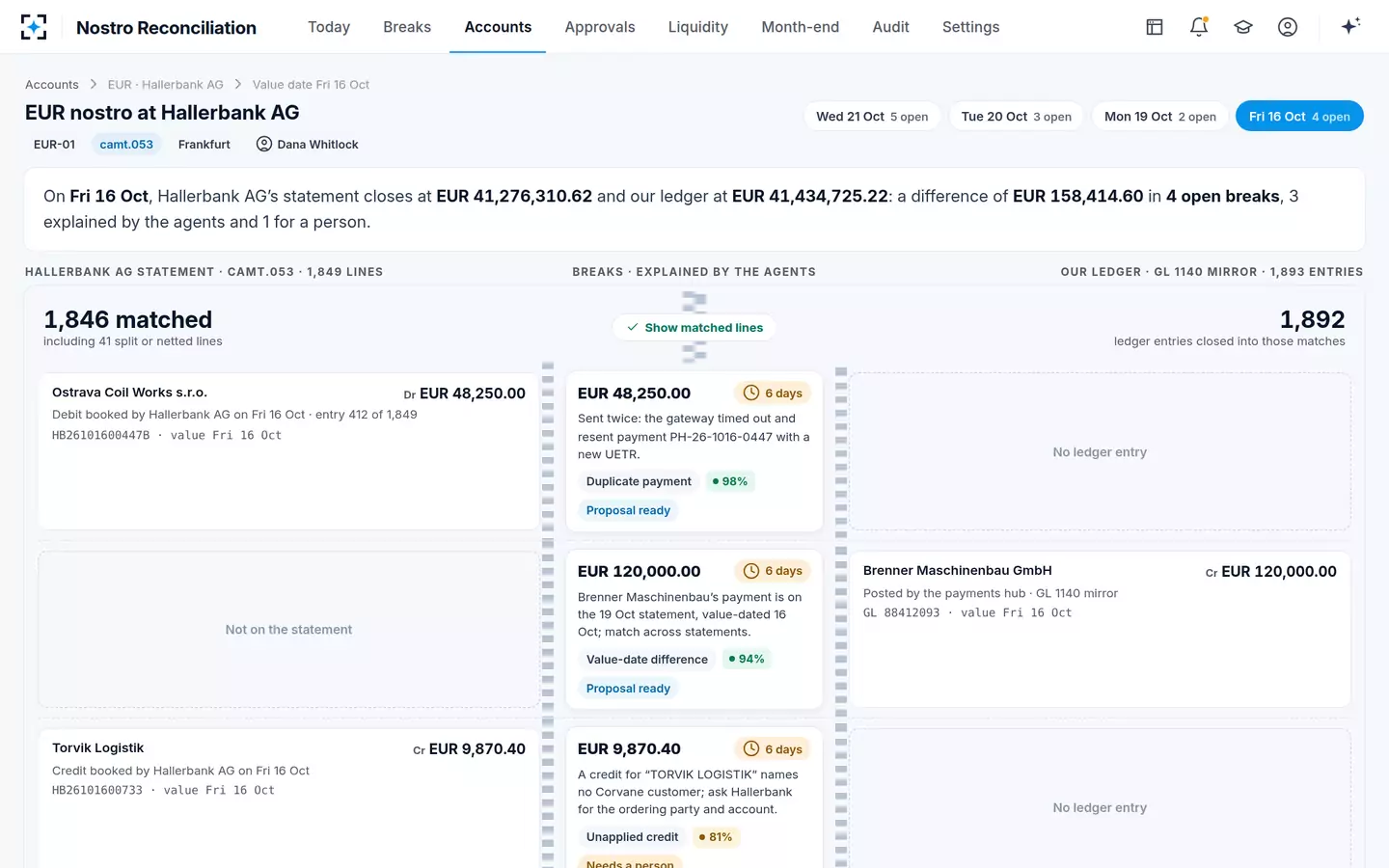
Take that sample bank's morning as it runs through Botminds' Nostro Reconciliation. Corvane National Bank (fictional, like every name and figure from it here) holds 46 nostro accounts in 19 currencies and 12 vostro accounts for other banks, and splits them across four analysts by region. Dana Whitlock holds the Europe desk, 18 accounts. Her morning starts with the breaks on those 18 accounts, oldest first, each already carrying a one-line cause and a confidence score from the agents.
The analyst's main screen in Nostro Reconciliation: one account, one value date, only the breaks
The responsibilities the examiner writes into the job
The clearest job description for a reconciliation analyst is the OCC's internal control questionnaire for due-from accounts. It asks whether reconcilements are prepared promptly, whether the people preparing them examine the statements for any sign of alteration, whether every reconciling item is clearly described and dated, and whether "the person performing reconcilements" signs and dates them (OCC, Due from Banks). Each question is a duty an analyst owns.
Two of the questions describe the hardest part of the job. One asks whether delays in clearing deposits in transit, outstanding drafts and other reconciling items are investigated, the same question the Federal Reserve's manual asks and reconciling items tolerance quotes. The other asks whether, once an item clears, there is a written account "regarding the follow-up and reason for any delay". That is the investigation: not just clearing the break, but leaving behind why it happened. The handbook also asks whether the details of each reconcilement are "reviewed and approved by an officer or supervisory employee", which is why the analyst prepares and someone else signs.
A nostro reconciliation analyst's job description, written from the examiner's questions
- Reconcile every account promptly
The OCC asks for reconcilements at least monthly; a busy nostro is reconciled every business day, value date by value date.
- Check the statement itself
Look for any sign of alteration, and confirm each statement opens where the last one closed.
- Describe and date every open item
Each break carries its amount, value date, side and a plain description, so the next person can act on it.
- Investigate every delay
An item that does not clear in its normal time is investigated, not just carried forward.
- Keep the reason after it clears
The follow-up and the reason for the delay stay with the item once it is closed.
- Route corrections to their owner
Adjusting entries go to the department that originated the entry, and the reconciler reviews the result.
- Sign and date the work, then hand it on
An officer or supervisor reviews and approves; the preparer does not approve their own reconcilement.
- Stay out of the money and the dealing
Reconcilers do not issue drafts alone or handle cash, and those reconciling foreign accounts stay out of foreign exchange dealing.
Five seats around one break, and what each may not do
A nostro break passes through five seats before it is closed, and the separations between them are the control. The analyst prepares. A team lead approves postings, recalls and claims. A treasury liquidity manager uses the reconciled balances to decide funding. A financial controller approves the larger write-offs and certifies month-end. Internal audit reads everything and changes nothing. The rules that keep those seats apart are covered in bank reconciliation segregation of duties; here the point is what each seat does all day.
The seats on a nostro desk, before and with Nostro Reconciliation
Today
The engine says what did not match; the day goes on the payments hub, the message archive and the inbox, finding out why.
With agents
Opens each account and value date with the breaks already explained and cited, and accepts, edits or rejects each with a reason.
Still theirs: Every judgement on what a break is, and the preparer’s signature
Today
Signs dozens of items a day from emails and screenshots, and owns every break past the bank’s escalation line.
With agents
Sees the entries, the cited evidence and both signatures on one screen, and approves or rejects with a reason.
Still theirs: Approval of postings, recalls and claims
Today
Sees balances, not the breaks inside them, and can fund an account that is only short on paper.
With agents
Sees which balances sit above their target buffer, with the forecast cited, and proposes releases for a second person.
Still theirs: Every funding and release decision
Today
Certifies month-end from a pack assembled in the last days of the month.
With agents
Certifies from a pack kept current as the work is done: account proofs, aged breaks with reasons, every posting with two signatures.
Still theirs: Larger write-offs and the month-end certification
Today
Rebuilds who decided what, and on which evidence, from emails and spreadsheets.
With agents
Reads every person’s and agent’s action with its version and evidence, and can change nothing.
Still theirs: Independence from the work tested
Where the analyst's hours actually go
Most of an analyst's time on a break goes to the hunt, not the decision. In Botminds' own estimate of a typical break worked by hand, about 26 minutes in all, finding the line and its candidate entries takes 3 minutes, searching the payments hub and message archive 8, reading the gateway log, the payment tracker and the correspondent's replies 6, drafting the query or recall 5, and preparing the posting for approval 4. That is 17 of 26 minutes spent learning what happened before any judgement is made. The estimate excludes the longest wait of all, the days a correspondent can take to answer.
The arithmetic scales badly. At 20 to 30 minutes a break, the sample bank's 180 or so new breaks a day would need 60 to 90 analyst hours, which is more than four people have. That is why breaks age: the oldest are the ones nobody had time to start. It is also why the aging clocks matter so much to the role, which aged items in reconciliation sets out clock by clock.
Checking a cited explanation is a different task from producing one. When the cause arrives with the statement line, the general ledger search, the payment's two messages and the gateway log already attached, the analyst's work becomes reading the sources the agents relied on and deciding whether they prove the point. Botminds estimates that at about 4 minutes a break, and it is the part of the job that was always the analyst's to do.
The analyst was never paid to search four systems. The analyst is paid to decide what the evidence shows and to put a name to it.
How many accounts does one reconciliation analyst handle?
There is no regulatory or published industry ratio of nostro accounts to analysts, and any figure quoted without a source should be treated as one bank's experience. The load depends on lines, not accounts: one busy euro or dollar nostro can carry thousands of lines a day, while a small currency account may carry a handful. In the fictional sample bank, four analysts share 46 nostros and 12 vostros, and the Europe desk alone holds 18 accounts, one of which carried 1,849 statement lines for a single value date.
Four things decide how many accounts one person can hold: the number of lines the engine leaves unmatched, the share of correspondents still sending MT statements rather than ISO 20022 camt.053, the time zones the statements arrive from, and how many breaks are waiting on a correspondent rather than on the bank. A desk that measures its own breaks per analyst per day, and their age, has the only ratio that matters for staffing.
What sets an analyst's load, and how to measure it on your own desk
| Driver | Why it moves the load | What to count |
|---|---|---|
| Unmatched lines | Every line the engine leaves is a break someone must explain | New breaks per analyst per day |
| Statement format | MT statements can carry less of the payment’s data than camt.053, so more lines may need a search | Accounts on MT950 or MT940 against camt.053 |
| Time zones | Statements from Asia-Pacific arrive hours before Europe’s and the Americas’ | Statements arriving after the matching run |
| Waiting on correspondents | A query can sit for days, and the break ages while it waits | Breaks waiting on a reply, by correspondent |
| Approvals | Items prepared but not yet signed still count as open | Items waiting for the second signature |
What skills does a reconciliation analyst need?
A nostro analyst needs three kinds of skill: reading payment messages, knowing the clocks, and writing to other banks. On the message side, that means following one payment from its instruction (an MT103 or an ISO 20022 pacs.008) through the gateway to the line on the correspondent's statement, and recognising when a reference has been cut short or a charge netted from the amount. The BIS notes that ISO 20022's structured data helps resolve straight-through processing and truncation issues, and that MT-to-ISO 20022 converters have drawbacks as a permanent solution (CPMI Brief No 11, April 2026), which is exactly where truncated references come from during a migration.
On the clocks, an analyst should know that under Article 4A of the Uniform Commercial Code, where it governs a funds transfer and the order went out under a security procedure for detecting errors, a sender who learns that a duplicate was accepted must tell its bank within a reasonable time, and no later than 90 days after the bank's notice (UCC § 4A-205(b)). On writing, the analyst drafts queries in the correspondent's own standard: a free-format MT n99, which the BIS glossary lists as the MT199/299 "Swift free format message types", or the ISO 20022 cancellation and investigation messages. Judgement on write-offs, foreign exchange revaluation and when to escalate comes with experience, and is the part that cannot be handed to anyone else.
Reconciliation analyst pay, and the job titles behind it
No federal occupation code isolates the reconciliation analyst, so pay statistics have to use the nearest proxy. The Bureau of Labor Statistics' code for bookkeeping, accounting and auditing clerks, which covers clerical reconciliation work across all industries, counted 1,373,680 jobs in May 2025, with a mean annual wage of $53,560 and a median of $50,670 (BLS, OEWS 43-3031). Senior reconciliation roles that carry accounting judgement sit closer to accountants and auditors: 1,449,500 jobs and a mean of $94,750 (BLS, OEWS 13-2011).
No occupation code isolates the nostro analyst: the nearest proxies
1.37M
bookkeeping, accounting and auditing clerks employed, May 2025
All industries; a proxy, not nostro staff
$53,560
their mean annual wage; median $50,670
BLS OEWS 43-3031
$94,750
mean annual wage of accountants and auditors
BLS OEWS 13-2011; senior reconciliation roles
Titles vary more than the work: nostro reconciliation analyst, cash reconciliation analyst, payments operations analyst and correspondent banking operations officer can describe the same seat. What separates the roles is the signature each carries, not the title. An analyst who prepares, a lead who approves and a controller who certifies are three jobs even if the payroll system calls two of them analysts.
Is reconciliation being automated, and what is left for the analyst?
Matching has been automated for years; explaining breaks is what is changing now. In the sample bank's morning, the rules engine matched 55,886 of 58,214 lines on its own, 96.0%. Botminds' agents then matched 2,146 harder lines, splits, netted charges and repaired references, for the analysts to accept in bulk, and explained 177 of the 182 new breaks before anyone arrived. What they did not do is decide: every explanation waits for an analyst to accept, edit or reject it with a reason, and every posting, recall or claim waits for a second person.
The agents also have limits written into them. The matching agent never matches across accounts or currencies and, below a confidence of 0.97, waits for a person. The break investigator never posts and never contacts a customer, and below 0.90 it hands the break to a person with a list of what is missing. Those thresholds are the bank's to set and to test, the way a nostro reconciliation example shows on one duplicate payment.
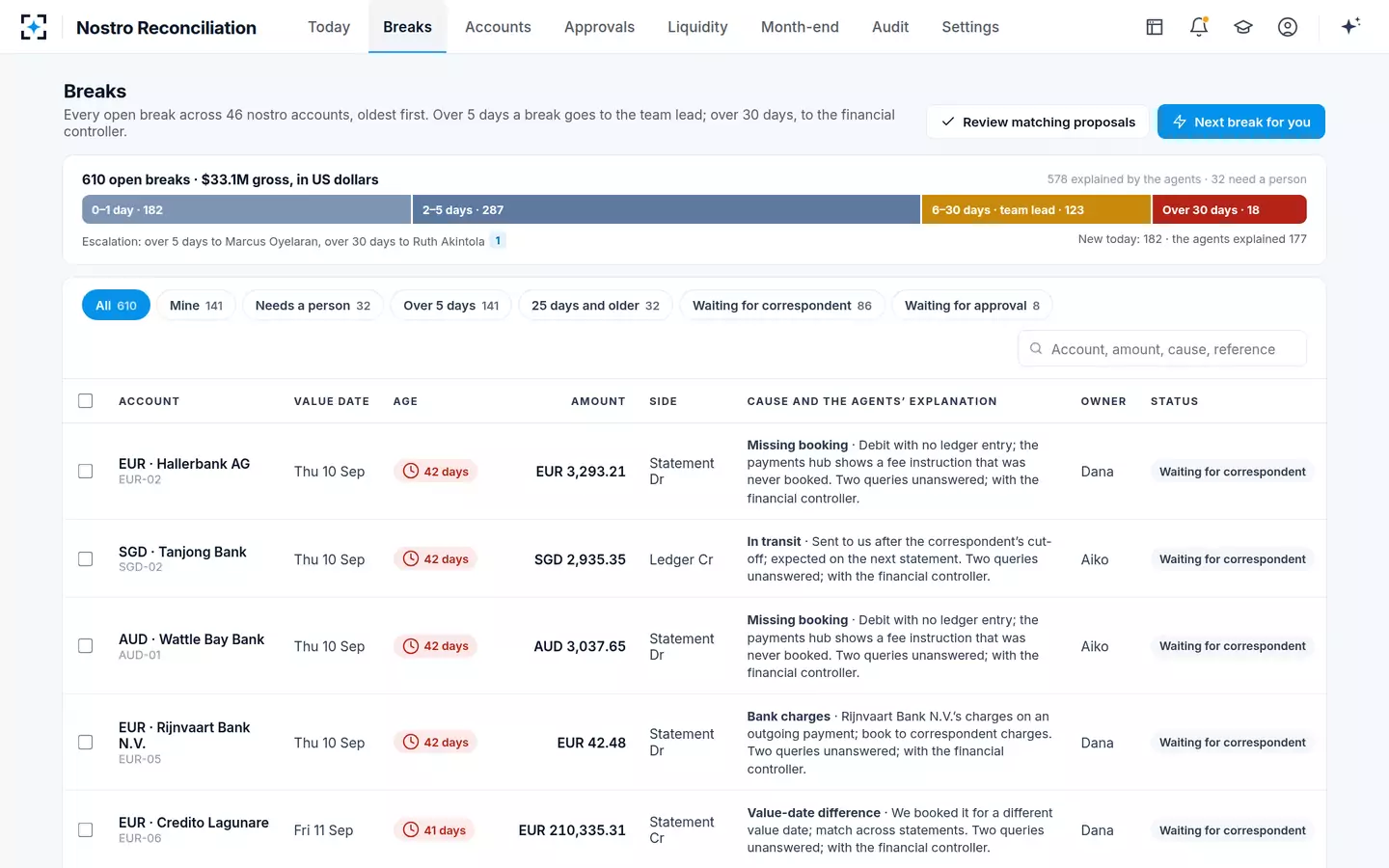
Every open nostro break, oldest first, in Nostro Reconciliation
What the analyst signs at month-end
The daily work rolls up into a monthly attestation, and that signature is the analyst's most consequential one. Each desk attests that its accounts are proved and that every open item is described, dated and owned; the team lead reviews; the controller certifies the nostro balances for the books. The OCC's handbook frames the same chain from the examiner's side: closing balances on the reconcilements must agree with the general ledger and with the cut-off statement, and the examiner in charge can have bank staff perform the reconcilements under an examiner's supervision, then test the ones sampled for correctness.
In the sample bank, the September pack was certified by the controller on 5 October with 46 account proofs, 22 breaks over 30 days each explained, and 198 adjustments. For October, three of the four desks had signed their weekly attestation by Friday 16 October, and the Europe desk's was due the following Friday. The pack builds as the work is done rather than in the last days of the month, so what the analyst attests to on the last day is what the controller already sees.
Foreign exchange adds a responsibility that domestic reconciliation lacks. A nostro is kept in two currencies at once, the foreign balance and its dollar equivalent, and the OCC expects each foreign currency account to be revalued monthly, with the revaluation reviewed by an officer who did not prepare it. An analyst who books the revaluation difference is preparing, not approving, and a break that is really an exchange-rate difference belongs in that review, not in a write-off.
Who approves a reconciliation?
Someone other than the person who prepared it: the OCC's questions expect reconcilement details to be reviewed and approved by an officer or supervisory employee, and the analyst's signature as preparer is a separate question. In practice the approver depends on what the reconciliation produces. A clean proof needs review; a posting, recall or counterparty claim needs a team lead's approval; a write-off above the bank's threshold also needs the controller; and the month-end certification belongs to the controller alone. In the sample bank, the analyst's approval screen shows the item but not the approve button: "You prepared this, so you cannot approve it."
Questions people ask
What is the difference between a nostro and a vostro reconciliation analyst?
A nostro analyst reconciles the accounts the bank holds with other banks, using their statements; a vostro analyst reconciles the accounts other banks hold with it, against the statements the bank itself sends. The skills are the same, and many desks combine them: the sample bank's Africa and India desk also carries its 12 vostro accounts.
Is a reconciliation analyst an accountant?
Usually not by title or qualification, but the work is accounting control. Public pay data group most reconciliation roles with bookkeeping, accounting and auditing clerks, mean wage $53,560 in May 2025, while senior roles with write-off and certification judgement sit nearer accountants and auditors, mean $94,750.
Do reconciliation analysts need to know SWIFT messages?
Yes, at reading level. A break is explained from the payment's messages (MT103 or pacs.008, the statement line, any return or cancellation message), so an analyst who cannot read them depends on someone else for every investigation. Writing them is less common; queries are usually drafted in a free-format MT n99 or the ISO 20022 equivalent and approved before sending.
How long should a break stay with the analyst?
That is the bank's policy, not a rule: the sample bank escalates to the team lead after 5 days and the controller after 30. The external lines are longer, starting with the OCC's examiners, who look at large, unusual or old outstanding items, past two months, and ask whether they should be charged off.
Can an analyst approve their own write-off if it is small?
Not under a sound control. Bank policies often let a team lead approve small write-offs and require the controller above a threshold, but the preparer is never the approver at any amount. In the sample bank, write-offs over $10,000 need the controller as well as the team lead.
What does a reconciliation team lead do differently?
The lead approves what analysts prepare, owns breaks past the first escalation line and answers for the desk's aging. With cited evidence on one screen, the lead's review becomes reading the sources rather than re-doing the search, which is why approval in the sample bank took three minutes from the analyst's acceptance.