Reconciliation exception management is the process, and the tooling, for working every item a reconciliation cannot match: deciding what kind of break it is, proving why it happened, taking the right action with the right counterparty, getting that action approved, and clearing the item before its clocks run out. On a nostro account, where the bank's books are compared with a correspondent bank's statement, exceptions are not one queue. A duplicate payment, a correspondent's fee, a credit that names no customer and a payment that arrived on the wrong day each need different evidence, a different message and a different signer. Botminds' Nostro Reconciliation is built around that difference: its agents classify and explain each break from the payment's own messages and draft the action, and people accept and approve it.
Every nostro break sits on one of four sides, named in the OCC's examination procedure for due-from accounts (OCC, Comptroller's Handbook, Due from Banks). The side tells you where the evidence is likely to be and who has to move first.
The four sides of a nostro break, and what usually causes each
Money left the account at the correspondent; the bank’s books do not show it.
Usually: Duplicate payments after a resend, correspondent charges, fee or standing-order instructions never booked.
In the sample: EUR 48,250.00 duplicate; EUR 35.00 charges
Money arrived at the correspondent; the bank has not booked it.
Usually: Unapplied credits naming no customer, returns of payments the bank thought had gone, interest paid by the correspondent.
In the sample: EUR 9,870.40 credit naming no customer
The bank booked money coming in; the statement does not show it yet.
Usually: Value-date differences, items in transit after a cut-off, inflows sent to another of the bank’s nostros.
In the sample: EUR 120,000.00 on the next statement
The bank booked money going out; the statement does not show it.
Usually: Payments rejected or never accepted, returns still booked as paid, entries on the wrong account or date.
In the sample: None on the Hallerbank account that day
What is reconciliation exception management?
It is everything that happens to a reconciling item between "did not match" and "closed". A matching engine produces exceptions; exception management decides what each one is and who must do what about it. The OCC's questions describe the minimum: whenever an item is delayed in clearing, the delay is investigated; every reconciling item is clearly described and dated; follow-up and adjusting entries go back to the department that originated the entry; and the reason for non-clearance is determined and documented for items the correspondent booked that do not clear in a reasonable time.
The stakes are wider than the reconciliation team. BIS staff, describing today's correspondent banking chains, write that "failures to complete cross-border payments are frequent and expensive, impacting not only direct costs of unwound transactions but also the costs of uncompleted business" (BIS Bulletin No 87, 2024). A nostro break is often the first place such a failure becomes visible to the bank that sent or expected the money.
What are the types of breaks in nostro reconciliation?
By side, there are four, as above. By cause, a small set covers most of what a nostro desk sees: duplicate payments after a gateway resend, correspondent charges not booked, value-date differences, payments rejected or returned but still booked, credits that name no customer, missing bookings for instructions that never reached the books, and foreign exchange differences on converted amounts. Rarer but more serious are debits nobody instructed. Each cause has a test that confirms it, and the test is what separates an explanation from a guess.
The fictional sample bank used in this guide shows how the causes spread across the age bands. Its oldest open breaks on one Thursday, 41 and 42 days old, were missing bookings for fee instructions the payments hub held but nobody booked, an item in transit after a correspondent's cut-off, a correspondent's charges, and a value-date difference, each with two queries unanswered. The youngest included the duplicate, charges, value-date and unapplied-credit breaks on one euro account below.
What causes a nostro break?
Most nostro breaks come from three places: the bank's own systems (a resend, a booking that never happened, a posting to the wrong account), the correspondent (charges, a different value date, a cut-off), and the payment chain between them (a reference cut short in a format conversion, a return, a beneficiary bank that cannot apply the money). The CPMI's harmonised ISO 20022 requirements target several of these directly, including a unique end-to-end transaction reference (UETR) on every cross-border payment and remittance information carried unaltered from end to end (CPMI, February 2026). Better data removes some breaks; it does not remove the need to decide the rest.
A route for every nostro break
A route is the fixed sequence for one kind of break: the test, the evidence, the message, the clock and the signer. Writing routes down is what turns a queue into a process, because it tells the analyst what "explained" means for each cause and tells the approver what to look for. The table sets out the routes the sample bank uses.
Routes for the common nostro breaks: test, evidence, message, clock and signer
| Break | How you know | Evidence to cite | To the correspondent | Clock and signer |
|---|---|---|---|---|
| Duplicate payment | Two debits, one booking; two UETRs with one end-to-end id | Both messages, gateway log, customer debited once | Recall: camt.056 or MT 192, reason DUPL | Act at once; team lead approves recall and posting together |
| Correspondent charges | A debit with no instruction behind it, at a fee amount | The statement line; the charge terms | A query only if unexpected; a claim if refused | Booked or written off; team lead, controller above $10,000 |
| Value-date difference | The same payment on another statement with an earlier value | Both statements | Claim for back-value interest if it cost the bank | Match across statements; team lead for claims |
| Missing booking | A statement line matching an instruction the payments hub holds but nobody booked | The hub’s instruction | None; the fix is internal | Posting by the owning department; reviewed by the reconciler |
| In transit after a cut-off | Sent after the correspondent’s cut-off | Send time against the cut-off | None, unless it misses the next statement | One statement; then a query |
| Credit naming no customer | A credit with no matching beneficiary | The statement narrative | Query for the ordering party and account | Never to income; team lead decides where it goes |
| Returned payment still booked | A pacs.004 payment return, original still booked as paid | The return message | None | Reversal; foreign exchange loss routed to the controller above limits |
| Debit nobody instructed | No instruction in the hub, no message in the gateway log | The absence, documented, and the full message trail | Urgent query or recall | Escalate the same day; restricted handling if referred to the BSA team |
How do you resolve a duplicate payment?
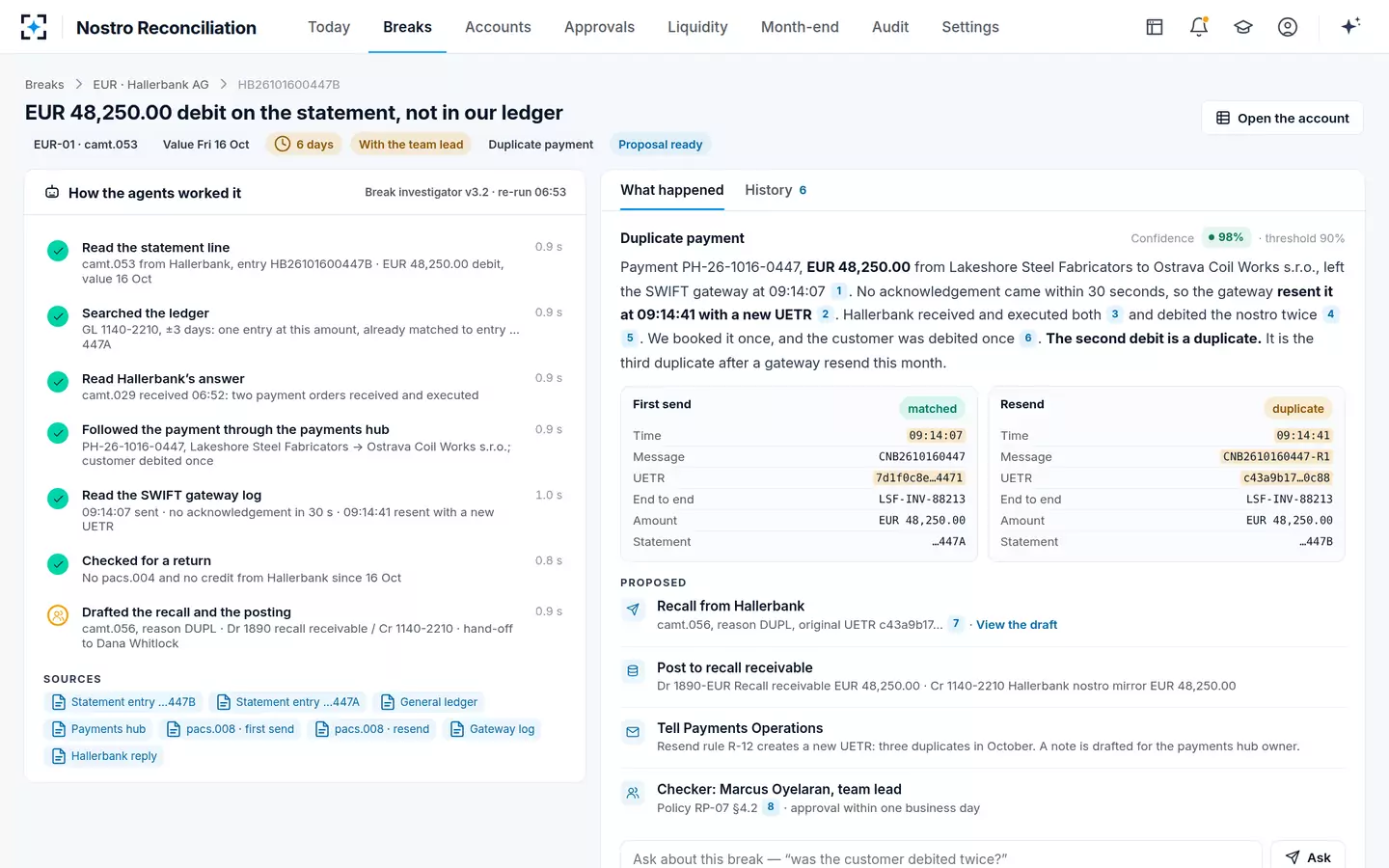
Prove it, recall it, book the receivable, and fix the cause. Take the sample bank's euro nostro at Hallerbank AG, Frankfurt: a EUR 48,250.00 debit on the 16 October statement with no booking behind it. The break investigator found two pacs.008 messages 34 seconds apart with different UETRs and the same end-to-end id, a gateway log showing a timeout and a resend, the customer debited once, and the correspondent's confirmation that it executed both. The correspondence drafter wrote a camt.056 cancellation request with reason DUPL; the correction proposer drafted the posting to a recall receivable; the analyst accepted and the team lead approved, and only then did either go out.
A camt.056 recall drafted in Nostro Reconciliation, every field traced to a cited message
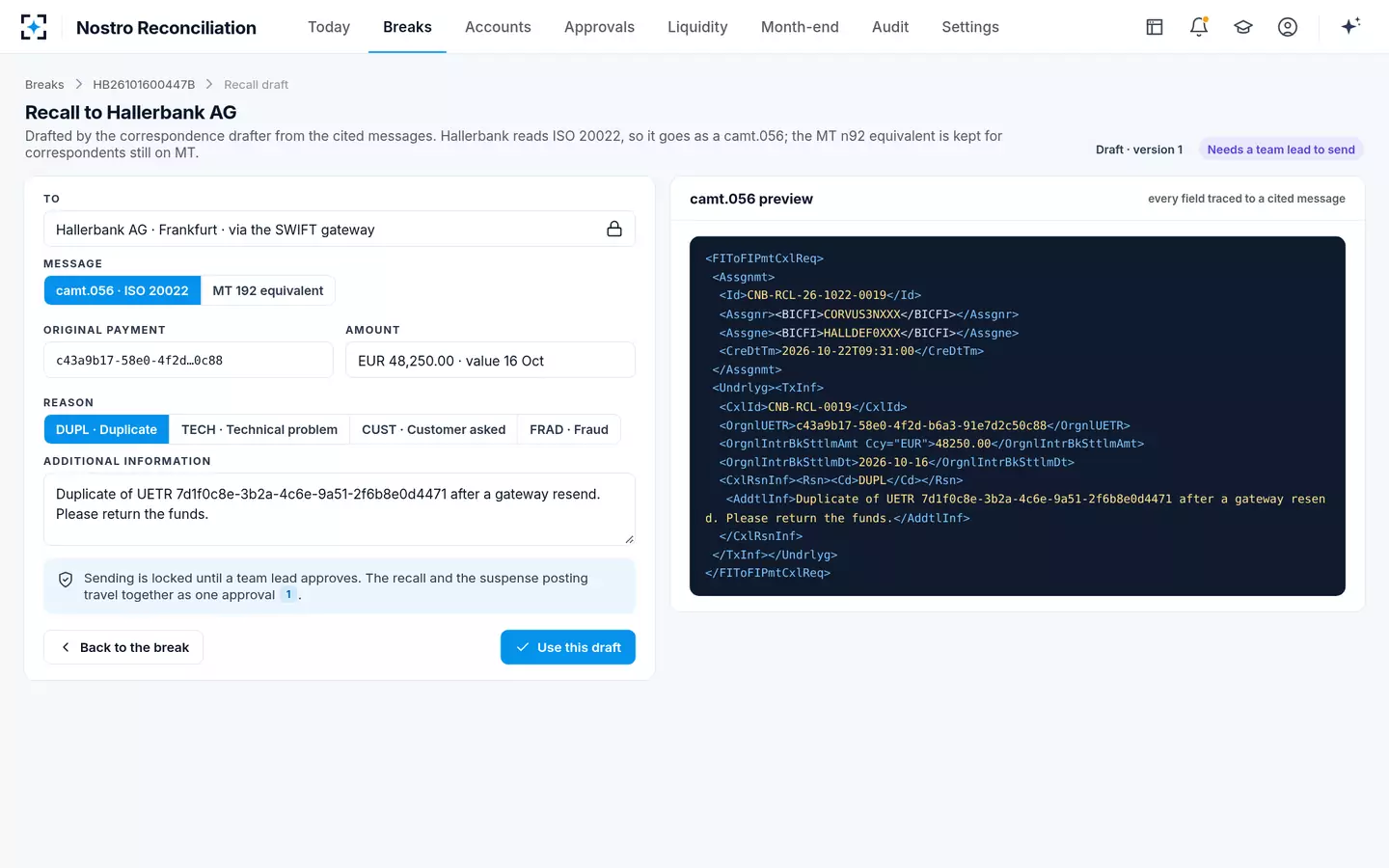
The last step is the one most often skipped. The investigator noticed this was the third duplicate after a gateway resend that month and drafted a note to the payments team: the gateway's resend rule assigns a new UETR, so the correspondent sees a new payment. Recalling each duplicate treats the symptom; the cause is in the resend rule. Exception management that never feeds causes back to their owners will work the same break every month.
Can a payment be recalled after acceptance?
It can be asked for, and the receiving bank decides. Under Article 4A of the Uniform Commercial Code, a cancellation after acceptance takes effect only with the receiving bank's agreement or under a funds-transfer system rule, and at the beneficiary's bank only for listed mistakes, a duplicate among them (UCC § 4A-211(c)). Where the receiving bank does agree, the sender is liable for its losses and expenses from the cancellation, which is why the sample bank treats a recall as an approval, not a message.
Whether Article 4A governs at all depends on place. Between the sender and the receiving bank, Article 4A applies "the law of the jurisdiction in which the receiving bank is located", unless the parties agree otherwise or a funds-transfer system rule chooses a law (UCC § 4A-507(a)(1)). For a recall to a correspondent in Frankfurt, that points away from the UCC, so the bank's agreement with the correspondent and the network's rules matter more than any one statute. The investigation that follows a refused or unanswered recall belongs to the payment investigation process.
A recall is a request. The correspondent decides, the network's rules may decide, and the law that applies is usually the correspondent's, not yours.
How a camt.056 recall ends on a nostro break
A camt.056 is the ISO 20022 Payment Cancellation Request, the message a bank sends to ask the next bank in the chain to cancel a payment (the wire recall guide to camt.056 takes it field by field). In the CPMI's core message set for cross-border payments it sits with camt.029, the Payment Cancellation Response, and pacs.004, the Payment Return (CPMI, February 2026). A recall that succeeds therefore usually ends as a pacs.004 crediting the money back, and the sample bank's morning summary shows exactly that state for its approved recall: funds expected back as a pacs.004. The MT equivalent for a customer payment is the MT 192, which correspondents still on MT read instead.
How long a nostro debit stays open to challenge
Under Article 4A, where it governs, the clock that matters is 90 days for interest and one year for the right to object. A receiving bank must refund an unauthorized payment order it cannot enforce, with interest, but the customer loses the interest if it fails to report within a reasonable time not exceeding 90 days after being told of the order or debit (UCC § 4A-204(a)). After a year from notification, a customer is precluded from objecting to a debit for an accepted order (UCC § 4A-505). A funds transfer any part of which is governed by the Electronic Fund Transfer Act falls outside Article 4A, with an exception for certain remittance transfers (UCC § 4A-108).
For the bank's own nostro, an unexplained debit is an emergency, not an aging item. The evidence that matters is the full trail of instructions and messages, because a fraudulent payment can arrive properly authenticated. The Justice Department's account of the 2016 Bangladesh Bank theft describes attackers who "sent fraudulently authenticated SWIFT messages directing the Federal Reserve Bank of NY to transfer funds" (US Department of Justice, 2018). That is not a case reconciliation would have prevented; it is a reminder that a message being genuine in form says nothing about whether anyone at the bank intended it.
Unapplied credits: when money arrives with no name
A credit that names no customer is someone's money, and the route for it is a question, not a posting. On the sample bank's euro account, Hallerbank credited EUR 9,870.40 for "TORVIK LOGISTIK", a name that matched no customer. The agents could explain only so far, 81% confidence, and the break was marked as needing a person; the route is a query to the correspondent for the ordering party and the account it was meant for. It is not income, and it should not be quietly matched to the nearest plausible customer.
A break the agents could not finish: Nostro Reconciliation hands it to a person
Where the open breaks were waiting
A queue sorted only by age hides why items are old. The sample bank's breaks screen filters the same 610 open breaks by who they are waiting for, and the answer explains most of its aging: many more breaks wait on correspondents than on its own staff.
What 610 open nostro breaks were waiting for, on one morning
What should an exception management tool do?
Route, not just list. The useful test for any product, including Nostro Reconciliation, is whether a break arrives at the right person with its cause proved, its message drafted and its clock visible, and whether the person who prepared the action is blocked from approving it. Ask to see each item below on your own breaks. The buying decision around it, and how it fits a matching engine you already own, is covered in nostro reconciliation software.
Eight things a nostro exception management tool should do
- Classify by side and cause
One of the four sides, and a cause with the test that confirms it.
- Cite the evidence
Statement lines, bookings, messages, gateway log and replies, each opening to the passage used.
- Say when it is not sure
Below its threshold, hand the break to a person with what is missing.
- Draft in the correspondent’s standard
camt.056 or MT 192 for a recall; the free-format query the correspondent reads.
- Track the counterparty
A due date on every query, a reminder when it passes, escalation on a second miss.
- Run the bank’s clocks
Escalate by age to the owners the policy names; show the legal clocks that apply.
- Separate preparer and approver
At every amount, with the controller added above the bank’s limits.
- Keep sensitive breaks out of correspondence
A break referred to the BSA team never appears in messages or in customer views.
Questions people ask
What is the difference between a break and an exception?
In nostro reconciliation the words are used almost interchangeably: a break is a line that did not match, and an exception is the case opened to resolve it. Some banks reserve "exception" for breaks that have passed their first escalation line, which is a useful distinction if the policy writes it down.
Should exceptions be closed by write-off?
Only after the route has been followed and the approver agrees that recovery is unlikely or not worth the cost. A write-off closes the item in the books, not the money's trail, and the sample bank requires a team lead's approval for any write-off and the controller's as well above $10,000.
What is a pacs.004?
The ISO 20022 Payment Return, listed in the CPMI's core message set. It is how money comes back after a successful recall or a rejected payment, and a return that arrives while the original is still booked as paid is itself a common break.
How do you stop duplicate payments after a gateway resend?
Fix the resend rule, so a retry reuses the original UETR or checks for an acknowledgement before sending again, and monitor duplicates by cause. In the sample bank, three duplicates in one month traced to the same resend rule, which is a payments-operations fix, not a reconciliation one.
Can exceptions be cleared automatically?
Matches can, within tight rules; decisions should not. In the sample bank the matching agent accepts only at 0.97 confidence or above, never across accounts or currencies, and every explanation, posting, recall and write-off waits for people.