Aged items in reconciliation are reconciling items, breaks, that have stayed open beyond the time they would normally take to clear. On a nostro account, the foreign-currency account a bank keeps with a correspondent, age is not just a housekeeping number: an open debit can be a duplicate payment that is getting harder to recover, an open credit can be someone else's money, and each crosses lines set by law and by examiners as it ages. The work is hard because the oldest breaks are usually the ones that need a correspondent's answer, and nobody's day has room to chase them. Botminds' Nostro Reconciliation explains each break as it arrives, runs the bank's escalation clocks, and keeps every aged item's reason and owner ready for the month-end certification.
No single rule says how old a US nostro break may be. What exists is a set of clocks from different sources, each starting at a different moment, and together they explain why a break found on day two is a query and the same break found on day ninety-five can be a loss. The chart sets them side by side.
The clocks an open nostro break runs against, in calendar days
What are aged items in reconciliation?
An aged item is an open reconciling item that has outlived its normal clearing time. A charge booked by the correspondent today and by the bank tomorrow is a timing item and clears itself; the same charge still open after two weeks is aged, because something other than timing is holding it. The OCC's examination procedure draws exactly that line for the items a correspondent has booked and the bank has not: "The reason for nonclearance should be determined for all 'they debit' and 'they credit' items that do not clear in a reasonable amount of time" (OCC, Comptroller's Handbook, Due from Banks).
Age should be measured from the value date, not from the day someone noticed the break. A break discovered late is not young; it is old and undiscovered, and every legal clock below runs from an event in the payment's life rather than from the reconciliation team's calendar. The OCC's questionnaire asks whether the bank's foreign currency accounts clearly reflect "entry and value dates", which is what makes honest aging possible.
How old can an open reconciling item be?
There is no federal maximum for a US bank; there are thresholds at which the item changes character. Within the first week, an outgoing payment that was never accepted cancels itself by law. By two months, examiners expect the bank to have decided whether a large or unusual item should be charged off. By 90 days, a customer's rights over an erroneous or unauthorized payment begin to narrow, and by one year a customer who was told of a debit may be unable to object to it at all. In India the outer lines are written down: two years for debits, three for credits, set out in the RBI's nostro reconciliation guidelines.
Inside those lines, each bank writes its own. In the fictional sample bank used in this guide, a break goes to the team lead after five days and to the financial controller after thirty, and the design target is that no break over thirty days reaches month-end without a reason, an owner and an approver.
The first week: payments that cancel themselves
The shortest clock belongs to payments the bank sent that were never accepted. Under Article 4A of the Uniform Commercial Code, an unaccepted payment order is cancelled by operation of law at the close of the fifth funds-transfer business day of the receiving bank after its execution or payment date (UCC § 4A-211(d)). An outgoing item still open as we credit, they do not debit after a week is therefore either booked wrongly in the bank's own books or stuck somewhere it should not be, and either way it needs an investigation, not more waiting.
The same section explains why early recalls work and late ones often do not. Before the receiving bank accepts an order, a cancellation received in time to act on is effective; after acceptance, cancellation needs the receiving bank's agreement or a system rule, and at the beneficiary's bank only for listed mistakes such as a duplicate. A duplicate found on day one can often be stopped. Found on day thirty, it is a request to a bank that has long since paid the beneficiary.
What happens to unreconciled items after 90 days?
After 90 days, the parties' rights over erroneous and unauthorized payments start to close, which makes old breaks harder to recover. Where Article 4A governs and a security procedure for detecting errors was in place, a sender who is relieved of paying an erroneous order, a duplicate included, and is notified that it was accepted must report the error within a reasonable time, and no later than 90 days after the notice; if it fails, it is liable for the loss the bank proves it caused, up to the amount of the order (UCC § 4A-205(b)). For unauthorized orders, a customer who does not report within a reasonable time, at most 90 days after notice, still gets the refund but loses the interest on it (UCC § 4A-204(a)), and the parties may fix by agreement what counts as a reasonable time.
Two cautions apply. These rules run between a sender and its receiving bank, and Article 4A applies the law of the place where the receiving bank is located unless the parties or a system rule choose otherwise (UCC § 4A-507), so a break with a correspondent abroad may run on that country's clocks instead. And the clocks start at notification, which for a bank usually means the statement: a break that arrived on Monday's statement has been running since Monday, whatever day the team opened it.
A break found on day two is a query. The same break found on day ninety-five can be a loss, and the statement that would have shown it has been in the bank's hands the whole time.
What happens after two months: the examiner's line
Two months is where the OCC's examiners start looking at individual items. Their procedure tells them, for any significant due-from account, to review the latest reconcilements "for any outstanding items which are large, unusual, or outstanding for more than two months", read the related correspondence, and decide whether charge-off of outstanding items is appropriate. If the bank's own charge-off policy for old open items allows exceptions, examiners review the exceptions; if the bank has no policy, they charge items off in line with the OCC's guidance.
The test is not just age but explanation. For items the correspondent has booked and the bank has not, the procedure asks that the reason for non-clearance be found, its validity established and documented on the reconcilement form, and any material item that is not satisfactorily resolved brought to the attention of the examiner in charge. An aged break with a cited reason, an owner and a next step passes that test; an aged break with a blank cause column does not.
One year: the customer's last word
The longest UCC clock protects the bank. Where a receiving bank has been paid by its customer for an accepted order and the customer received notification reasonably identifying it, the customer is precluded from disputing the bank's right to keep the payment unless it objects within one year of receiving that notification (UCC § 4A-505). For a reconciliation team, it marks the point after which an unexplained customer debit is very hard to reverse, whoever made the mistake.
When must old reconciling items be written off?
In the United States, when the bank's charge-off policy says so, and the examiners will test the policy and its exceptions. There is no federal day count for nostro items comparable to India's. In India, the Reserve Bank's 2025 Directions require 100 per cent provision for unreconciled nostro debits outstanding for more than two years, and the transfer of unreconciled credits outstanding for more than three years to a Blocked Account shown as outstanding liabilities (RBI, Commercial Banks – Financial Statements Directions, 2025).
A write-off closes a break in the books, not in the world. The money behind an old debit may still be recoverable from a correspondent, and a write-off approved without the evidence behind it is the kind of entry segregation of duties exists to catch. In the sample bank, every write-off is prepared by an analyst, approved by a team lead, and also approved by the financial controller above $10,000; in October to date the bank had six write-offs totalling $23,914.
Should aged credits be taken to income?
No, not as a matter of course. An unexplained credit on a nostro is money the correspondent says belongs to the bank or its customer; until someone knows whose it is, it is a liability, not a gain. The RBI makes this explicit for Indian banks: old unreconciled nostro credits go to a Blocked Account as outstanding liabilities, and unreconciled credit balances in transitory accounts may not be taken to profit and loss or to reserves (nostro reconciliation RBI guidelines quotes the paragraph). US banks reach the same place through their own accounting and charge-off policies. The sample bank's EUR 9,870.40 credit naming no customer is a query to the correspondent, not income.
How do examiners treat aged items?
As a signal about the whole reconciliation, not just about the item. An examiner who finds old items without reasons will ask whether delays are investigated, whether reasons are kept after items clear, and whether anyone above the preparer reviews the reconcilement. The checklist below is what an aged item should carry for the examination to go quickly.
What every aged nostro item should carry before an examiner sees it
- Value date and age
Counted from the value date, not the day it was found.
- Side
One of the four: we debit or credit, they debit or credit, and the other side did not.
- A cause with its evidence
The statement line, the booking, the messages or the correspondent’s reply it rests on.
- The clocks it has crossed
Escalation lines, the two-month review line, any UCC clock that applies.
- An owner and a next step
Who has it now, what has been asked of whom, and when the answer is due.
- A decision, if it is old enough
Keep open with a reason, recover, or propose a write-off for approval.
What an aging report should show
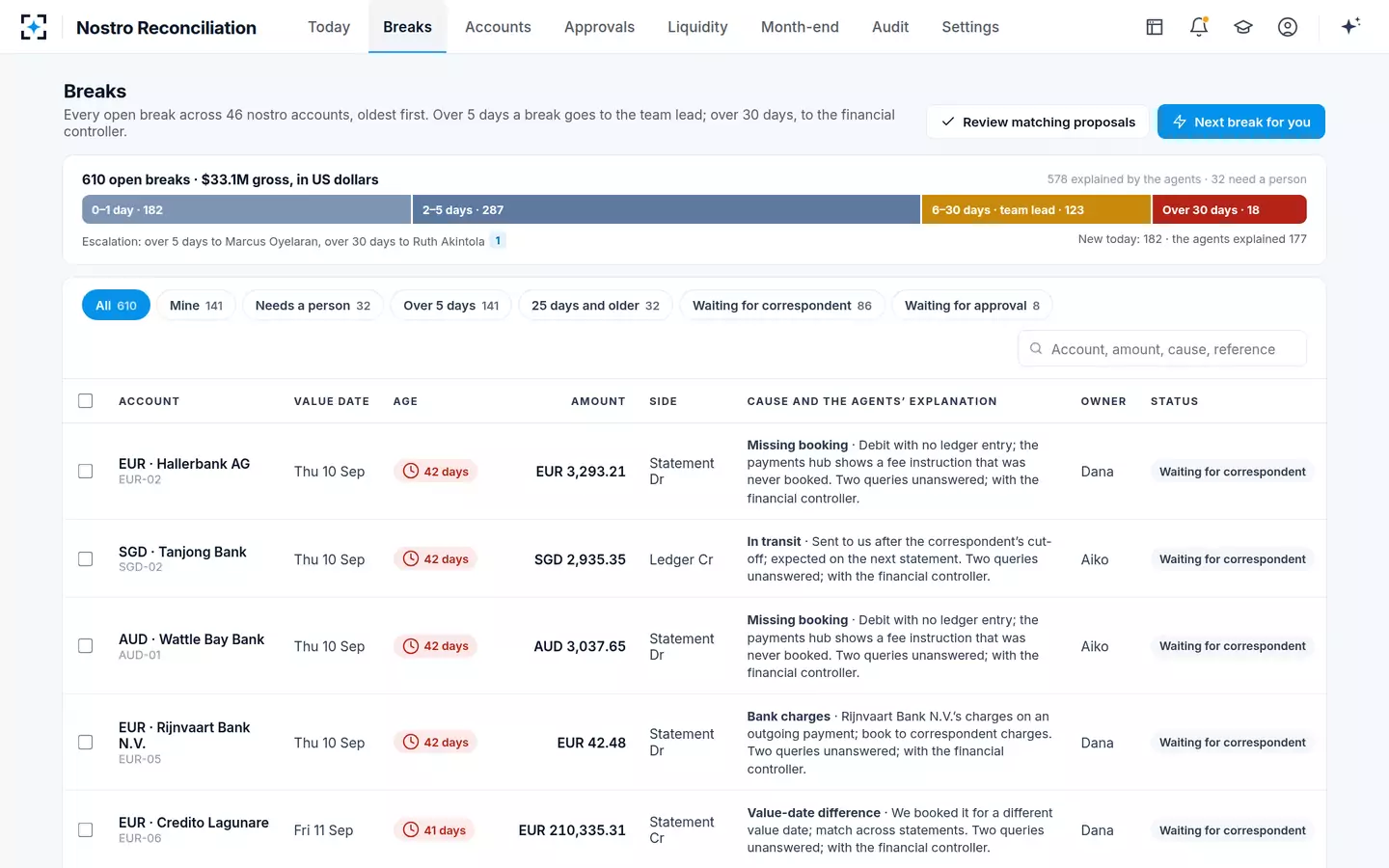
An aging report sorts every open break by age band and makes the escalation visible. The sample bank's queue on one Thursday held 610 open breaks worth $33.1 million gross: 182 under two days old, 287 at two to five days, 123 at six to thirty days with the team lead, and 18 over thirty days with the financial controller. Agents had explained 578 of them; 32 needed a person. The oldest was 42 days, which is under the examiner's two-month line, but the projection for month-end was 51 breaks over thirty days.
The sample bank's 610 open nostro breaks, by age band
610 open breaks, $33.1M gross
- 0–1 day: 182 · 30%
- 2–5 days: 287 · 47%
- 6–30 days, team lead: 123 · 20%
- Over 30 days, controller: 18 · 3%
The breaks queue in Nostro Reconciliation, oldest first, with the escalation bands
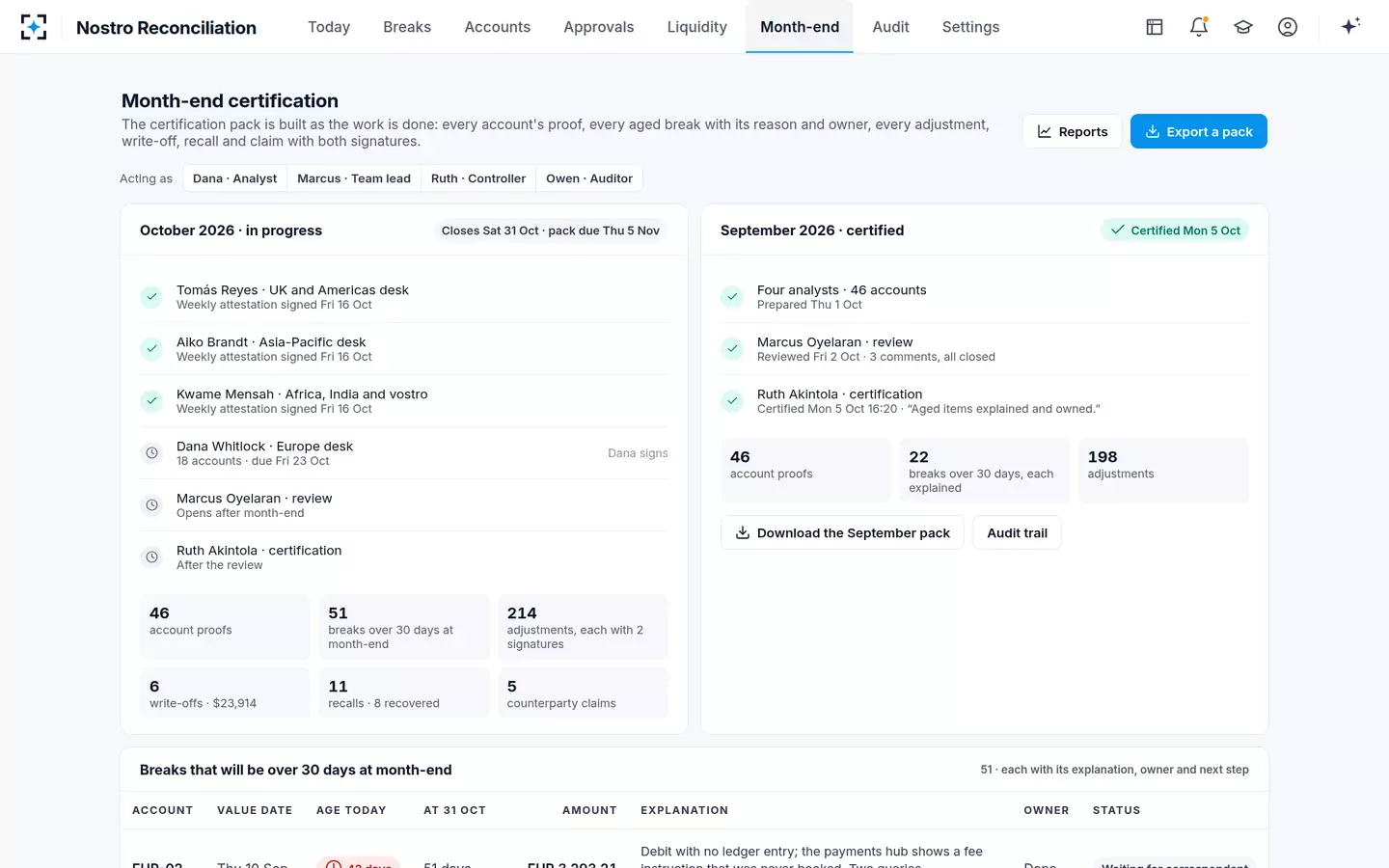
The month-end view of aged items, as the controller certifies it
| What the controller sees | September (certified 5 Oct) | October (in progress) |
|---|---|---|
| Account proofs | 46 | 46 |
| Breaks over 30 days at month-end | 22, each explained | 51 projected, each with explanation, owner and next step |
| Adjustments with two signatures | 198 | 214 so far |
| Write-offs | Not shown on the summary | 6, $23,914 |
| Recalls | Not shown on the summary | 11, 8 recovered |
Month-end certification in Nostro Reconciliation, built as the work is done
The most effective way to keep aged items down is to explain breaks on the day they arrive, while the evidence is fresh and the correspondent's operations team still remembers the payment. Reconciliation exception management sets out the route for each kind of break, and a nostro reconciliation example shows how much evidence one break can need.
Questions people ask
What is an aging report in reconciliation?
A list of open reconciling items sorted by age band, usually with amount, side, cause and owner. It is the control that shows whether breaks are being cleared or carried; examiners use it to pick the large, unusual and old items they review individually.
What is a stale item?
An informal name for an open item past its normal clearing time, usually one with no recent activity. The OCC's handbook uses a similar idea for drafts, asking whether drafts outstanding for an unreasonable period, perhaps six months or more, are placed under special controls.
Who should own breaks over 30 days?
Someone senior enough to approve the outcome, because by then the likely outcomes are recovery, a claim or a write-off. The sample bank sends them to the financial controller, who also approves write-offs over $10,000 and certifies month-end.
How long must reconciliation evidence be kept?
As long as the bank's retention policy requires, and at least five years for records kept under the Bank Secrecy Act regulations (31 CFR 1010.430(d)). The sample bank keeps break evidence for seven years, a policy choice.
Can an aged debit be recovered after it is written off?
Sometimes, which is why a write-off should not end the pursuit. The write-off reflects the bank's judgement about the books; a recovery from the correspondent or the beneficiary can still follow, and India's rules expressly expect banks to keep honouring claims on old credit entries they once wrote back.
Does a break on a correspondent's statement start the UCC clock?
Where Article 4A governs, the reporting clocks generally run from notification, and a statement showing the debit is a common form of notification. Whether Article 4A governs a given correspondent relationship depends on where the receiving bank is and what the parties or the network's rules chose.