Bank reconciliation segregation of duties means that the person who reconciles an account cannot also be a person who can move money through it, book the corrections alone, or approve their own reconcilement. For nostro accounts, the foreign-currency accounts a bank holds with its correspondents, the OCC's examiners test it with specific questions: whether reconcilers also issue drafts or handle cash, whether the staff reconciling foreign accounts are kept out of foreign exchange dealing, and whether an officer reviews and approves the result. The work is hard to separate because one break can need a search, a posting, a recall and a write-off, each with a different owner. Botminds' Nostro Reconciliation adds agents to the desk and keeps the separation intact: agents prepare, an analyst accepts, and a second person approves before anything is posted or sent.
The pairs below are the ones the OCC's handbook names for due-from accounts, nostro accounts included (OCC, Comptroller's Handbook, Due from Banks). None of them assumes software, and none of them is relaxed by it. What changes with agents is who does the preparing.
The duties a nostro desk keeps apart, and the examiner's question behind each
| Keep apart | From | What the OCC asks |
|---|---|---|
| Preparing the reconcilement | Issuing drafts or official checks alone, or handling cash | Whether reconcilements are prepared by persons who do not also do either |
| Reconciling foreign currency accounts | Foreign exchange dealing and position-keeping | Whether those staff are excluded from foreign exchange and position clerk functions |
| Handling statements before reconcilement | Issuing drafts and posting the general or subsidiary ledgers | Whether statements reach only people without those duties, if the reconciler does not examine them |
| Finding a correction | Making it | Whether adjusting entries go to the department that originated the entry, with review by the reconciler |
| Calculating a revaluation | Reviewing it | Whether an officer who did not prepare the calculations reviews them |
| Preparing the reconcilement | Approving it | Whether an officer or supervisory employee reviews and approves the details |
What is segregation of duties in bank reconciliation?
It is the rule that no one person both controls an account's money and proves the account's balance. The OCC's questionnaire puts it in two lines: "Are bank reconcilements prepared by persons who do not also: – Issue drafts or official checks singly? – Handle cash?" A person who could send money out and then explain away the missing balance on the reconcilement holds both halves of a fraud. Splitting the halves means a theft needs two people.
For nostro accounts the handbook adds a currency-specific pair. It asks whether people handling and reconciling due-from foreign bank demand accounts are "excluded from performing foreign exchange and position clerk functions". The reason is the same in a different shape: a dealer who can also reconcile the account where the trade settles can hide a loss in a break. On a desk where every foreign exchange trade settles through a nostro, that separation is the one most worth testing.
The duty also runs through time. The handbook asks whether reconcilement duties for foreign demand accounts are "rotated on a formal basis", so that no single analyst holds the same correspondents long enough for a pattern to stay hidden.
Can the person who reconciles the bank account also post entries?
Not alone. The OCC's question is whether follow-up and adjusting entries go back to the department that made or owns the entry for correction, with the reconciler then reviewing the corrected entries (the Federal Reserve's identical wording is quoted in what is a topside adjustment). The reconciler finds the error and checks the fix; the department that owns the entry makes it. On a nostro desk that usually means the analyst prepares the posting and a team lead approves it, with the posting made only after the approval.
The distinction matters because a reconciling entry is a way to make a difference disappear. A posting to suspense or a write-off closes a break whether or not the money was found. If the person who explains the break can also book its disappearance, the reconcilement proves nothing. In the fictional sample bank used in this guide, analysts can prepare an adjustment of any size but approve none; team leads approve postings, recalls and claims; and write-offs over $10,000 and adjustments over $250,000 also need the financial controller.
Maker-checker when an agent is the first maker
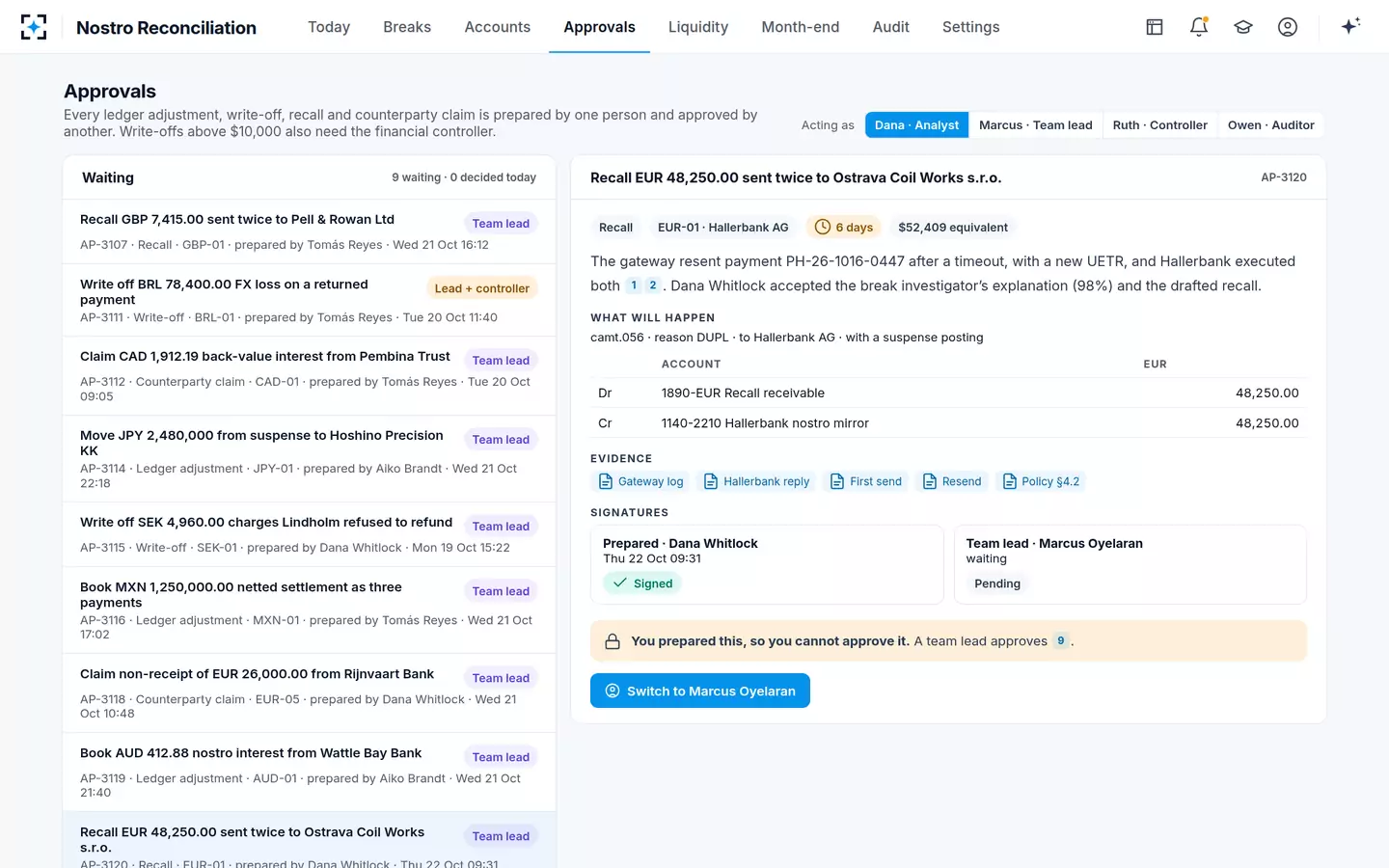
When agents join the desk, the chain gains a link but the rule does not change: whoever prepares cannot approve, and an agent prepares. Take the fictional Corvane National Bank's euro nostro at Hallerbank AG, Frankfurt. A EUR 48,250.00 debit appeared on the correspondent's statement with no entry in the bank's books. In Nostro Reconciliation, the break investigator traced it to a gateway timeout and a resend with a new reference, the correspondence drafter wrote the recall, and the correction proposer drafted the posting. None of the three could send or approve anything.
One recall through Nostro Reconciliation: three agents prepare, two people decide
Agent
Break investigatorExplains the EUR 48,250.00 debit from the statement, the general ledger, both payment messages, the gateway log and the correspondent’s reply, and cites each source.
Never: posts or contacts a customer; below 0.90 confidence it hands the break to a person.
Agent
Correspondence drafterDrafts the camt.056 recall with the original reference, amount, value date and reason DUPL, keeping the MT 192 equivalent for correspondents still on MT.
Never: sends without approval, or mentions a referral to the BSA team.
Agent
Correction proposerProposes the balanced posting to a recall receivable and routes it to the approver the amount requires.
Never: approves anything.
A person decides
Analyst, as preparerReads the cited sources, accepts the explanation and sends the recall and its posting for approval as one item at 09:31.
A person decides
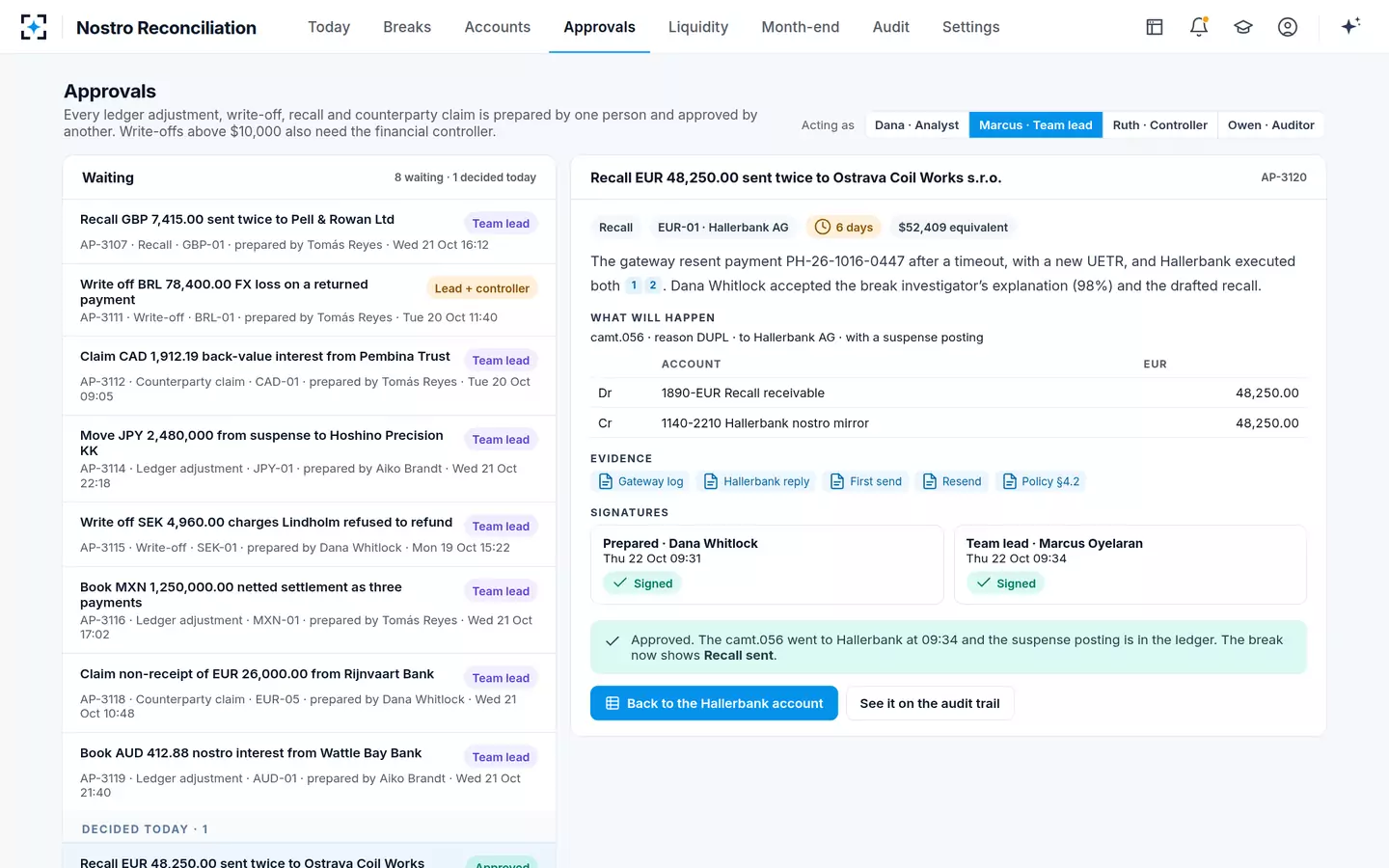
Team lead, as approverSees the entries, the evidence and the preparer’s signature on one screen and approves at 09:34; only then does the recall go out and the posting reach the books.
Never: approves an item they prepared.
Separation of duties on screen in Nostro Reconciliation: the preparer cannot approve
Can an AI agent post a reconciling entry?
It can if someone gives it the permission, and the control question is whether it should be allowed to both prepare and approve. Under any sound separation the answer is no: an agent that can propose a write-off and also post it is one actor holding both halves, exactly what the OCC's questions are built to stop. The design that survives an examination treats the agent as a preparer whose work a person accepts and a second person approves, and makes the posting the consequence of the approval, not of the agent's confidence.
Responsibility does not move with the work either. The Wolfsberg Group's principles for AI in financial crime compliance say financial institutions are responsible for their use of AI, including decisions that rely on it, whether the systems are built in-house or bought (Wolfsberg Group, 2022). The federal banking agencies' revised model risk guidance of April 2026 leaves generative and agentic AI models outside its scope for now (OCC Bulletin 2026-13), so a bank has to write its own testing and approval rules for them rather than borrow the model risk framework.
The industry has also said where full automation stops. The Wolfsberg Group, ICC and BAFT wrote in 2019 that the review of trade documents, taken as a whole, is beyond what automation can do (Trade Finance Principles; see how technology can assist in combating TBML). Nostro matching is a different task: structured messages and amounts that must add up, which rules engines have matched for decades. But the judgement at the end of a break is the same kind of judgement: whether a debit is a duplicate, whether to recall it, whether an old item should be written off. That is the part Nostro Reconciliation leaves to people, and the part an examiner will ask a person to explain.
An agent that can propose a write-off and also post it is one actor holding both halves of the control. Make the posting follow the approval, not the confidence score.
Why does a recall need two signatures?
Because a recall commits the bank to costs and to a legal position, not just a message. Under Article 4A of the Uniform Commercial Code, once a receiving bank has accepted a payment order, a cancellation works only if that bank agrees or a funds-transfer system rule allows it, and at the beneficiary's bank only for listed reasons, a duplicate among them (UCC § 4A-211(c)). A recall is therefore a request the other bank may refuse.
If it agrees, the sender pays for the attempt. Unless an agreement or system rule says otherwise, the sender must cover the receiving bank's losses and expenses from the cancellation, reasonable attorney's fees included, and that holds for an attempted cancellation too (UCC § 4A-211(f)). A recall sent on a wrong diagnosis, of a payment that was not really a duplicate, can cost the bank money and a correspondent's goodwill. That is why the preparer's reading of the evidence needs a second reader before the message leaves.
Article 4A also has limits of place. Between a sender and a receiving bank it applies the law of the jurisdiction where the receiving bank is located, unless the parties or a system rule choose otherwise, so a recall to a correspondent abroad may be governed by that country's law. Reconciliation exception management follows the duplicate route, and the others, through to their messages and clocks.
The team lead approves; the recall goes out and the posting is made
What do examiners ask about reconciliation controls?
They ask whether the separations exist on paper and whether they hold in practice. The OCC's internal control questionnaire for due-from accounts is the most complete list in public, and it reads as a test plan. An internal auditor can run it against a nostro desk in a day; an examiner will run a version of it during the examination and then test reconcilements on a sample of accounts.
Reconciliation control questions an examiner can ask of a nostro desk
- Are reconcilers kept away from drafts and cash?
No one who issues drafts or official checks alone, or handles cash, prepares the reconcilement.
- Are foreign account reconcilers kept out of dealing?
Staff who handle and reconcile nostro accounts are excluded from foreign exchange and position clerk functions.
- Is every statement examined?
The preparer checks for any sign of alteration and compares payments with the statement.
- Do corrections go back to their owner?
Adjusting entries go to the originating department and are reviewed by the reconciler.
- Is the reconcilement signed, dated and approved?
The preparer signs and dates it; an officer or supervisor reviews and approves the details.
- Is the evidence protected?
Reconcilements are kept permanently and safeguarded against alteration.
- Do duties rotate?
Reconcilement duties for foreign accounts are rotated on a formal basis.
- Is revaluation checked by someone else?
Monthly revaluation of foreign currency balances is reviewed by an officer who did not prepare it.
Rotation, small desks and the one-person problem
Segregation is easy on a desk of twenty and hard on a desk of two. A community bank with a handful of nostro accounts may have one person who knows the correspondents, and rotating that person on a formal basis can feel like a risk of its own. The OCC's questions still apply, so small desks lean on compensating controls: an officer who reviews and approves every reconcilement, a preparer who signs and dates each one, reconcilements kept where they cannot be altered, and unissued drafts held under dual control, the two-person rule set out for branches in dual control in banking.
Agents change the arithmetic for a small desk without removing the need for a second person. If the search and the drafting are done before the analyst arrives, one analyst can cover more accounts, and the second person's review becomes reading cited sources rather than repeating the investigation. What agents cannot supply is the independent second human; a bank that has only one person who can approve has a staffing problem no software solves.
Segregation by email versus segregation enforced on screen
Many desks have the right policy and weak evidence that it was followed. Approvals given by reply-all, screenshots pasted into a spreadsheet and a shared login for the posting screen all leave an auditor unable to say who approved what. The comparison below is between two ways of keeping the same policy.
The same policy, two kinds of evidence
Separation kept by email and spreadsheet: The sender of the email, if the thread survives.
Separation kept in Nostro Reconciliation: A named preparer and time on the item, set when the analyst accepts.
Separation kept by email and spreadsheet: A reply saying “approved”, sometimes to a different version of the posting.
Separation kept in Nostro Reconciliation: A named approver and time on the same item; the preparer has no approve button for it.
Separation kept by email and spreadsheet: Attachments, if anyone kept them.
Separation kept in Nostro Reconciliation: The cited statement line, payment messages, gateway log and reply, kept with the break.
Separation kept by email and spreadsheet: Not applicable, or invisible.
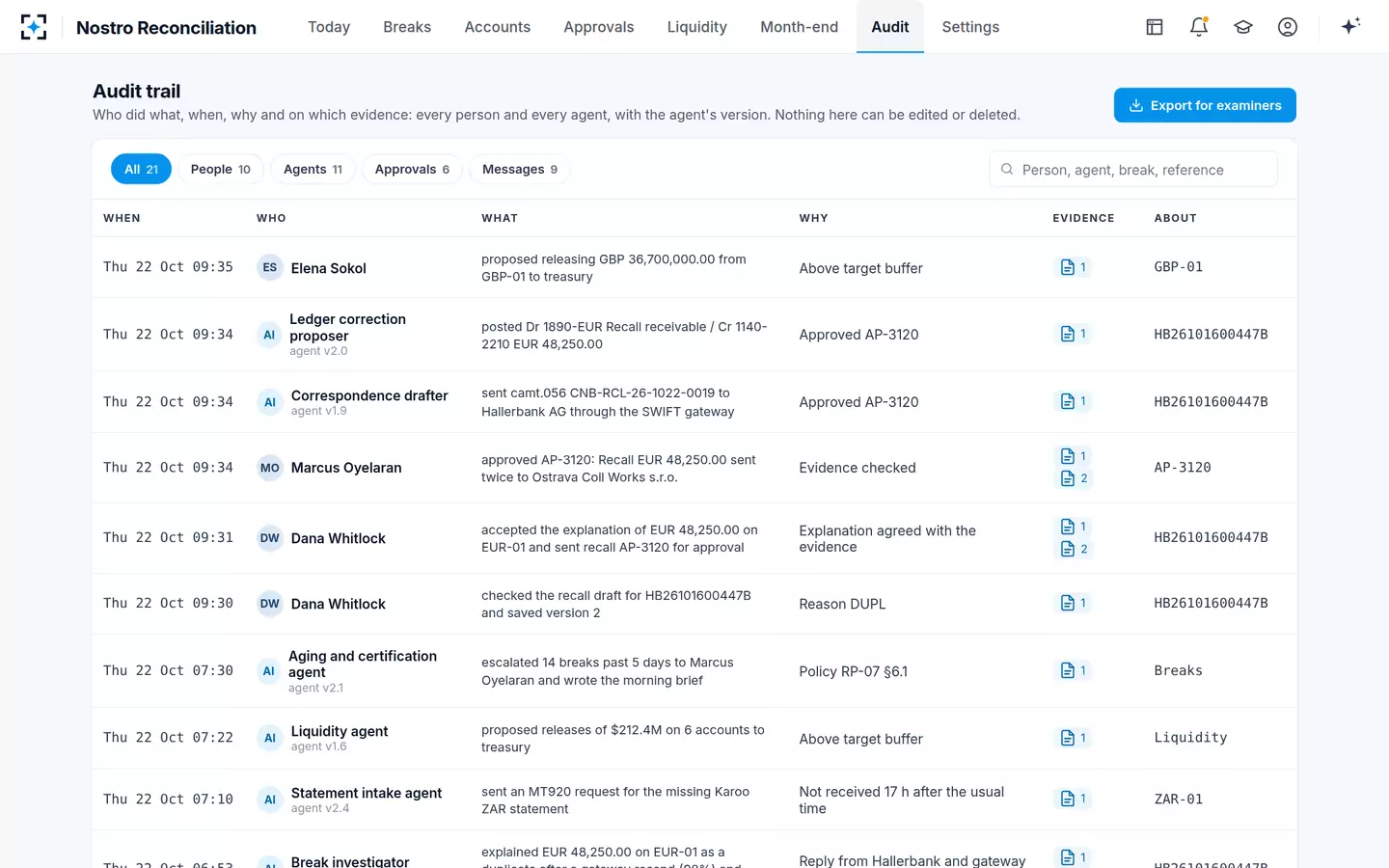
Separation kept in Nostro Reconciliation: Each agent action with its version, like any person’s action.
Separation kept by email and spreadsheet: Depends on someone remembering the limit.
Separation kept in Nostro Reconciliation: Write-offs over $10,000 and adjustments over $250,000 route to the controller automatically.
Separation kept by email and spreadsheet: Whoever has access edits the spreadsheet.
Separation kept in Nostro Reconciliation: Each change saved as a new version and approved by a second person before it runs.
The audit trail in Nostro Reconciliation: people and agents, with versions and evidence
Is maker-checker the same as segregation of duties?
Maker-checker is one form of it, applied to a single item: one person makes, another checks. Segregation of duties is wider: it separates whole functions across the process, so the reconciler does not deal, does not issue drafts, does not handle cash and does not approve. A desk can have perfect maker-checker on every posting and still fail segregation if its analysts also run the foreign exchange position. Examiners test both, and so should internal audit.
Questions people ask
Who can recall a payment?
The sender of the payment order, which for a nostro payment is usually the bank itself acting for its customer. The receiving bank decides whether to agree: under UCC Article 4A, where it governs, cancellation after acceptance needs that bank's agreement or a system rule, and the sender bears the receiving bank's losses and expenses if it agrees.
Does an AI agent count as the maker?
It should be treated as one. Its output is a proposal that a person must accept, and the person who accepts becomes the accountable preparer; a second person then approves. Giving an agent approval rights would merge maker and checker in one actor.
Can the team lead approve a write-off on their own?
Up to the limit the bank's policy sets. In the fictional sample bank, team leads approve write-offs up to $10,000 and the financial controller must also approve anything larger, with adjustments over $250,000 treated the same way. The preparer never approves at any amount.
Should the reconciler also do the monthly revaluation?
The reconciler may prepare it, but the OCC asks whether an officer who did not prepare the calculations reviews the revaluation of foreign currency balances, including the rates used and the resulting general ledger entries. Preparing and reviewing the same revaluation is the separation the question is meant to catch.
How long should approval evidence be kept?
As long as the bank's retention policy and the applicable rules require; records kept under the Bank Secrecy Act regulations must be retained for five years under 31 CFR 1010.430(d). The sample bank keeps reconciliation evidence for seven years, a policy setting rather than a federal rule.
What if only one person on the desk can approve?
Then the bank has a single point of failure, and the fix is a second approver from outside the desk, such as a treasury officer or the controller, not a waiver. Compensating controls such as officer review and protected reconcilements help, but they do not replace a second person.