Nostro reconciliation software does three jobs: it takes in each correspondent bank's statement and proves it is complete, it matches the statement's lines against the bank's mirror account in the general ledger, and it helps people explain and clear the lines that do not match. Most banks already have the second job covered by a rules-based matching engine, and that engine usually matches the large majority of lines without anyone touching them. The hard part, and the part most worth buying, is the remainder: breaks that need a search across the payments hub, the message archive and the SWIFT gateway log, a message to a correspondent, and a posting someone else must approve. Botminds' Nostro Reconciliation is built for that remainder. It keeps the bank's engine as it is, and puts seven agents around the breaks, with people accepting and approving everything that moves.
This guide is for the operations and technology leaders choosing what to buy. It sets out what an engine does and does not do, what the ISO 20022 migration has changed as of October 2026, what to ask in a demonstration, how to price the work, and where Botminds' solution fits and where it does not. Product figures come from a fictional sample bank and are marked as such.
Keep the engine, add the investigation: what each part of the stack does
What the matching engine does: Loads files that arrive; some engines check balances.
What Nostro Reconciliation's agents add: Checks sequence, opening against last close and entries against the close; quarantines exact duplicates; requests a late statement.
What the matching engine does: Matches by amount, date and reference under versioned rules.
What Nostro Reconciliation's agents add: Proposes the matches rules miss: one-to-many splits, netted charges, references truncated between MT and ISO 20022, rounding. Never across accounts or currencies.
What the matching engine does: Lists what did not match.
What Nostro Reconciliation's agents add: Explains each break from the statement, books, payments hub, message archive, gateway log and the correspondent’s replies, citing each source.
What the matching engine does: Usually none; queries go by email or a separate tool.
What Nostro Reconciliation's agents add: Drafts the query, claim or recall in the correspondent’s standard (camt.056, camt.027, MT n99, MT 192) for approval.
What the matching engine does: Manual entries in the general ledger.
What Nostro Reconciliation's agents add: Proposes balanced postings with reason codes and routes each to the approver its amount requires.
What the matching engine does: An aging report.
What Nostro Reconciliation's agents add: Runs the bank’s escalation clocks and keeps the month-end certification pack current.
What the matching engine does: Not in scope.
What Nostro Reconciliation's agents add: Shows balances above their target buffer, with the forecast cited, for treasury to decide.
What does nostro reconciliation software do?
It turns the OCC's reconcilement procedure into a daily process at the bank's volume. The handbook examiners use for due-from accounts walks through the steps by hand: insert both balances, check that each statement opens where the last one closed, offset every entry against the other side, list what does not offset under four headings, and prove that the two balances agree (OCC, Comptroller's Handbook, Due from Banks). Software does the offsetting at scale and keeps the lists. Good software also keeps what the handbook asks a bank to keep after an item clears: the follow-up and the reason for any delay.
The volume is why this is software and not a spreadsheet. In the fictional sample bank, 46 nostro statements carried 58,214 lines for one value date. The engine matched 55,886 of them on its own, 96.0%, and the agents matched 2,146 more for the analysts to accept in bulk. That left 182 new breaks for the day, and those 182 are where a buyer should spend most of the evaluation.
Should we replace our reconciliation matching engine?
Usually not. A matching engine that has run for years carries versioned rules, an audit history and tuning that reflects the bank's own correspondents, and replacing it means re-proving all of that through a parallel run. Its weakness is not the matching it does but the work it leaves: an engine tells the analyst what did not match, not why. A buyer who replaces the engine to fix the breaks may end up with a new engine and the same breaks.
The alternative is to keep the engine as a connection and add the investigation around it. That is how Nostro Reconciliation is built: the engine stays, with its own rule versions, and the agents work on what it leaves. If an engine is genuinely at the end of its life, replace it on its own merits and on its own timetable, not as a side effect of a breaks problem.
Statement integrity: the check before matching
Matching an incomplete or duplicated statement produces confident wrong answers, so the first job is proving the statement. The OCC's procedure asks examiners to determine that the closing balance and date on the statement used in the last reconcilement agree with the opening balance and date on the next, and, where intervening statements arrived, that each new opening balance agrees with the previous closing balance. A missing statement, a statement received twice or a general ledger extract that stopped halfway all break that chain.
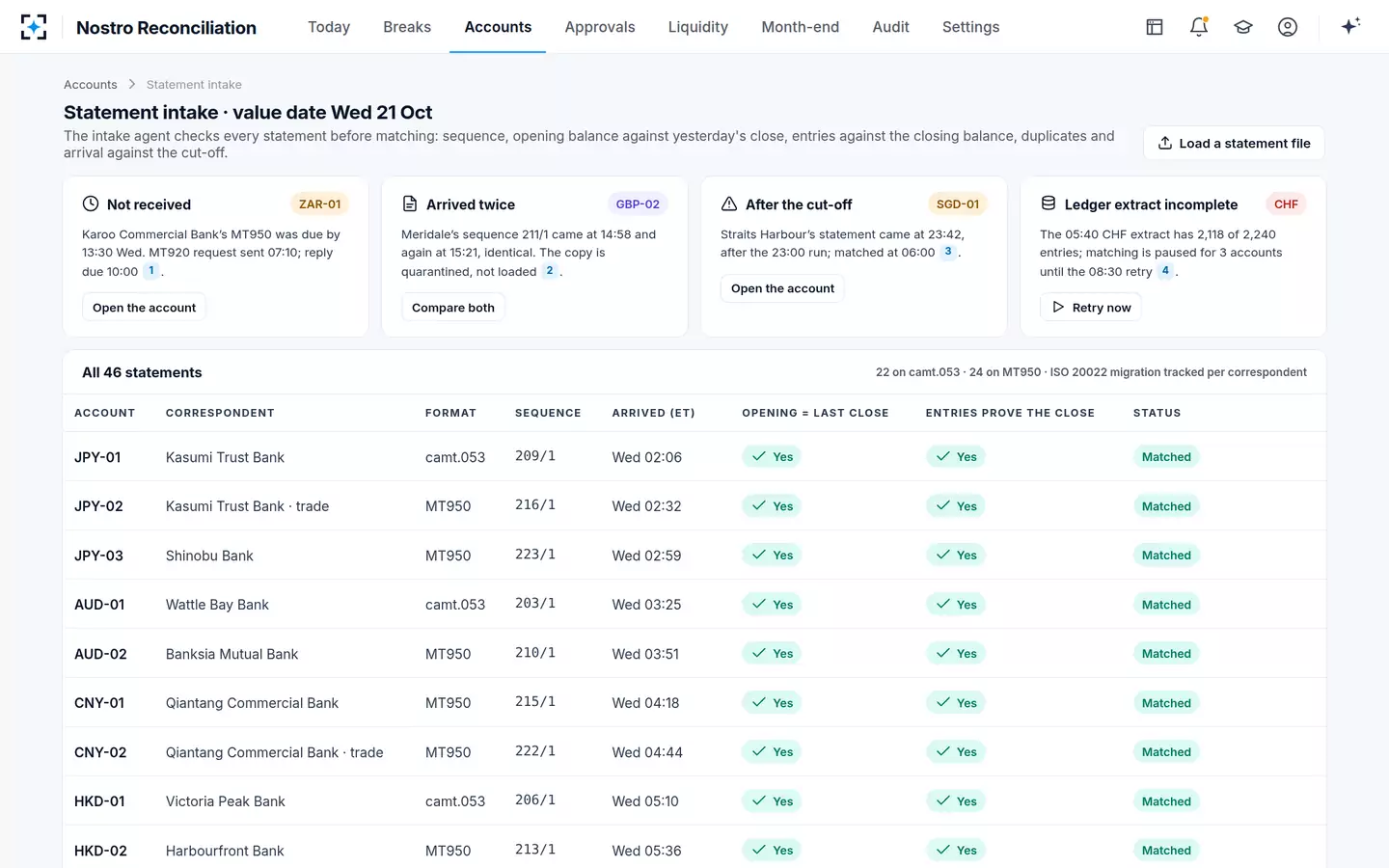
In the sample bank's overnight run, four exceptions were caught before any matching: a correspondent's ZAR statement had not arrived and a request went out at 07:10; a GBP statement arrived twice and the identical copy was quarantined; an SGD statement came after the 23:00 cut-off and was matched in the 06:00 run; and the CHF general ledger extract held 2,118 of 2,240 entries, so matching paused on three accounts until a retry. Each would have produced phantom breaks, or hidden real ones, had matching run regardless.
Statement intake in Nostro Reconciliation, with the overnight exceptions caught
What does ISO 20022 change for nostro reconciliation?
For cross-border payments the migration has happened; for reconciliation its effects are still arriving. The BIS Committee on Payments and Market Infrastructures states that the coexistence period between the MT and ISO 20022 standards ended on 22 November 2025, and that market participants can align with its harmonised data requirements at their own pace until end-2027 (CPMI, February 2026). Those requirements include a unique end-to-end transaction reference (UETR) on every cross-border payment, which is the single most useful field a matching rule can have.
Statements are a separate question. The CPMI's requirements cover only the cross-border payment data in the bank-to-customer reporting messages, camt.052, camt.053 and camt.054, and no regulator or standard-setter we cite has published an end date for MT statements, so the practical test is your own correspondent list: in the sample bank, 22 of 46 correspondents send camt.053 and 24 still send MT950. Software must read both and repair references across them. The BIS staff brief on ISO 20022 migrations warns that "MT-to-ISO 20022 message converters, while useful as temporary contingency measures for limited volumes, have drawbacks as a permanent solution" (CPMI Brief No 11, April 2026), and converted messages are where references get cut short.
Some dates moved in 2026. The Federal Reserve rescheduled its November 2026 Fedwire Funds Service release to November 2027 (Federal Reserve Financial Services), and the Bank of England expects its November 2026 changes, including the removal of unstructured address fields, to move to its November 2027 release, subject to confirmation (Bank of England). Address formats do not change matching, but the same project teams own both; the dates are tracked in the ISO 20022 structured address deadline.
ISO 20022 and nostro reconciliation, as of October 2026
22 Nov 2025
MT and ISO 20022 coexistence ended for cross-border payments
CPMI, February 2026
End-2027
to align with the CPMI’s harmonised data requirements
CPMI
Nov 2027
Fedwire’s rescheduled release, moved from November 2026
Federal Reserve Financial Services
24 of 46
correspondents still sending MT950 at the sample bank
Fictional sample data
What should reconciliation software explain about a break?
Everything the next person needs to decide without repeating the search: the side of the break, its cause, the evidence for the cause, how sure the system is, and what should happen next. An explanation without its sources is an opinion, and an analyst who has to re-open five systems to check it has saved nothing. The test is whether a team lead can approve the proposed action from one screen, and whether an auditor can later see why.
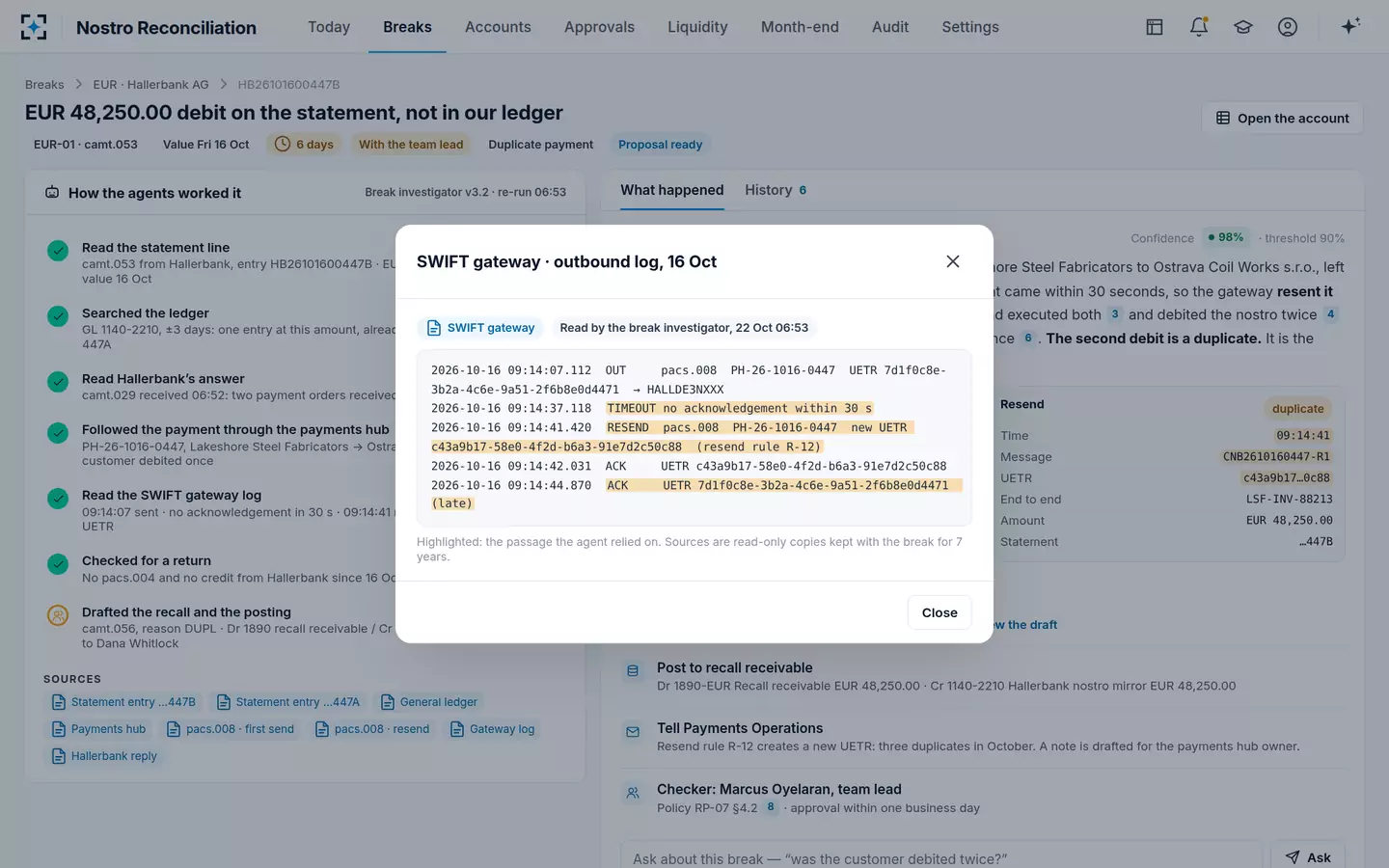
In Nostro Reconciliation, each point in an explanation opens to the passage it rests on: the statement line, the general ledger entry, the payment message, the gateway log or the correspondent's reply. Each break also carries the agent's confidence against its threshold. The matching agent acts alone only at 0.97 or above; the break investigator proposes at 0.90 and, below that, hands the break to a person with a list of what is missing.
Every citation in Nostro Reconciliation opens to its source: the gateway log behind a duplicate
How does reconciliation software integrate with the payments hub?
Mostly by reading, and writing only after approval. The investigation needs read access to the payment's whole trail; the outputs (a message to a correspondent, a posting, a release) go out only when a second person has signed. The table sets out what Nostro Reconciliation connects to, and in which direction.
The systems Nostro Reconciliation connects to, and what flows each way
| System | Read | Written, only after approval |
|---|---|---|
| SWIFT gateway | MT950, MT940 and camt.053 statements; the outbound log | Queries, claims and recalls |
| Payments hub | Payment records and the message archive | Nothing |
| General ledger | Nostro mirror accounts | Postings, reversals, suspense moves, write-offs |
| Reconciliation engine | Its matches and rule versions, kept as they are | Nothing; its rules stay the bank’s |
| Treasury system | The five-day cash forecast | Release proposals for treasury to decide |
| Core banking system | Vostro and customer accounts | Postings, after approval |
How long must reconciliation records be kept?
At least as long as the rules that apply to them say, and longer if your policy does. For records the Bank Secrecy Act regulations require, 31 CFR 1010.430(d) sets one period: five years (eCFR, 31 CFR 1010.430). That covers BSA records, not every reconciliation document; general ledger and accounting records follow the bank's own retention schedule and any other rules that apply to them. Software should keep the evidence for each break with the break, read-only, for whichever period is longest. The sample bank sets seven years.
How much does nostro reconciliation software cost, against the work it takes over?
List prices are rarely published, so price the work instead, with your own numbers. The term that matters most is analyst time on breaks. Botminds estimates about 26 minutes per break by hand, most of it searching, against about 4 minutes to check an explanation whose sources are cited; those are our estimates, not measured results, and your own time study should replace them. At the sample bank's volume of about 180 new breaks a day, that difference is about 66 hours a day, more than the bank's four analysts work, which is why its breaks age.
Price the work, not the licence: a method for your own desk
Analyst hours
new breaks a day × (minutes by hand − minutes checking) ÷ 60 × working days
At 180 breaks, 26 and 4 minutes: about 66 hours a day
Operations, from a time study
Priced hours
analyst hours × loaded hourly cost
BLS mean for the nearest proxy occupation, $53,560 a year, is about $25.75 an hour before benefits
Finance
Idle balances
balance above buffer × your funding rate × days ÷ 365
Only for balances a reconciled view shows can be released
Treasury
Cost to run
licence + integration + validation of the agents
Include internal audit’s and model risk’s time to test the agents before relying on them
Technology and risk
Four things move the price of any product in this market: the number of accounts and statement lines, the number of systems it must read, whether it drafts and sends messages to correspondents, and whether it includes the approval and certification steps or leaves them in email. Budget separately for the integration work and for the time internal audit will need to test the agents before the bank relies on them.
What to ask in a nostro reconciliation software demonstration
Ask to see each of these on your own statements and messages, not on the vendor's sample. A product that explains breaks well will be glad to; one that matches well but explains poorly will steer the demonstration back to its match rate.
Eight questions for any nostro reconciliation software demonstration
- Does it prove each statement before matching?
Sequence, opening against last close, entries against the close, duplicates and late arrivals.
- Does it keep our engine, or require replacing it?
Replacing a working engine is a separate project with its own parallel run.
- Can it read MT950, MT940 and camt.053 at once?
And repair references truncated between them, with a person accepting each repair.
- Does every explanation cite its sources?
Each point should open to the statement line, message, log or reply behind it.
- What does it do below its confidence threshold?
It should hand the break to a person with what is missing, not guess.
- Can the preparer approve their own item?
The answer must be no, at every amount, enforced on screen.
- Does it draft in each correspondent’s standard?
camt.056 or MT 192 for a recall, camt.027 or MT n99 for a claim or query.
- What will internal audit and examiners see?
Every person’s and agent’s action, with version and evidence, exportable and unchangeable.
Where Nostro Reconciliation fits, and where it does not
It fits a bank that already matches most of its lines in an engine and is losing time and control on the remainder: many correspondents, a mix of MT and ISO 20022 statements, breaks aging past the bank's escalation lines, and approvals given by email. It covers nostro and vostro accounts; the sample bank runs 46 nostros in 19 currencies and 12 vostros through it. It is designed to be judged on your own data: Botminds runs it on a sample of a bank's statements, general ledger extracts and payment messages before anything else.
It does not replace the matching engine, the general ledger, the payments hub or the treasury system, and it is not built to. Its agents do not decide: they cannot approve, and nothing they prepare is posted or sent until a person has accepted it and a second person has approved it. A bank with few breaks and a short correspondent list may get more from tuning its engine's rules. Banks weighing the category against general-purpose AI reconciliation tools will find the comparison in nostro reconciliation system vs bank reconciliation AI.
Questions people ask
What is the best nostro reconciliation software?
The one that explains your breaks with evidence your team lead can approve from, on your own data. Match rates are a weak guide because most engines already match the large majority of lines; compare products on the breaks they leave, how they explain them, and whether the preparer can approve their own work.
Does nostro reconciliation software handle vostro accounts too?
It should, because the method is the same in reverse: the bank reconciles its books for other banks' accounts against the statements it sends them. Nostro Reconciliation reconciles the sample bank's 12 vostro accounts alongside its 46 nostros.
Do we need ISO 20022 statements before buying?
No. Software has to read whatever correspondents send, and in the sample bank more than half still send MT950. What ISO 20022 adds is more data per line, the UETR above all, which makes matching more precise as correspondents move.
Can reconciliation software send recalls by itself?
It should not. A recall commits the bank to costs if the receiving bank agrees to cancel, so it needs a person's acceptance and a second person's approval. In Nostro Reconciliation, sending stays locked until a team lead approves, and the recall and its posting travel as one approval.
How long does it take to go live?
It depends on the connections more than the software. Nostro Reconciliation is built from the bank's own reconciliation policy, sample statements, general ledger extracts and payment messages, and it goes live once its quality checks on that data have passed; the first step is running it on a sample of your own breaks.