Nostro liquidity management is the treasury discipline of keeping each nostro account, the account a bank holds in a foreign currency with a correspondent bank, funded enough to make the payments it must make without overdrawing, and not much more, because anything above that earns little or nothing while the bank's funding costs keep running. It is hard because the balance treasury sees in its own books is not always the balance at the correspondent: open breaks such as duplicate payments, unbooked charges and credits nobody has claimed sit between the two. Botminds' Nostro Reconciliation explains those breaks every morning and, with a liquidity agent, shows treasury which nostro balances sit above their target buffer, with the forecast cited, for a person to decide whether to release them.
The OCC's examiners have framed the problem the same way for decades. Their handbook for due-from accounts says: "Nostro balances may be compared to an inventory of goods and must be supervised in the same manner" (OCC, Comptroller's Handbook, Due from Banks). Inventory has two failure modes, running out and carrying too much, and nostro balances have both.
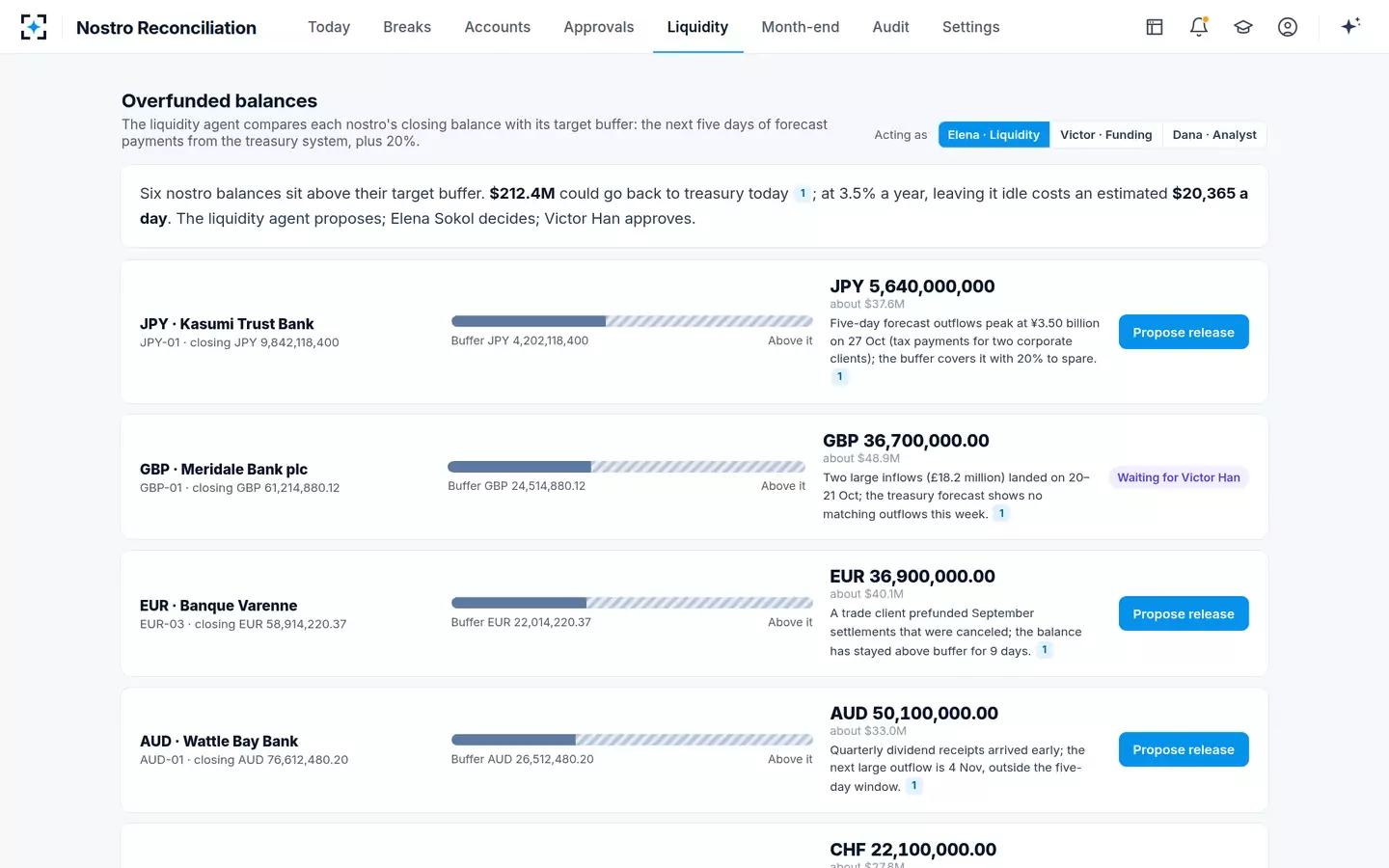
Six nostro balances above their target buffer in the sample bank: $212.4 million that could go back to treasury
What is nostro liquidity management?
It is deciding, account by account, how much of each currency to hold at each correspondent, and moving money in or out as forecasts change. The OCC's handbook sets out both sides of the decision: the bank "must maintain adequate balances in its nostro accounts to meet unexpected needs and to avoid overdrawing those accounts for which interest must be paid. However, the bank must not lose income by maintaining excessive idle nostro balances that do not earn interest." Too little and the bank pays overdraft interest, or fails payments; too much and the money earns less than it costs.
The volume through these accounts makes the decision material. The same handbook notes that all foreign currency transactions except over-the-counter cash trades settle through nostro accounts (quoted in what a nostro reconciliation system is for), so every foreign exchange trade, trade finance payment and customer wire in a currency moves its nostro balance. The handbook also ties nostro levels to the bank's currency position: "Excessive nostro overages and shortages should be avoided by entering into spot and forward exchange contracts to buy or sell such nostro 'inventories.'" Funding a nostro is a foreign exchange decision as much as a cash one.
What is the difference between nostro and vostro accounts?
A nostro is the bank's account at another bank; a vostro is another bank's account at the bank. The BIS's payments committee notes that reciprocal correspondent relationships "may involve the use of so-called nostro and vostro accounts to settle foreign exchange transactions" (CPMI, Correspondent banking, 2016): the same account is a nostro in the books of the bank that owns the money and a vostro in the books of the bank that holds it. The OCC adds a twist on what counts as foreign: US dollars become foreign currency when, for example, a London branch of a US bank holds a dollar account with another bank.
Nostro and vostro accounts: the same relationship, seen from each side
Nostro: our account with them: The bank’s own, held at a correspondent abroad.
Vostro: their account with us: Another bank’s, held on the bank’s own books.
Nostro: our account with them: An asset, a due-from account, with a mirror account in the general ledger.
Vostro: their account with us: A liability to the respondent bank.
Nostro: our account with them: Received from the correspondent: MT950, MT940 or camt.053.
Vostro: their account with us: Sent by the bank to its respondent.
Nostro: our account with them: How much to keep there: enough for the forecast, not more.
Vostro: their account with us: How much intraday credit to extend, and how the respondent’s payments affect the bank’s own liquidity.
Nostro: our account with them: The correspondent’s statement.
Vostro: their account with us: The statements the bank sent, and the respondent’s queries.
How much should a bank keep in nostro accounts?
Enough to cover the payments it expects plus a margin for the ones it does not, and the margin is a policy choice. The OCC's handbook sets no number, and the Basel Committee's intraday tools measure usage rather than prescribe balances. The practical method is a buffer built from the treasury forecast: in the fictional sample bank used in this guide, each nostro's target buffer is the next five days of forecast payments from the treasury system, plus 20%. A balance above that buffer is a candidate for release; a balance below it is a candidate for funding.
The method only works if the balance is right. The sample bank's liquidity screen shows why each balance sits where it does: on its Kasumi Trust Bank yen account, the five-day forecast peaks at ¥3.50 billion of outflows on 27 October, for two corporate clients' tax payments, and the buffer covers that with 20% to spare. On its Meridale Bank sterling account, two large inflows totalling £18.2 million landed on 20 and 21 October and the forecast shows no matching outflows that week.
Why four of the sample bank's nostro balances sat above their buffer
| Account | Above buffer | Reason the agent cited |
|---|---|---|
| GBP · Meridale Bank plc | £36,700,000.00 | Two large inflows, £18.2 million, landed on 20–21 October; no matching outflows forecast this week |
| EUR · Banque Varenne | €36,900,000.00 | A trade client prefunded September settlements that were cancelled; above buffer for nine days |
| JPY · Kasumi Trust Bank | ¥5,640,000,000 | Outflows peak at ¥3.50 billion on 27 October; the buffer covers that with 20% to spare |
| AUD · Wattle Bay Bank | A$50,100,000.00 | Quarterly dividend receipts arrived early; the next large outflow, on 4 November, is outside the five-day window |
What are idle nostro balances, and what do they cost?
Idle balances are the part of a nostro above what the bank needs to hold there, and they cost whatever the money would earn, or save, elsewhere. Whether a nostro balance itself earns interest depends on the account's terms; the OCC's handbook, written for a world of non-interest-bearing correspondent accounts, describes excessive idle balances as ones "that do not earn interest". Either way the arithmetic is the same: the balance above the buffer, times the difference between what the bank could earn and what the account pays, times the days it sits.
What an idle nostro balance costs, per account
Idle balance
reconciled balance − target buffer
Use the balance at the correspondent, adjusted for explained breaks, not the general ledger alone
Treasury, with reconciliation
Rate gap
your funding or investment rate − rate the account pays
Often the full funding rate, if the account pays nothing
Treasury
Daily cost
idle balance × rate gap ÷ 365
The sample bank’s six balances, $212.4 million at an assumed 3.5%, come to roughly $20,000 a day
Finance
Cost of releasing too much
overdraft interest + failed or delayed payments
Why the buffer has a margin, and why a second person approves each release
Treasury funding
Treasury funds from the balance it believes. Reconciliation decides whether that belief is true.
How does reconciliation affect nostro funding?
Every open break is a difference between the balance in the books and the money at the correspondent, so funding from unreconciled books funds the wrong number. A duplicate payment means the correspondent has paid out money the books still show as there: treasury that funds from the books will think the account is richer than it is and can let it run short. A credit nobody has claimed means the opposite: the correspondent holds money the books do not show, and treasury may fund an account that is already full. At the sample bank, that was the treasury liquidity manager's old problem: she saw balances, not the breaks that explain them, and could fund an idle account again before anyone noticed.
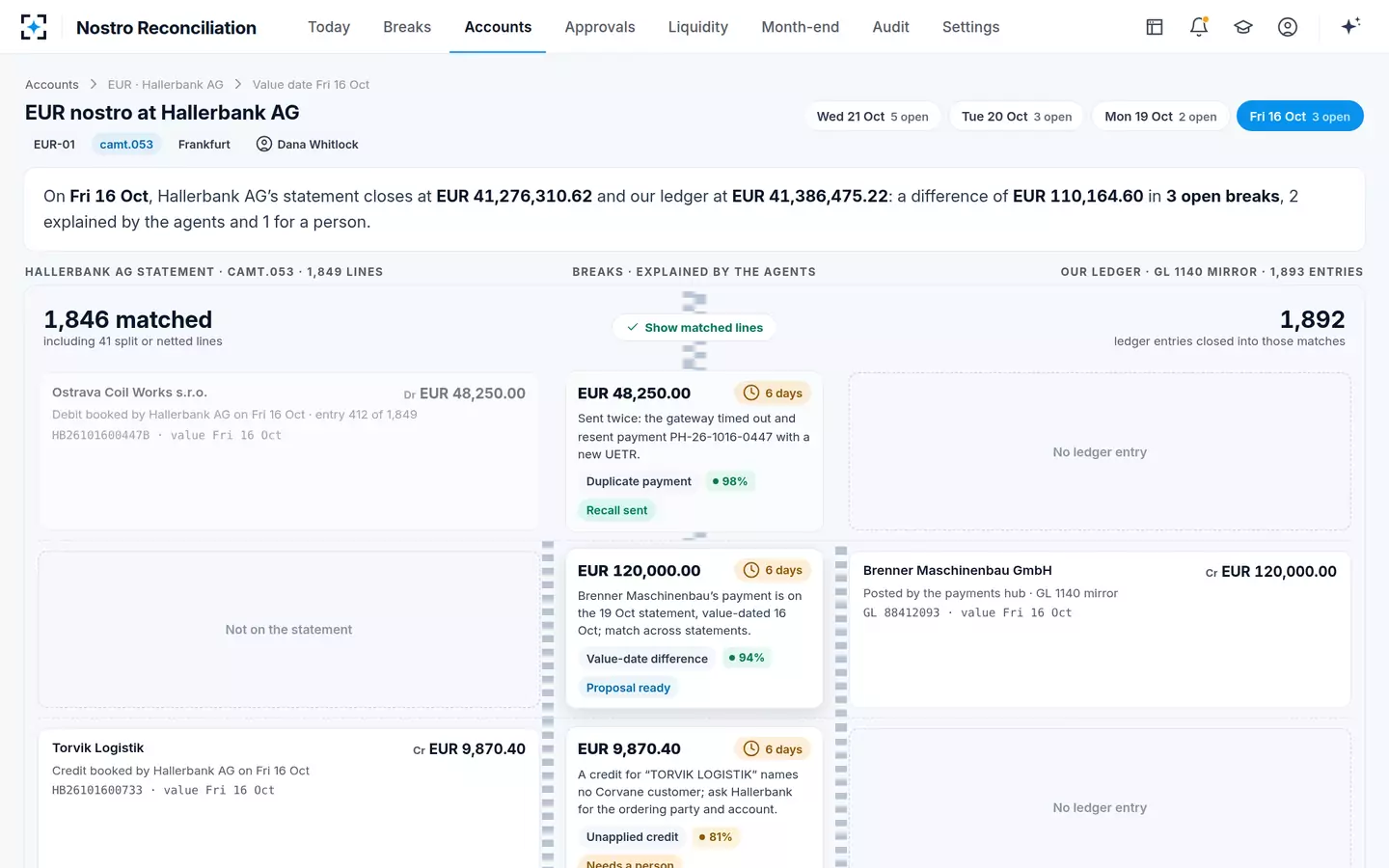
Take the sample bank's euro account at Hallerbank AG on 16 October. The correspondent's statement closed at EUR 41,276,310.62 and the bank's books at EUR 41,434,725.22: the books overstated the account by EUR 158,414.60 across four open breaks. The largest was a EUR 48,250.00 duplicate payment; once it was explained and its recall approved, the books came down by that amount and the remaining difference was EUR 110,164.60, each part with a known cause. Treasury's question, how much is really there, has an answer only after that work.
The Hallerbank account after the recall: the books move toward the statement
Three balances, one funding decision
Treasury can fund from the correspondent's statement, from its own books, or from a reconciled figure between them, and only the third is right. The statement shows money that is there but may not be the bank's to use; the books show money the bank expects that may already be gone. The reconciled figure starts from the statement, adds what is certain to arrive for that value date, and takes out what is there but belongs to someone not yet identified.
Worked on the Hallerbank account for 16 October, with the sample bank's four explained breaks, the arithmetic is short. The statement closed at EUR 41,276,310.62. The EUR 120,000.00 Brenner Maschinenbau payment, booked by the bank for that value date, appeared on Hallerbank's statement for 19 October with value 16 October, so it belongs in the figure. The EUR 9,870.40 credit naming no customer is at the correspondent but cannot be spent until someone claims it. That gives a usable balance of EUR 41,386,440.22, against books that had claimed EUR 41,434,725.22.
The Hallerbank euro account on 16 October: which balance should treasury fund from?
| Balance | EUR | What it gets wrong, or right |
|---|---|---|
| The bank’s books, before reconciliation | 41,434,725.22 | Does not yet show the second EUR 48,250.00 debit or the EUR 35.00 of charges |
| The correspondent’s statement | 41,276,310.62 | Includes EUR 9,870.40 nobody has claimed; misses EUR 120,000.00 credited later with this value date |
| Reconciled, usable for funding | 41,386,440.22 | Statement, plus the late-booked credit, less the unclaimed one |
| The books after the recall posting | 41,386,475.22 | Differs from the usable figure only by the EUR 35.00 of charges still to book |
The last line is the check that the work is done right: once the duplicate is moved to a recall receivable, the books and the usable figure differ by exactly the one break still waiting for a booking. A treasury team that sees that line can fund with confidence; one that sees only the first two is choosing which error to accept.
What is intraday liquidity monitoring?
It is measuring how much liquidity a bank uses during the day, not just where it ends, and the Basel Committee introduced monitoring tools for it in 2013. Its monitoring tools for intraday liquidity management say that "Internationally active banks will be required to apply these tools", with national supervisors deciding how far they apply to other banks (BCBS, Monitoring tools for intraday liquidity management, April 2013). For a bank that settles through correspondents, the core tool tracks the net balance of payments made and received over the day on its accounts with those correspondents, and the largest net negative position is its maximum daily intraday liquidity usage.
Banks that provide correspondent services have two further tools: the value of payments made on behalf of correspondent banking customers, and the intraday credit lines extended to them. The Committee recognised that the data do not all sit in one bank: banks "may need to liaise closely with counterparts, including payment system operators and correspondent banks, to collate these data". A nostro desk that can produce timestamped, reconciled account activity makes that liaison far easier.
What is a nostro buffer?
A nostro buffer is the balance a bank decides to keep in an account to cover expected payments and a margin for surprises; everything above it is available to release, and a balance below it needs funding. The definition is the bank's: the sample bank uses the next five days of forecast outflows from its treasury system plus 20%, account by account. A buffer that is not tied to a forecast tends to drift upward, because nobody is blamed for an idle balance and everyone is blamed for an overdraft.
Who decides a nostro release, and on what evidence?
Treasury decides, and a second person approves, because a release moves money. In Nostro Reconciliation the liquidity agent compares each nostro's closing balance with its target buffer and proposes releases, citing the forecast behind each one; it never moves funds. In the sample bank, the treasury liquidity manager, Elena Sokol, proposed releasing GBP 36,700,000.00 from the Meridale account at 09:35, and the release waited for the head of treasury funding, Victor Han, to approve. The same separation that governs reconciliation postings governs liquidity: the person who proposes is not the person who approves.
Overfunded nostro balances in Nostro Reconciliation: proposed by treasury, approved by a second person
Liquidity is one reason breaks should not age: the clocks on them, and the routes for clearing each kind, are in aged items in reconciliation and reconciliation exception management.
Questions people ask
What is a nostro overdraft?
A nostro balance that goes below zero at the correspondent, usually because payments went out before funding arrived or because a break hid how low the balance was. The OCC's handbook asks whether overdrafts of foreign due-from accounts are properly recorded and promptly reported to the responsible officer, and treats avoiding interest-bearing overdrafts as one half of nostro management.
Do nostro balances earn interest?
It depends on the account's terms. The OCC's handbook describes idle nostro balances as ones that do not earn interest, but some correspondents pay it; the fictional sample bank, for instance, had an entry waiting to book AUD 412.88 of nostro interest from one correspondent.
Who manages nostro accounts in a bank?
Treasury manages the balances and funding; payments or cash operations reconcile them; the controller certifies them for the books. The OCC's questions also expect the staff who reconcile foreign accounts to be kept out of foreign exchange dealing and position-keeping.
How often should nostro balances be forecast?
Daily for active accounts, over a horizon that matches how far ahead payments are known. The sample bank forecasts five days ahead; its Wattle Bay balance looked surplus only because the next large outflow, on 4 November, fell outside that window.
What is nostro funding?
Moving money into a nostro, usually by a foreign exchange trade or a transfer from another account, so it can cover expected payments. Because funding is often an FX trade, the OCC links nostro levels to the bank's currency position and to its spot and forward contracts.