The NCUA call report deadline is 11:59:59 p.m. Eastern on the 30th of the month after each quarter-end: January 30, April 30, July 30 and October 30. The NCUA's FAQ puts it in one line, "Call Reports are due by 11:59:59 p.m. Eastern time on the 30th of January, April, July, and October" (5300 FAQs), and the instructions add that "late-filer penalties are based on calendar—not business—days because the CUOnline system is available 24 hours a day, 7 days a week" (5300 instructions). The NCUA reinstated those penalties on January 1, 2024. Meeting the deadline is rarely the problem; meeting it with time left to review is. Botminds' NCUA 5300 Call Report drafts and checks the 5300 in the first days of the cycle so the last ones are spent on decisions.
The NCUA call report deadline, in four numbers
11:59:59p.m.
Eastern on the 30th: the last second CUOnline accepts the report
30days
from quarter-end to the due date, counted in calendar days
19
late-filing consent orders the NCUA published for 2024, its first year back
$11,609
the total of those 19 penalties: $180 to $1,361 each
When is the NCUA call report due? The 30th, at 11:59:59 p.m. Eastern
The 5300 is due on the 30th day of the month following the quarter-end, by 11:59:59 p.m. Eastern. The NCUA's CUOnline page lists the four cycles: March 31 due April 30, June 30 due July 30, September 30 due October 30, and December 31 due January 30 (NCUA CUOnline). Rule 741.6 makes the filing mandatory for every natural person credit union, each quarter and under the 5300's own instructions (12 CFR 741.6), and the instructions state that "credit unions are required to submit a Call Report by the submission date".
The time of day matters more than it looks. CUOnline's user guide says that all Call Reports in Submitted status at 10:00:01 p.m. and 12:00:01 a.m. Eastern "will be automatically validated", and that "once a Call Report is validated, it is available to the public" (CUOnline user guide). A report submitted at 11:50 p.m. on the 30th is on time, but it has had no review after submission, and any correction from then on is a corrected Call Report on the public record.
What are the NCUA call report due dates for 2026 and 2027?
The due dates follow the same rule every year, so the only planning question is the day of the week. Two due dates in 2027 fall on a Saturday. The instructions and the CUOnline page give the 30th without exception, and late days are counted in calendar days because CUOnline is always open, so a team that plans to file on a weekend due date should plan to finish on the Friday.
NCUA 5300 due dates, 2026 and 2027, with the day of the week
| Cycle (report date) | Due in CUOnline by 11:59:59 p.m. Eastern | Day of the week |
|---|---|---|
| December 31, 2025 | January 30, 2026 | Friday |
| March 31, 2026 | April 30, 2026 | Thursday |
| June 30, 2026 | July 30, 2026 | Thursday |
| September 30, 2026 | October 30, 2026 | Friday |
| December 31, 2026 | January 30, 2027 | Saturday |
| March 31, 2027 | April 30, 2027 | Friday · first cycle of the proposed new form |
| June 30, 2027 | July 30, 2027 | Friday |
| September 30, 2027 | October 30, 2027 | Saturday |
The March 2027 row carries a second deadline. The NCUA has proposed a revised 5300, with a new schedule for payment stablecoin activities, to take effect with the March 31, 2027 report date; comments close on December 8, 2026. The March 2027 changes sets out what is proposed and what a preparer should do before January.
Is the NCUA call report deadline business days or calendar days?
Calendar days. The 5300 instructions say so in as many words: "late-filer penalties are based on calendar—not business—days because the CUOnline system is available 24 hours a day, 7 days a week". The due date itself is a calendar date, the 30th, not a count of business days from quarter-end. A report due on Saturday, January 30, 2027 that arrives on Monday, February 1 is two days late.
Only the report date, the "as of" date, has a business-day rule, and it comes from the statute rather than the NCUA's instructions: the Federal Credit Union Act says that "when any of said reporting dates is a nonbusiness day for any credit union the preceding business day shall be its reporting date" (12 U.S.C. 1782(a)(1)). That rule moves the balance-sheet date. It does not move the filing date.
What is the penalty for a late 5300? Three statutory tiers, and the fines actually paid
The Federal Credit Union Act sets three tiers of daily penalty for a late or false report, and the NCUA adjusts the maximums for inflation. A credit union that keeps procedures designed to prevent mistakes and files late by mistake faces up to $2,000 a day in the statute's original figure, and it must prove the mistake was a mistake. Any other late or false report faces up to $20,000 a day; one filed knowing it was wrong, or recklessly careless of whether it was right, up to $1,000,000 or 1% of total assets a day, whichever is less (12 U.S.C. 1782(a)(3); the bank statute uses the same three tiers, set out in what one call report error costs).
Maximum civil money penalties for a late or false 5300, as adjusted in January 2025
| Tier | When it applies | Maximum |
|---|---|---|
| Inadvertent | Late or false through an inadvertent error, with procedures reasonably adapted to avoid errors; the credit union must prove it | $5,026 |
| Non-inadvertent | Any other failure to submit, or a false or misleading report | $50,265 |
| Knowing or reckless | A false or misleading report filed knowingly or with reckless disregard for accuracy | $2,513,215 or 1% of total assets, whichever is less |
Two details in the statute deserve a place in any 5300 procedure. The penalty runs "for each day during which such failure continues or such false or misleading information is not corrected", so a known error left uncorrected is penalized like a late report, which is why rule 741.6 requires a corrected report as soon as the credit union is told of an error or finds one (5300 call report instructions quotes the rule). And the lowest tier is only available to a credit union that can show procedures reasonably adapted to avoid errors. A written, followed preparation and review procedure is not paperwork; it is the condition for the smallest fine.
The fines the NCUA has actually imposed are far below the maximums. The agency publishes signed consent orders for late filers. For 2024, the first year after reinstatement, the list shows 19 orders totaling $11,609, from $180 to $1,361 each; for 2025 it shows five more, all marked as the first quarter, totaling $2,218. As of October 27, 2026 it lists nothing later (NCUA late filers list).
Published late-filing consent orders since penalties returned
Can the NCUA waive a late call report penalty?
The NCUA weighs mitigating factors before it assesses a penalty, and it has said what they are. Announcing the reinstatement, it listed "the size of financial resources and good faith of the credit union", "the gravity of the violation", "the history of previous violations", and "other matters regarding the circumstances of late or false or misleading submissions, such as natural disasters and the incapacitation of key employees, among other factors" (NCUA, November 28, 2023). The instructions tell a late filer to inform the NCUA's Office of Examination and Insurance of special circumstances by e-mail to CallReportLateFiler@NCUA.gov or the late filer voicemail at 703-518-6367.
Those are factors, not a waiver process, and the published orders show credit unions paying. The history factor also means that a second late filing costs more than the first: several credit unions appear on the list in more than one quarter.
Does the NCUA send a reminder before the deadline?
Yes, more than one. When it reinstated penalties the NCUA said it "will send a reminder to credit unions with outstanding Call Reports one week before the due date". The CUOnline user guide lists "one- and two-day reminder emails to submit the Call Report" and a notice "when a Call Report is late and subject to civil money penalties", and the instructions say reminders go to the "Call Report Contact" and "Manager or CEO" roles on the credit union's Profile. If you receive a reminder after attempting to submit, the instructions say to log in, re-submit and look for the NCUA's confirmation e-mail.
The reminders are only as good as the Profile. A credit union whose Profile still names a departed manager gets its warnings in an unread inbox, and CUOnline will not take the Call Report at all until the Profile is certified (CUOnline user guide; 5300 call report instructions explains why the Profile comes first).
The bigger cost of a late day is the review it squeezes out
For most credit unions the cost of the deadline is not a fine but a compressed review. The NCUA now estimates 47 hours of work in each 5300, up from 4, and most of that work cannot start until the general ledger closes. When the NCUA's errors and warnings first appear only after a draft is keyed or imported, days before the 30th, every warning gets a comment written under time pressure and the CFO approves a report too long to read.
Thirty days from quarter-end: where the time goes, and where it should
- Close and key the report20 d
- First errors6 d
- Comments, submit4 d
- Drafts by business day 6Oct 1–8
- ReviewsOct 9–16
- CFO approvalOct 17–23
- CertificationOct 24–27
- BufferOct 28–30
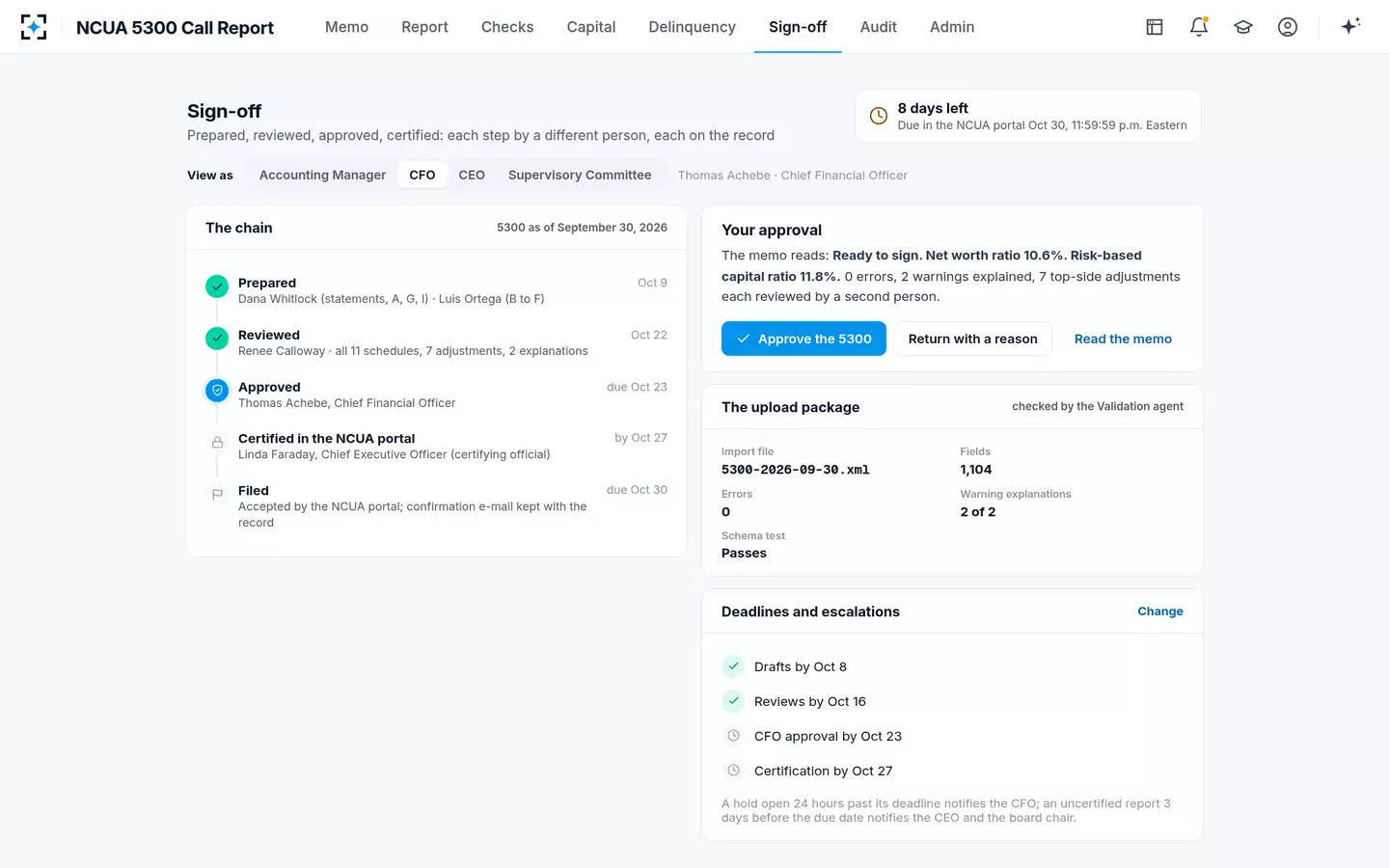
The second lane is a choice the solution makes possible rather than a promise. In NCUA 5300 Call Report the internal deadlines are settings, and escalation is on by default: a hold left open 24 hours past its deadline goes to the CFO, and a report still uncertified three days before the due date goes to the CEO and the board chair. In the sample quarter the CFO's memo arrived on October 22 with eight days left and two decisions to make, rather than eleven schedules to read.
Deadlines and escalations in NCUA 5300 Call Report, eight days before the due date
Submitted is not finished: validation, corrections and amendments
A 5300 can be on time and still not be done. After submission the report waits to be validated by the regulator, and corrections after that are filed through CUOnline, and the FAQ is clear that the Profile has to be certified before any correction can go in. The NCUA or a state supervisor may also require an amended report for a significant error in where an item was classified, or for any error that is material to the credit union, measured against the FASB's definition of materiality (both tests are quoted in 5300 call report instructions).
That is the deadline's real trade-off. Every hour saved at the end by skipping a check can come back later as a correction, and an uncorrected error carries the same daily penalty as a late report. The 5300 instructions in plain words covers amendments in detail.
A late-day playbook for the NCUA call report deadline
The checklist below is what a CFO should have in place before the cycle starts, so that a sick day, a system outage or a late adjustment on the 29th does not become a late filing.
Before each cycle: eight steps that keep the 5300 on time
- Put the 30th and the day of the week in the calendar
Two 2027 due dates fall on a Saturday; plan to finish on the Friday.
- Set internal deadlines backwards from the due date
Drafts, reviews, CFO approval and certification, each with a named owner.
- Keep two registered CUOnline users who can submit
And make sure both can certify the Profile, which must come first.
- Check the Profile contacts
Reminders go to the Call Report Contact and Manager or CEO roles; a stale Profile means missed warnings.
- Run the NCUA’s errors and warnings on the draft
Using the edit file the NCUA publishes for this cycle, before anything is uploaded.
- Draft warning comments early, from evidence
CUOnline will not accept the report until every warning has a comment.
- Write the procedure down, and follow it
The lowest penalty tier is only for credit unions with procedures reasonably adapted to avoid errors.
- Know who to call if it goes wrong
CallReportLateFiler@NCUA.gov or 703-518-6367 for special circumstances; OneStop at 1-800-827-3255 for technical problems.
The people side of the deadline, who carries it at a small credit union and what happens when that person is out, is on the credit union CFO job description. The solution that moves the drafting to the start of the cycle is NCUA 5300 Call Report.
Questions people ask
What time is the 5300 due?
By 11:59:59 p.m. Eastern time on the due date, which is the 30th of January, April, July and October. CUOnline automatically validates reports in Submitted status at 10:00:01 p.m. and 12:00:01 a.m. Eastern, so a report submitted late in the evening has no time for a second look.
Is the 5300 due date moved when the 30th is a weekend?
Neither the instructions nor the CUOnline page provides for it: both give the 30th, and late days are counted in calendar days because CUOnline is available every day. The safe plan is to file by the preceding Friday; January 30, 2027 and October 30, 2027 are Saturdays.
When did the NCUA start fining late call reports again?
Penalties were suspended after the December 2019 cycle because of the pandemic and reinstated effective January 1, 2024, starting with the report due January 30, 2024. The NCUA said the December 2023 cycle would be the first under the reinstated program, and its published list of consent orders since then begins in 2024.
Is a late penalty charged per day?
The statute sets each tier as a maximum for every day the failure continues or false information is not corrected. The orders the NCUA has published for 2024 and early 2025 were for a few hundred to about thirteen hundred dollars each.
Does filing on time protect us if the 5300 is wrong?
No. The same statute penalizes a false or misleading report for each day it is not corrected, and rule 741.6 requires a corrected Call Report as soon as the need is discovered. The NCUA or a state supervisor may also require an amended report for significant classification errors or material errors.