The 5300 call report instructions are the NCUA's manual for Form 5300, the quarterly Call Report every federally insured natural person credit union files. The current edition is Version 2025.1, "Effective September 30, 2025 Until Superseded", and it goes with the form "Effective March 31, 2025", also Version 2025.1 (5300 instructions; Form 5300). Most of its pages explain individual account codes. The duties that sit above them are few: file every quarter through CUOnline by the 30th, on GAAP from $10 million in assets, accurately whatever method you use, correct errors as soon as they are found, and keep the copy. Botminds' NCUA 5300 Call Report drafts and checks the report against these instructions and the NCUA's published edits, and leaves the certification to the credit union's own officer.
The six duties the 5300 instructions and rule 741.6 put on every filer
“Every credit union is required to submit a quarterly Call Report using CUOnline.”
Instructions; 12 CFR 741.6(a)(2)“The Call Report submission date is the 30th day of the month following the quarter-end date.”
InstructionsStatements “must reflect U.S. generally accepted accounting principles (GAAP)” at $10 million or more.
Instructions; 12 CFR 741.6(b)The credit union “is responsible for ensuring that the data reported each quarter reflects fully and accurately the reporting requirements”.
InstructionsCredit unions “must submit a corrected Call Report upon notification or the discovery of a need for correction.”
12 CFR 741.6(a)(2)Part 749 requires “either a hard copy or an electronic copy in their permanent records.”
5300 FAQsWhat is the NCUA 5300 call report?
The 5300 is the quarterly financial and statistical report a federally insured credit union files with the NCUA: a Statement of Financial Condition, a Statement of Income and Expense, and nine supporting schedules, A to I. The form says it "includes the quarterly financial statement and 9 schedules", that every credit union completes the two statements every period, and that "Schedules A through I require your input only as applicable" (Form 5300). The collection is "mandatory under 12 U.S.C. 1756, 1766, and 1782", and "except for selecting sensitive items, the Call Report Form 5300 is not given confidential treatment" (Federal Register, October 9, 2026): once validated, it is public.
The NCUA uses it for almost everything it knows about a credit union between examinations. The prompt corrective action category is computed from it, its Financial Performance Report is built from it, and the agency's supervisory models read it. That is why the instructions spend their few general paragraphs on accuracy and correction rather than on format.
Which 5300 instructions apply this quarter?
For the September 30, 2026 cycle, due October 30, 2026, the instructions effective September 30, 2025 apply, with the form effective March 31, 2025. Both are Version 2025.1, and both are the documents the NCUA's CUOnline page links as current on October 27, 2026 (NCUA CUOnline). The edit file and the XML schema are different: the NCUA publishes them every cycle, so the files to use are the ones labeled September 2026.
What applies to the September 30, 2026 cycle, and where it is
| Document | Edition in force | What it governs |
|---|---|---|
| 5300 Call Report instructions | Version 2025.1, effective September 30, 2025 | How to report each account; the general instructions on submission, amendments and penalties |
| Form 5300 | Version 2025.1, effective March 31, 2025 | The pages, lines and account codes |
| Changes document | March 2025 | What changed in the form, including retired and replacement accounts |
| Errors and warnings (edit file) | September 2026 | The 983 checks CUOnline runs this cycle |
| XML schemas and account descriptions | September 2026 | The import file format, by charter type, and the account list |
| Profile Form 4501A instructions | September 2026 | The Profile that must be certified before the Call Report is submitted |
| 5300 FAQs | Current web page | The NCUA’s answers on specific accounts and schedules |
Two other places are worth checking each quarter. The NCUA's Letters to Credit Unions can change how something is reported; in 2026 so far there are three, on supervisory priorities, the operating fee and the loan rate ceiling, and none changes the Call Report (NCUA letters and guidance). And the Federal Register carries proposed changes before they reach the form: the next one, proposed on October 9, 2026, would add a stablecoin schedule from the March 31, 2027 report date. To correct a past quarter, use that quarter's edition from the archive, not today's.
The 5300 rulebook as of October 27, 2026
2025.1
version of both the form and the instructions now in force
9
schedules, A to I, completed only as applicable
983
published errors and warnings for the September 2026 cycle
0
NCUA letters issued in 2026 that change the Call Report
Who has to file the 5300, and which schedules apply?
Every federally insured natural person credit union files the 5300 quarterly; corporate credit unions file a different report, Form 5310, monthly. Rule 741.6 says "Natural person credit unions must file a Call Report with NCUA quarterly in accordance with the instructions in the NCUA Form 5300" (12 CFR 741.6). Within the 5300, the two statements are always required; each schedule is triggered by what the credit union has.
Schedules A to I: when each one applies
| Schedule | Complete it if the credit union has | Notes |
|---|---|---|
| A · Loans (Sections 1 to 8) | Any loans; delinquent loans; charge-offs or recoveries; indirect, purchased or sold, real estate or commercial loans | Most sections tie back to Section 1 |
| B · Investments | Securities classified available-for-sale, held-to-maturity or trading; time deposits | Sections 1 to 4 |
| C · Liquidity | Unfunded commitments, off-balance-sheet exposures, contingent liabilities or borrowings | Section 2 required above $500 million |
| D · Shares and members | Shares; every credit union reports its number of members | Includes the insured savings computation |
| E · Supplemental | Grants, employees, new branches, remittances, CUSOs or money services businesses | |
| F · Derivatives | Derivative contracts | |
| G · Capital adequacy | A total assets election, CECL, a qualifying merger or subordinated debt in net worth | Net worth (Account 997) and the net worth ratio |
| H · CCULR | Assets over $500 million and an election into the complex credit union leverage ratio | |
| I · Risk-based capital | Assets over $500 million | The ratio applies unless the CCULR is elected |
Do credit unions under $10 million need GAAP?
Not always. The instructions say the Call Report financial statements "must reflect U.S. generally accepted accounting principles (GAAP) in federal credit unions with total assets of $10 million or greater", that federal credit unions under $10 million "may reflect regulatory accounting principles other than GAAP", and that state-chartered credit unions "may be required by their state credit union supervisor to follow GAAP regardless of asset size" (5300 instructions).
The crossing point has no grace period. Asked how long a credit union has to adopt CECL once it reaches $10 million, the NCUA's FAQ answers: "Unfortunately, there is no official lag in time", and "the expectation is that the credit union will adopt CECL in its Call Report filing in the same quarter that the $10 million asset threshold is reached" (5300 FAQs). A separate $10 million line matters for capital: a "new" credit union, under 10 years old and with assets of $10 million or less, reports its net worth classification on a different line of Schedule G.
What changed in the September 2025 instructions?
The September 2025 edition added a general instructions section and clarified a dozen account definitions; it did not change the form. Its revision list opens with: "Added a section for general Call Report instructions with information on preparing, submitting, and amending Call Reports, merging credit union Call Reports, new charter Call Reports, and Civil Money Penalties." Other items tie nonmember deposits on page 3 to Schedule D ("must equal the Total Nonmember Deposits reported in Account SH0880"), add Visa Class B-1 and B-2 stock as an example of other assets, name core deposit intangibles among other intangible assets, and restrict the allowance in Account 719 to credit unions that have not adopted CECL.
The NCUA's own account of the process is modest. It received three comment letters on the proposal; one asked it to put technical instructions into "plain language or flowcharts", and the NCUA said it "will consider providing additional information on final changes when the instructions are released" (Federal Register, July 18, 2025). This guide is one way of meeting that request; the instructions themselves remain the authority.
When must a credit union amend its call report?
Whenever it finds an error, and whenever the NCUA or its state supervisor requires it. The form puts the first duty bluntly: "If a previously submitted Call Report contains errors, inaccurate information, or omissions, you must correct and resubmit" (Form 5300). Rule 741.6 says the same: credit unions "must submit a corrected Call Report upon notification or the discovery of a need for correction".
The instructions describe when a supervisor will require an amendment: for "significant errors in how the credit union classified or categorized items", and for errors "that are material for the credit union", with materiality taken from the FASB's Concepts Statement No. 8: "The omission or misstatement of an item in a financial report is material if, in light of surrounding circumstances, the magnitude of the item is such that it is probable that the judgment of a reasonable person relying upon the report would have been changed or influenced by the inclusion or correction of the item" (5300 instructions).
A classification error can be significant without being large. Materiality is about the reader's judgement, not only the size of the number.
Delay has a price. The Federal Credit Union Act's penalties for a false or misleading report run every day the information stays uncorrected (12 U.S.C. 1782(a)(3); NCUA call report deadline sets out the three tiers). Corrections go through CUOnline, with the Profile certified first: the FAQ says "the Profile must be certified before you can submit corrections to a 5300 Call Report".
Where are the latest 5300 instructions, and what else to download each cycle?
The latest instructions, form and changes document are linked from the NCUA's CUOnline page, under "Call Report Reporting Forms and Documents"; the cycle-specific files are lower on the same page. The checklist below is the set a preparer should download at the start of every cycle, before the first figure is drafted.
Download at the start of every 5300 cycle
- The instructions and the form
Check the version and effective date; Version 2025.1 is current until superseded.
- The changes document
Retired, replaced and new account codes, with the reason for each.
- The cycle’s errors and warnings file
September 2026 for the September 30, 2026 report; it lists every edit, its formula and its message.
- The cycle’s XML schema for your charter type
Federal, federally insured state-chartered, or non-federally insured.
- The account descriptions file
The NCUA recommends it for anyone building or checking an import file.
- The 4501A Profile instructions
The Profile has to be certified before the Call Report can be submitted.
- The 5300 FAQs
Answers on specific accounts, from overdrawn shares to nonaccrual loans.
- Any Federal Register notice on Form 5300
Proposed changes appear there months before they reach the form.
What is the 4501A Profile, and why does it come first?
The 4501A Profile is the credit union's register entry with the NCUA: officials, contacts, sites, services and systems. Its instructions cite rule 741.6(a)(1) and section 111(b) of the Federal Credit Union Act and require a Profile "within 10 days of electing or appointing senior management or volunteer officials, or within 30 days of changing any information required to be reported", and add that "credit unions must ensure their profile information is accurate and certify their information quarterly" (Profile 4501A instructions, September 2026).
It comes first in the cycle because CUOnline enforces the order: "Users will not be able to submit the Call Report until the Profile is certified." It also decides who hears from the NCUA, since reminder e-mails go to the "Call Report Contact" and "Manager or CEO" roles listed on it. A certifier who signs the Profile without reading it can certify contacts who left months ago.
Reading the instructions as the certifier
The person who certifies the 5300 does not need to know every account code; they need to know that someone did, and that someone else checked. The Federal Credit Union Act asks an officer to declare that, as far as that officer knows and believes, the report is true and correct (12 U.S.C. 1782(a)(1); quoted in credit union CFO job description). Knowledge, in practice, means three things: the current instructions and edits were used, every warning has a comment someone accepted, and the schedules tie to the general ledger and the core.
What the certifier sees in NCUA 5300 Call Report before approving
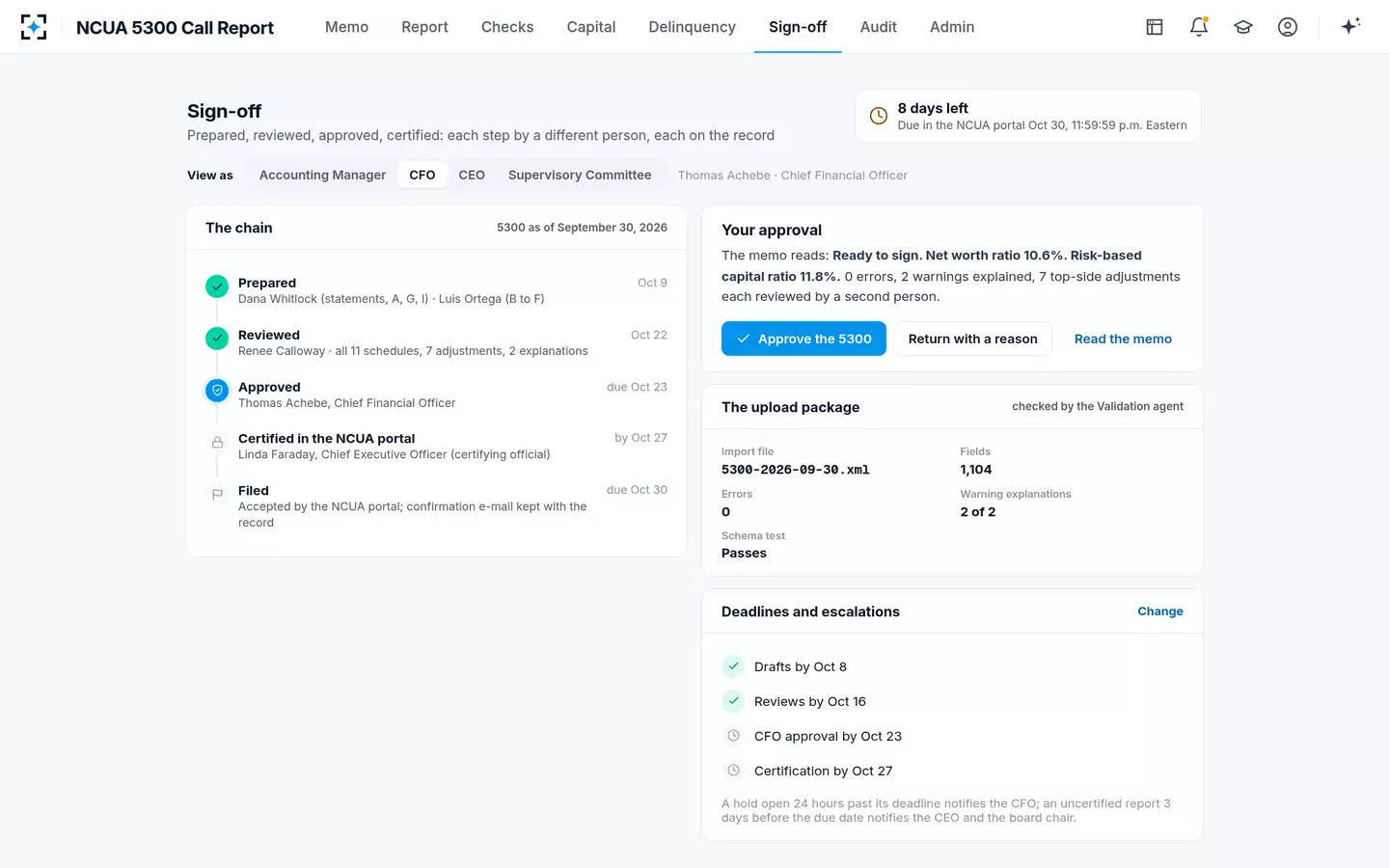
NCUA 5300 Call Report is built to make those three things visible. Each drafted field opens to its general ledger accounts or records; the Validation agent runs the cycle's published errors and warnings and schema test on the draft; and each warning comment shows who drafted it, who accepted it and the evidence it cites. The due dates and penalties and who carries the 5300 at a small credit union are covered separately; the solution is on NCUA 5300 Call Report.
Questions people ask
What is a 5300 report?
It is the NCUA Form 5300 Call Report: the quarterly statement of financial condition, income statement and Schedules A to I that every federally insured natural person credit union files through CUOnline. Once validated, most of it is public, and the NCUA builds each credit union's Financial Performance Report from it.
Are the 5300 instructions updated every quarter?
No. The instructions and form are revised when the NCUA changes them, after notice in the Federal Register; both are now Version 2025.1. The edit file, the XML schemas and the account descriptions are republished every cycle.
Which instructions do we use to correct an old Call Report?
The edition that applied to that quarter. The CUOnline page points to the NCUA's Call Report Forms and Instructions Archive for anyone revising previously filed reports.
Do the 5300 instructions apply to state-chartered credit unions?
Yes, if they are federally insured: rule 741.6 applies to insured credit unions, and the CUOnline page publishes a separate XML schema for federally insured state-chartered credit unions. Their state supervisor may add requirements, such as GAAP below $10 million.
How long must we keep our filed 5300s?
Permanently. The NCUA's FAQ says Part 749 of its regulations requires credit unions to keep either a hard copy or an electronic copy of the 5300 in their permanent records.