Credit union call reports are the quarterly 5300 filings every federally insured credit union submits to the NCUA: public once validated, the basis of each credit union's Financial Performance Report, and the first thing an examiner reads. They are only as reliable as the review behind them. At C B S Employees Federal Credit Union, a $21 million credit union in Southern California, the NCUA's examiner found in 2016 "errors in the Call Report and a lack of secondary review of items reported in the Call Report". The chief executive had "sole responsibility for financial reporting". In 2019 an embezzlement of about $42.2 million, running for some 20 years, came to light, and the credit union was liquidated with an estimated $39.5 million loss to the share insurance fund (NCUA OIG-20-01). Botminds' NCUA 5300 Call Report gives every schedule a preparer and a different reviewer; this case shows why that is the control to start with.
C B S Employees Federal Credit Union, from the Inspector General's report
$21M
total assets on its final Call Report, December 31, 2018, with 2,798 members
$42.2M
embezzled by the former chief executive over about 20 years
2
CAMEL composite rating at the 2016 and 2017 examinations
$39.5M
estimated loss to the National Credit Union Share Insurance Fund
What credit union call reports are, and who reads them
A credit union call report is NCUA Form 5300: the statement of financial condition, the income statement and Schedules A to I, filed quarterly through CUOnline. Once the regulator validates it, "it is available to the public" (CUOnline user guide), on the NCUA's Research a Credit Union site and in its quarterly data downloads. Members, analysts and other credit unions can read it; the NCUA reads it most closely of all, through its examiners, its Financial Performance Reports and a machine-learning model that flags items outside a predicted range.
All of those readers share one assumption: that the figures came from the credit union's books and that somebody other than the preparer checked them. The 5300 instructions put the responsibility on the institution whatever method it uses to file (5300 instructions; quoted in NCUA call report software). The C B S case is what happens when that assumption is wrong for years.
The case: one person held every key
The Inspector General found that the credit union "failed due to misappropriation of approximately $42.2 million in cash, due to fraud", which the former chief executive "concealed ... by understating member share balances on the financial statements, primarily related to share certificates". He posted entries "directly to general ledger account #XXXXXX, Regular Shares", so that share liabilities on the reports were lower than the members' balances added up to, and wrote official checks to himself and his companies from a clearing account (NCUA OIG-20-01). The flow below shows the duties he held alone, and where a second person would have stood.
Who held each duty at C B S, and where a second person would have stood
Held aloneHe “performed almost all recordkeeping functions, including posting of journal entries”.
Missing reviewA reconciliation of the share subledger to the general ledger by someone else.
Held alone“Super-user” access let him delete check payees and alter the file maintenance reports that would have shown it.
Missing reviewA reader of the file maintenance reports, “which track changes made to the accounting records”.
Held alone“Sole responsibility for financial reporting” gave him “the ability to prepare fraudulent financial statements”.
Missing review“Someone other than the preparer” for “a thorough second review of manual calculations and entries”, as the 2016 examiner required.
Held aloneDone through the supervisory committee and an outside firm, on statements printed from his system.
Missing reviewA reconciliation of the printed statements to the share and loan subledgers.
The reports he filed balanced. The Inspector General noted that he "appears to have spent considerable time and effort concealing his fraudulent activities and creating fraudulent financial statements that were in balance as of the dates requested, most commonly as of quarter end". The table shows what the balance sheet looked like as reported, and what it was.
As reported, and as corrected: the balance sheet at February 28, 2019
| Line ($ thousands) | Fraudulently reported | Corrected |
|---|---|---|
| Cash, missing | — | 42,157 |
| Cash | 7,461 | 7,461 |
| Other assets | 15,182 | 15,182 |
| Total assets | 22,643 | 64,800 |
| Share certificates | 4,900 | 45,191 |
| Other shares | 15,074 | 16,940 |
| Other liabilities | 24 | 24 |
| Equity | 2,645 | 2,645 |
What the 2016 examiner found, and what happened next
The warning was in the examination file three years before the fraud surfaced. At the examination effective March 31, 2016, the examiner in charge found errors in the Call Report and the missing second review, and told the credit union to "ensure someone other than the preparer performs a thorough second review of manual calculations and entries in the CU Online system". The Inspector General then records: "During the next examination, which was effective December 31, 2017, this was not included as an examiner's finding." The 2017 risk assessment noted "Limited dual controls due to the personnel available at a small credit union", and the CAMEL composite stayed at 2.
C B S Employees Federal Credit Union, date by date
| Date | What happened |
|---|---|
| 1961 | Chartered by the NCUA to serve employees of C B S, Inc. in nine western states. |
| March 31, 2016 examination | Call Report errors and no secondary review found; second review required. CAMEL composite 2. |
| December 31, 2017 examination | Second-review finding not repeated; limited dual controls noted. CAMEL composite 2. |
| December 31, 2018 Call Report | Its last: total assets $21 million, 2,798 members, about $3.5 million of share certificates while offering 3.1% on a one-year certificate. |
| About March 10, 2019 | The office manager, stopping payment on a member’s check, notices a large check made out to the chief executive. |
| March 11–12, 2019 | The board reports the theft to the NCUA; the chief executive is suspended. |
| March 29, 2019 | Order of Liquidation signed, within three weeks of uncovering the fraud; projected loss $39.5 million. |
| September 16, 2019 | The former chief executive is sentenced to 169 months in prison and ordered to pay $40,541,130 in restitution to the NCUA. |
| February 11, 2020 | The Inspector General publishes its material loss review, with two recommendations the NCUA accepts. |
The fraud was found by a member's ordinary request, not by any review of the reports. And once the chief executive was removed, "the remaining Credit Union employees struggled to produce basic reports such as General Ledger reports and Trial Balances because the former CEO had never allowed them access to these functions within the accounting system". One person preparing the Call Report was not only a fraud risk; it was a continuity risk the credit union could not run without.
Who should review a credit union call report?
Someone other than the preparer, with the skills, authority and system access to check it against the books. The Inspector General describes the control precisely: "a separate individual with appropriate skills, authority, and access to the accounting system to review and approve documentation prepared by a different person", and says that with it "this type of fraud would be much more difficult to conceal". It names what that person should look at: "the reconciliation between the share subsidiary ledger and the general ledger, file maintenance reports, which track changes made to the accounting records, and the supporting documentation used in financial statement preparation" (NCUA OIG-20-01).
The examiner asked for one thing in 2016: someone other than the preparer. Every later loss in this file passed through that missing person.
The reviewer does not have to be an accountant of equal rank. At a small credit union it can be the board's financial officer, an employee from operations trained to read the share reconciliation, or an outside accountant engaged for the purpose. What matters is independence from the preparer and real access: a reviewer who can only read the reports the preparer prints is checking the preparer's arithmetic, not the books.
What is the supervisory committee's role in the call report?
The supervisory committee must make sure the Call Report requirements are met and that controls guard against fraud; it does not prepare the report. Under 12 CFR 715.3 the committee "must ... ensure that the credit union adheres to the measurement and filing requirements for reports filed with the NCUA Board under § 741.6", and must determine whether "policies and control procedures are sufficient to safeguard against error, conflict of interest, self-dealing and fraud" (12 CFR 715.3). It also obtains the annual supervisory committee audit and the verification of members' accounts.
At C B S both existed on paper. An outside party performed the audits, which "merely consisted of checklists", with steps that "were outdated". The member verifications were done, but with no evidence of "a fundamental procedure to reconcile the share subsidiary to the statements printed by the print processor", without which "there is no way to ensure the list of verified accounts represents an accurate and complete listing of a credit union's member accounts". Examiners did not review the audit workpapers in 2016 because the outside firm "would have charged $300 to copy workpapers". The Inspector General's second recommendation, which the NCUA accepted, was to require that reconciliation whenever a statement verification is performed.
What are red flags in a credit union call report?
Some red flags show in the report itself; the most important show in how it was made. The Inspector General's first observation is the second kind: "Lack of segregation of duties and lack of dual controls are two of the most significant indicators of potential fraud risk." The first kind was there too. On its December 31, 2018 Call Report the credit union "reported approximately $3.5 million in share certificates", while offering 3.1% on a one-year certificate, "significantly above the market rate of approximately 1.3 percent at the time"; the report found "no documentation in the Examination Reports that examiners questioned these above-market rates".
Red flags a board, a supervisory committee or an examiner can test
- One person prepares, posts and files
The OIG’s first observation: lack of segregation of duties and dual controls is among the most significant indicators of fraud risk.
- Rates that do not match the balances
Above-market certificate rates with a small reported certificate book, as at C B S in December 2018.
- Reports always in balance, only at quarter-end
The fraudulent statements balanced “as of the dates requested, most commonly as of quarter end”; ask for a mid-quarter share reconciliation.
- Nobody else can produce a trial balance
After the chief executive left, staff “struggled to produce basic reports such as General Ledger reports and Trial Balances”.
- A share subledger that is never reconciled to the general ledger by someone else
The reconciliation the OIG says a separate reviewer should have performed.
- Audits that are checklists
Supervisory committee audits without workpapers that show the procedures were done.
- Member verifications without the print reconciliation
Statements must be reconciled to the share and loan subledgers, or the verified list may be incomplete.
- An examiner finding that is not closed
The 2016 second-review finding disappeared from the next examination; the board should track it to closure.
How can a small credit union separate duties?
By separating the few duties that matter most, even if the same people share everything else. Small staffs are the norm: of 4,214 federally insured credit unions at June 30, 2026, only 748 had assets above $500 million, and the NCUA examines most federal credit unions of $50 million or less under a defined scope (Letter 26-CU-01). The 2026 supervisory priorities letter says examiners will keep reviewing "the adequacy of internal controls and separation of duties to guard against insider abuse".
The C B S file suggests the minimum. Whoever prepares the 5300 should not be the only person with administrator rights to the core and accounting system. Someone else should reconcile the share and loan subledgers to the general ledger each quarter and read the file maintenance report. The person who submits in CUOnline should be able to show what they reviewed. And at least one other employee should be able to produce the trial balance. None of those needs a second accountant; each needs a second person.
What a second review checks that the NCUA's edits cannot
The NCUA's published edits test whether a report is possible; a second review tests whether it is true. The 983 errors and warnings in the September 2026 edit file check accounts against each other and against the last quarter (NCUA edit file). A report built from a falsified general ledger passes them, because it is internally consistent. That is what "in balance as of the dates requested" means.
What the NCUA's edits check, and what only a second person checks
NCUA errors and warnings: Itself and the prior quarter’s report.
An independent second review: The share and loan subledgers, the general ledger detail and the documents behind each entry.
NCUA errors and warnings: Not the fraud: understated shares and assets balanced on the report.
An independent second review: Possibly, and much sooner: the share subledger and the general ledger disagreed, by about $42.2 million at the end.
NCUA errors and warnings: The report only.
An independent second review: The accounting system, the file maintenance reports and the preparer’s support.
NCUA errors and warnings: CUOnline: errors block submission; every warning needs a comment.
An independent second review: The examiner’s 2016 finding; the supervisory committee’s duties under 12 CFR 715.3.
Where the agents fit, and where they do not
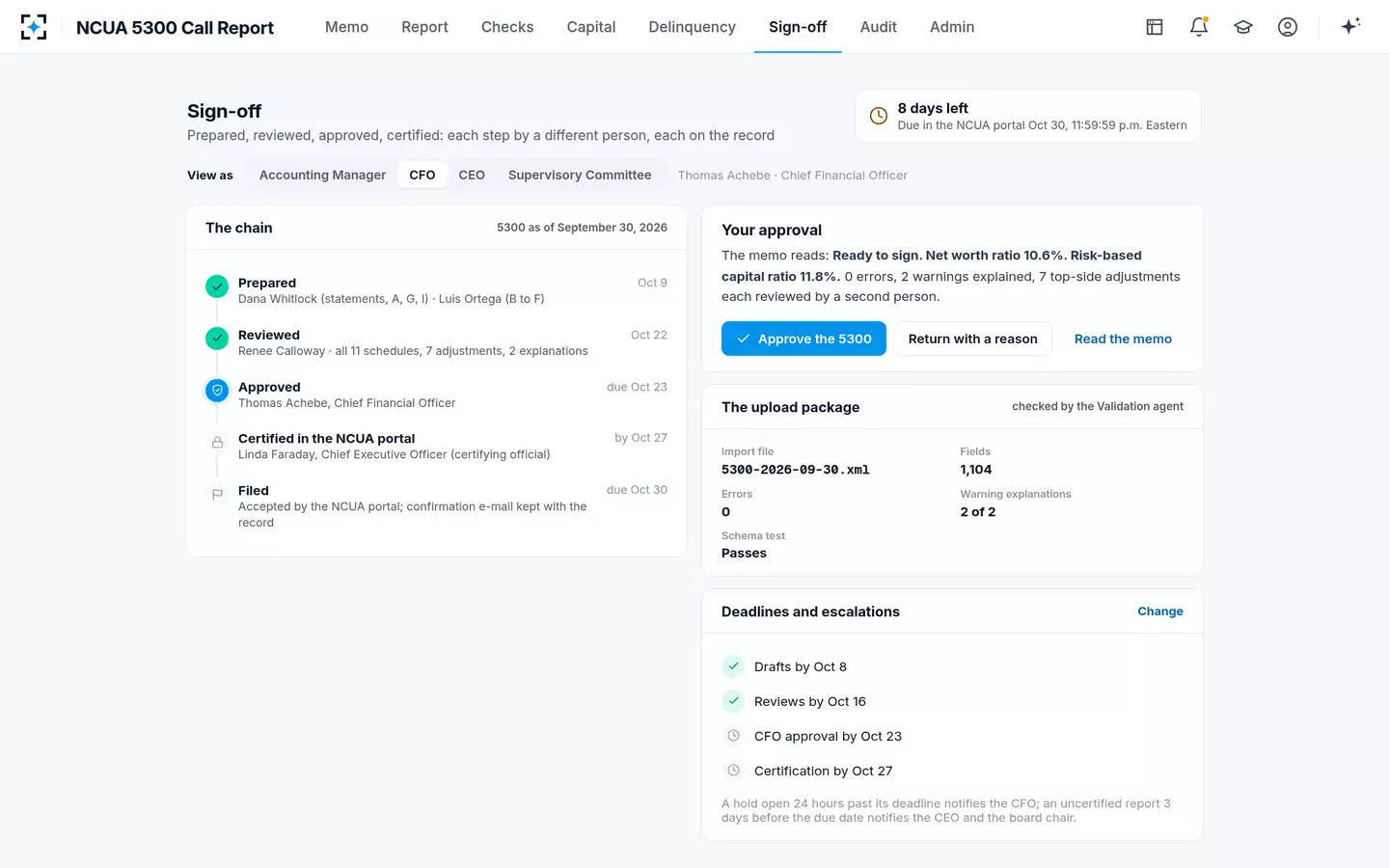
Agents can make the second review fast and thorough; they cannot be the second person. In NCUA 5300 Call Report a Reconciliation agent ties each schedule to the general ledger and to the core's subledgers and to the prior filing, and opens a break wherever they disagree; the agents never post to the general ledger, never clear a break themselves, and never upload or certify. Every schedule, adjustment and explanation has a preparer and a different reviewer, enforced by the system rather than by habit, and the administrator who configures the solution never prepares or approves.
Separation of duties as a setting in NCUA 5300 Call Report
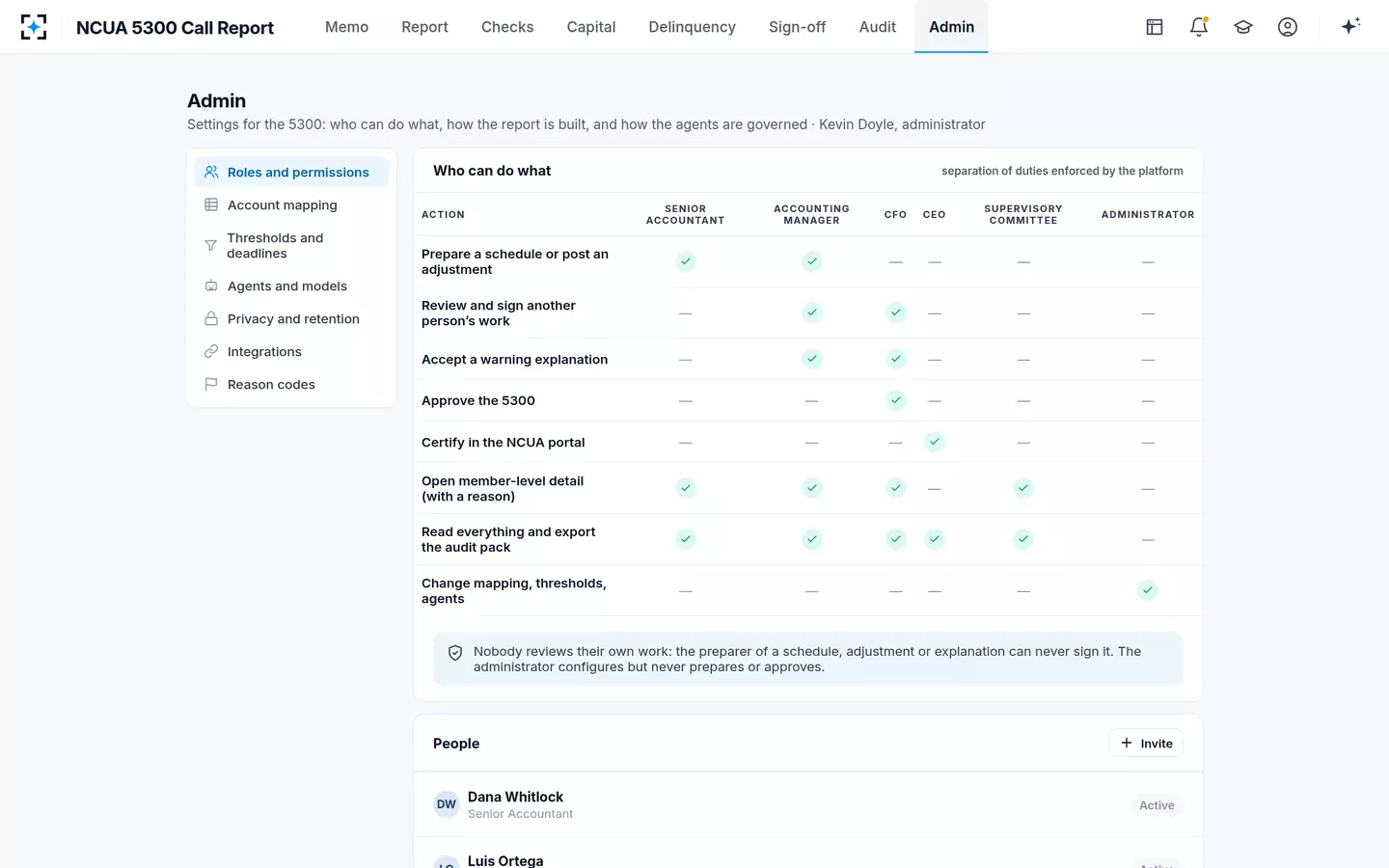
The trail matters as much as the tie. Every preparation, review, adjustment, explanation and approval is recorded with who did it, when, why and on what evidence, and one export assembles it for NCUA examiners, the supervisory committee, internal audit or the external auditor, with member and loan numbers masked. What no software supplies is the independence: a credit union with one person in finance still has to find a second one. The credit union CFO job description writes that duty into the role.
The sign-off chain in NCUA 5300 Call Report: a different person at each step
Where can I find a credit union's call report?
On the NCUA's Research a Credit Union site, which lets anyone "view information for a specific credit union, download Call Reports, and request Financial Performance Reports" (NCUA, Research a Credit Union). Bulk quarterly data for all credit unions is on the NCUA's quarterly data pages (NCUA quarterly data), and the NCUA says peer averages for the latest cycle "are normally available within six to eight weeks following the cycle date" (NCUA Financial Performance Reports).
Reading one well means reading it as the Inspector General read C B S: rates against balances, shares against the general ledger, and the people behind the numbers. The delinquency ratio and the net worth ratio explain the two lines most readers start with; the solution is on NCUA 5300 Call Report.
Questions people ask
What happened at C B S Employees Federal Credit Union?
Its long-time chief executive embezzled about $42.2 million over roughly 20 years and hid it with false entries and fraudulent financial statements, including Call Reports. A staff member noticed a suspicious check in March 2019; the NCUA liquidated the credit union on March 29, 2019, and he was later sentenced to 169 months in prison.
How much did the C B S Employees failure cost the share insurance fund?
The NCUA's Inspector General put the estimated loss to the National Credit Union Share Insurance Fund at $39.5 million. The court ordered $40,541,130 in restitution to the NCUA.
What did the NCUA OIG recommend after C B S?
Two things, both accepted by NCUA management: examination procedures that assess and respond to a lack of segregation of duties and dual controls, and guidance requiring member account verifications to reconcile printed statements to the share and loan subledgers.
Are credit union call reports audited?
Not separately. The annual supervisory committee audit, or a financial statement audit, covers the credit union's books, examiners review Call Reports during examinations, and 12 CFR 715.3 makes the supervisory committee responsible for seeing that filing requirements are met. We know of no NCUA rule requiring an independent audit of each quarterly 5300, which is why the second review before submission matters.
Can members see their credit union's call report?
Yes. Once the regulator validates a Call Report it is available to the public, apart from select sensitive items, and anyone can download it from the NCUA's Research a Credit Union site.