A credit union CFO owns one deadline that never moves: the NCUA 5300 Call Report, due in the NCUA's CUOnline system by 11:59:59 p.m. Eastern on the 30th of the month after every quarter-end. The standard federal credit union bylaws give the financial officer the duty to "ensure that financial and other reports the Administration may require are prepared and sent", and the NCUA now estimates that each 5300 takes 47 hours. At a small credit union one person often prepares, checks and submits it. The duty no single desk can perform is the second review. Botminds' NCUA 5300 Call Report is an agentic solution that drafts, ties and checks the 5300 from the general ledger and the core, so the CFO's quarter goes on review and sign-off rather than keying.
The 5300 part of the CFO's job, in four numbers
47hours
the NCUA’s estimate of the work in one 5300 filing, October 2026
4hours
the same estimate fifteen months earlier, July 2025
4,214
federally insured credit unions filing every quarter, June 30, 2026
748
of them “complex”, over $500 million, with a risk-based capital measure too
What does a credit union CFO do? The duties the bylaws write down
A credit union CFO runs the money and the numbers that describe it: custody of the assets, complete books, a monthly statement to the board, and the reports the NCUA requires. For a federal credit union the duties are written into the standard bylaws, which the NCUA publishes as Appendix A to Part 701 of its rules. Article VII, Section 6 says the financial officer will "have charge over all funds, securities, valuable papers and other assets", "provide and maintain full and complete records of all the assets and liabilities", and, "within 20 days after the close of each month, prepare and submit to the board a financial statement showing the condition of this credit union as of the end of the month, including a summary of delinquent loans" (Federal credit union bylaws, Art. VII §6).
The next clause is the one that puts the 5300 on the job: the financial officer will "ensure that financial and other reports the Administration may require are prepared and sent". The bylaws' financial officer is a board officer, elected by the directors. Section 7 lets the board appoint a management official and "assign any or all of the responsibilities of the financial officer described in Section 6", which is how most federal credit unions of any size end up with a paid CFO or manager doing the work while a volunteer treasurer holds the board title. A role description should say which of the two owns the 5300, because the bylaws make one of them answerable for it. State-chartered credit unions answer to their own state's rules as well.
The rest of the role is set by what examiners look at. The NCUA's 2026 supervisory priorities letter names lending and the allowance for credit losses, interest rate and liquidity risk, and "earnings and capital adequacy" as the balance-sheet priorities, and says the delinquency rate and rolling 12-month loss rate across federally insured credit unions are "at its highest point in over a decade" (NCUA Letter 26-CU-01). Every one of those topics reaches the examiner first as a line on the 5300.
The 5300 is the deadline the CFO job cannot move
The 5300 is due on the 30th day of the month after each quarter-end, and nothing in the rules moves it. Rule 741.6 requires every natural person credit union to file the 5300 with the NCUA each quarter, following its instructions, and the instructions set "the 30th day of the month following the quarter-end date" (5300 instructions, September 2025). CUOnline accepts the report until 11:59:59 p.m. Eastern on January 30, April 30, July 30 and October 30. Late days are counted in calendar days, because CUOnline never closes. The full calendar for 2026 and 2027, with the weekends that fall on a due date, is on what a late day costs.
What has to be inside the report is just as fixed. The form is two financial statements and nine schedules; every credit union completes the Statement of Financial Condition and the Statement of Income and Expense, and Schedules A to I only where they apply (5300 call report instructions walks through each). The sample credit union used in this series, a fictional one of $6.8 billion, files 1,104 fields. The monthly cadence in the bylaws and the quarterly one in the 5300 run on the same close: the September statement goes to the board by October 20, and the September 5300 is due ten days later.
How many hours does the 5300 take? The NCUA's own estimate jumped to 47
The NCUA estimates 47 hours for one 5300 filing, nearly twelve times its previous figure. The agency publishes the estimate each time it renews the form under the Paperwork Reduction Act. In April and July 2025 it put the burden at 4 hours per response (Federal Register, April 23, 2025; July 18, 2025). In October 2026 it published 47.0 hours per response, 794,112 hours a year across 4,224 respondents, and said the estimate rose because the public told it the old one was too low, in feedback gathered by its April 2026 request for information on streamlining data collection (Federal Register, October 9, 2026).
The NCUA's estimate of one 5300 filing rose from 4 hours to 47
The revision matters to a role description because it is the regulator's own number. Forty-seven hours a quarter is 188 hours a year, more than four forty-hour weeks of one person's time, on our arithmetic. It is also an average across credit unions of every size, so it hides the spread. For the fictional $6.8 billion credit union used in this series, Botminds estimates about nine working days of two accountants' time after the general ledger closes, and about three with the agents doing the drafting and tying. That is our estimate, kept modest, not a measured result.
Who prepares the 5300 at a small credit union?
At a small credit union the CFO or the manager usually prepares the 5300, and often the same person checks and submits it. Most filers are small: of the 4,214 federally insured credit unions at June 30, 2026, only 748 had assets above $500 million (NCUA, 2026 Q2). The NCUA runs "defined scope exams in most federal credit unions with assets of $50 million or less", which tells you how many of them there are. Below $10 million, a federal credit union may even prepare its financial statements on regulatory accounting principles rather than GAAP.
One desk, three jobs: the 5300 at a small credit union
Today
Maps general ledger accounts to 5300 account codes, keys the statements and schedules, pulls delinquency from the core.
With agents
Reviews schedules drafted from the general ledger and the core, each field showing the accounts behind it.
Still theirs: Judgement on classification and every adjustment
Today
Checks work they did themselves, usually the night before the due date.
With agents
Gets the NCUA’s published errors and warnings run before upload, and each move over threshold explained from evidence.
Still theirs: A second person still has to look
Today
Imports or keys the report in CUOnline and writes warning comments from memory.
With agents
Uploads a checked import file and comments a person has accepted.
Still theirs: Certifying in CUOnline
Can a small credit union outsource the call report? It can get help: CUOnline has a box to declare that "the credit union uses a third party to assist with updating the Profile and/or Call Report" (CUOnline user guide). It cannot hand over the responsibility. The instructions keep the credit union responsible for the accuracy of each quarter's figures whatever method it uses to file (quoted in NCUA call report software). Outsourcing moves the keying; the role description keeps the accountability.
Who certifies the 5300 call report?
The credit union's own authorized user certifies and submits the 5300 in CUOnline; the law asks for an officer's declaration that it is true and correct. The Federal Credit Union Act says each report of condition "shall contain a declaration by the president, by a vice president, by the treasurer, or by any other officer designated by the board of directors of the reporting credit union to make such declaration, that the report is true and correct to the best of such officer's knowledge and belief", and that, unless the NCUA Board waives it, three officers attest to its correctness (12 U.S.C. 1782(a)(1)).
In practice CUOnline, the NCUA's web system for submitting and certifying the report, is where that happens (NCUA call report software sets out what software may and may not do there). Its user guide gives credit unions two roles, Administrator and User, and both can input and submit a 5300 for their credit union; every user first needs an NCUA Connect account. The NCUA's reminder e-mails go to the "Call Report Contact" and "Manager or CEO" roles listed on the credit union's Profile. A CFO role description should therefore name who holds which CUOnline role, and the board should minute which officer makes the declaration, rather than leaving it to whoever has the password.
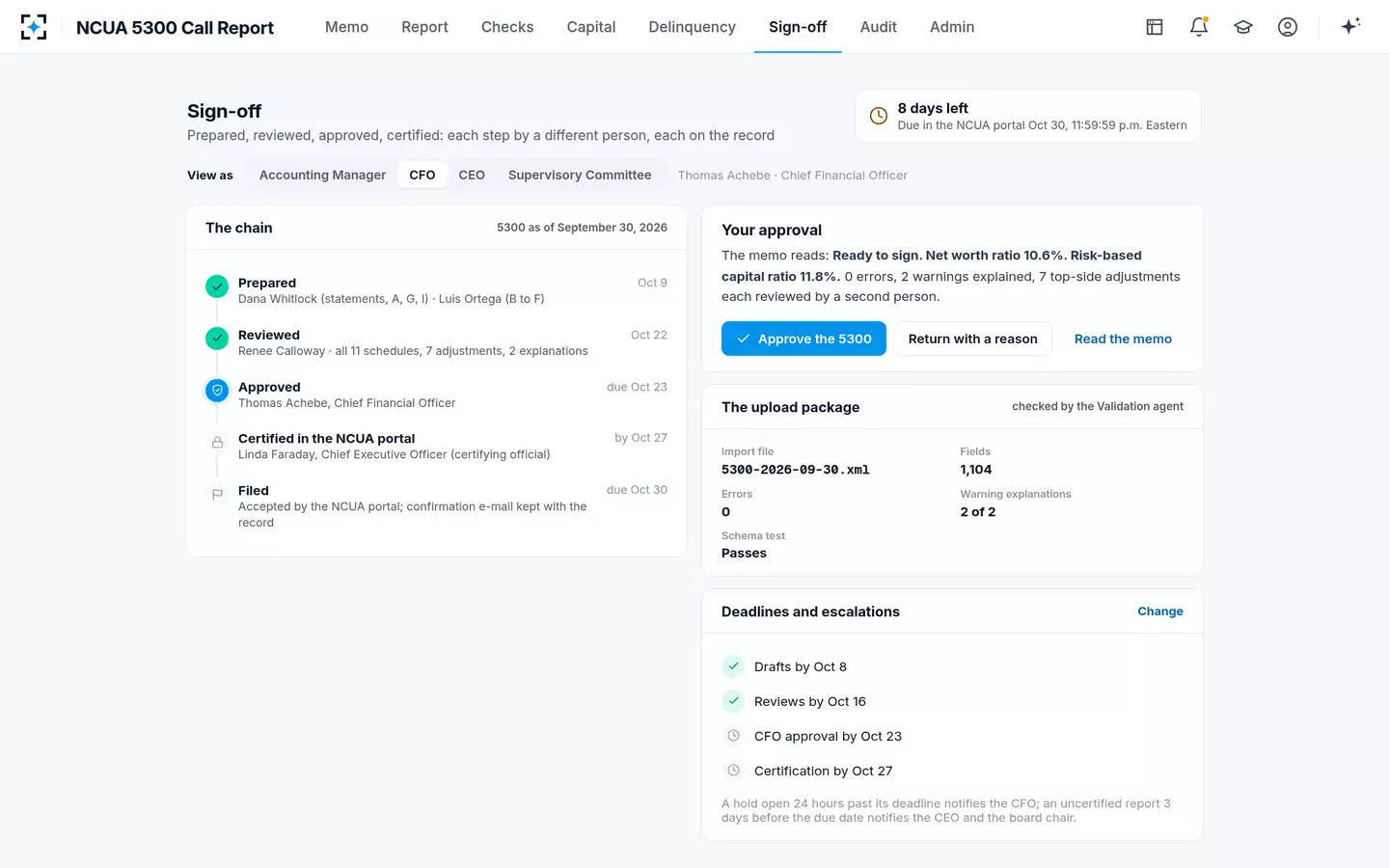
The sign-off chain as the CFO sees it in NCUA 5300 Call Report
What happens if the person who files the call report is out?
The deadline does not move, and the penalty clock runs in calendar days. The NCUA reinstated civil money penalties for late 5300s "effective January 1, 2024", after suspending them from the December 2019 cycle, and among the mitigating factors it weighs are a natural disaster or a key employee unable to work (NCUA, November 28, 2023). A mitigating factor is something argued after the fact, not an extension. The instructions give late filers an e-mail address and a voicemail line to report special circumstances; they give no grace period.
The practical answer belongs in the role description. Keep at least two registered CUOnline users who can submit, and remember that CUOnline blocks the Call Report until the Profile is certified (CUOnline user guide), so the backup needs the rights to do both. Write down where the trial balance, the account-code mapping and last quarter's filing live. CUOnline sends one- and two-day reminders to submit, and then a notice once the report is late and penalties can apply; by then the backup plan should already have run.
The numbers a credit union CFO answers for
The 5300 is also where the CFO's capital and credit numbers become official. Prompt corrective action is computed from it, so the thresholds below belong in any CFO role description as standing knowledge, not something looked up in October.
The thresholds the 5300 puts on the CFO's desk every quarter
| Measure | Where it comes from | The line that matters |
|---|---|---|
| Net worth ratio | Schedule G: net worth (Account 997) over total assets, rounded to two decimals | 7.0% or more is well capitalized; 6.0% to 6.99% adequately; below 6.0% undercapitalized or worse |
| Risk-based capital ratio | Schedule I, for credit unions over $500 million that do not opt into the CCULR | 10% or more to be well capitalized; under 8% is undercapitalized |
| Complex credit union leverage ratio | Schedule H, an option for qualifying complex credit unions | 9.0% or more counts as well capitalized |
| Delinquency ratio | Loans 60 days or more past due (Account 041B) over total loans (025B) | No regulatory floor; the system ran at 96 basis points in June 2026 |
Each line has its own traps. The net worth ratio can be computed on four different measures of total assets, and the choice is reported on the form; the net worth ratio, worked line by line goes through them. Delinquency has exclusions and special lines that move the ratio without anyone changing a loan.
The one duty a single desk cannot do: review its own work
One person can prepare, check and submit a 5300. No one can independently review their own work, and the NCUA's case files show what that costs. At C B S Employees Federal Credit Union, a $21 million credit union, the examiner in 2016 found Call Report errors and no second review of what was reported, and told the credit union to have someone other than the preparer check the manual calculations and the CUOnline entries. The former chief executive alone was responsible for financial reporting. When an embezzlement of about $42.2 million came to light in 2019, the credit union was liquidated with an estimated $39.5 million loss to the share insurance fund (NCUA OIG-20-01). The full case follows it year by year.
A small credit union can live without a second accountant. It cannot live without a second look at what the first one filed.
The rules already expect that look to happen somewhere. The supervisory committee must see that the credit union meets the measurement and filing rules for its reports to the NCUA, and must judge whether its policies and controls are enough to prevent error, conflicts of interest, self-dealing and fraud (12 CFR 715.3; quoted in credit union call reports with no second review). The 2026 priorities letter says examiners will look at whether internal controls and separation of duties are strong enough to stop insider abuse. A small credit union can meet that with an accountant from another area, a committee member trained to review the tie-outs, or an outside accountant; what it cannot do is let the preparer be the last person to see the report.
A credit union CFO role description, written around the 5300
Most CFO role descriptions list the 5300 in one line. The checklist below writes it the way the rules divide it, so that a new hire, a board and an examiner read the same job.
Eight 5300 lines for a credit union CFO role description
- Owns the quarterly 5300 and the 4501A Profile
Filed through CUOnline by 11:59:59 p.m. Eastern on the 30th of the month after each quarter-end; the Profile certified before the Call Report can be submitted.
- Prepares, or supervises the preparation of, the statements and Schedules A to I
Under the current form and instructions (Version 2025.1), with the general ledger mapped to 5300 account codes and reconciled.
- Arranges an independent review before submission
Someone other than the preparer checks manual calculations, entries and every warning comment.
- Explains every warning in writing
CUOnline will not accept a report until every warning has a comment and every error is fixed.
- Reports capital and asset quality to the board
Net worth ratio, risk-based capital or CCULR where it applies, and delinquency, with the monthly statement due within 20 days.
- Corrects the 5300 when an error is found
Rule 741.6 requires a corrected Call Report upon notification or discovery of the need.
- Keeps two trained CUOnline users
So that an absence on the 29th does not become a late filing counted in calendar days.
- Keeps each filed report permanently
The NCUA’s FAQ points to Part 749: a hard or electronic copy in the permanent records.
Where NCUA 5300 Call Report takes the hours, and what stays with the CFO
The agents take the hours that are mechanical and leave the judgement and the signatures where the rules put them. In NCUA 5300 Call Report a Preparation agent drafts the statements and schedules from the general ledger through the account-code mapping, the core's loan and share data and the investment accounting system, and cites each field's sources. A Reconciliation agent ties each schedule to the general ledger, the core and the prior filing; a Validation agent runs the NCUA's published errors and warnings and the import file schema test before anything is uploaded; a Capital agent computes the ratios; a Memo agent writes the CFO a one-page memo of the decisions still needed. None of them posts to the general ledger, uploads or certifies.
Who may do what in NCUA 5300 Call Report: nobody signs their own work
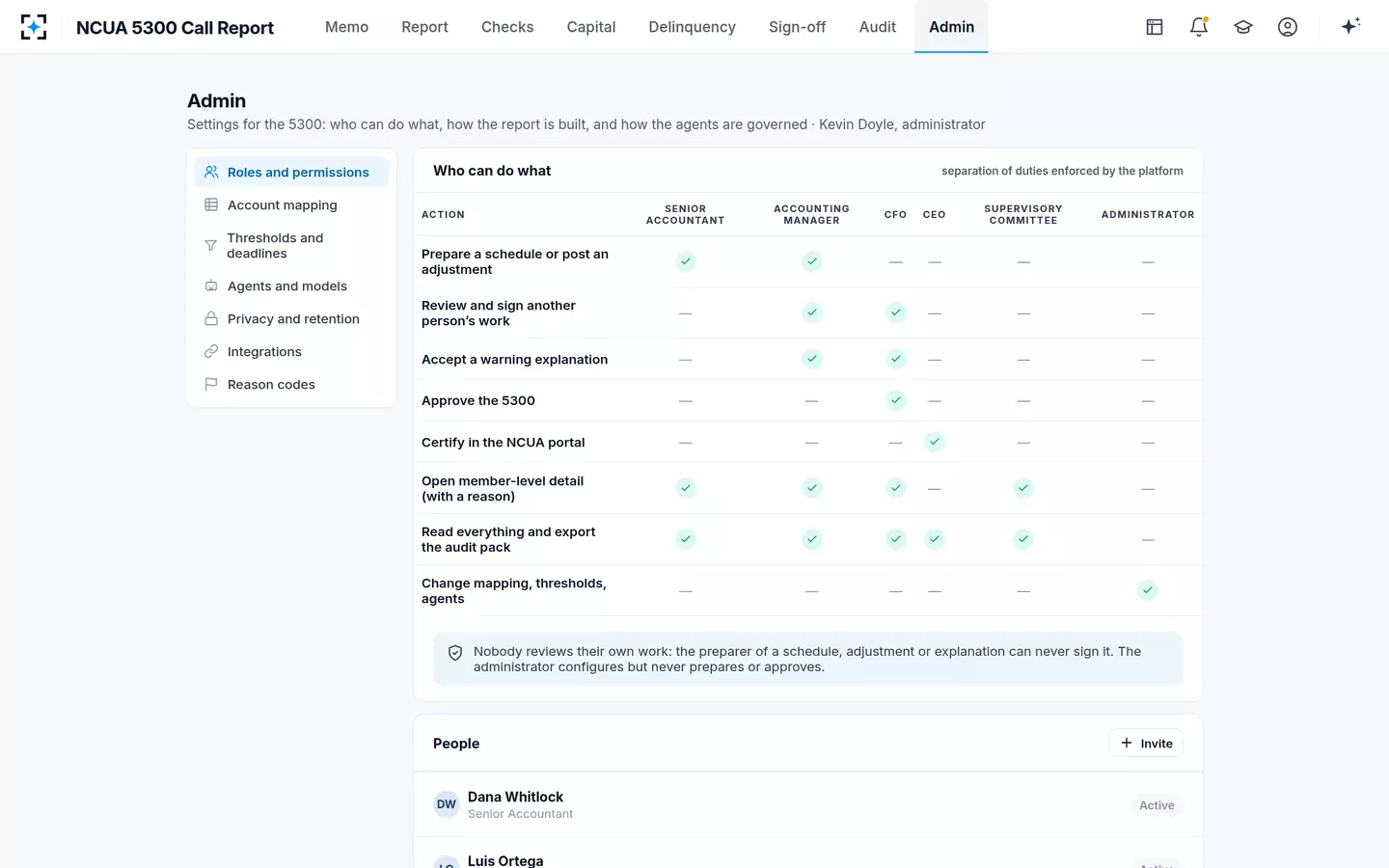
For a CFO that changes the shape of the quarter rather than its owner. The questions that reach the CFO arrive as a short memo with each number opening to its schedule line and its general ledger accounts, and the approval is still a signature. What to look for in any software that claims to do this is on NCUA call report software: seven agents and what none may do, and the whole solution, with its sample quarter screen by screen, is on NCUA 5300 Call Report.
Questions people ask
Is a credit union CFO the same as the treasurer?
Not necessarily. In the standard federal credit union bylaws the "financial officer" is a board officer elected by the directors, and the board may appoint a management official and assign that official any or all of the financial officer's duties. Many credit unions therefore have a volunteer treasurer on the board and a paid CFO or manager who does the work, including the 5300.
How often does a credit union CFO report to the board?
Monthly at least. The bylaws require a financial statement to the board within 20 days after each month-end, including a summary of delinquent loans, and posted in the office until the next one replaces it. The quarterly 5300 adds capital ratios and schedules on top of that statement.
Can a small credit union outsource the call report?
It can buy help with preparation, and CUOnline asks credit unions to declare when a third party assists with the Profile or the Call Report. The responsibility cannot be outsourced: the 5300 instructions hold the credit union responsible for accurate data whatever method it uses to submit.
Who gets the NCUA's reminder e-mails about the 5300?
The people listed in the "Call Report Contact" and "Manager or CEO" roles on the credit union's 4501A Profile. CUOnline sends one- and two-day reminders to submit and a notice when a report is late and subject to civil money penalties, so an out-of-date Profile can mean nobody gets the warning.
Does the CFO have to sign the 5300?
No rule names the CFO. The Federal Credit Union Act asks for a declaration by the president, a vice president, the treasurer or another officer the board designates, and the report is certified and submitted by an authorized CUOnline user. Many credit unions have the CFO approve the report and another officer certify it, which also gives them a second review.
What does the supervisory committee check about the 5300?
Under 12 CFR 715.3 the committee must ensure the credit union meets the measurement and filing requirements for reports filed with the NCUA, and that controls guard against error and fraud. It does not prepare the report; it checks that someone independent of the preparer has reviewed it.