The NCUA call report changes on the table are for March 2027. On October 9, 2026 the NCUA proposed revising Form 5300 to collect "data on a credit union's involvement with payment stablecoin activities", through a new Schedule J, Payment Stablecoin Activities, of 26 accounts, "proposed to take effect with the March 31, 2027, report date"; comments "must be received on or before December 8, 2026" (Federal Register, October 9, 2026). The September and December 2026 reports stay on the current form, Version 2025.1. The same notice raised the NCUA's estimate of the work in one 5300 from 4 hours to 47. Botminds' NCUA 5300 Call Report treats a form change as a change to its mapping and checks, made by the administrator and recorded as a new version, so the first 2027 cycle is drafted on the new form rather than patched onto the old one.
The March 2027 proposal in four numbers
26
accounts in the proposed Schedule J, Payment Stablecoin Activities
Dec 8
2026: the last day for comments on the proposal
Mar 31
2027: the first report date the revised form would apply to
47hours
the NCUA’s new estimate of one 5300 filing, up from 4
What are the NCUA call report changes for 2027?
One new schedule is proposed: Schedule J, Payment Stablecoin Activities, effective with the March 31, 2027 report date. The notice describes it as four groups of accounts, each of which "will enhance NCUA's offsite supervision", and says the proposed revisions "would not have a material impact on the existing burden estimates" (Federal Register, October 9, 2026). No other change to the form or instructions is listed in the notice. Until the revision is approved and published, the form effective March 31, 2025 and the instructions effective September 30, 2025 remain in force, as the NCUA's CUOnline page shows (NCUA CUOnline).
The 5300 today, and as proposed for March 31, 2027
Today (September and December 2026 cycles): Statements plus Schedules A to I, as applicable.
Proposed from the March 31, 2027 report date: Statements plus Schedules A to J; J is new.
Today (September and December 2026 cycles): No schedule collects it.
Proposed from the March 31, 2027 report date: 26 accounts on custody of reserve assets, key custody, exposure to issuers and stablecoins held.
Today (September and December 2026 cycles): Version 2025.1: form effective March 31, 2025; instructions effective September 30, 2025.
Proposed from the March 31, 2027 report date: A revised form and instructions, submitted to the Office of Management and Budget for clearance.
Today (September and December 2026 cycles): 4 hours per filing, in the July 2025 notice.
Proposed from the March 31, 2027 report date: 47.0 hours per filing, 794,112 hours a year; the change is not attributed to Schedule J.
Today (September and December 2026 cycles): 4,411 in the July 2025 notice.
Proposed from the March 31, 2027 report date: 4,224 in the October 2026 notice.
What is Schedule J on the 5300?
Schedule J is the proposed new schedule for payment stablecoin activities, in four parts. The notice lists them: "eight new accounts for reporting custody of reserve assets for permitted payment stablecoin issuer (PPSI) third parties", "nine new accounts for reporting cryptographic key custody and control", "five new accounts for reporting direct exposure to PPSIs", and "four new accounts for reporting payment stablecoins held on the credit union's balance sheet" (Federal Register, October 9, 2026). Eight, nine, five and four make 26.
Proposed Schedule J: 26 accounts in four parts
The notice does not reproduce the account codes or the instructions, so neither does this guide. What it does make clear is the shape of the data: two parts are about services a credit union might provide to others, custody of an issuer's reserves and custody of cryptographic keys, and two are about the credit union's own exposure. A preparer can already ask, for each part, which department would know the answer and which system, if any, holds it.
Do credit unions report stablecoins today, and who will have something to report?
Not on the 5300 as it stands; no schedule collects stablecoin data. The proposal follows federal legislation. The NCUA's 2026 supervisory priorities letter refers to the "continued implementation of Presidential executive orders and other laws, including the Guiding and Establishing National Innovation for U.S. Stablecoins (GENIUS) Act (P.L. 119-27)" (Letter 26-CU-01). In May 2026 the NCUA proposed rules for the issuance of payment stablecoins by subsidiaries of federally insured credit unions, noting that the GENIUS Act "charges the NCUA with licensing, regulating, and supervising Payment Stablecoin issuers that are subsidiaries of federally insured credit unions", and that it had proposed rules in February 2026 "to govern investments in and licensing of permitted payment stablecoin issuers" (Federal Register, May 18, 2026).
Most credit unions are likely to have nothing to report in most of the 26 accounts, at least at first. That does not mean nothing to do. CUOnline's rule today is that "all Call Report fields must have a value, even if that value is zero" (CUOnline user guide), while the form asks for most schedules "only as applicable" (Form 5300). Which of those conventions governs Schedule J will be settled by the final instructions. Either way, someone must be able to say, with evidence, that the credit union has no custody, key control, exposure or holdings to report, and an import file built without the new accounts will need to know what CUOnline does with them.
When do the new call report changes take effect?
With the March 31, 2027 report date, whose 5300 is due on Friday, April 30, 2027, if the proposal is approved as published. The notice says the NCUA "is submitting the following revised form and instructions of a currently approved information collection to the OMB for review and clearance", and that comments "will be summarized and included in the request for Office of Management and Budget approval". The final form, instructions and the March 2027 XML schema will then appear on the CUOnline page.
From the request for information to the first filing on the new form
- RFI commentsApr 24–Jun 23, 2026
- Notice preparedto Oct 9
- Comments on the formOct 9–Dec 8
- Clearance and publicationDec 8–Mar 31, 2027
- Filing
The past shows the NCUA will adjust timing when systems are not ready. When it added a maturity distribution of uninsured shares for March 2025, four commenters worried that "the core processor would not be able to implement these changes in time", and the NCUA decided it "will not require credit unions to report the maturity distribution of uninsured shares in March 2025" (Federal Register, December 30, 2024). Asking for time is a legitimate comment, and the comment period is when to make it.
How do I comment on NCUA call report changes?
By December 8, 2026, through any one of the channels the notice lists, identified by OMB Control Number 3133-0004 or the document number, 2026-20729. The notice offers the Federal Register portal, Regulations.gov (search for "NCUA Call Report 2027-Q1"), the NCUA's Rulemakings and Proposals for Comment page, mail to 1775 Duke Street, Suite 6055, Alexandria, Virginia 22314, and fax to 703-519-8161; the NCUA's CUOnline page adds e-mail to PRAComments@ncua.gov (NCUA CUOnline). It asks for "comments by one method only", and "all comments will become a matter of public record".
The notice also says what it wants to hear: whether the revisions are "necessary for the proper performance of the function of the agency, including whether the information will have practical utility"; "the accuracy of the agency's estimate of the burden"; "ways to enhance the quality, utility, and clarity of the information"; and "ways to minimize the burden ... including the use of automated collection techniques or other forms of information technology". A useful comment answers one of those with numbers from your own credit union: the hours, the systems involved, the accounts that are ambiguous.
Why did the 5300 burden estimate rise to 47 hours?
Because credit unions told the NCUA it was too low. The notice says: "The estimated average burden per response increased based on recent feedback received from the public", and that the figure "was updated based on feedback received from the Request for Information Regarding Enhancing and Streamlining Data Collection from Credit Unions issued to the public in April 2026" (Federal Register, October 9, 2026). The new estimate is 47.0 hours per response, 4,224 respondents and 794,112 hours a year; fifteen months earlier the NCUA had estimated 4 hours per response and 70,576 hours a year for 4,411 respondents (Federal Register, July 18, 2025).
The rise is in the estimate, not the form: the notice says the Schedule J revisions would not materially change it. That makes it the most useful number the NCUA has published about the 5300 in years. It is the regulator's own acknowledgement that filing takes more than a working week a quarter, and it is the baseline any future simplification will be measured against.
What did the NCUA data collection RFI ask?
The April 2026 request for information asked ten questions about the 5300, the 5310 corporate Call Report and the 4501A Profile, with comments due June 23, 2026. It opened with "What specific areas of the Call Report, Corporate Call Report, and Profile forms do you find challenging to complete?", asked whether software is available to credit unions that use manual processes and what keeps them from using it, which schedules "could be made optional for small or non-complex credit unions", which items "could be removed from collection", whether the instructions could be improved, whether "the burden estimates ... are accurate", and what "could be collected more efficiently ... by obtaining reports or data directly from other sources" (Federal Register, April 24, 2026).
The NCUA said it "intends to issue additional RFIs in the future", and the answers so far have produced one visible result, the 47-hour estimate. Questions 3 and 6, on optional schedules and removing items, have no proposal behind them yet. A credit union that wants a lighter 5300 has two open doors: the December 8 comment period, and the next RFI.
The last round of changes, and what it cost a preparer
The previous form change took effect with the March 31, 2025 report date, and it is a good guide to what the next one will demand. The NCUA retired Overdraft Fee Income (IS0048) and Non-Sufficient Funds Fee Income (IS0049) "due to an NCUA policy change" (5300 changes, March 2025). It removed accounts for purchased credit impaired loans and for the Federal Reserve's Paycheck Protection Program Lending Facility, added an account for assets pledged to secure deposits and other funding, and added accounts on Schedule D, while dropping a proposal to collect loans to officials after four commenters objected. It received 20 comment letters (Federal Register, December 30, 2024).
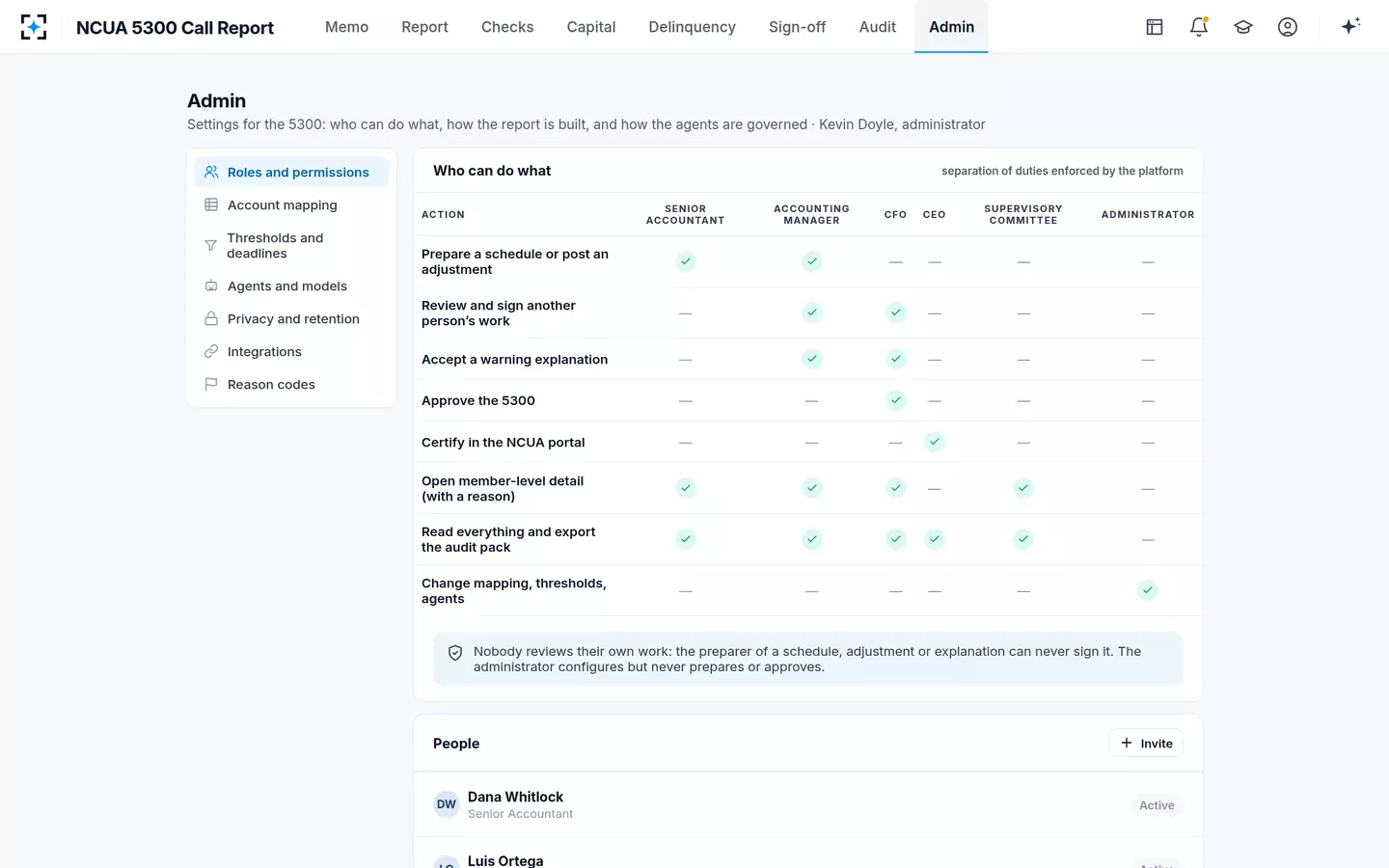
Every one of those changes touched a mapping. A retired account leaves general ledger balances with nowhere to go; a new one needs a source; a removed one must stop being sent. A GL account opened mid-quarter falls out of the mapping the same way a new 5300 account falls out of an old import file: silently, unless something checks. In NCUA 5300 Call Report, mapping changes are made only by the administrator, saved as new versions and recorded, and the Reconciliation agent's tie back to the general ledger turns anything left unmapped into a visible break.
Who may change the mapping and checks in NCUA 5300 Call Report
A readiness checklist for the March 2027 cycle
The first cycle on a new form is where mapping errors are born. The steps below are what a credit union can do between now and April 30, 2027, whatever software it uses.
Getting ready for the first 5300 on the revised form
- Decide whether to comment by December 8, 2026
If you have stablecoin activity, or know the accounts will be hard to source, say so with numbers.
- Name an owner for each of Schedule J’s four parts
Custody of reserves, key custody, exposure to issuers, and holdings: who would know, and from which system?
- Document a “nothing to report” answer
If the answer is zero, keep the evidence that it is zero, such as a policy or a confirmation from investments and operations.
- Watch the CUOnline page for the final documents
The revised form and instructions, the changes document and the March 2027 schema and account descriptions.
- Ask your core or call report vendor for its plan
When it will support the new accounts and schema, and what it will send if it does not.
- Update and approve the mapping before quarter-end
New accounts get a source, even if that source is a documented zero; nothing new should be mapped by the preparer alone.
- Test the import file against the March 2027 schema
The NCUA’s Import File Test Utility checks a file without importing it.
- Re-run last quarter on the new mapping
Every existing field should come out the same; only the new schedule should differ.
Nothing on that list depends on the outcome of the comment period except the content of Schedule J itself. What you bring from your accounting software covers the mapping in detail, and the 5300 instructions in plain words covers which documents apply in each cycle. The solution is on NCUA 5300 Call Report.
Questions people ask
Are there NCUA call report changes for December 2026?
None has been announced. The CUOnline page still links the form effective March 31, 2025 and the instructions effective September 30, 2025, and the October 9, 2026 notice proposes its changes from the March 31, 2027 report date. The edit file and XML schema are republished every cycle regardless.
Is Schedule J final?
No. It is a proposal under the Paperwork Reduction Act, open for comment until December 8, 2026 and then submitted to the Office of Management and Budget for clearance. The account codes and instructions could change before the final documents are published.
What is a permitted payment stablecoin issuer?
It is the GENIUS Act's term for an entity licensed to issue payment stablecoins. The Act charges the NCUA with licensing and supervising issuers that are subsidiaries of federally insured credit unions, and the NCUA proposed rules on investments in such issuers in February 2026 and on issuance in May 2026.
Where can I see the full proposed Schedule J?
The notice says copies of the submission can be requested from the NCUA's contact named in it and that the entire information collection request can be viewed at reginfo.gov. The Federal Register notice itself lists only the four groups and their account counts.
Did the April 2026 RFI lead to any simplification?
Not yet. Its visible result so far is the higher burden estimate. The NCUA said it intends to issue further requests for information, and questions on optional schedules for small credit unions and removable items are still open.