AI for credit unions has a first use that the regulator has already chosen: the NCUA runs machine learning over the 5300. Its public inventory of AI use cases lists "Machine Learning Data Validation", deployed since February 1, 2023 and developed in-house, which "flags anomalies in Call Report data to improve data quality and reduce manual review" and produces "lists of potential data outliers for each credit union" (NCUA AI use case inventory). The Government Accountability Office describes the same tool: the NCUA predicts what each 5300 item should be and flags the ones that land outside that range (AI in regulatory reporting quotes GAO's account), then asks the credit union "to review the flagged items and correct them if necessary" (GAO-25-107197). A credit union that checks its own 5300 the same way before filing, and explains each outlier with evidence, is using AI where the output is verifiable and the regulator will look anyway. That is the job Botminds' NCUA 5300 Call Report is built for.
The NCUA's own AI: three deployed uses, all reading Call Report data
| NCUA use case | What it does, in the NCUA’s words | Since | Built |
|---|---|---|---|
| Machine Learning Data Validation (NCUA 01) | “Flags anomalies in Call Report data to improve data quality and reduce manual review”; outputs “lists of potential data outliers for each credit union” | February 1, 2023 | In-house |
| Supervisory Stress Testing (NCUA-02) | “Forecasts loan performance (repayment, defaults) to support stress testing and risk analysis”, using “some NCUA credit union and Call Report Data” | May 31, 2023 | In-house |
| Risk Indicator Model (NCUA-03) | “Identifies credit unions risks to proactively manage NCUSIF exposure”, from “Call report and examination data” | January 1, 2025 | In-house |
Does the NCUA use AI? Yes, on the Call Report, since 2023
The NCUA uses machine learning on Call Report data for validation, stress testing and risk identification, and publishes the list. Its AI page says the agency's AI work is aligned with the AI in Government Act of 2020 and OMB Memorandum M-25-21, and links an individual and a consolidated inventory of use cases (NCUA, Artificial Intelligence). Each of the three deployed uses reads 5300 data; each is classical or predictive machine learning rather than a generative model; each is marked "Not high-impact" and was built in-house.
GAO adds how the outputs are used. For stress testing, "if AI analysis predicts a credit union will fall short of minimum capital ratio requirements, NCUA examiners consider the prediction alongside other supervisory information before deciding on an action". And across the regulators it reviewed, "officials from each regulator told us they were not using generative AI for supervisory or market oversight activities" (GAO-25-107197, May 2025). The regulator's own pattern is narrow models, human decisions and a published inventory: a useful template for a credit union's.
What does the NCUA flag in call reports? Rules first, then a model
The NCUA flags 5300 data in two layers. The first is deterministic: the errors and warnings it publishes each cycle, 983 in the September 2026 file, which CUOnline runs as data is entered (NCUA edit file). Errors block submission, and every warning needs a written comment before the report will go (CUOnline user guide; NCUA call report software explains each kind of edit). The second is the machine-learning check, which runs on submitted data, predicts what each item should be, and flags the ones outside the range. Its thresholds are not published.
Two ways the NCUA checks a 5300, and what each means for a preparer
Published errors and warnings: Fixed formulas: 428 errors, 3 historical errors, 203 warnings, 349 historical warnings this cycle.
The NCUA's machine-learning validation: A model trained on the NCUA’s quarterly Call Report data that predicts each item’s value.
Published errors and warnings: In CUOnline, as data is entered, before submission.
The NCUA's machine-learning validation: On submitted data; outputs lists of potential outliers for each credit union.
Published errors and warnings: Yes: every formula and message is in the edit file.
The NCUA's machine-learning validation: No: the predicted range is not published.
Published errors and warnings: The impossible, and quarter-over-quarter moves of 50% or 75% and more.
The NCUA's machine-learning validation: Values unusual for this credit union or its peers, even when every edit passes.
Published errors and warnings: Fix every error; comment on every warning.
The NCUA's machine-learning validation: The NCUA asks the credit union to review the item and correct it if necessary.
The gap between the two columns is where a credit union's own AI earns its place. Because the model's range is not published, a credit union cannot run the NCUA's check. It can run the question behind it: does this quarter's figure make sense against our own history, our own drivers and our own documents? If the answer is yes, the explanation is ready before anyone asks. If the answer is no, the error is fixed before it is public, and rule 741.6's duty to correct, which applies as soon as the credit union is told of an error or finds one itself, never has to be triggered by the regulator.
How do credit unions use AI, and where does the 5300 fit?
Credit unions are applying AI across member service, operations, lending and fraud, and the NCUA has said so. Its AI resource page notes that "credit unions are increasingly exploring AI solutions to enhance member services, streamline operations, and remain competitive", and GAO reports NCUA officials' view that "credit unions are increasingly using models in most aspects of financial decision-making, including loan underwriting, stress testing, and fraud detection" (NCUA AI resources; GAO-25-107197).
Regulatory reporting differs from most of those uses in four ways that make it a good place to start. It makes no decision about a member, so it raises no fair lending question. Every output can be checked against a source: a schedule line against the general ledger, a delinquency total against the core's aging report. A person reviews every output before it leaves the building, because the instructions leave the credit union answerable for the accuracy of every figure it reports, however it files (5300 instructions; quoted in NCUA call report software). And the work is measured: the NCUA's own estimate of one filing is now 47 hours.
Why the 5300 is a sensible place to start with AI
47
hours of work in each 5300 filing, the NCUA’s October 2026 estimate
0
member credit decisions made by a reporting agent
983
published edits an AI-drafted report must still pass
3
NCUA AI use cases that already read your Call Report data
Can AI check the 5300 before filing?
Yes: AI can draft the 5300, tie it to its sources, run the published edits and the credit union's own thresholds, and draft an explanation for each move, all before upload. What it cannot do is certify the report or take the responsibility. The NCUA's April 2026 request for information asked credit unions directly whether software is available to automate manual Call Report work and what stands in the way of using it (Federal Register, April 24, 2026; NCUA call report software quotes the question); a check that leaves the decision with a person removes the largest hurdle, which is accountability.
Checking the 5300 before the NCUA does, with NCUA 5300 Call Report
Agent
Tie and run the rulesEach schedule against the general ledger, the core, the investment system and the prior filing; then all published edits, the schema test and the credit union’s own thresholds.
Never: clear a break or upload
Agent
Trace the moversFor each move past threshold, find the driver in loan, investment and general ledger detail.
Never: change a loan record
Agent
Draft the explanationFrom cited evidence: minutes, agreements, allowance memos, rate sheets.
Never: submit an explanation a person has not accepted
A person decides
Accept, edit or rejectA reviewer decides each explanation, with a reason code for every rejection.
A person decides
Approve and certifyThe CFO approves; the certifying official submits in CUOnline.
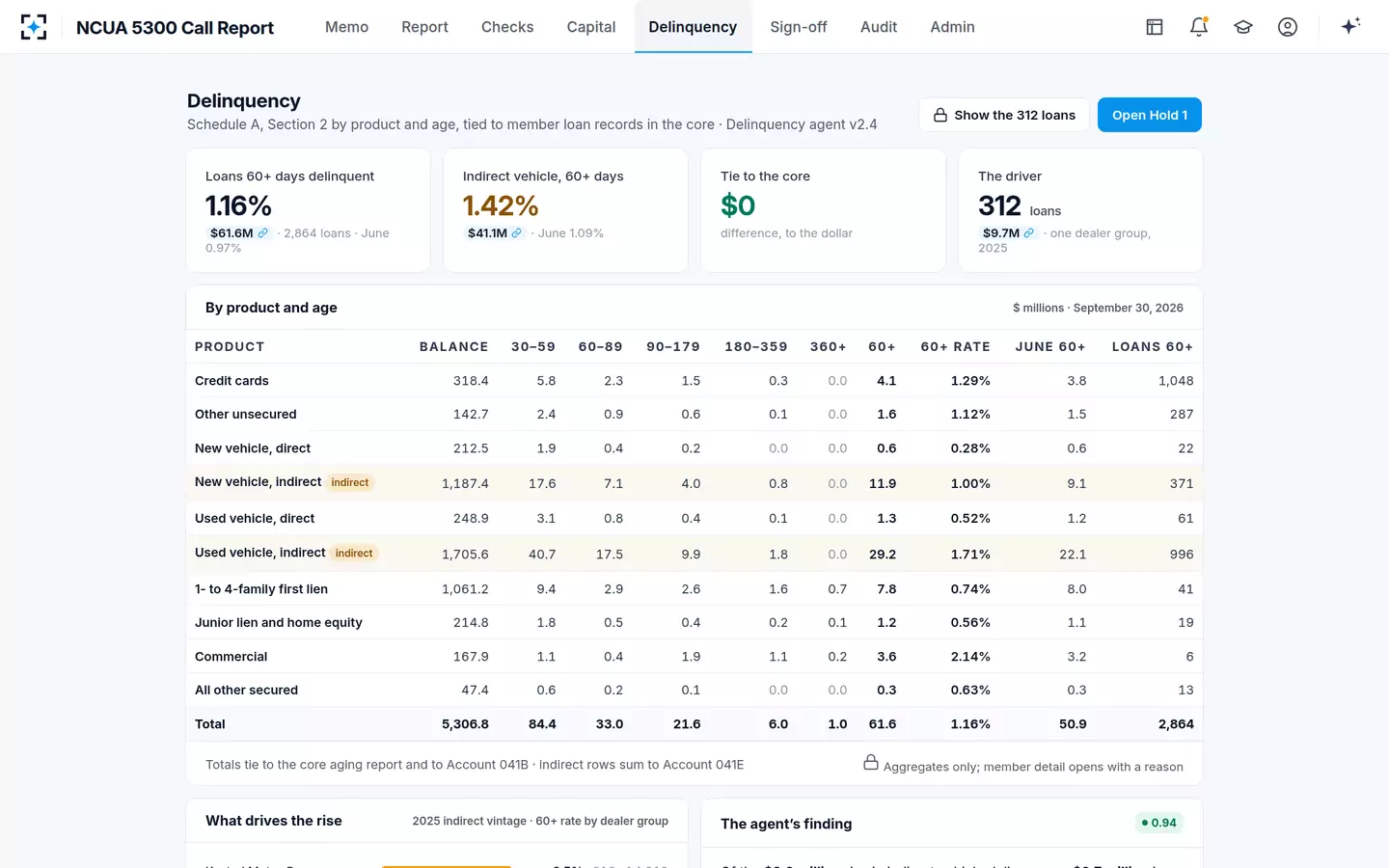
A delinquency rise traced and tied before anyone explains it, in NCUA 5300 Call Report
Is AI safe for credit union reporting? What the NCUA's own resources ask
It can be, if the credit union does the due diligence the NCUA cannot do for it. The NCUA's AI resource page points credit unions to two letters for evaluating AI vendors, 07-CU-13 on third-party relationships and 01-CU-20 on due diligence over third-party service providers, and names the risks: "understanding algorithmic decision-making processes, ensuring fair lending compliance, protecting member data privacy, maintaining operational resilience, and managing model risk" (NCUA AI resources).
Two findings in GAO's 2025 report explain why that diligence falls on the credit union. First, unlike the banking agencies, the NCUA has no power to examine the technology firms that serve credit unions (GAO's wording is quoted in AI audit software for branch reviews). Second, the NCUA's model risk management guidance "addresses only interest rate risk modeling", and its examiner guide "refers examiners to other banking regulators' model risk management guidance", which credit unions may also use (GAO-25-107197). The banking agencies' revised guidance of April 2026 leaves the newest tools out of scope, calling generative and agentic AI too new and too fast-moving to cover, and it does not count fixed rule-based processes as models (Federal Reserve SR 26-2; both passages are quoted in customer risk rating model).
No rulebook yet tells a credit union how to govern an agent that drafts its Call Report. The controls have to be designed in, and shown to the supervisory committee.
In practice, safe means four things for a reporting agent. Every output cites the record it came from, so a reviewer checks rather than trusts. The agent cannot act on the books, the member file or the regulator: no posting, no record changes, no upload. A person decides every output that leaves the credit union. And every run is reproducible: the agent's prompt, model and version are recorded with what it produced.
What AI policy should a credit union have for regulatory reporting?
A short one, specific to the work, that the board can approve and the supervisory committee can test. The checklist below is a starting point for the reporting part of a credit union's AI policy; the broader policy should also cover member-facing and lending uses, which raise questions this one does not.
Nine lines for the regulatory reporting section of a credit union AI policy
- Scope the use
Drafting, tying, checking and explaining the 5300; no member decisions, no posting, no submission.
- Require sources for every output
Each figure and sentence opens to the general ledger account, core report or document passage behind it.
- Keep a person on every decision
A reviewer accepts, edits or rejects each draft explanation; rejections carry a reason code.
- Separate preparer and reviewer
Nobody, and no agent, approves their own work; adjustments need a maker and a different checker.
- Set confidence thresholds
Below the threshold, a draft is marked as needing a person rather than presented as finished.
- Version prompts and models
Record which version produced each output, so a past quarter can be explained.
- Minimize member data
Totals by default; member detail only on a drill with a reason, masked and logged.
- Do vendor diligence the NCUA cannot
Use 07-CU-13 and 01-CU-20; ask where data is processed and what the vendor can see.
- Report to the supervisory committee
Show the controls and a sample of decisions each quarter; it must ensure filing requirements are met.
What the agents may do on the 5300, and what stays with people
In NCUA 5300 Call Report, seven agents do the mechanical work and none of the accountable work. The agents draft, tie, check and explain; they never post to the general ledger, upload or certify. A Preparation agent drafts the statements and schedules; a Reconciliation agent ties them and matches any top-side adjustment, an entry made for the report on top of the closed books, to the break it fixes; a Validation agent runs the NCUA's published edits; Delinquency and Variance agents trace movers and draft explanations; a Capital agent computes the ratios; a Memo agent writes the CFO one page of decisions still needed and never says "ready" while a hold, error or unexplained warning remains.
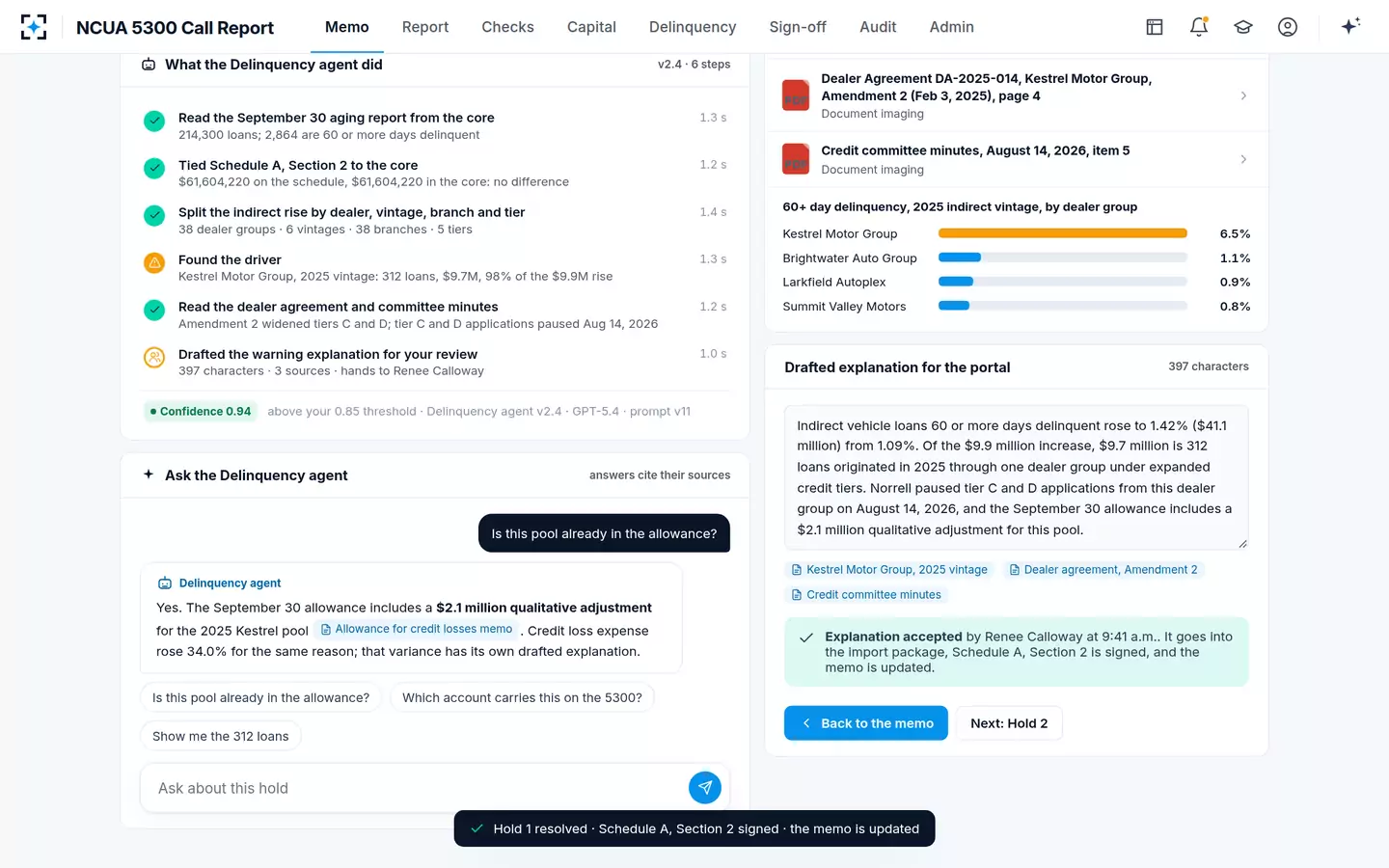
Asking the agent, then deciding: an explanation accepted in NCUA 5300 Call Report
Where NCUA 5300 Call Report fits as a first AI use, and where it does not
The solution fits a credit union that wants its first serious AI use to be one an examiner can audit line by line: a 5300 prepared from systems it already has, with the hours going on review rather than keying. It reads the general ledger, core, investment and loan servicing systems and imaged documents, read-only, and hands the certifying official a checked import file.
It is not a member-facing tool, a lending model or a fraud system, and it does not predict what the NCUA's own model will flag; the NCUA does not publish that model's ranges. It will not make a thin control environment strong: if nobody independent of the preparer reviews the report today, an agent that drafts it faster does not create the second person. What a missing second review cost one credit union is the case for that person. What each agent may never do sets out the limits in full, and the solution is on NCUA 5300 Call Report.
Questions people ask
Does the NCUA use generative AI to examine credit unions?
Not according to GAO's 2025 report, in which officials from each financial regulator said they were not using generative AI for supervisory or market oversight activities. The NCUA's published inventory lists classical and predictive machine-learning models for Call Report validation, stress testing and risk indicators.
Will the NCUA contact us about a flagged Call Report item?
GAO reports that when the NCUA's model flags discrepancies, the agency asks the credit union to review the flagged items and correct them if necessary. A credit union that has already explained an unusual figure with evidence answers that request in minutes.
Do we need board approval to use AI for the Call Report?
No NCUA rule requires a specific approval for it, but the board owns the credit union's policies and the supervisory committee must ensure filing requirements are met under 12 CFR 715.3. A short, approved policy for AI in reporting makes both jobs easier and answers the examiner's first question.
Is an AI that drafts warning comments a model under model risk guidance?
The NCUA has no detailed guidance on it; its examiners may use the banking agencies' guidance as best practice, and the April 2026 revision of that guidance puts generative and agentic AI outside its scope. Treat the drafting agent as a tool whose every output a person reviews, with sources, thresholds and versions recorded.
What data does an AI need to check our 5300?
The same data a preparer uses: the trial balance and account-code mapping, the core's loan, share and delinquency data, investment holdings and prices, the documents behind each explanation, and prior filings. NCUA 5300 Call Report reads them read-only and shows member detail only on a drill with a reason.