The NCUA delinquency ratio calculation divides the loans and leases 60 days or more past due, reported in Account 041B on Schedule A, Section 2 of the 5300, by total loans and leases, Account 025B, and multiplies by 100. The NCUA's Financial Performance Report calls it "Delinquent Loans / Total Loans" and defines it as "the amount of loans 60 days or more delinquent ÷ total loans" (FPR Ratio and Formula Guide). Loans 30 to 59 days late are reported on the same schedule but stay out of the ratio, and some loans that are badly past due are excluded altogether. Getting the numerator right is the work: it is built loan by loan from the core's aging report, which is why Botminds' NCUA 5300 Call Report ties the schedule to that report to the dollar before anyone explains a change in it.
The NCUA delinquency ratio, with a sample credit union's September 30 figures
How is the NCUA delinquency ratio calculated? Account 041B over Account 025B
The ratio is total reportable delinquency, Account 041B, over total loans, Account 025B, times 100. Account 041B is not keyed: the instructions say line 21 of Schedule A, Section 2 "does not require input and will automatically populate when the Call Report is submitted with the sum of items 1 through 20", and the form labels its column "Total Amount of Loans Delinquent 60+ Days" (5300 instructions). Each of those twenty lines is a loan category, from unsecured credit cards to unsecured commercial lines, aged into five columns: 30–59 days, 60–89, 90–179, 180–359, and 360 days or more.
The NCUA's FAQ settles which number counts: "Only those delinquent loans included in Account 041B will be included in the delinquent loan ratio" (5300 FAQs). The 30–59 day column is reported, as Account 020B, but sits outside the ratio. The FPR also prints a second measure from the same numerator, "Delinquent Loans / Net Worth", 041B over Account 997. For the sample credit union that is $61.6 million over $722.1 million, or 8.53%, on our arithmetic: the same delinquency read as a share of the capital that would absorb it.
For context, the delinquency rate across all federally insured credit unions was 96 basis points at June 30, 2026, up 6 basis points from a year earlier (NCUA, 2026 Q2), and the NCUA's 2026 supervisory priorities letter says the overall delinquency rate and rolling 12-month loss rate are at their highest point in over a decade (Letter 26-CU-01). The ratio is getting more attention, not less.
One loan, followed from the core to the ratio
Follow one used-vehicle loan bought through a dealer, an indirect loan in the 5300's terms, with a payment due on the 15th of each month. The borrower pays through June, then misses July 15 and every payment after it. The loan's days past due climb on the core every day; the 5300 only sees them on the quarter-end, and what it sees changes the ratio, the indirect line and, for a complex credit union, the capital calculation.
One missed payment on July 15, aged day by day against the quarter-ends
- 1–29 daysJul 16–Aug 13
- 30–59 days: not in ratioAug 14–Sep 12
- 60–89 days: in 041BSep 13–Oct 12
- 90+ days: nonaccrualOct 13 on
At June 30 the loan is current and appears only in the loan balances on Schedule A, Section 1. At September 30 it is 77 days past due. It goes in the 60–89 day column on the used vehicle line, so it is inside Account 041B and the ratio. Because it was bought through a dealer it also goes in Account 041E, which the instructions define as the loans in Account 618A, total indirect loans, "that are 60 days or more delinquent". At December 31, at 169 days, it sits in the 90–179 column, unless the credit union has repossessed the car, in which case it leaves the delinquency schedule entirely.
The same loan on three 5300s
| Report date | Days past due | Where it is reported | In the ratio? |
|---|---|---|---|
| June 30 | Current | Schedule A, Section 1 balances only | No |
| September 30 | 77 | Used vehicle line, 60–89 column; part of 041B and of indirect 041E | Yes |
| December 31, car still with the member | 169 | Used vehicle line, 90–179 column; nonaccrual amount in DL0145 | Yes |
| December 31, car repossessed | — | Off the delinquency schedule; written down and moved to foreclosed and repossessed assets | No |
What loans count as delinquent on the 5300, and which are left out?
Every loan and lease 30 days or more past due is reported by collateral type, including loans "serviced by outside processors" and "loans held on the balance sheet of wholly-owned CUSOs". Two kinds are left out, however late they are. The instructions exclude loans "already written down to fair value ... through a 'decision to sell' and/or otherwise transferred to a 'loans held for sale' classification", and "any loans for which the credit union has already obtained physical possession of the underlying collateral (automobiles, boats, real estate), regardless of whether formal foreclosure or repossession proceedings have been instituted" (5300 instructions).
The second exclusion moves the ratio without any change in credit quality. A credit union that repossesses a batch of cars in the last week of September takes them out of 041B, and the ratio falls. That is correct reporting, but it is also exactly the kind of move that needs an explanation in the board pack, because charge-offs and repossessed assets will rise in the same quarter.
When is a credit union loan nonaccrual?
A loan goes on nonaccrual "when doubt exists as to the full collection of principal and interest OR after 90 days past due", in the words of the NCUA's FAQ, and the instructions add that "each credit union will need to make their own determination on a loan-by-loan basis". Nonaccrual amounts are reported separately on the same page, in Account DL0145 for non-commercial loans and DL0146 for commercial ones; they are not a second numerator for the ratio.
Returning a loan to accrual is harder than putting it there. The FAQ quotes the NCUA's own regulation (Part 741, Appendix B): a nonaccrual loan may be restored when "its past due status is less than 90 days, and the credit union expects repayment of the remaining contractual principal and interest within a reasonable period", or after the borrower has kept up payments for a sustained period, generally at least six months, on a loan that is not yet fully current. A loan can therefore be current on the delinquency schedule and still in DL0145, which is worth a sentence in any explanation of a quarter's nonaccrual total.
How do bankruptcies, modifications and participations affect the delinquency schedule?
Each has its own line, and each changes what goes into 041B in a different way. Bankruptcies are reported in Account 971 as the total outstanding balance of every borrower who has filed under Chapter 7, 11, 12 or 13, including reaffirmations and "regardless of the year filed", and excluding bankruptcies the court has dismissed. Account 971 is reported apart from the aging columns, and nothing in the instructions takes a loan in bankruptcy out of them.
Modified loans are aged on their modified terms. For troubled debt restructurings the instructions let a credit union "consider a partial payment equivalent to 90 percent or more of the contractual payment as a full payment when computing the past due status on 'consumer credit'". Credit unions of $10 million or more report modifications to borrowers experiencing financial difficulty that are 30 days or more past due, or on nonaccrual, under their modified terms, both in the aging columns and in aggregate in Accounts DL0148 and DL0149.
Participations and purchased loans count, by collateral, on lines 1 to 20, and their 60-day delinquency is also broken out: "For Participation Loans, report delinquency in Account DL0142. For whole or partial loans purchased under 701.23, report delinquency in Account DL0144" (5300 FAQs). Commercial loans secured by real estate are reported in the commercial section by their collateral, not twice.
How are indirect loans reported on the delinquency schedule?
Indirect loans are aged on their collateral line like every other loan, and their 60-day total is reported a second time, in Account 041E, against total indirect loans in Account 618A. The indirect delinquency rate, 041E over 618A, is not an FPR key ratio, but it is where dealer-originated credit problems show first, and the NCUA's edits check its arithmetic: it may not exceed total indirect loans or total reportable delinquency.
Schedule A, Section 2 in NCUA 5300 Call Report, tied to the core aging report
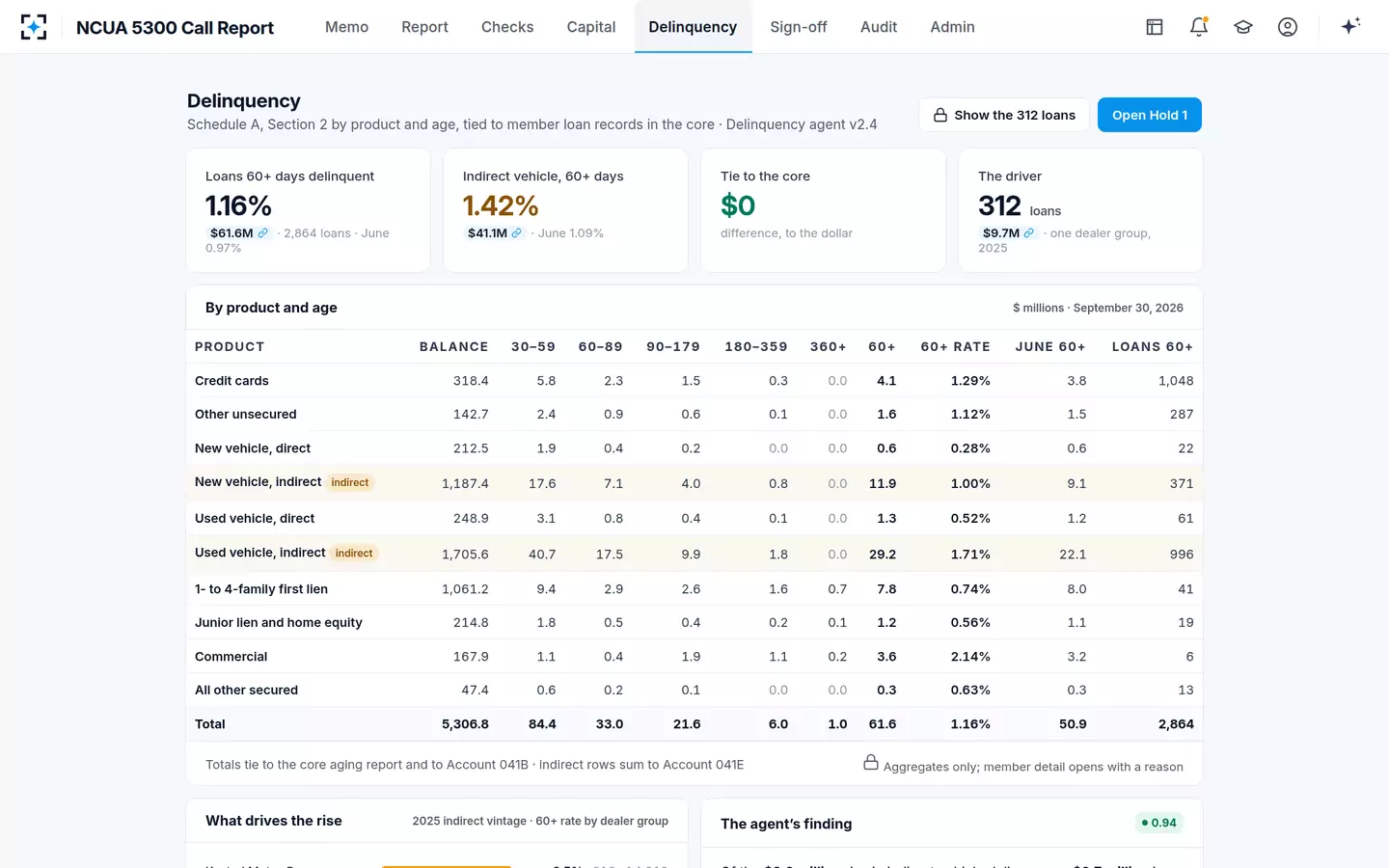
In the sample quarter the indirect rate rose from 1.09% to 1.42%, past the credit union's own trigger of a 25 basis point rise in a product's 60-day rate, so the Delinquency agent split the rise across 38 dealer groups and six vintages. It found 312 loans, $9.7 million, from one dealer group's 2025 vintage: 98% of the $9.9 million increase, after an amendment to that dealer's agreement had widened two credit tiers. The 60-day rate by product makes the point visually.
Sixty-day delinquency by product: two indirect lines carry the rise
What the NCUA's edits check on delinquency, and what they miss
The NCUA's published edits check that the delinquency schedule is internally possible and flag extreme quarter-over-quarter moves; they do not check that it matches the core. Of the 983 edits in the September 2026 file, these are the ones a delinquency preparer meets most.
NCUA edits on Schedule A, Section 2, September 2026 cycle
| Edit | Kind | What it tests |
|---|---|---|
| E0207 | Error | Total delinquent loans (041B) cannot exceed total loans (025B) |
| E92396 | Error | Indirect delinquency (041E) cannot exceed total indirect loans (618A) |
| E92395 | Error | Indirect delinquency (041E) cannot exceed total delinquency, leases excluded |
| E0923 | Warning | Delinquent loans above 30% of total loans |
| E0989 | Warning | Loans outstanding but no delinquency reported |
| E1429 | Warning | Indirect loans above $250,000 but no indirect delinquency reported |
| E5175 · E5174 · E5478 | Historical warning | 041B moves 75% or more and by at least $250,000 (under $20 million in assets), $1 million (up to $200 million) or $2.5 million (above) |
Read the historical thresholds as a buyer would. A credit union above $200 million can see total 60-day delinquency rise by half in a quarter and trip none of them, and a schedule that is wrong but plausible, with a home equity bucket mapped twice or a dealer's loans aged on the wrong date, passes every edit. The test the edits cannot run is the tie to the aging report: Schedule A, Section 2 against the core, line by line, to the dollar. The NCUA's own machine-learning check on 5300 data looks for outliers from another angle, after you file.
Why one late loan moves capital as well as the ratio
For a complex credit union, one over $500 million that reports a risk-based capital ratio, a loan that reaches 90 days changes its risk weight. Part 702 defines current as "less than 90 days past due, not placed on non-accrual status, and not restructured", and weights "current secured consumer loans" at 75% but "consumer loans that are not current" at 150% (12 CFR 702.2 and 702.104). Our hypothetical car loan stops being current on October 13, the day it turns 90 days late and two weeks after the September report date, so the December report carries it at twice the risk weight.
Consumer loans dominate risk-weighted assets in NCUA 5300 Call Report's capital view
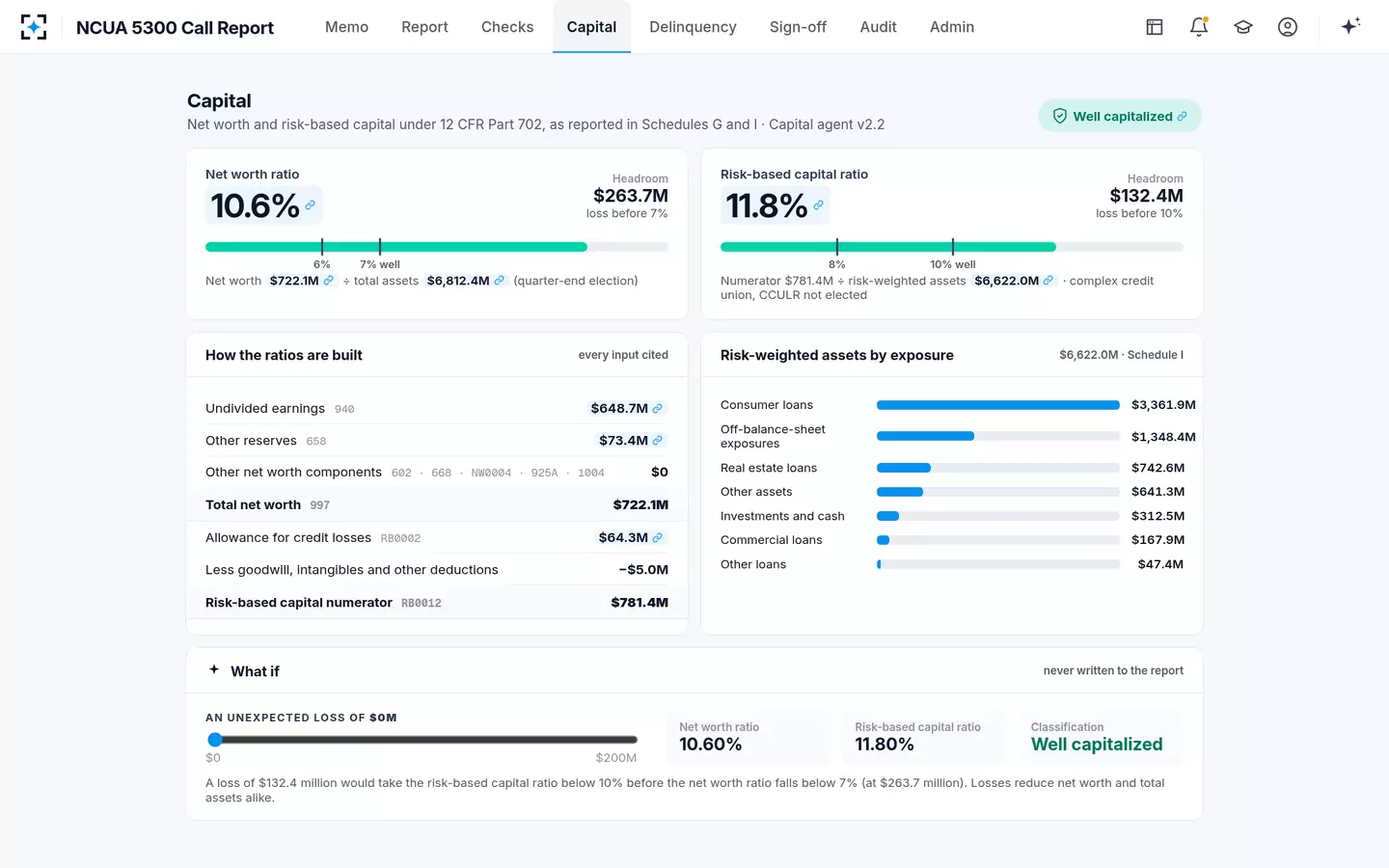
That is one reason the CFO wants delinquency and capital in the same memo, and why the net worth and risk-based capital formulas are worth knowing line by line. A rise in late consumer loans raises the denominator of the risk-based ratio while the allowance build that usually accompanies it lowers earnings and, in time, net worth.
Proving the ratio: tie the schedule to the aging report before explaining it
A delinquency ratio is only as good as the tie from Schedule A, Section 2 to the core's aging report, so that tie comes first. In NCUA 5300 Call Report the Delinquency agent reads the quarter-end aging report, ties each product and age column to the schedule, and only then looks for drivers by dealer, vintage, branch and credit tier. In the sample quarter it read 214,300 loans, found 2,864 of them 60 days or more past due, and matched the schedule to the core to the dollar, $61,604,220 on both sides.
The sample quarter's delinquency, proven before it was explained
$0
difference between Schedule A, Section 2 and the core aging report
214,300
loans read from the core to build and tie the schedule
312loans
$9.7 million from one dealer group’s 2025 vintage: 98% of the indirect rise
Two controls keep the agent honest. It never changes a loan record, and member detail appears only when a person opens a drill and gives a reason, masked and logged. The explanation it drafts names its sources, here the aging report, the dealer agreement and the credit committee minutes, and a person accepts, edits or rejects it. What each of the seven agents may never do is set out in full, and the solution itself is on NCUA 5300 Call Report.
Questions people ask
What is the NCUA FPR delinquency ratio?
It is the "Delinquent Loans / Total Loans" key ratio on the NCUA's Financial Performance Report: Account 041B over Account 025B, times 100. The FPR is built from the filed 5300, and the NCUA says peer averages for the latest cycle are normally available six to eight weeks after the cycle date.
Are loans 30 to 59 days late in the delinquency ratio?
No. They are reported on Schedule A, Section 2 in the 30–59 day column, Account 020B, but the ratio uses only Account 041B, loans 60 days or more past due. Watching the 30–59 column is still the best early warning of next quarter's ratio.
Do participation loans count in delinquency?
Yes. Delinquent participations are reported on lines 1 to 20 by their collateral, so they are inside 041B, and their 60-day amount is also shown in Account DL0142. Whole or partial loans purchased under section 701.23 are broken out in DL0144.
Does a loan in bankruptcy count as delinquent?
Account 971 reports the balances of all borrowers in bankruptcy, whatever the year filed, on a separate line. Whether a loan also appears in the delinquency columns depends on its payment status; the instructions do not exclude bankrupt borrowers from the aging.
Why did our delinquency ratio fall after repossessions?
Because the instructions exclude any loan whose collateral the credit union has physically taken back, whether or not formal proceedings have started. The loan is written down to the collateral's fair value less costs to sell and moves to foreclosed and repossessed assets, so delinquency falls while charge-offs and repossessed assets rise.
How does the NCUA define a current loan for capital?
Under 12 CFR 702.2 a current loan is less than 90 days past due, not on nonaccrual and not restructured. For a complex credit union, a secured consumer loan that stops being current moves from a 75% to a 150% risk weight.