The net worth ratio credit union formula is net worth divided by total assets, multiplied by 100 and rounded to two decimal places. Part 702 of the NCUA's rules defines it as "the ratio of the net worth of the credit union to the total assets of the credit union, expressed as a percentage rounded to two decimal places" (12 CFR 702.2). On the 5300 it is Schedule G's Account 997, total net worth, over total assets as the credit union elects to measure them, reported as Account 998. Net worth is retained earnings, not total equity, so unrealized losses on securities are left out. A ratio of 7.0% or more is well capitalized; a credit union over $500 million also needs a risk-based capital ratio of 10% or an elected leverage ratio of 9%. Botminds' NCUA 5300 Call Report computes all three with every input opening to its account code and general ledger accounts.
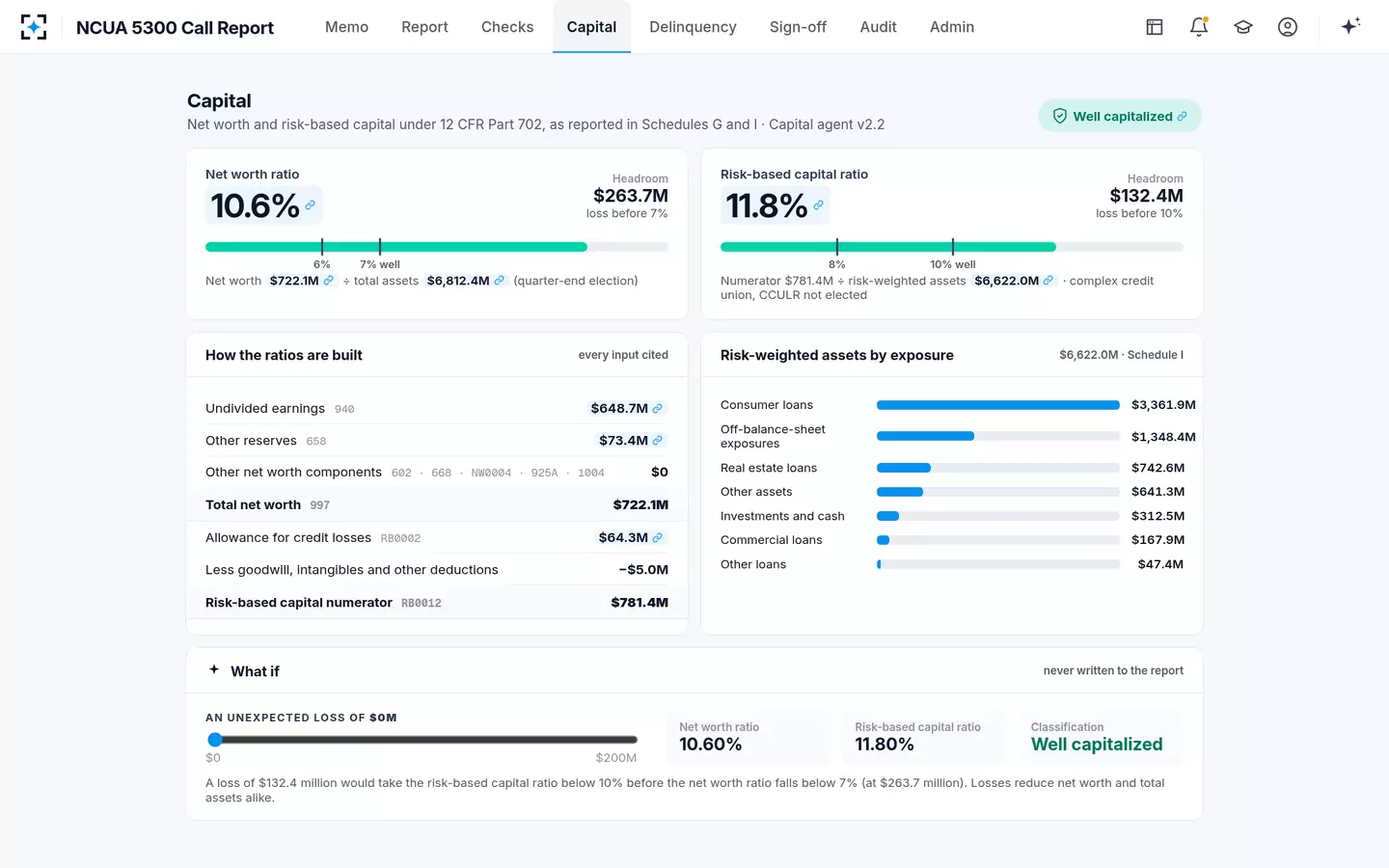
The net worth ratio on the 5300, with a sample credit union's September 30 figures
How do you calculate a credit union's net worth ratio?
Add up net worth on Schedule G, Section 2, divide it by total assets as measured under your election on Schedule G, Section 3, multiply by 100 and round to two decimals. The form's own formula for Account 998 is "Account 997 divided by Account NW0010, (010A-LC0047+NW0004), (010B-LC0047+NW0004), or (010C-LC0047+NW0004)" (Form 5300). NW0010 is total assets, Account 010, "excluding SBA PPP loans pledged as collateral to the FRB PPP Lending Facility (LC0047) and including the CECL Transition Provision (NW0004)"; 010A, 010B and 010C are the three average-balance alternatives.
Rounding is not a detail at the boundary. The NCUA's ratio guide gives the example itself: "The Net Worth ratio is rounded to two decimal places (for example, 6.997 would be rounded to 7.00%)" (FPR Ratio and Formula Guide). A credit union at 6.997% is well capitalized; one at 6.994% is not. A spreadsheet that rounds to one decimal, or truncates, can put a credit union in the wrong category.
The NCUA's Financial Performance Report shows two versions. "Net Worth / Total Assets for Prompt Corrective Action" follows Part 702 with the elections and the CECL transition provision. A second "Net Worth / Total Assets" ratio, since March 31, 2023, takes the CECL transition provision out of both numerator and denominator; the system-wide figure in the NCUA's quarterly data summary, 11.42% at June 30, 2026, "excludes the Current Expected Credit Loss (CECL) transition provision" (NCUA, 2026 Q2). Check which one you are comparing with a peer.
What counts as net worth? Schedule G, line by line
Net worth is the credit union's retained earnings under GAAP, with a few defined additions. Part 702 defines it as "the retained earnings balance of the credit union at the most recent quarter end, as determined in accordance with U.S. GAAP", plus, for a low-income designated credit union, qualifying subordinated debt and grandfathered secondary capital, plus retained earnings acquired in a mutual combination, plus certain section 208 assistance (12 CFR 702.2). Schedule G turns that into seven lines.
Schedule G, Section 2: the lines that add up to total net worth (Account 997)
| Line | Account | What goes in it |
|---|---|---|
| 1. Undivided earnings | 940 | Post-closing undivided earnings; the NCUA’s FAQ says regular reserves go here too |
| 2. Appropriation for non-conforming investments | 668 | State-chartered credit unions only |
| 3. Other reserves | 658 | Appropriations of undivided earnings |
| 4. Net income | 602 | Only if not already closed into undivided earnings |
| 5. CECL transition provision | NW0004 | As determined under the CECL transition rule |
| 6. Subordinated debt or grandfathered secondary capital in net worth | 925A | Low-income designated credit unions |
| 7. Adjusted retained earnings from business combinations | 1004 | Mergers completed after December 31, 2008 |
| 8. Total net worth | 997 | Sum of lines 1 to 7 |
What is not on the list matters as much. Accumulated unrealized gains and losses on available-for-sale securities, Account EQ0009, are equity on the balance sheet but not net worth. Neither is the allowance for credit losses, which counts in the risk-based capital numerator instead. A December report has its own rule: the FPR guide notes that "credit unions must close out net income into Undivided Earnings for the December reporting period", so line 4 is empty at year-end.
Which total assets? The four measures Part 702 allows
A credit union may measure total assets for the ratio in four ways. Part 702 lists "average quarterly balance", the average of the current and three preceding quarter-ends; "average monthly balance", the three month-ends of the quarter; "average daily balance" over the quarter; and "quarter-end balance" as reported on the Call Report (12 CFR 702.2). On Schedule G, a credit union using the quarter-end balance leaves Accounts 010A to 010C blank; one using an average enters it there.
The NCUA's FAQ is frank about why the choice exists: "Using one of the optional total assets elections as the denominator in the net worth calculation, may result in a higher net worth ratio. As a result, a credit union could improve its net worth position to above 7% and not be subject to PCA requirements if the standard net worth calculation is below 7%" (5300 FAQs). The effect is largest for a credit union whose balance sheet jumped at quarter-end.
One credit union, four denominators: an illustration
| Total assets measure | Total assets | Net worth ratio on $28.0 million of net worth |
|---|---|---|
| Quarter-end balance | $405.0 million | 6.91%: adequately capitalized |
| Average of the three month-ends | $401.0 million | 6.98%: adequately capitalized |
| Average daily balance | $398.0 million | 7.04%: well capitalized |
| Average of four quarter-ends | $391.0 million | 7.16%: well capitalized |
The election is not free. It is made quarter by quarter on the report, the averages need daily or monthly balances the credit union can evidence, and a change of method from one quarter to the next is worth documenting, because it moves the ratio without any change in capital. NCUA 5300 Call Report treats it as a setting, saved as a new version whenever it changes and recorded on the audit trail.
Worked example: one sample credit union to the second decimal
Take the sample credit union's September 30, 2026 report as it runs through the solution. Net worth is undivided earnings of $648,712,904 plus reserves of $73,391,412, total $722,104,316. Total assets were $6,814.2 million before a $1.84 million top-side adjustment, an entry made for the report on top of the closed books, which brought available-for-sale securities to the investment system's September 30 prices; after it, $6,812.4 million. The quarter-end election applies, with no PPP loans pledged and no CECL transition provision.
The sample credit union's net worth ratio, step by step
| Step | Calculation | Result |
|---|---|---|
| 1. Total net worth (997) | Undivided earnings and reserves, $648,712,904 + $73,391,412; other components $0 | $722,104,316 |
| 2. Total assets (NW0010) | Quarter-end total assets after adjustment, − PPP loans pledged $0, + CECL transition $0 | $6,812.4 million |
| 3. Divide | $722.104 million ÷ $6,812.4 million | 0.105998… |
| 4. Express and round (998) | × 100, rounded to two decimals | 10.60% |
| 5. Classify | 10.60% ≥ 7.0%, and risk-based capital 11.80% ≥ 10% | Well capitalized |
Step 5 needs both ratios because this credit union is complex and has not elected the CCULR. The net worth ratio could be comfortable and the classification still fall to adequately capitalized if the risk-based ratio dropped below 10%. That is why the solution's memo to the CFO reports both, and why the capital view shows the headroom on each.
What is a good net worth ratio for a credit union?
Seven percent or more is well capitalized under the NCUA's rules, and most credit unions hold well above that. Part 702 sets the categories; the table gives them in full (12 CFR 702.102). The system-wide net worth ratio at June 30, 2026 was 11.42%, compared with 11.11% a year earlier (NCUA, 2026 Q2).
NCUA capital categories under Part 702
| Category | Net worth ratio | Also required if complex (over $500 million) |
|---|---|---|
| Well capitalized | 7.0% or greater | RBC 10% or greater, or CCULR 9.0% or greater |
| Adequately capitalized | 6.0% or greater | RBC 8.0% or greater |
| Undercapitalized | 4.0% to under 6.0% | Or RBC under 8.0% |
| Significantly undercapitalized | 2.0% to under 4.0% | — |
| Critically undercapitalized | Under 2.0% | — |
"Good" is a planning question more than a regulatory one. The NCUA's 2026 supervisory priorities letter notes that while "regulatory capital levels, as measured by the net worth ratio, have improved for many credit unions, earnings have shown less resilience", and that examiners will assess whether earnings "are sufficient to support capital targets under a range of interest rate, credit, and liquidity stress scenarios" (Letter 26-CU-01). A ratio well above 7% with falling earnings is a weaker position than the number suggests.
What is a complex credit union, and what is the CCULR?
A credit union is complex when its "quarter-end total assets exceed five hundred million dollars ($500,000,000), as reflected in its most recent Call Report", and only then does a risk-based capital measure apply (12 CFR 702.103). A complex credit union can meet it with the full risk-based capital ratio or, if it qualifies, opt into the complex credit union leverage ratio, the CCULR, which "calculates its CCULR in the same manner as its net worth ratio".
To qualify, under 12 CFR 702.104(d), a complex credit union needs a CCULR of 9.0% or more, off-balance-sheet exposures of 25% or less of total assets, trading assets and liabilities of 5% or less, and goodwill and other intangibles of 2% or less, all measured from the latest Call Report. It opts in by completing Schedule H, and if it stops qualifying it has a two-quarter grace period to requalify or switch to the risk-based ratio (12 CFR 702.104).
Complex credit unions at June 30, 2026: most chose the CCULR
748
complex federally insured credit unions, assets over $500 million
458
opted into the CCULR, with an average CCULR of 12.19%
290
reported the risk-based capital ratio, averaging 15.39%
11.42%
system-wide net worth ratio, excluding the CECL transition provision
What is risk-based capital for credit unions?
Risk-based capital is a numerator of net worth-like capital over risk-weighted assets, required of complex credit unions that do not use the CCULR, with 10% as the well-capitalized line. The numerator starts from undivided earnings, other reserves, equity acquired in mergers, net income and the allowance for loan and lease losses, and deducts the NCUSIF capitalization deposit, goodwill, other intangible assets and certain mortgage servicing assets (12 CFR 702.104(b)). The denominator weights each asset by its risk: cash at 0%, current first-lien residential mortgages up to 35% of assets at 50%, current secured consumer loans at 75%, current unsecured consumer loans at 100%, and consumer loans that are not current at 150%.
For the sample credit union the numerator is $722.1 million of net worth plus $64.3 million of allowance for credit losses, less $5.0 million of goodwill, intangibles and other deductions: $781.4 million. Risk-weighted assets are $6,622.0 million, half of them consumer loans. The ratio is 11.80%.
Net worth and risk-based capital in NCUA 5300 Call Report, every input cited
Do unrealized losses affect the net worth ratio?
Not directly. Net worth is retained earnings, so accumulated unrealized losses on available-for-sale securities, which sit in equity outside retained earnings, are not in the numerator. They do reduce total assets, because those securities are carried at fair value, which nudges the ratio up rather than down. In the sample quarter a $1.84 million adjustment to unrealized losses lowered total assets from $6,814.2 million to $6,812.4 million and left the ratio at 10.60%.
That does not make them irrelevant. The NCUA's 2026 priorities letter warns that "equity capital continues to reflect unrealized losses associated with long-duration securities credit unions acquired during the recent low-rate environment, which may limit balance sheet flexibility under stress" (Letter 26-CU-01). A sale realizes the loss through earnings, and then it reaches net worth. The 5300 reports the unrealized figure in Account EQ0009 every quarter, where an examiner and the public can see it next to the ratio.
Headroom: the loss that changes the category
Headroom is the loss a credit union could absorb before a ratio falls below its threshold, and it is the number a board can actually plan with. A loss reduces net worth and total assets alike, so the arithmetic is not simply the ratio minus 7%. NCUA 5300 Call Report's Capital agent computes it for each ratio as a what-if that is never written to the report.
How much loss the sample credit union could take before each line
For this credit union the risk-based ratio binds first, by a factor of two. Rising delinquency tightens it from both sides, as the delinquency ratio guide shows: consumer loans that stop being current double their risk weight. The full solution, including the memo that puts both ratios in front of the CFO, is on NCUA 5300 Call Report; what you bring from your general ledger covers the mapping behind Schedule G.
Questions people ask
What is well capitalized for a credit union?
A net worth ratio of 7.0% or more, and, for a credit union over $500 million, also a risk-based capital ratio of 10% or more, or a CCULR of 9.0% or more if it has opted into that framework. The categories are in 12 CFR 702.102.
Is the net worth ratio the same as equity to assets?
No. Net worth is retained earnings, plus a few defined items, so it excludes accumulated unrealized gains and losses on available-for-sale securities that sit in total equity. A credit union with large unrealized losses can have a healthy net worth ratio and much lower total equity.
Can a credit union change its total assets election every quarter?
The election is made on Schedule G each quarter, by entering an average in Account 010A, 010B or 010C or leaving them blank for the quarter-end balance. Whatever is chosen should be supported by the daily or monthly balances behind it, and a change of method is worth documenting.
Does the allowance for credit losses count in net worth?
Not in the net worth ratio. The allowance is added to the numerator of the risk-based capital ratio under 12 CFR 702.104(b), which is one reason a complex credit union's risk-based numerator is larger than its net worth.
What happens if a credit union falls below 7%?
It becomes adequately capitalized or lower, and prompt corrective action under Part 702 applies, with requirements that tighten at each lower category, such as a net worth restoration plan for undercapitalized credit unions. The FAQ notes that the total assets election can sometimes keep a credit union above 7% when the quarter-end calculation falls just below it.