Legal spend management software is the system an insurer's claims legal team uses to receive panel law firms' invoices, check them against billing guidelines, rate agreements and case budgets, pay them, and report spend by firm, case and litigation phase. The KPIs that show such software paid for itself are the ones that still hold after a firm answers back: reductions upheld after appeal, the days taken to answer an appeal, budget variance by phase, the share of invoices paid within terms and the share of lines actually read, all set against defense and cost containment expense as a share of premium. Reductions proposed, the number most programmes report, is the one KPI that rises when review gets worse. Botminds' Legal Bill Review is the line-by-line review part of that stack, and every figure in the scorecard below can be computed from what it records.
A legal spend KPI scorecard: what to measure, how to compute it, and what distorts it
| KPI | How to compute it | Why it holds up | What distorts it |
|---|---|---|---|
| Reductions upheld | Reductions applied minus reductions reversed on appeal, in dollars | Money actually not paid | Counting reductions proposed, or applied before the appeal window closes |
| Appeal reversal rate, by rule | Appeals accepted in full or in part ÷ appeals closed, per guideline section | The false-flag rate as the firms see it | Small counts per rule; read it over a year |
| Days to answer an appeal | Median days from the firm’s answer to the decision | What a reduction costs both sides in time | Holding appeals open, or answering without reasons |
| Paid within terms | Invoices paid within the agreed days of a complete invoice ÷ all invoices | Panel relations and the firm’s cash | Restarting the clock on trivial queries |
| Lines read | Lines checked against every rule ÷ lines billed | The ceiling on everything else | Calling a sampled invoice "reviewed" |
| Flags per 100 lines, by firm and rule | Flagged lines ÷ lines billed × 100 | Billing behaviour, and whether it changes | A guideline changed mid-year |
| Budget variance by phase | Fees in each litigation phase at close ÷ the approved phase budget | Whether budgets are real | Revisions approved after the work was done |
| Warning lead time | Days from the budget alert to the date the case passes its budget | Whether revisions come before the work | Alerts with no projected date |
| Defense cost per premium | Defense and cost containment expense ÷ direct premiums earned, by line | The top-line denominator | Mix of lines and states, and reforms such as Florida’s |
What is legal spend management software?
It is the set of tools that carries a law-firm invoice from receipt to payment and turns the result into reporting: electronic invoice intake, billing-guideline review, rate and staffing controls, budgets, approvals, payment and analytics. Invoices typically arrive in a LEDES format maintained by the LEDES Oversight Committee, a not-for-profit standards body, with UTBMS codes that tie each line to a task and a litigation phase.
For an insurer the matters are mostly suits against policyholders, defended by panel firms the insurer pays, which changes two things. The invoices are numerous and similar, which suits line-level automation. And the review sits inside a three-way relationship between insurer, insured and defense counsel, with ethics limits on what a billing guideline may ask, which suits a review that judges billing and never the defense.
Which legal spend KPIs show a programme paid?
The ones in the scorecard that measure money not paid and time not lost: reductions upheld, appeal reversal rate, days to answer, paid within terms, lines read and budget variance. Each has an obvious way to look good without being good, listed in its last column, and the scorecard works only if those are closed off in how the number is computed.
Two of them need line-level data that many programmes do not keep. The appeal reversal rate needs each appeal tied to the guideline section of the reduction it disputes; a firm that wins most of its appeals on one section is telling the reviewer the rule is being applied too hard. Budget variance by phase needs each invoice line applied to its phase by task code, which is what makes a budget a forecast; the litigation budget template that projects the crossing date shows how.
What share of premium is spent on defense costs?
Across U.S. property and casualty insurers, defense and cost containment expense was 3.9% of direct premiums earned in 2023 and 2024, according to the Federal Insurance Office, down from about 4.5% between 2015 and 2020. Florida ran higher and moved more: from 4.5% in 2015 to 6.6% in 2022, then 5.1% in 2024 after its reforms.
Defense and cost containment expense as a share of direct premiums earned
3.9%
U.S. P&C insurers, 2023 and 2024
4.5%
U.S., roughly flat from 2015 to 2020
6.6%
Florida, 2022, before its reforms
5.1%
Florida, 2024
That is the denominator a claims legal executive is judged against, and it moves for reasons a bill review programme does not control: state law, the mix of lines, the rate of litigation. Over a decade, the Casualty Actuarial Society and the Insurance Information Institute, an insurer-funded association, estimate that litigation trends contributed $231.6 billion to $281.2 billion of the increase in liability insurance losses over the decade to 2024; for personal auto liability alone they put the losses and defense costs added by these trends and inflation at $91.6–102.3 billion. A KPI set that does not separate what review controls from what the market does will credit or blame the wrong people.
Why reductions proposed is the wrong number
Because it rewards cutting, not cutting correctly. Outside bill auditors have been paid on exactly this basis: Oklahoma's bar ethics committee described auditors who guaranteed a set percentage off defense counsel's bills, or took a share of what they saved, and New York's committee noted that an auditor paid that way profits from every fee it cuts.
Courts show how fast a percentage cut inflates. In Welch v. MetLife the trial court cut all requested hours by 20% for block billing; the Ninth Circuit found that because only "barely more than half of all hours submitted by Welch’s counsel were block billed", the cut worked as a 40% penalty on the hours that really were block billed, and vacated it; the reasoning is followed through in block billing reductions. Reductions proposed would have counted the full 20%. Reductions upheld would have counted what survived.
How do you measure legal spend savings?
Count what was not paid and stayed unpaid, add the over-budget work that was stopped or approved in advance, and subtract what the review and the appeals cost. Each term has an owner who can vouch for it, which is what lets finance accept the result.
Net saving from legal bill review, as a sum finance can audit
Reductions upheld
Applied − reversed on appeal
Line by line, after the appeal window closes
Legal bill reviewer
Over-budget work avoided
Projected overrun − approved revision
Only where the alert came before the work
Litigation specialist
Cost of review
Reviewer hours + software + any outside audit fees
Including contingency fees, if any
Claims legal operations
Cost of appeals
Hours to answer × appeals, both sides
A firm’s appeal time is billed somewhere too
Claims legal counsel
The last term is the one programmes forget. A reduction the firm appeals costs the firm's billing coordinator and partner time, the reviewer time, and often counsel time, and the firm's side of that cost tends to reappear in rates. A reduction that names its line, its rule and its calculation is answered faster, and one that is wrong is reversed faster, which is why days to answer belongs on the scorecard.
How do insurers benchmark legal spend?
Mostly against themselves: firm against firm, rule against rule and year against year on the same panel, with defense cost per premium as the external check. Public data is thin at the invoice level; the useful external series are statutory ones, such as the Federal Insurance Office's defense cost ratios by line of business.
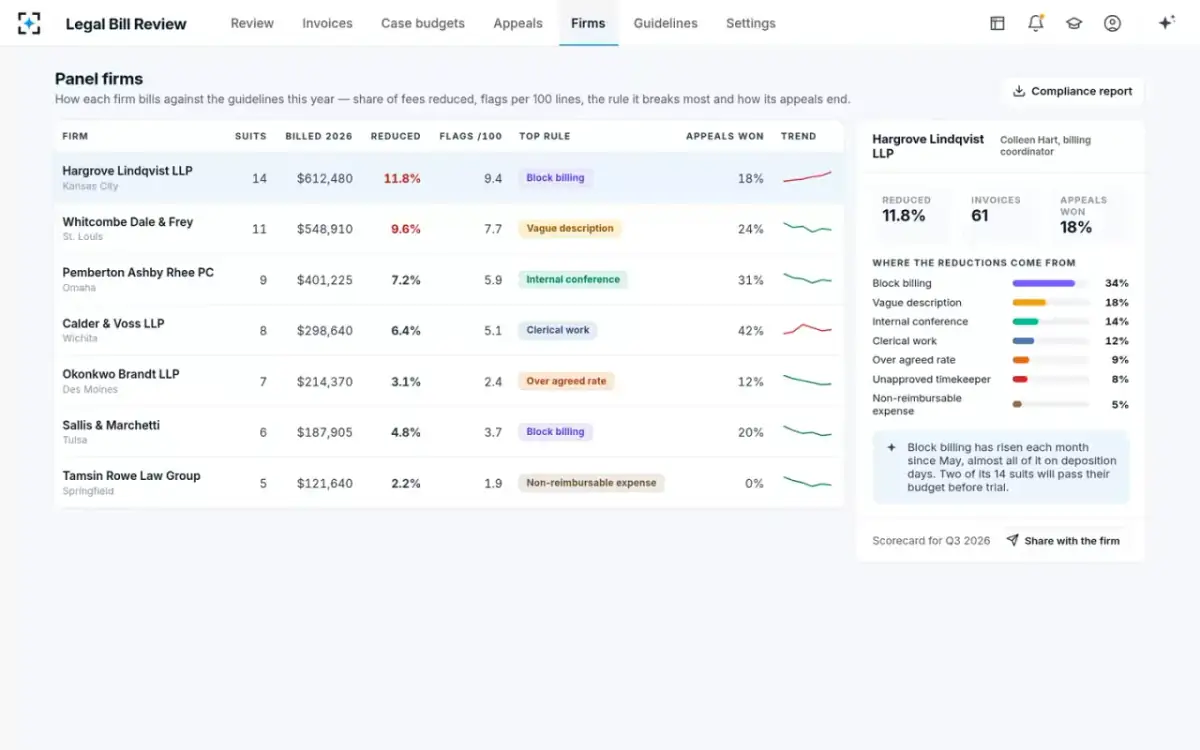
Share of fees reduced by panel firm in 2026, fictional sample panel
Read a chart like this with the appeals beside it. A firm at the top with few successful appeals is billing outside the agreement; a firm at the top that wins many appeals may be the victim of a rule applied too hard. In the sample panel, the firm at 11.8% wins 18% of its appeals, a third of its reductions are for block billing, and its block billing has risen each month since May, almost all of it on deposition days: a conversation to have with the firm about how it records deposition preparation.
The panel scorecard in Legal Bill Review: reductions, flags per 100 lines, top rule and appeals, by firm
What a quarterly panel review should show each firm
The same numbers the insurer reports internally, shown to the firm line by line, so the conversation is about billing practice rather than about the total. For each firm: lines billed and flags per 100 lines, by rule; reductions applied, and how many survived appeal; the firm's appeals won, by rule; and which of its suits will pass their budgets before trial at the current pace. A firm that sees its own pattern can change it; a firm that sees only a percentage off its invoices negotiates the percentage.
In the fictional sample panel, the review for Hargrove Lindqvist LLP covers 61 invoices and $612,480 billed in 2026: 11.8% of fees reduced, 9.4 flags per 100 lines, appeals won 18%, and two of its 14 suits projected to pass their budgets before trial. Block billing is 34% of its reductions and vague descriptions 18%. Those two rules are about how time is written down, which is the cheapest thing for a firm to change.
The review is also where the insurer's own seat gets measured. The share of lines read should be the whole invoice; the reviewer's minutes per invoice show whether reading every line is affordable, and Legal Bill Review's design target is eight minutes for a 140-line invoice; waivers, and how many needed a second reviewer, show whether the rules are being applied as written. A rule that is waived more often than it is applied is a rule counsel should rewrite.
What is a good legal bill reduction rate?
There is no good rate in the abstract, and we know of no published benchmark from a regulator or research body for insurance defense invoices. A rising rate can mean firms are billing worse or reviewers are cutting harder; only the appeal reversal rate tells which. The pattern that shows a programme working is a falling reduction rate with a stable or falling reversal rate: firms are billing inside the agreement, and the reductions that remain hold up.
The rate also depends on what is counted. On the sample September invoice in Legal Bill Review, $8,723.00 of $44,995.62 is reduced, 19.4%, and another $1,458.00 is held until four vague entries are described; counting the held amount as a saving would overstate the month, because it will be paid once the firm rewrites the entries.
Where Legal Bill Review fits in a legal spend stack, and where it does not
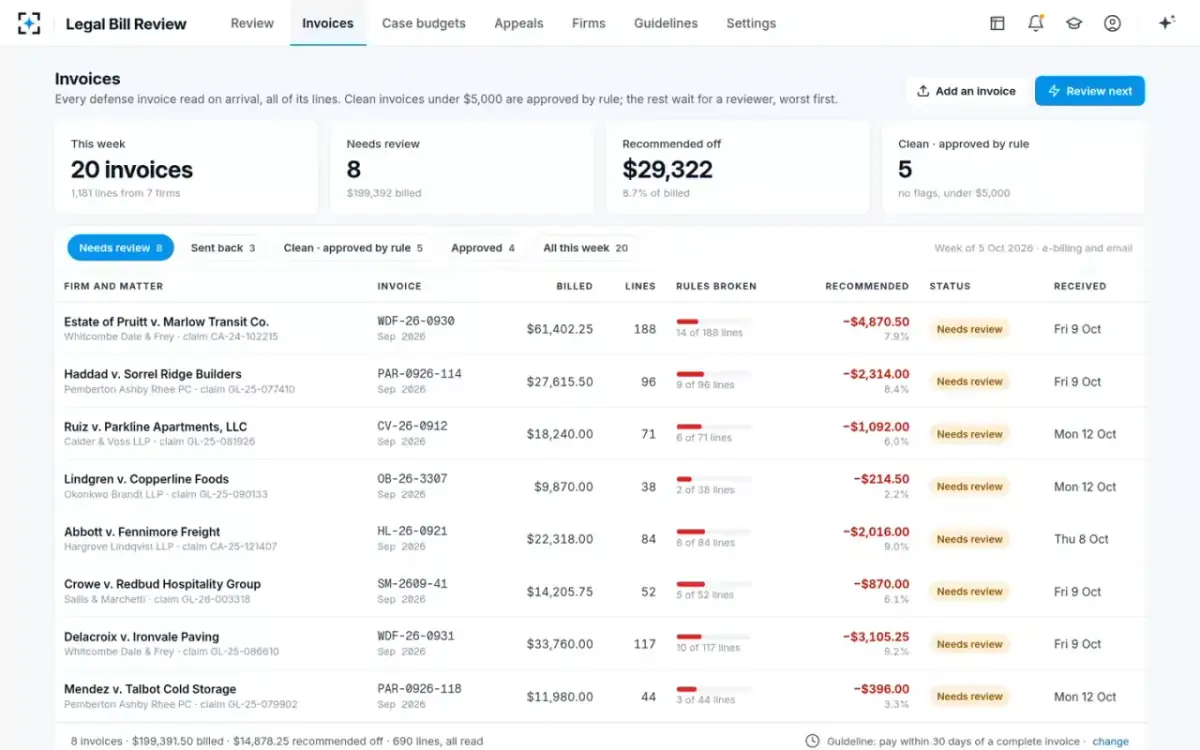
It is the review engine: it reads each invoice as it arrives through e-billing or email, checks every line against the guideline, the rates, the staffing approvals and the budget, drafts the reasons and the adjustment file, and passes the approved amount to claims payment. It works with the billing an insurer already runs, rather than replacing the e-billing channel firms submit through.
Every defense invoice that week in Legal Bill Review, read on arrival, with the clean ones approved by rule
Two things sit outside it. Litigation management itself, the deadlines, reports, counsel strategy and trial dates of each suit, belongs to Claims Litigation Management, compared in litigation management software for insurers. And the bills of independent adjusters, which have their own fee schedules, belong to Independent Adjuster Bill Review, whose buyer's questions are in invoice auditing software for adjuster bills. A buyer comparing legal spend management software should ask which of these each product covers, and how its numbers reconcile with the payment system's. How the review goes live on an insurer's own invoices is set out in the go-live plan for legal invoice review software.
Questions people ask
What is the best legal spend management software for insurers?
The one that can show, on your own invoices, how many known errors it catches, how often its reductions are reversed, and how far ahead it warns of budget overruns. Ask every vendor to run a seeded-error test on last year's paid invoices before comparing features.
How do you measure legal spend savings without inflating them?
Count reductions applied minus reductions reversed on appeal, after the appeal window closes, and subtract the cost of review and appeals. Exclude amounts held for description, which are paid once the firm rewrites the entries.
What legal spend KPIs should a claims legal team report each quarter?
Reductions upheld, appeal reversal rate by rule, median days to answer an appeal, invoices paid within terms, flags per 100 lines by firm, budget variance by phase on closed suits, and defense cost as a share of premium by line.
Does reading every line change the KPIs?
It changes what they mean. When every line is read, flags per 100 lines describes the firm's billing rather than the reviewer's luck, and a firm's falling rate over the year is evidence the firm changed.
How do defense costs differ by line of business?
The Federal Insurance Office charts defense and cost containment ratios separately for commercial auto, private auto and homeowners multiperil, and reports that the national decline to 3.9% tracked declines in Florida's homeowners and private auto lines after its reforms.