Insurance defense billing guidelines are the rules an insurer sets for the law firms it pays to defend its policyholders: how time must be recorded and described, what rates and staff are allowed, which costs are reimbursed, and which tasks need the insurer's say-so first. Most of that is ordinary contract terms for payment, and a federal court has imposed nearly the same terms on lawyers claiming fees from it. Part of it is not. Because the policyholder is defense counsel's client, rules that let the insurer control what the defense does have been held to violate counsel's duties: Montana's Supreme Court held in 2000 that lawyers who submit to prior-approval requirements "violate their duties under the Rules of Professional Conduct to exercise their independent judgment and to give their undivided loyalty to insureds." The table sorts common guideline rules by where they stand. Botminds' Legal Bill Review enforces a guideline's payment rules on every line and judges billing, never whether the work was needed.
Common insurance defense billing guideline rules, and where courts and bar opinions put them
| Guideline rule | Where it stands | Authority |
|---|---|---|
| Describe each task: what, about what, why | Payment term; a court asks the same of fee claimants | C.D. Cal. order (2010): generic descriptions "inappropriate" |
| One task per time charge (no block billing) | Payment term | C.D. Cal. order (2010); Ninth Circuit, Welch (2007) |
| Time in tenths of an hour | Payment term | C.D. Cal. order (2010) |
| Costs at actual cost; overhead not billed | Payment term | C.D. Cal. order (2010) |
| Explain a second attendee at a hearing or deposition | Payment term | C.D. Cal. order (2010) |
| Agreed rates; approved timekeepers | Payment terms, in our reading; we found no ruling against them | — |
| Insurer’s approval before depositions, research, experts or motions | Violates defense counsel’s duties (Montana) | Supreme Court of Montana, 2000 MT 110 |
| A duty to consult the insurer before acting | Flagged as possibly no different from prior approval | Supreme Court of Montana, 2000 MT 110, ¶44 |
| Guidelines that work as practice guidelines | Following them violates the lawyer’s code (Nebraska) | Nebraska Opinion 00-1 |
| Bills sent to an outside auditor | Needs the insured’s informed consent; in some states counsel may not even ask | New York 716; Montana; Oklahoma 314 |
What are insurance defense billing guidelines?
They are the outside counsel guidelines of an insurer, written for the special case where the firm is hired by the insurer but represents the insured. Oklahoma's bar ethics committee described them in 2000 as guidelines "which require great detail and specificity in attorneys’ bills", and noted that "Some billing guidelines place time limits on counsel’s activities which cannot be exceeded without prior approval from the insurer." They typically sit beside a rate agreement, a staffing approval per case and a case budget by phase.
The difference from a corporation's outside counsel guidelines is the client. A company paying its own lawyers can direct the work as it likes. An insurer paying for a policyholder's defense is a third-party payer, and in Montana not a client at all: the state supreme court held that the policyholder alone is defense counsel's client. Other states recognise the insurer as a co-client in some cases. Either way, the rules of professional conduct, not the guideline, govern what defense counsel owes.
Can an insurer require prior approval for legal research?
In Montana, no: its Supreme Court held that a requirement of prior approval before research, depositions, experts or motions violates defense counsel's duties. The guideline it examined, one insurer's litigation management plan, said "we require that defense counsel secure the consent of the claim professional prior to scheduling depositions, undertaking research, employing experts or preparing motions".
The insurers' defences are the ones heard today, and the court answered each. They said they "rarely" withhold approval; the court said that begs the question. They said counsel could do the work anyway; the court rejected "dubious premise that the threat of withholding payment does not interfere with the independent judgment of defense counsel." And it warned that "a mere requirement of consultation may be indistinguishable" in its effect from prior approval.
The court also drew the other side of the line. Its holding, it said, "should not be construed to mean that defense counsel have a "blank check" to escalate litigation costs", and lawyers must still charge reasonable fees. A guideline may require that a research entry name its issue and its purpose, and may pay for it only on that basis; that is a rule about the bill. Whether the research should be done is the lawyer's call.
This bites on ordinary guidelines, including the sample one in Legal Bill Review. Its section 6.1 requires the litigation specialist's approval for research above 3.0 hours on one issue. In a state that follows Montana, claims counsel should decide whether to apply such a section as a prior-approval rule, as notice to the insurer, or not at all; the threshold is a setting, and turning it off is a new guideline version counsel approves.
Do billing guidelines interfere with independent judgment?
They can, when they decide what work gets done rather than how it is billed. Nebraska's ethics committee separated the two concerns: guidelines demanding more supporting detail, and "billing guidelines which are tantamount to practice guidelines that encroach upon the lawyer's exercise of independent professional judgment." It concluded that following the second kind violates the lawyer's code, and said what that leaves a lawyer facing an insurer that will not pay for a deposition the lawyer thinks necessary.
[T]he Code requires the attorney to withdraw or to proceed with the matter at his or her own expense.
Nebraska Ethics Advisory Opinion for Lawyers No. 00-1
That sentence is the practical test for any guideline rule. If a firm that does the work anyway would go unpaid not for how it billed but for what it did, the rule is a practice rule. Rules about description, increments, block billing, rates, staffing and expenses pass the test; rules that make payment for a deposition depend on the insurer's view of the case do not.
What is the tripartite relationship in billing?
It is the three-way relationship of insurer, insured and defense counsel, and in billing it means the insurer pays for work done for someone else's defense. Oklahoma's committee explained why the insurer may see the bills at all: an insurer typically controls and pays for the defense, so disclosure to it is impliedly authorized; disclosure to an outside auditor, a fourth party, is not. The litigation side of that relationship, who may see what across the suit, is covered in the tripartite relationship in insurance defense, part of Claims Litigation Management.
Can insurers send bills to third-party auditors?
Only with the insured's informed consent, in the states whose ethics bodies have ruled; Oklahoma and New Mexico went further and said defense counsel ordinarily cannot even ask for it. New York's committee held that a lawyer for the insured "may not submit legal bills to an independent audit company employed by the insurance carrier without the consent of the insured after full disclosure." A guideline clause that sends bills to an outside auditor therefore has a consent question attached in each state the panel covers; the rulings and what consent must cover are set out in the legal bill auditor's seat between insurer and defense counsel.
What a federal court asks of fee claimants, beside an insurer's guideline
Nearly the same payment terms. In a 2010 securities class action, a federal judge in Los Angeles ordered the lawyers who would later seek fees to keep their time a particular way, and the order reads like an outside counsel guideline. It set a minimum increment, banned block billing, asked for UTBMS categories, limited conference time, demanded an explanation for second attendees and barred markups.
A federal court's billing rules for fee claimants beside a sample insurer's defense billing guideline
C.D. Cal. order on time records (2010): "Generic or general activity descriptions are inappropriate."
Sample insurer guideline in Legal Bill Review: §5.1: each entry must describe the work done, its subject and its purpose; vague entries held until described
C.D. Cal. order on time records (2010): "a line item with a single time charge for multiple activities is inappropriate."
Sample insurer guideline in Legal Bill Review: §5.2: entries combining two or more tasks under one time charge paid at 50%
C.D. Cal. order on time records (2010): "The minimum time increment will not be greater than one-tenth of an hour."
Sample insurer guideline in Legal Bill Review: Not shown in the sample sections; commonly a tenth of an hour
C.D. Cal. order on time records (2010): Conference time "kept to a minimum"; a second attendee must be explained
Sample insurer guideline in Legal Bill Review: §5.6: internal conferences and second attendees flagged
C.D. Cal. order on time records (2010): "Only actual costs, without markup, will be permitted."
Sample insurer guideline in Legal Bill Review: §8.2: non-reimbursable expenses not paid
C.D. Cal. order on time records (2010): A summary of fees by categories such as those described in the UTBMS
Sample insurer guideline in Legal Bill Review: Every line read with its UTBMS task and activity codes and budget phase
The comparison makes a narrow point. Rules about how time is recorded and described are not an insurer's invention or an intrusion on the defense; courts impose them when they pay lawyers. The court's order says nothing about which motions to file. That is where a defense guideline should stop too.
How to write a defense billing guideline a reviewer can enforce
Write each rule about the bill, make it testable on the invoice and the records behind it, and give every number an owner. A guideline written that way survives both an ethics challenge and a firm's appeal, because each reduction under it points to a sentence about billing and a fact on the invoice. The other half of an insurer's rules for counsel, reporting and case handling, is a separate document; how to write those so counsel can meet them is in litigation management guidelines.
Eight tests for each section of an insurance defense billing guideline
- Is it about the bill, not the defense?
Description, increments, rates, staffing, expenses: yes. Whether to depose, research or retain an expert: no.
- Can it be tested on the invoice and the records on file?
A rule that needs the lawyer’s strategy memo to apply is a practice rule.
- Is the text quotable in a reduction?
The firm should see the sentence it broke, not a paraphrase.
- Does every number have an owner?
A block-billing share or a research threshold changes only as a new version someone approves.
- Is the consequence stated?
Not payable, paid at a share, or held until described: each is a different outcome for the firm.
- Is there a route to payment?
Resubmission with time per task, or a description rewritten, should reopen the line.
- Does it vary by state where the law does?
Prior-approval and outside-audit clauses need claims counsel’s view state by state.
- Is the answer window stated?
How long the firm has to answer a reduction, and who decides appeals above what amount.
Where the agents stop
On the billing side of the line, by design. In Legal Bill Review the guideline checker tests every line against each section and quotes the words that break it, and its stated limit is that it never questions counsel's legal judgement, only how the work is billed. Each section is shown beside the rule applied, with its hits and dollars for the quarter, so claims legal counsel can see what the guideline is doing in practice.
The guideline in Legal Bill Review: the text the firms signed, the rule applied beside each section, and what it caught this quarter
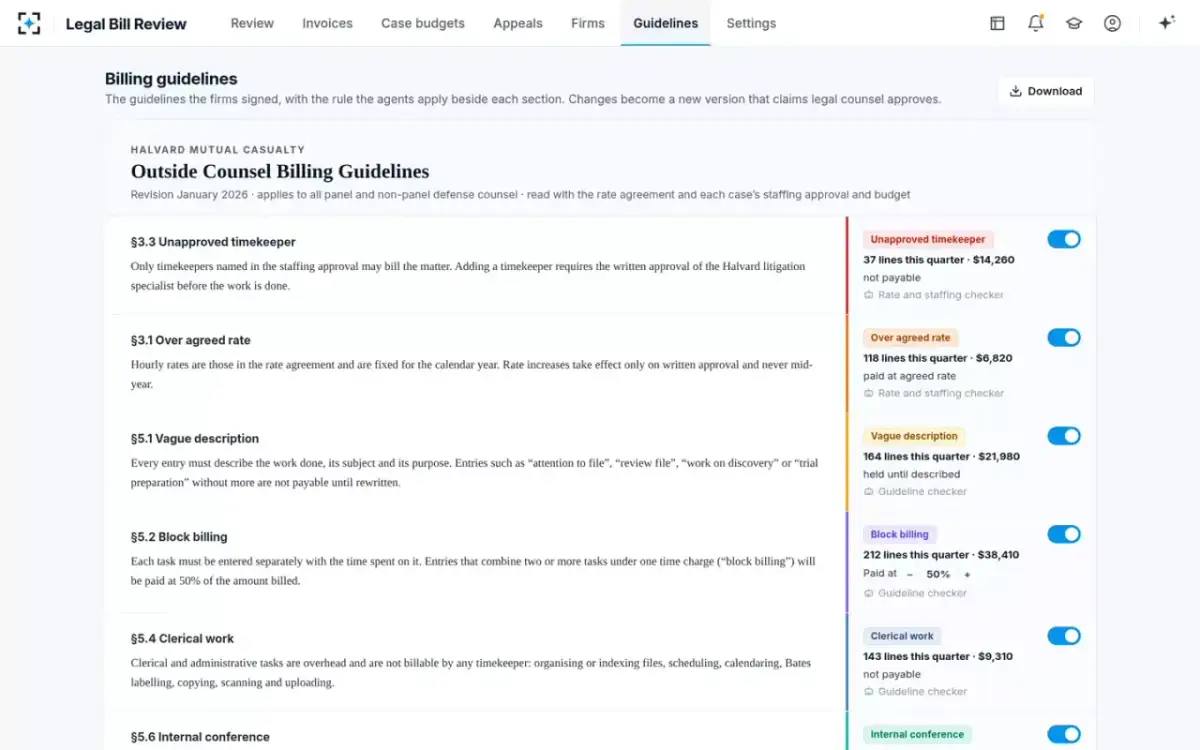
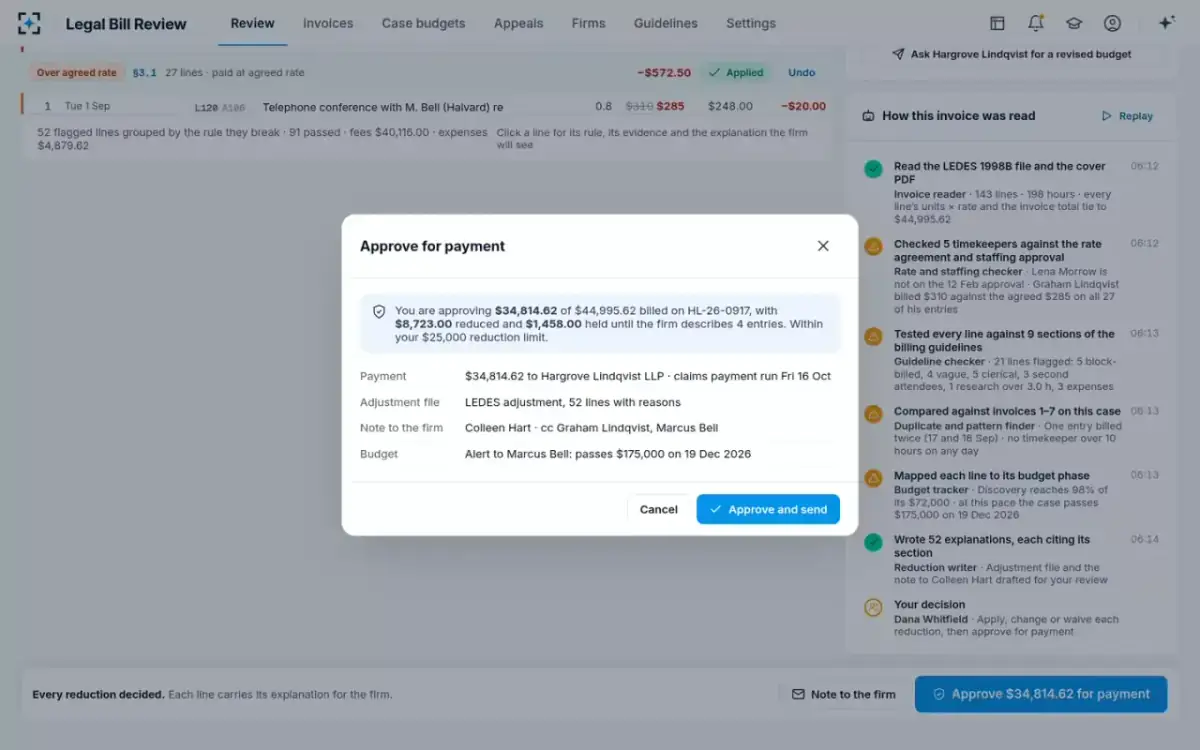
People keep every decision the guideline leads to. The reviewer approves the invoice with each reduction and hold listed; the litigation specialist approves timekeepers and budget revisions; claims legal counsel owns the guideline and decides appeals above a threshold. How a block-billing rule like section 5.2 should be applied entry by entry is in why a typical block billing reduction is the wrong answer.
Approval in Legal Bill Review: the reviewer confirms the payment, the reasons file and the budget alert in one step
Questions people ask
What do bar ethics opinions say about insurance defense billing guidelines?
That guidelines may regulate billing but not the defense, and that bills may not go to outside auditors without the insured's informed consent. Nebraska's Opinion 00-1 held that following guidelines that encroach on independent judgment violates the lawyer's code; Montana's Supreme Court held prior-approval requirements violate counsel's duties.
Are insurance defense billing guidelines enforceable?
Payment terms are what a firm agrees to when it accepts the work. Rules that control the defense are another matter: Montana's Supreme Court held that counsel who submit to prior-approval requirements violate their duties, so claims counsel should check each state's rulings before relying on such a clause.
How do outside counsel billing guidelines differ for insurers?
A company's outside counsel guidelines govern lawyers it hires for itself. An insurer's govern lawyers it hires for its policyholder, so they must leave the defense to counsel and treat the insured's confidences, including the detail in the bills, as the insured's.
Can a guideline cap the hours on a task?
A cap that stops payment for work counsel judges necessary is the kind of time limit Oklahoma's committee described as requiring the insurer's prior approval, and Montana's ruling applies to such approvals. A budget by phase, revised when the case changes, does the same job without that problem.
Who writes an insurer's billing guidelines?
Claims legal counsel usually owns them. In Legal Bill Review the guideline is held as versioned rules that counsel approves, so the text the firms signed and the rule applied to each invoice line cannot drift apart unnoticed.