The typical block billing reduction people quote is a flat percentage of the block-billed time, and in the federal decisions discussed below it runs from 5% to 40%. That spread is the problem. In January 2025 the Eleventh Circuit vacated a 40% cut to block-billed entries because the trial court had picked an "arbitrary percentage", and the Ninth Circuit has held that a court may trim up to 10% without explaining itself, but must give specific reasons for anything more. Block billing, one time charge for several tasks, makes the time per task unknowable; the reduction that survives says which entries, under which rule, by how much, and how the firm can fix it. For an insurer reviewing panel counsel's invoices, the same discipline decides how fast an appeal is answered. Botminds' Legal Bill Review writes each block-billing reduction that way, entry by entry.
A typical-amount block billing reduction against a line-specific one
Flat percentage cut: A share of all hours, or of all block-billed hours
Line-specific reduction: The named entries that lump tasks under one time charge
Flat percentage cut: "Block billing" in general
Line-specific reduction: The tasks quoted from each entry, and the guideline section they break
Flat percentage cut: One percentage, chosen
Line-specific reduction: Shown per entry: 8.7 h × $210 = $1,827.00, paid at the agreed share
Flat percentage cut: Argue about the percentage
Line-specific reduction: Resubmit the entry with time per task, to be reviewed again
Flat percentage cut: Reversed as arbitrary when nothing ties it to the over-billing
Line-specific reduction: Checked against the entry and the rule, line by line
What is block billing?
Block billing is recording several tasks under one time charge, so that nobody can tell how long each took. The Ninth Circuit adopted the Tenth Circuit's definition: "the time-keeping method by which each lawyer and legal assistant enters the total daily time spent working on a case, rather than itemizing the time expended on specific tasks." A federal court in California put it more briefly in an order on fee records: one time charge covering several activities is not acceptable.
The Eleventh Circuit's 2025 case gives an ordinary example: "Continue reviewing administrative record, conduct research, continue drafting arguments." The court agreed this was block billing, rejecting the argument that the three tasks happen at once: whatever the connection between reviewing, researching and drafting, counsel must keep records that let a reviewer identify distinct claims.
How much do courts reduce block billing?
Anywhere from a few percent to 40% in the reported cases, which is why a single "typical" figure misleads. The amounts in the chart all come from federal fee disputes, where a court decides what the losing side pays the winner's lawyers; the outcomes beside them matter more than the numbers.
Block billing reductions in five federal fee decisions, and what happened to them
The Eleventh Circuit drew the lesson itself. Counsel had pointed to recent orders in the same district cutting block-billed fees by 20% and 40%, with no explanation for either; the court wrote that "This inconsistency also highlights why we believe the reduction to be arbitrary." The same footnote praised a judge who declined a recommended 20% cut as excessive, because the block billing in that case was "far less egregious than other cases", and applied 5% instead.
The range people cite as typical has a source. In Welch, the trial court took its 20% from a California State Bar fee-arbitration advisory which concluded that block billing "may increase time by 10% to 30%", and chose the middle. That is an estimate of how much block billing may inflate time in general, not a measure of what happened on any invoice.
Why a typical percentage is the wrong answer
Because it is not tied to the over-billing it is meant to correct. The courts' objections come in three forms, and each applies to a bill reviewer as much as to a judge.
[A] district court ‘must do more than eyeball the request and if it seems excessive cut it down by an arbitrary percentage.’
U.S. Court of Appeals for the Eleventh Circuit, 2025, quoting its own 2022 decision
First, the base. Welch's trial court applied 20% to every hour requested, not only the block-billed ones; because barely more than half were block billed, the Ninth Circuit found the cut "effectively served as a 40 percent penalty on those hours actually block billed, well above the range justified by the Fee Report." A reviewer who applies a block-billing percentage to a whole invoice repeats the error.
Second, the connection. In the same case the Ninth Circuit upheld a separate 20% cut for billing in quarter-hour increments, because "the district court expressly correlated its reduction for quarter hour billing to Kantor & Kantor’s actual over-billing": it had found phone calls and emails billed at fifteen minutes that likely took a fraction of that. The same percentage survived where it was tied to evidence and fell where it was not.
Third, the explanation. The Ninth Circuit's Moreno decision allows a court to "impose a small reduction, no greater than 10 percent—a “haircut”—based on its exercise of discretion and without a more specific explanation." Beyond that, the reasons must be specific enough to review. The Eleventh Circuit asks a court to "articulate the decisions it made, give principled reasons for those decisions, and show its calculation."
Block billing vs task billing: one entry, two ways
Task billing gives each task its own line and its own time; block billing gives several tasks one. The difference is easiest to see on the same day's work. Both entries below come from Legal Bill Review's fictional sample data: the first is a block-billed deposition-preparation entry; the second is a mediation entry a panel firm resubmitted with time per task after it was reduced.
Block billing vs task billing, on two sample entries
| Block-billed | Task-billed | |
|---|---|---|
| The entry | Prepare for deposition of driver Curtis Dunmore; review ELD logs and dash-camera stills; draft outline; telephone conference with client safety director; email to G. Lindqvist | Prepare for and attend mediation; travel to and from Wichita mediation center |
| Time recorded | 8.7 hours, one charge | 5.4 hours, split on resubmission: preparation 0.9, attendance 3.7, travel 0.8 |
| What a reviewer can tell | Not how long any of the five tasks took | The time on each task, so each can be tested against its rule |
| Result in the sample | Paid at 50% under the guideline’s block-billing section: −$913.50 of $1,827.00 | Appeal reader recommends accepting: preparation and attendance in full, travel at 50% under the travel section |
The second entry shows why task billing is worth asking for rather than penalising its absence. Once the firm split the 5.4 hours, the travel time could be paid under its own rule and the rest in full. The block-billed version could only be paid at a guessed share.
How should a block billing reduction be explained?
So that the firm can check it and fix it without asking a question: the entry, the rule, why the time per task cannot be known, the calculation and the way to resubmit. Each element below answers a ground on which a court has set a percentage aside.
Seven parts of a block billing reduction a firm can answer
- The entry, identified
Invoice, line number, date, timekeeper, and the description quoted in full.
- The tasks lumped together
Listed from the description, so the firm sees what the reviewer counted.
- The rule, quoted
The guideline section and its words, not "block billing" as a label.
- Why the time is unknowable
One charge for several tasks; the reduction rests on that, not on the work.
- The base and the calculation
This entry’s hours × rate, the share applied under the agreed rule, the amount.
- The route to payment
Resubmit with time per task, and the entry will be reviewed again.
- The deadline to answer
The window the guideline or agreement gives; 30 days in the sample.
Is a 50% block billing rule in an insurer's guideline different?
Yes, in law, because it is a term the panel firm agreed rather than a judge's discretion; but it still has to be applied entry by entry. The sample carrier's guideline in Legal Bill Review says entries combining two or more tasks under one time charge "will be paid at 50% of the amount billed". That is a contract price for a defect, known in advance. The fee-shifting cases above do not govern it.
What the cases still teach is where such a rule goes wrong in practice: applied to the wrong base, or to entries that were not block-billed, or announced as a total. In the sample invoice, five entries by three timekeepers lump four or five tasks each: 35.6 hours, $6,800.00 billed. The reviewer applies the rule to those five and no others, and they fold into one reduction of $3,400.00, with each entry still listed and the firm free to resubmit with time per task.
Block billing applied in Legal Bill Review: five named entries, one rule, one reduction the firm can answer
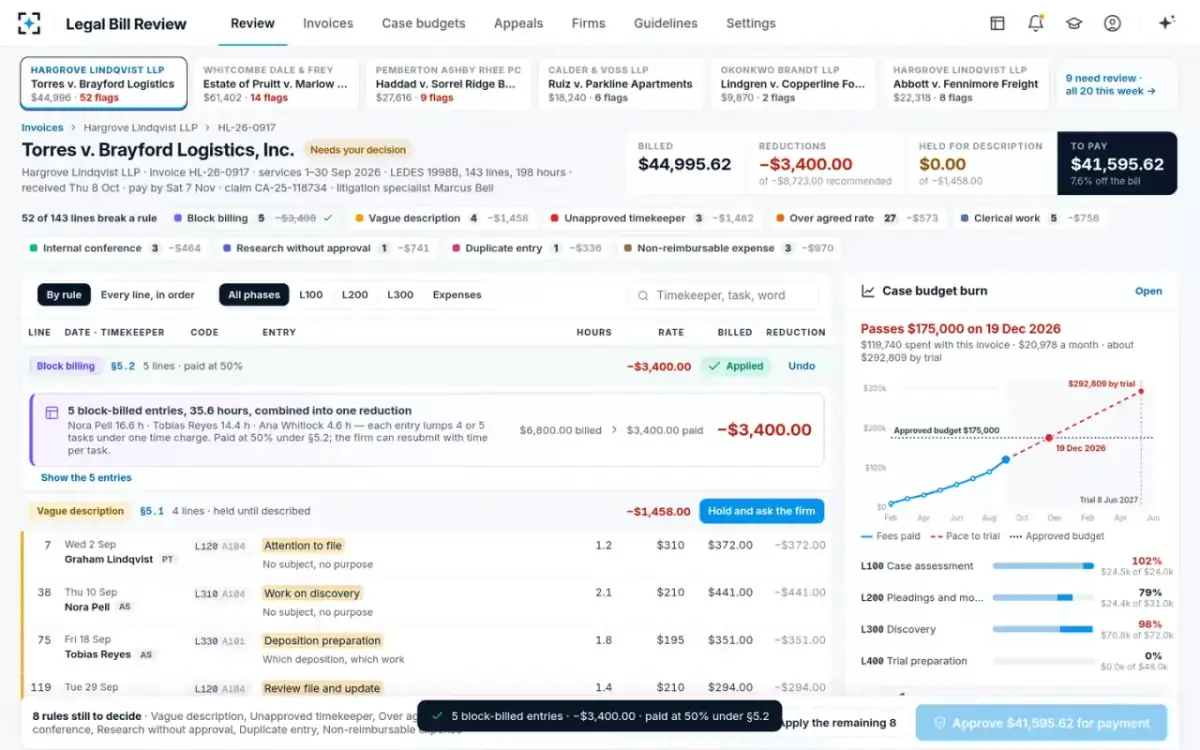
A percentage written into the guideline also removes the argument about the number, which leaves only the question a firm can resolve: was this entry block-billed or not? That is the argument a reviewer wants to have, because the entry answers it. Whether the guideline itself may contain such a rule, and which rules bar opinions say it may not contain, is in insurance defense billing guidelines: what courts and bars forbid.
Is block billing allowed?
It is not unlawful, but courts discount it and insurer guidelines such as the sample carrier's discount or forbid it. The federal court order quoted above calls it inappropriate. The LEDES Oversight Committee's standard list of e-billing errors gives it its own code, number 53, "Bulk Billing", with the note "Multiple services or expenses must be itemized as separate entries". A firm billing an insurer under such a guideline has agreed not to do it.
Why it is bad is the courts' reason: the fee claimant carries the burden of documenting hours, and block billing "makes it more difficult to determine how much time was spent on particular activities." It also hides tasks that are separately disallowed, such as clerical work inside a block of legal work, or travel billed at a full rate.
Can a law firm appeal a legal bill reduction?
Yes; guidelines and auditors have long provided for it. New York's bar ethics committee described the outside-auditor version in 1999: a firm whose bill is reduced may ask for reconsideration, but is paid only once it sends further documentation and justification, a step described in the legal bill auditor's seat. For block billing the documentation is simple, the same entry with time per task.
A block-billing appeal in Legal Bill Review: the firm splits the entry, and the recommendation follows the guideline
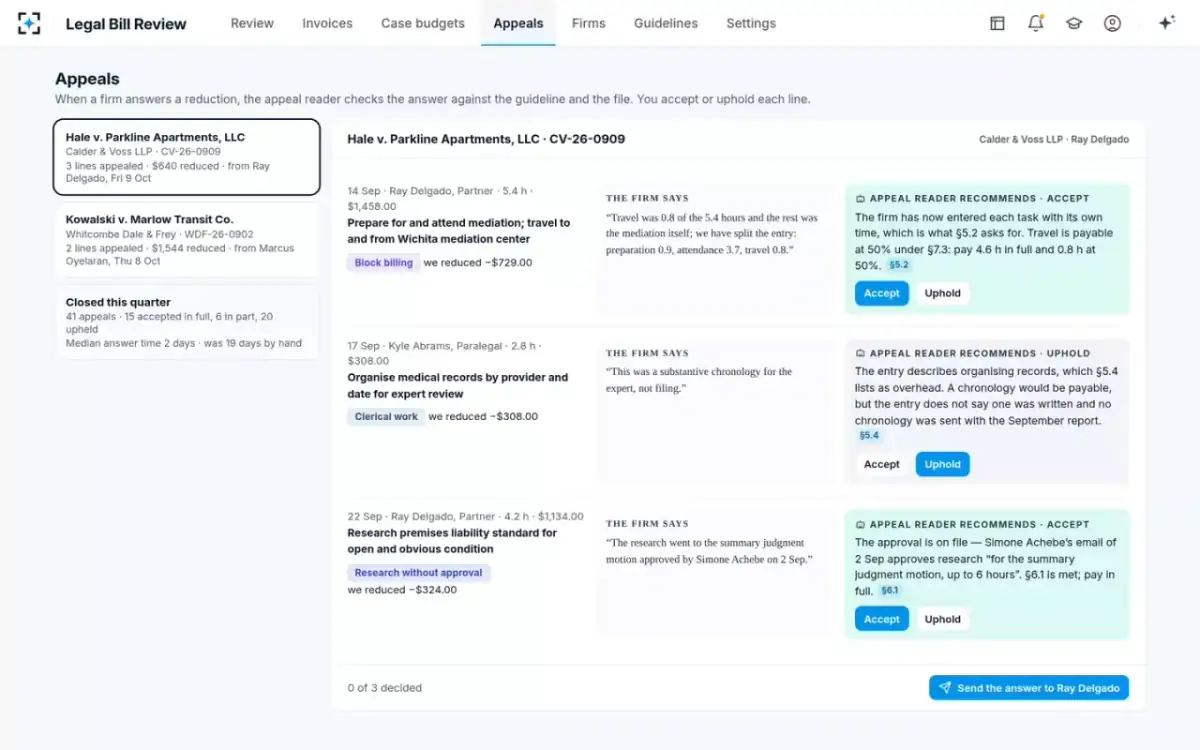
A reduction written with all seven parts turns most appeals into resubmissions, which are quick to check. Where reductions are a bare percentage, appeals become arguments about the percentage, and they wait for someone to pull the guideline and the file. How appeals and their outcomes belong on a legal spend scorecard is in the KPIs that show legal spend management paid.
Questions people ask
Why is block billing bad?
Because nobody can tell how long each task took, so nobody can test whether each was reasonable or separately payable. Courts put the burden of documenting time on the lawyer claiming it, and block billing defeats that.
Does block billing increase the time billed?
A California State Bar fee-arbitration advisory, as quoted by the Ninth Circuit in Welch (2007), concluded it may increase time by 10% to 30%. That is a general estimate; the reasoned course is to judge the entries in front of you.
Is a 10% haircut always safe?
In the Ninth Circuit, a court may cut up to 10% on its own judgment without a more specific explanation (Moreno, 2008). That is a rule about judges' fee awards in one circuit, not a licence for an insurer's reviewer to cut every invoice by 10%.
Can a block-billed entry be fixed after it is reduced?
Yes, if the firm resubmits it with the time for each task. In Legal Bill Review's sample, block-billed entries resubmitted that way are reviewed again, and a resubmitted mediation entry is recommended for payment with only the travel at the guideline's travel rate.
What is the difference between block billing and vague billing?
Block billing lumps several described tasks under one time charge; vague billing describes one task too thinly to judge, such as "attention to file". The sample carrier treats them differently: block-billed time is paid at a set share, vague entries are held until described.