A legal bill auditor is the person, inside an insurer's claims legal team or at an outside audit firm, who reads each invoice a panel law firm sends for defending a policyholder and recommends which fees and expenses should not be paid. The work is old and narrow: the Oklahoma Bar's ethics committee wrote in 2000 that "for years insurers have examined defense counsel’s bills via in-house claims personnel", and that outside auditors are hired "to examine all of defense counsel’s bills and, in some cases, to recommend that certain fees and expenses, or portions thereof, should not be paid." It is hard because a single monthly invoice can carry well over a hundred time entries, each to be tested against a billing guideline, a rate agreement, a staffing approval and a case budget, and because the auditor sits between two parties with a lawyer-client bond the auditor is not part of. Botminds' Legal Bill Review exists for that seat: agents read every line and draft the reasons, and the reviewer decides.
Four people carry one defense invoice: what the legal bill auditor's seat looks like before and after agents read every line
Today
Samples twenty lines of a 143-line invoice and pays the rest on faith; writes reductions as a number.
With agents
Starts from every line already read and grouped by the rule it breaks; applies, waives and approves.
Still theirs: Every reduction, waiver and approval for payment
Today
Learns a suit blew its budget when the next budget request arrives.
With agents
Sees each suit’s projected budget-crossing date every Monday.
Still theirs: Timekeeper approvals, research approvals, budget revisions
Today
Hears about a disputed reduction when the firm escalates it.
With agents
Owns the guideline as versioned rules; decides appeals above a set amount.
Still theirs: The guideline text and the large appeals
Today
Receives a total cut with no line or rule attached.
With agents
Receives one row per reason, each with its guideline section, and an adjustment file.
Still theirs: The answer to each reduction, line by line
What does a legal bill auditor do?
A legal bill auditor tests each line of a defense invoice against the rules the insurer and the firm agreed, recommends a reduction where a line breaks one, and answers the firm when it disputes the result. New York's bar ethics committee described the outside version of the job in 1999 in terms that still fit: the auditor "evaluates the defense bills to determine whether certain charges conform to the insurance company’s guidelines and adjusts defense bills downward or rejects them outright if the work performed or the charges for that work deviate from the guidelines."
In practice the tests fall into four families. Rates: is each timekeeper billed at the agreed hourly rate for that year? Staffing: is each timekeeper named on the case's staffing approval? Description: does each entry say what was done, about what, and why, with one task per time charge? Budget: which litigation phase does the line draw down, and how much is left? A fifth family, duplicates and patterns, compares the invoice with the firm's earlier invoices on the same case.
The output is a decision per line and a note the firm can answer. The note matters as much as the number: New York's committee recorded that a firm whose bill is cut "is given an opportunity to ask for reconsideration, but must submit additional documentation and justification of events and services in order to receive payment." Every reduction an auditor writes is the opening of that exchange.
Who reviews defense counsel invoices for insurers?
Three kinds of reviewer do, often on the same book: claims staff and legal bill reviewers employed by the insurer, a litigation specialist who owns the case budget and approvals, and outside audit firms hired by the insurer. The Oklahoma opinion drew the line between them that still governs: the ethics problem it addressed was "the use of outside auditors to review defense counsel’s bills, as opposed to evaluation of defense counsel’s bills by in-house personnel."
The distinction exists because of who the defense lawyer's client is. When an insurer hires a firm to defend its policyholder, the policyholder is a client, and in Montana the only one: the state's supreme court held in 2000 that the policyholder is defense counsel's only client. Other states treat the insurer as a co-client in some cases; how that three-way relationship works across a litigated file is set out in the tripartite relationship in insurance defense. Either way, an in-house reviewer works for a party inside the relationship. An outside auditor is a fourth party; Oklahoma's committee drew it as a second triangle hanging off the first.
Montana's court went further about what the outside auditor is for. Auditors argued they shared policyholders' interest in keeping defense costs down; the court answered that "Their mission, as characterized in part by Respondents, is to find fault with legal charges, not to further the representation of insureds." That sentence is the reason the auditor's seat is regulated at all.
Can an insurer send defense bills to an outside auditor?
Yes, in most states, but only after the policyholder has given informed consent, and in some states the defense lawyer may not even ask. By mid-2000, New Mexico's ethics committee could list opinions from twenty-three jurisdictions, and a ruling of the Montana Supreme Court, in accord with its view that sending the bills without the insured's consent breaches confidentiality. The table sets out six of the rulings in their own words.
What six rulings say about sending defense bills to an outside legal bill auditor
| Ruling | Year | What it says |
|---|---|---|
| New York State Bar, Opinion 716 | 1999 | A lawyer may not send bills to an insurer’s audit company unless the insured, fully informed, consents. |
| Kentucky Bar, E-409 | 1999 | Fully informed consent of the insured is required before billing information goes to the insurer if the lawyer knows the insurer forwards it to an auditor. |
| Supreme Court of Montana, 2000 MT 110 | 2000 | Disclosure of detailed descriptions of services to third-party auditors without "contemporaneous fully informed consent" violates client confidentiality. |
| State Bar of New Mexico, 2000-2 | 2000 | Without consent the bills must not go to auditing companies, and the lawyer "ordinarily may not seek consent" because of the conflicts involved. |
| Oklahoma Bar, Opinion 314 | 2000 | A lawyer may not agree to the representation knowing the insurer will send the invoices to an outside auditor; seeking consent is itself a conflict. |
| Nebraska, Opinion 00-1 | 2000 | Bills holding a client’s confidences or secrets may not go to an insurer’s auditor; the committee withdrew an earlier informal view: "This we now believe to be incorrect." |
The spread is the point for anyone who runs or buys bill review. Oklahoma sits at the strict end, agreeing with Washington's 1999 opinion that asking the client to waive confidences so the lawyer can be paid puts the lawyer in a conflict. New York and Kentucky sit in the middle: consent is required and possible. Oklahoma's opinion records the permissive end, a 1997 Massachusetts letter that inferred consent and a 1998 Nebraska letter that saw no problem, and Nebraska's committee later withdrew that reasoning. An insurer with a national panel is operating under all of these at once.
What does an insured have to consent to?
The insured has to understand what the bills reveal and what could follow from disclosing them, at the time of the disclosure, and a clause in the policy does not do that. Montana's court explained why: someone buying a liability policy "cannot know at the time he enters the contract what kind of claim will be brought against him, what the issues will be, or what kinds of services will be undertaken by his defense attorney."
What the opinions say an insured's informed consent to a legal bill audit has to cover
- What the bills contain
The nature of the information in the billing records the auditor will see (New York 716); Oklahoma adds a specific identification of any confidential information that could be disclosed.
- The privilege risk
Whether disclosure may waive the attorney-client privilege or work-product protection, and that an auditor’s confidentiality promise would not bind a third party seeking discovery (Oklahoma 314, New York 716).
- The insurance-contract consequence
The risk that the insurer refuses to pay the defense if the insured declines (New York 716; Kentucky E-409).
- The lawyer’s own interest
That the lawyer is paid by the insurer and has a financial interest in the audit going smoothly (Oklahoma 314).
- Timing
Consent contemporaneous with the facts, not at policy purchase (Montana); revisited when the auditor asks for more than was first authorised (New York 716).
- Form
In writing, per Oklahoma; revocable, per New York.
For an insurer, the practical consequence is a question to settle with claims counsel before any outside review begins: in which states does the panel firm need consent, who obtains it, and what happens to an invoice where it is refused. The answer belongs in the rules the review runs on, not in a reviewer's memory. How those rules are written, and which ones bar opinions say a guideline may not impose, is the subject of what courts and bars forbid in insurance defense billing guidelines.
How do legal bill auditors get paid?
Outside auditors have been paid a flat fee, a share of what they save, or on a promise of a set percentage of reductions. Oklahoma's committee listed "guaranteed reductions of specified percentages of defense counsel’s bills or contingency fee arrangements under which the auditing firm receives a percentage of the attorney fee expenses it saves the insurer." New York's committee spelled out the consequence.
Those charging a contingent fee receive a percentage of the difference between the amount of the lawyer’s bill and the amount approved, and thus have a financial interest in curtailing legal fees.
New York State Bar Association, Opinion 716 (1999)
How the seat is paid shapes what it reports. An auditor paid on reductions proposed will propose more, and a programme measured on reductions proposed will look better every quarter whether or not the reductions survive the firm's appeal. The measures that resist that drift are reductions upheld after appeal, the time taken to answer, and budget variance by phase, which the legal spend KPIs that show a programme paid works through.
What can a legal bill auditor question, and what stays with defense counsel?
An auditor can question how work was billed: rate, staffing, description, increments, duplication, expenses, and whether a task needed approval under the agreed terms. Whether the work should have been done at all is defense counsel's call. Montana's court held that requiring the insurer's prior approval before depositions, research, experts or motions "fundamentally interferes with defense counsels' exercise of their independent judgment", while warning that its holding did not give defense counsel a "blank check" to escalate litigation costs.
Billing questions a legal bill auditor can ask, and the judgment questions it cannot
Within the auditor's seat: Was the deposition entry described with its witness and purpose, at the agreed rate, by an approved timekeeper?
Defense counsel's judgment: Should this witness be deposed at all, and when?
Within the auditor's seat: Does the entry name the issue and the motion it served? Does the agreement require notice above a set number of hours?
Defense counsel's judgment: Is the research needed to defend the insured?
Within the auditor's seat: Is the timekeeper on the case’s staffing approval? Was a second attendee explained?
Defense counsel's judgment: Which lawyer is right for the hearing?
Within the auditor's seat: Is the expert’s invoice within the agreed expense terms, without markup?
Defense counsel's judgment: Does the defense need an expert, and which one?
Within the auditor's seat: Is each task entered separately, with its own time, in the agreed increment?
Defense counsel's judgment: How long should a good brief take?
The right-hand column is where audits have gone wrong. New York's committee recorded that the documentation auditors required before paying could include "the lawyer’s evaluation of the merits of a case or the lawyer’s tactical and legal strategy that justifies certain work". A review built on the left-hand column never needs to ask for that file.
One sample invoice at the auditor's desk, line by line
Take a sample September invoice as it reaches the reviewer in Legal Bill Review. The carrier, the firm and the people are fictional. Hargrove Lindqvist LLP bills $44,995.62 on Torres v. Brayford Logistics, a trucking injury suit in its deposition month: 143 lines, 198 hours, a LEDES 1998B file. By the time the reviewer opens it, every line has been read; 52 break a rule and 91 pass.
In Legal Bill Review, the auditor starts from every line already read and grouped by the rule it breaks
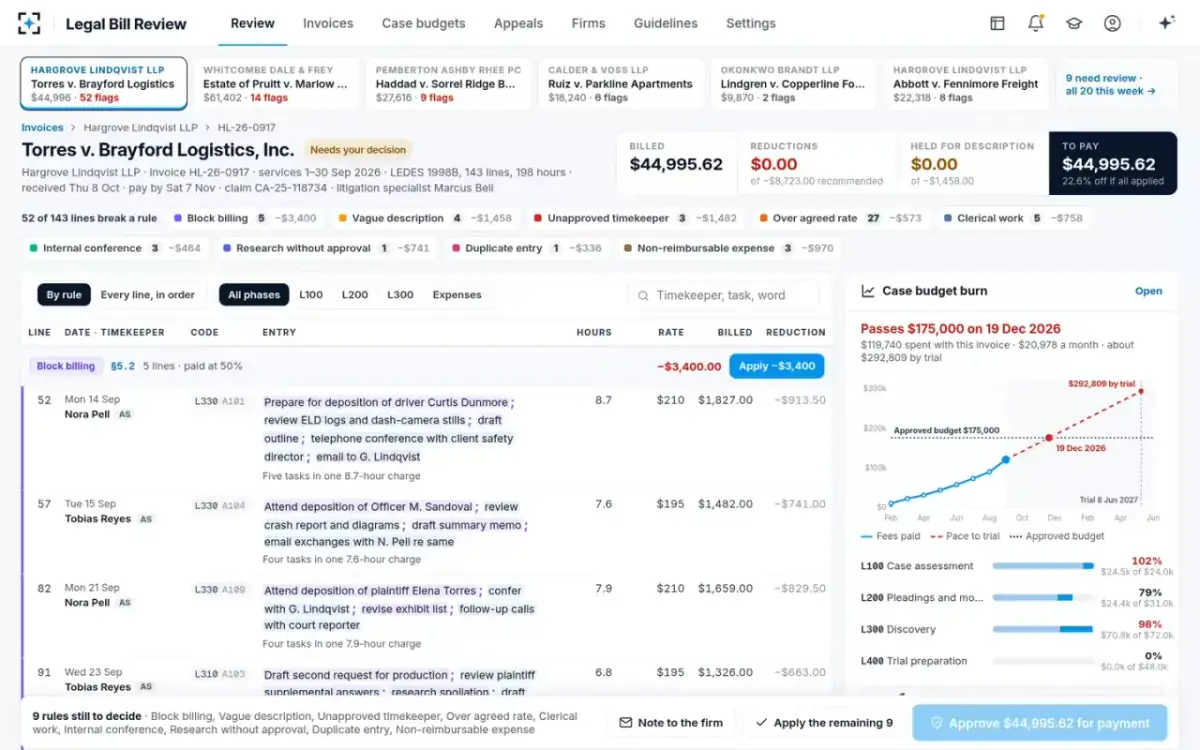
The groups are uneven in a way a sample would never show. Twenty-seven lines break the rate rule, each by a small amount: the partner billed $310 an hour against an agreed $285, worth $572.50 in all. Five block-billed entries carry $3,400.00 of the reduction under the guideline's block-billing section. Three lines belong to an associate who is not on the case's staffing approval: $1,482.00, payable only if the litigation specialist approves her in writing. Four vague entries, $1,458.00, are held rather than cut, to be paid once the firm describes them.
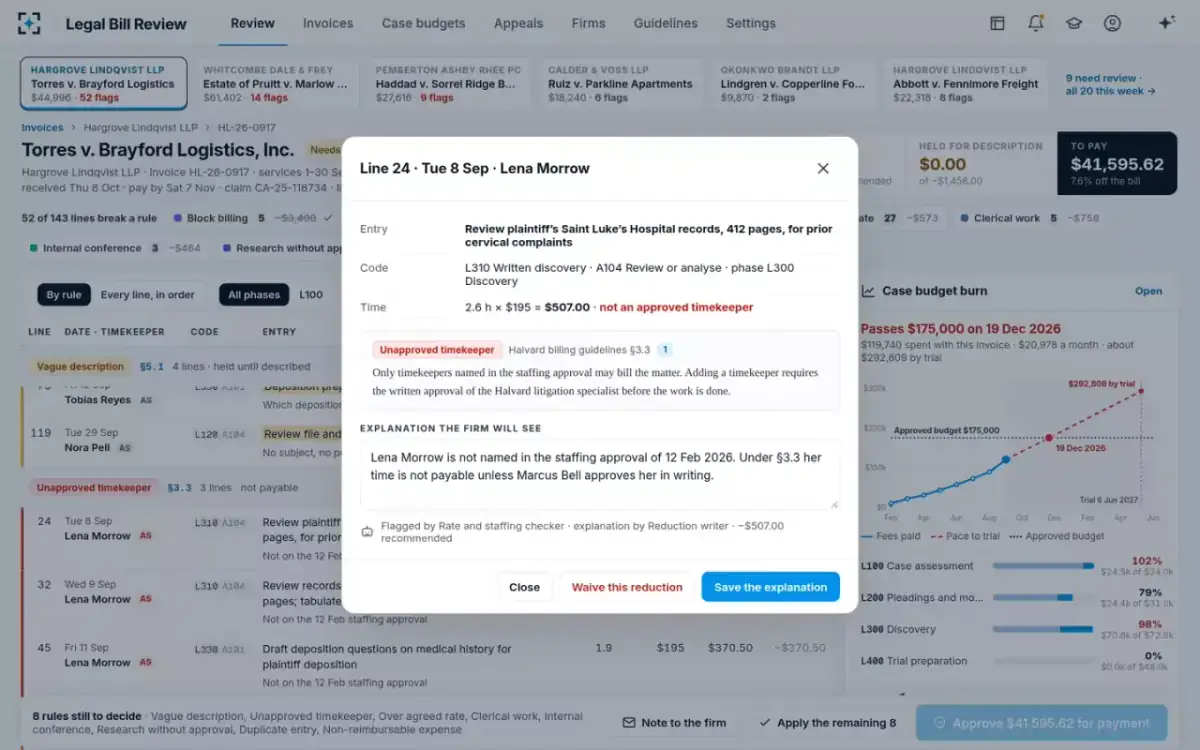
Each recommended reduction opens with its line, its UTBMS task and activity codes, its arithmetic, the guideline section quoted in full and the sentence the firm will see. The reviewer can edit that sentence, save it or waive the reduction; a waiver is recorded, and on the sample carrier waivers above $1,000 on one invoice need a second reviewer.
One line in Legal Bill Review: the entry, its codes, the quoted rule and the sentence the firm will see
Where agents fit at the auditor's seat, and where they stop
Agents fit the reading, not the deciding. In Legal Bill Review seven agents split the work: an invoice reader that turns the LEDES or PDF file into lines and re-adds every line and the total; a rate and staffing checker; a guideline checker that quotes the words that break each section; a duplicate and pattern finder; a budget tracker; a reduction writer; and an appeal reader that checks a firm's answer against the guideline and the approvals on file. Each has stated limits: the invoice reader never alters a billed figure, the guideline checker never questions counsel's legal judgement, and the pattern finder never reduces on a pattern alone.
The reviewer keeps every reduction, every waiver and every approval for payment, within a reduction limit the carrier sets ($25,000 an invoice on the sample carrier). Appeals above a threshold go to claims legal counsel. Timekeepers, research approvals and budget revisions go to the litigation specialist before the work is done. Nothing goes to the firm without the reviewer.
What changes is the shape of the reviewer's day. The sampling, the rate lookups and the first draft of every reason are done before the invoice is opened; the reviewer's time goes to the lines where judgment is needed, such as whether an entry is truly block-billed or whether an approval email covers the research billed. The design target is eight minutes for a 140-line invoice with every line read. How a block-billed entry should be reduced so the firm can answer it is worked through in why a typical block billing reduction is the wrong answer.
Questions people ask
What is a legal bill review?
A legal bill review is the check of a law firm's invoice against the client's billing guidelines, rate agreement, staffing approvals and budget before it is paid. For insurers it is applied to the panel firms defending policyholders, and it ends in a payment decision and a reasoned note for each line reduced.
Do legal bill auditor jobs sit inside insurers or at outside firms?
Both. Oklahoma's ethics committee noted in 2000 that insurers had long reviewed defense bills with in-house claims staff, and that some also hire outside auditors; the ethics rules bite hardest on the outside version, which needs the insured's informed consent in most states that have ruled.
Is a legal bill auditor bound by attorney-client privilege?
Not as a member of the privileged circle, according to Montana's Supreme Court, which held in 2000 that third-party auditors are not within the "magic circle" and called disclosure to them disclosure to a potential adversary. Whether a given disclosure waives privilege is a question of fact the court left open.
Can an auditor reduce a bill for work the claims handler approved?
New York's 1999 opinion recorded auditors who limited or rejected charges even where the work had been agreed with a claims representative. A review that checks approvals on file avoids that: in a sample appeal in Legal Bill Review, the appeal reader recommends paying a research entry in full because the litigation specialist's approval email covers it, and the reviewer decides.
How long does a firm have to answer a reduction?
As long as the guideline or the agreement says. The sample carrier in Legal Bill Review tells firms they may answer any line in the portal within 30 days; what matters more is that each reduction names its line and rule, so the answer can be checked against the guideline and the file.
Is legal bill auditing the same as legal spend management?
No. Bill auditing decides what to pay on each invoice; legal spend management covers the whole cycle of budgets, e-billing, review, payment and reporting across the panel. The auditor's decisions are one of its inputs.