Legal bill review is the check of a law firm's invoice against the client's billing guidelines, rate agreement, staffing approvals and budget before the invoice is paid; for insurers it is applied to the panel firms defending policyholders. Whether a review process works cannot be read from how much it cuts. It has two ways to fail: it can pay a line that breaks a rule, and it can cut a line that does not, which the firm will appeal. The only way to measure both is to plant known errors in invoices you have already paid, run the method over them, and count the catches and the false flags. Botminds' Legal Bill Review reads every line of every defense invoice, which removes the commonest reason review misses things, the sample. The first figure shows how much a sample leaves on the table.
The chance a random sample of lines includes one particular bad line on a 143-line invoice
What is legal bill review, and what makes one accurate?
A legal bill review is accurate when it catches the lines that break an agreed rule and leaves the rest alone, and when every reduction it makes can be traced to a line and a rule. Accuracy has two numbers, not one. The catch rate is the share of real violations found. The false-flag rate is the share of flags that were wrong, which the firm discovers and appeals.
The usual programme reports a third number instead, total reductions proposed, and it measures neither. A reviewer who cuts 10% of every invoice at random would score well on it. So would an outside auditor paid on what it saves; New York's bar ethics committee noted that an auditor paid a share of the savings gains from every fee it cuts, as the legal bill auditor's seat sets out. A test with known answers is the only measure that cannot be gamed this way.
Is sampling enough for legal bill review?
No. A sample is good at confirming that an invoice has problems and poor at finding them. On a 143-line invoice where 52 lines break a rule, a random sample of twenty lines will almost certainly turn up some: the chance of seeing none is about one in twenty thousand. The same sample sees on average about seven of the 52 flagged lines, and any one bad line only one time in seven.
What a 20-line sample sees on the sample invoice, against reading every line
86%
chance the sample skips any one bad line
yet it almost always shows some flagged line
7.3
of the 52 flagged lines found, on average
14%
of the $10,181.00 flagged, on average
about $1,424
52
flagged lines when every line is read
That is the trap. The reviewer who samples twenty lines and finds two block-billed entries has evidence the review was worth doing, and no evidence of what was paid. In the sample invoice, 27 lines carry a partner's rate of $310 against an agreed $285; a twenty-line sample would expect to meet four of them and pay the other 23. Rate and staffing errors are the easiest to plant and the easiest to miss, because each is small.
How do you test a legal bill review process?
Take invoices you have already paid, plant errors whose answers you know, run the process blind, and count. The protocol below works for an in-house team, an outside auditor or software, and it gives the same evidence for each.
A seeded-error test for any legal bill review method, in eight steps
- Choose 30 paid invoices from the last year
Spread across panel firms, phases and sizes, with the guideline, rates, staffing approvals and budgets that applied at the time.
- Have someone outside the review plant the errors
Internal audit or claims legal counsel; the reviewers must not know which invoices, lines or kinds.
- Plant one of each kind your guideline forbids
The table below gives ten, with how to plant each in a LEDES line. Plant 3–5 per invoice, on some invoices none.
- Record the answer key
Invoice, line, error kind, the guideline section it breaks and the dollar effect.
- Run the method exactly as in production
Same people, same time per invoice, same tools; a test run with extra care measures nothing.
- Count catches by error kind
A catch is the right line with the right rule. A right line with the wrong rule is half a catch at best.
- Count false flags
Every flag on an unplanted line that the original reviewer had passed and that a second reviewer confirms is sound.
- Repeat each quarter with fresh errors
Guidelines change, firms adapt, and a method tuned to last quarter’s test will drift.
What are common legal billing errors, and how do you plant them?
The common errors are the ones the e-billing standards body has catalogued. In 2024 the LEDES Oversight Committee published a standard list of 65 unique errors that receiving systems report, so that a firm gets a code instead of a message it cannot read that says nothing about what to fix. Eight of them, with two checks every insurer guideline adds, make a good planting menu.
Ten legal billing errors to plant, eight of them from the LEDES standard error list, and how to plant each in a LEDES 1998B line
| Error (LEDES code) | How to plant it | A correct catch names |
|---|---|---|
| Math error (41) | Change one LINE_ITEM_TOTAL so it no longer equals unit cost × units + adjustment | The line, the field and the difference |
| Timekeeper rate not approved (47) | Raise LINE_ITEM_UNIT_COST above the agreed rate on two lines | Each line, the agreed rate, the excess |
| Unapproved timekeeper | Add an entry by a timekeeper absent from the case’s staffing approval | The timekeeper and the approval checked |
| Bulk billing (53) | Merge three task entries into one description with their combined time | The tasks lumped together and the rule |
| Phrasing not allowed (54) | Rewrite a description as "attention to file" | The words and the guideline section |
| Firm overhead (55) | Add a paralegal entry for indexing and Bates-labelling | The overhead rule |
| Insufficient description (56) | Strip the subject and purpose from a deposition-preparation entry | What is missing: which deposition, which work |
| Prior approval required (57, 58) | Add research over the guideline’s threshold with no approval on file | The threshold and the missing approval |
| Hours in a day (59, 60) | Push one timekeeper’s day past the guideline’s maximum | The day, the total and the limit |
| Duplicate entry | Copy an entry from the previous invoice and date it a day later | Both entries, on both invoices |
Plant the small ones on purpose. A rate overcharge of $25 an hour on a line or two is a better test of a method than a $3,000 block-billed entry, because it is the kind of error that only an exhaustive check finds. Plant at least one error inside a long, otherwise sound entry, and one on the last page of a long invoice: those are where people tire.
Why a catch has to name its rule and its line
A catch that cannot say which rule and which line is not a catch, because it will not survive an appeal. Courts have said so about fee reductions. In January 2025 the Eleventh Circuit vacated a 40% cut to block-billed entries in a fee award because the trial court "appeared to have chosen an “arbitrary percentage,”" and repeated that a court has to explain each decision, give principled reasons for it and show the arithmetic.
Findings of duplicative work should not become a shortcut for reducing an award without identifying just why the requested fee was excessive and by how much.
U.S. Court of Appeals for the Ninth Circuit, Moreno v. City of Sacramento (2008)
Those were fee-shifting cases, where a court sets what a losing party pays, not insurer bill reviews. But the standard they set, the line, the reason and the calculation, is the same one a panel firm will hold a reviewer to on appeal. Score a test on it. How courts have treated percentage cuts for block billing in particular, and why a typical amount is the wrong answer, is in block billing reduction: why a typical amount is the wrong answer.
What came back on one sample invoice
Run the sample September invoice through Legal Bill Review and nine kinds of finding come back, each with its guideline section. Every line was read: 52 of 143 were flagged and 91 passed. The note drafted for the firm's billing coordinator lists each reason with its line count and amount, and says what the firm can do about it: the four vague entries will be paid once rewritten, and block-billed entries resubmitted with time per task will be reviewed again.
What Legal Bill Review returns on one invoice: nine reasons, each with its guideline section, lines and amount
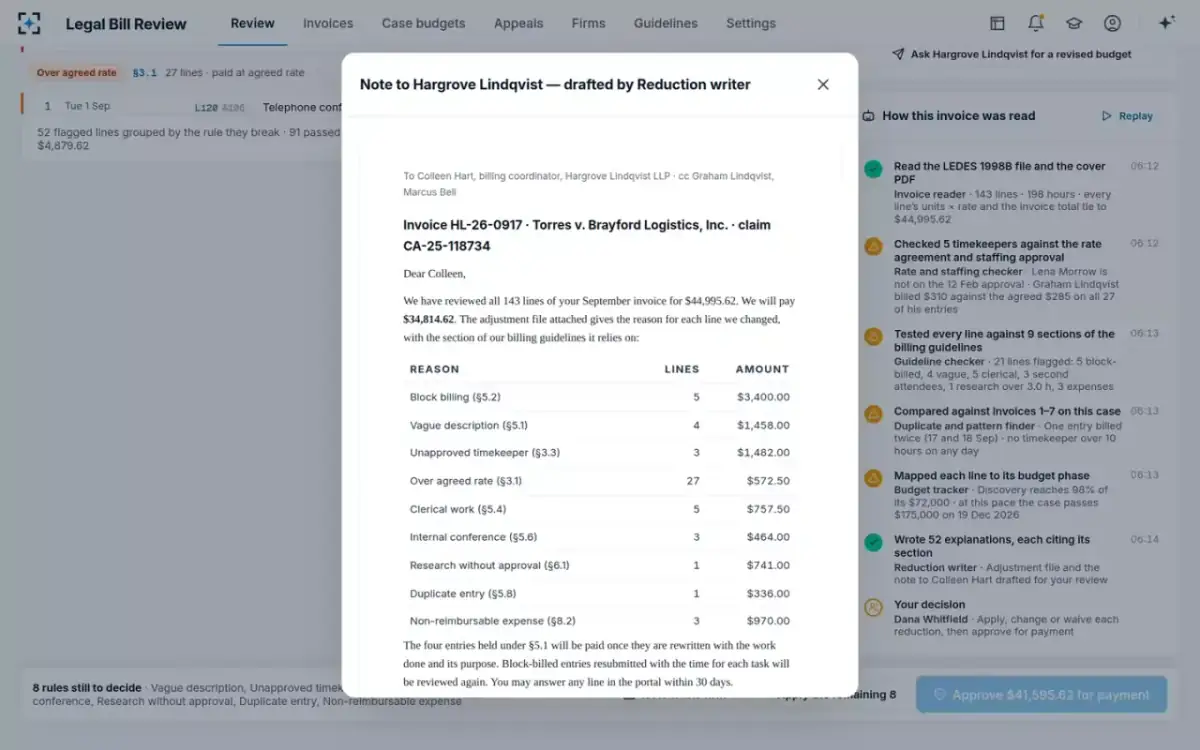
For a seeded test, the same output is the score sheet. Each planted error either appears as a line under the right section or it does not, and each flag on an unplanted line is either sound or a false flag. Because the duplicate finder compares an invoice with the earlier invoices on the same case, a planted duplicate needs its original left in the test set.
How much of a defense invoice is usually reduced?
We know of no public benchmark from a regulator or research body for insurance defense invoices, and a reduction rate is a poor target anyway. What can be compared is the reduction rate by firm, by rule and over time, on your own panel. In the fictional sample data, the panel's seven firms run from 2.2% to 11.8% of fees reduced in 2026, and the firm at the top has block billing as its most frequent problem.
In Legal Bill Review, reductions are compared by firm and by rule, with how each firm's appeals end
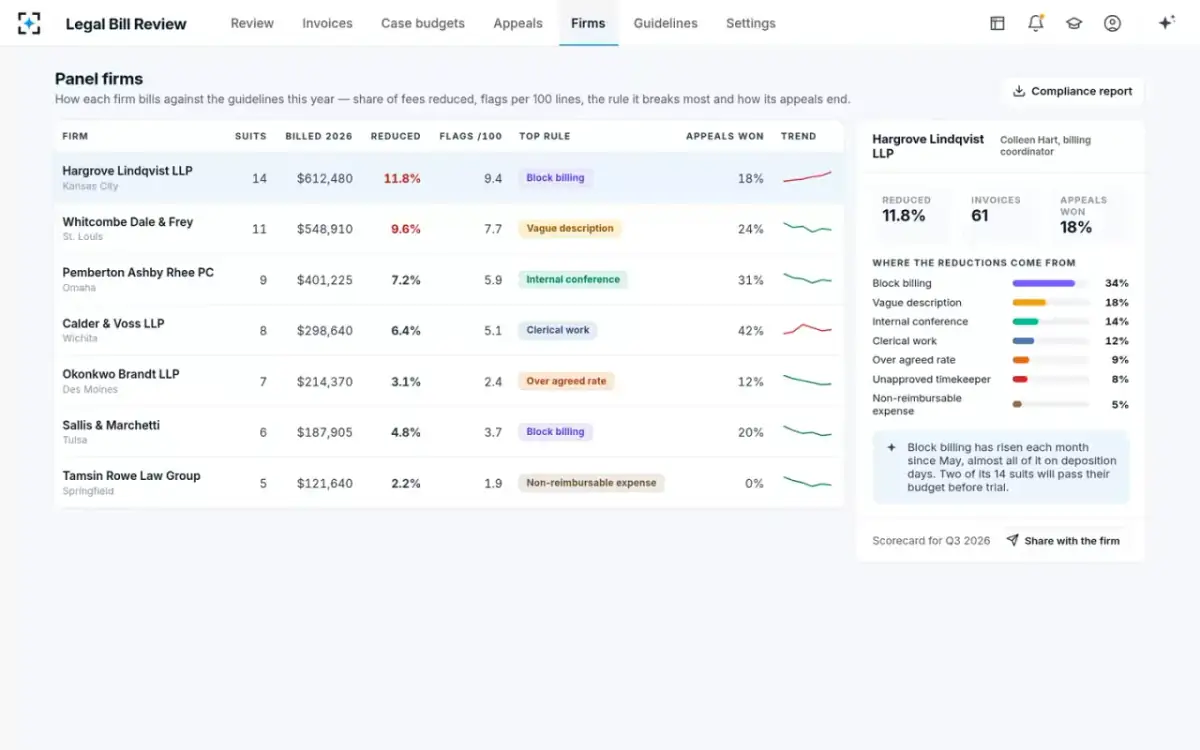
The appeals column is the false-flag rate seen from the outside. A firm that wins a large share of its appeals on one rule is telling the reviewer the rule is being applied where it should not be. In a seeded test, the same signal shows up earlier, before any firm has had to argue.
Who should run the test, how often, and what the score sheet shows
Someone independent of the review should plant and score, every quarter and after every change to the rules. Internal audit is the natural owner, with claims legal counsel signing off the answer key, because the people being measured should not write the test. In Legal Bill Review every change to a guideline rule, such as the block-billing share or the research threshold, becomes a new guideline version; each new version is a reason to rerun the test on the rules it touched.
A seeded-error score sheet: what each column counts, and why it is kept separate
| Column | What it counts | Why it matters |
|---|---|---|
| Planted | Errors of this kind placed in the test invoices | The denominator for the catch rate |
| Caught with the right rule | Planted errors flagged on the right line under the right guideline section | The only catch that survives an appeal |
| Caught with the wrong rule | Right line, wrong section or reason | A reduction the firm can still win; scored apart, not as a catch |
| Missed | Planted errors paid as billed | Money the method lets through |
| False flags | Flags on unplanted lines confirmed sound by a second reviewer | Appeals the method will cause |
Report the result by error kind, not as one number. A method that catches every block-billed entry and half the rate overcharges has a specific gap, and it is usually the small, repetitive lines: exactly the ones a person reviewing under time pressure skips, and the ones software should never miss. Compare the false-flag column with the firms' appeal outcomes over the same quarter; if both point at the same rule, the rule is being applied where it should not be.
How do you audit outside counsel invoices after they are paid?
Run last year's paid invoices back through the same checks and compare what was paid with what the guideline allowed. A retrospective audit is the seeded test's twin: instead of planting errors, it finds the ones that were already there. It answers the question a claims executive actually asks, how much was paid that the agreements did not require, and it gives each panel firm a fact-based conversation about its billing.
Two cautions. Recovering money already paid is a negotiation, not a reduction, and depends on the firm's engagement terms. And the retrospective is only as good as the guideline, rate and approval records for the period, which is why the go-live plan for legal invoice review software starts by collecting them.
Questions people ask
How do you audit outside counsel invoices?
Test every line against the guideline, the rate agreement, the staffing approval and the budget, and write a reason for each reduction that names the line and the rule. Then test the audit itself, with known errors planted in paid invoices, so you know its catch rate and false-flag rate.
How many invoices does a seeded-error test need?
Enough to plant several of each error kind: thirty invoices with three to five errors each gives roughly ten instances per kind for ten kinds. Fewer gives a rough read; the point is to compare methods on the same known answers.
What is a false flag in legal bill review?
A reduction on a line that breaks no rule, such as research flagged as unapproved when an approval email is on file. In Legal Bill Review's sample appeals, the appeal reader recommends accepting exactly that kind of appeal because the approval is on file.
Should planted errors be used on live invoices?
No. Plant them in copies of invoices already paid, so no firm receives a reduction for an error it did not make; the test measures the reviewer, not the firm.
Does reading every line take longer than sampling?
For a person, yes; that is why people sample. When agents read every line first, the reviewer's time goes to the flagged lines; Legal Bill Review's design target is eight minutes to review a 140-line invoice with every line read.