AI legal bill review means software agents that read every line of a law firm's invoice and run the checks whose answer is in the data: the arithmetic, the rate against the rate agreement, the timekeeper against the staffing approval, the task code against the budget, the wording against the billing guideline, and the entry against earlier invoices. It does not mean software deciding whether a deposition was worth taking. For an insurer paying panel firms to defend policyholders, that division is not a matter of taste: courts and bar ethics committees have drawn it. Botminds' Legal Bill Review is built on it. Seven agents read the invoice and draft a reason for every flag; the legal bill reviewer applies, waives and approves. The grid below shows which checks move and what each still needs from a person.
AI legal bill review, check by check: what the agent does on every line and what a person keeps
| Check | What it compares | Agent | Person |
|---|---|---|---|
| Arithmetic | Units × rate + adjustment against the line total; the lines against the invoice total | Recomputes every line; reports any difference, never alters a billed figure | Asks the firm to correct a file that does not add up |
| Rate | Billed rate against the rate agreement for the year | Flags each line above the agreed rate and computes the excess | Approves a rate change, in writing |
| Staffing | Timekeeper against the case’s staffing approval | Flags time from anyone not named | Litigation specialist approves or refuses the timekeeper |
| Block billing | One time charge against the number of tasks it describes | Quotes the tasks lumped together | Confirms the entry is truly several tasks |
| Vague or clerical entries | Description against the guideline’s wording rules and overhead list | Quotes the words that break the rule | Decides whether to hold, reduce or pay |
| Prior approval | Research or experts above a threshold against approvals on file | Finds the approval, or its absence | Litigation specialist approves before the work, where the agreement asks |
| Duplicates and patterns | The entry against earlier invoices and other timekeepers’ days | Reports the match or the pattern | Decides; a pattern alone is never a reduction |
| Budget phase | Task code against the approved budget by phase | Applies the line, projects when the case passes its budget | Litigation specialist revises the budget |
| Was the work needed? | Legal strategy | Not checked | Defense counsel |
Can AI review legal bills?
Yes, for every test whose answer sits in the invoice file and the agreements behind it, which is most of them. The industry's own e-billing codes were designed for exactly this. The UTBMS codes were written in the mid-1990s by a joint group of the American Bar Association, the Association of Corporate Counsel and PricewaterhouseCoopers, and the LEDES Oversight Committee's history of them explains that coding time entries makes it "possible for receiving systems to electronically test invoice submissions, allowing for consistent enforcement of a law department’s outside counsel billing guidelines and alleviating some of the burden on bill reviewers."
What has changed is how much of a guideline software can now read. A rate check needs only numbers. A block-billing check needs the description read as language. A sample entry reads "Prepare for deposition of driver Curtis Dunmore; review ELD logs and dash-camera stills; draft outline; telephone conference with client safety director; email to G. Lindqvist": how many tasks is that, and is there one time charge for all of them? The LEDES Oversight Committee, the not-for-profit body that maintains the e-billing formats, now publishes a standard list of 65 unique errors that receiving systems report. Sixteen of them are client-guideline errors, including "Bulk Billing", "Description Contains Phrasing Not Allowed By Client", "Firm Overhead, Not Reimbursed By Client" and "Insufficient Line Item Description". The list even carries a fatal error code for a file that AI could not parse: the standards body expects invoices to be read by AI.
What does AI legal bill review check that a sample misses?
It checks the many small, rule-bound lines a sample skips and gives every flag a reason, which shows where a reviewer's time should go. Take a sample September invoice in Legal Bill Review, on fictional data: Hargrove Lindqvist LLP bills $44,995.62 on one trucking injury suit, 143 lines. The agents flag 52 lines under nine guideline sections, worth $10,181.00: $8,723.00 recommended for reduction and $1,458.00 held until four vague entries are described.
On one sample invoice, rate and staffing flags are most of the lines; description rules are most of the money
Share of the 52 flagged lines
- Rate and staffing · 57.7%
- Description rules · 32.7%
- Approvals, expenses, duplicate · 9.6%
Share of the $10,181.00 flagged
- Rate and staffing · 20.2%
- Description rules · 59.7%
- Approvals, expenses, duplicate · 20.1%
The two bars point at different work. Twenty-seven lines carry a partner's rate of $310 against an agreed $285; each is worth little, together $572.50, and no reviewer sampling twenty lines would find all of them. They are pure lookup, and an agent should own them. The description rules carry most of the money and most of the judgment: five block-billed entries alone account for $3,400.00. Those are where a reviewer's minutes are worth spending, and an agent that has already quoted each entry and the rule it breaks makes those minutes short. Why a sample pays most of what it misses is worked through in plant the errors and count what comes back.
Can AI judge whether legal work was necessary?
It should not, and in insurance defense the reason is legal, not technical. When an insurer pays for a policyholder's defense, the lawyer's judgment about what the defense needs belongs to the lawyer. Montana's Supreme Court held in 2000 that requiring insurer approval before depositions, research, experts or motions strikes at defense counsel's independent judgment, and warned that a duty merely to consult the insurer can have the same effect; the rules that follow for guidelines are set out in insurance defense billing guidelines. Nebraska's ethics committee called guidelines that do this "tantamount to practice guidelines" and said following them violates the lawyer's code.
An agent that second-guessed strategy would carry the same problem at machine speed, across every invoice. So the line in Legal Bill Review is written into the agents: the guideline checker never questions counsel's legal judgement, only how the work is billed. It can say that a research entry names no issue, or that research above 3.0 hours on one issue needed the litigation specialist's approval under the sample carrier's guideline. It does not say the research was unnecessary. Where that line falls in each state, and what courts and bar committees have said a guideline may require, is in insurance defense billing guidelines: what courts and bars forbid.
Is AI legal bill review accurate, and how would you know?
It is accurate when every flag can be checked against the line and the rule it cites, and when that check is run on known cases before go-live. Some of the checks have a fixed answer. The LEDES 1998B specification defines each line total as unit cost times units plus any adjustment, and says that if a line is not within a reasonable variance of that formula, "e.g., .1%", there is an error the firm must resolve before payment. A rate is either the agreed rate or not.
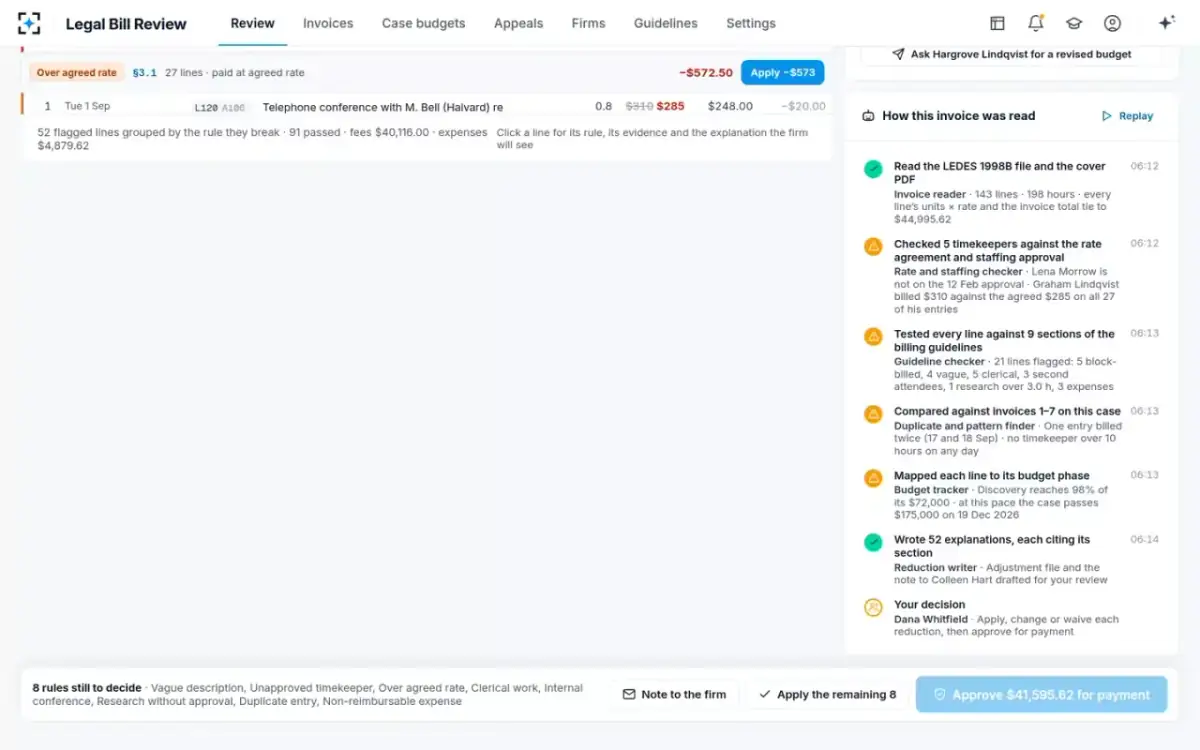
The rest need a test. Plant known errors in last quarter's paid invoices, one of each kind the guideline forbids, run them through, and count what comes back and what is flagged that should not be. A flag that arrives without its line, field and guideline section cannot be scored, and in a dispute it cannot be defended either. In Legal Bill Review each agent's step is recorded with what it found, so the reviewer can see how the invoice was read before deciding.
Every agent step in Legal Bill Review, recorded with what it found, ending in the reviewer's decision
Who approves reductions in AI bill review?
A person, every time, within a limit set in advance. In Legal Bill Review the agents recommend; the reviewer applies, changes or waives each reduction and approves the invoice for payment. The sample carrier's settings put $25,000 of reductions an invoice within the reviewer's authority, send appeals above $5,000 to claims legal counsel, and require a second reviewer when one invoice's waivers pass $1,000.
From LEDES file to payment in Legal Bill Review: what each agent does, what it never does, and where people decide
Agent
Invoice readerTurns LEDES 1998B, XML or PDF into lines with timekeeper, codes, hours, rate and amount; re-adds every line and the total.
Never: alters a billed figure; it reports the difference
Agent
Rate and staffing checkerTests every timekeeper against the staffing approval and every rate against the agreement.
Never: approves a timekeeper or applies a rate change without written approval
Agent
Guideline checkerTests every line against each guideline section and quotes the words or numbers that break it.
Never: questions counsel’s legal judgement
Agent
Duplicate and pattern finderFinds work billed twice and days a timekeeper bills more than is believable.
Never: reduces on a pattern alone
Agent
Reduction writerDrafts the reason for each line, the adjustment file and the note to the firm.
Never: sends without the reviewer, or characterises the firm
A person decides
Legal bill reviewerApplies, changes or waives each reduction and approves payment, within the reduction limit.
A person decides
Litigation specialist and claims counselApprove timekeepers, research and budget revisions; decide appeals above the threshold.
Will AI replace legal bill reviewers?
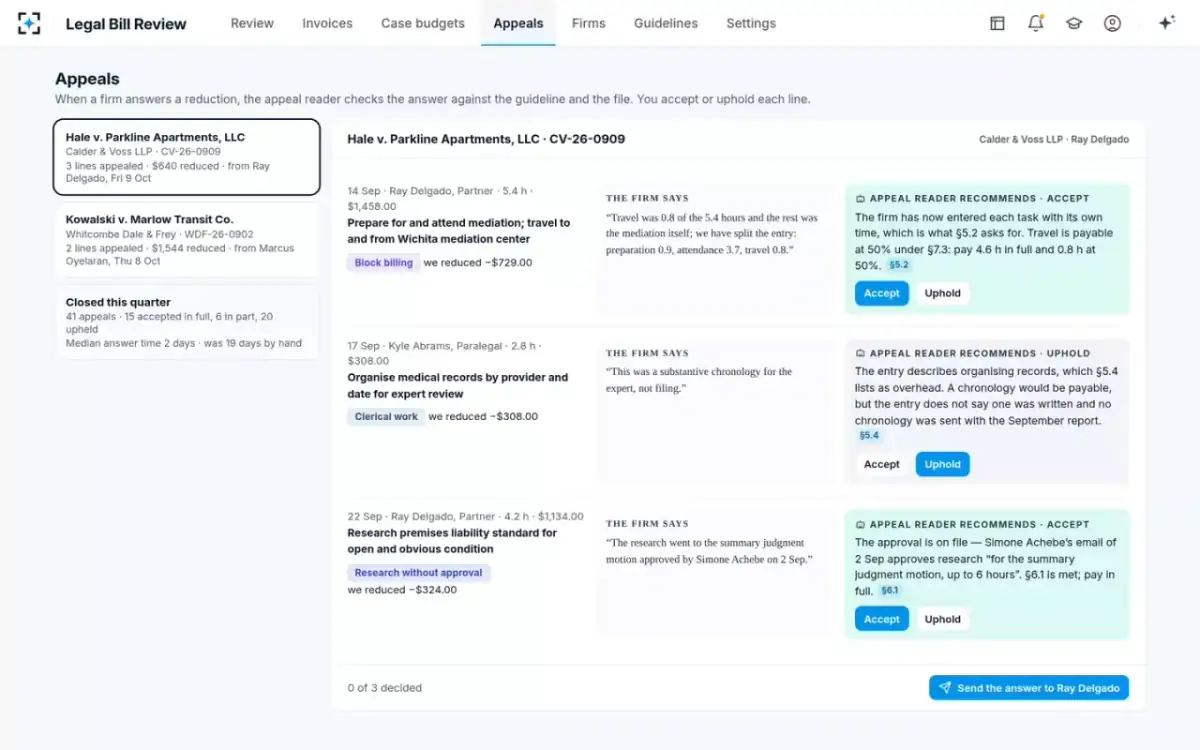
The reviewer's work changes from finding to deciding, and the deciding does not go away. Every reduction still needs someone accountable for it, and the firm's answer to each reduction still needs reading against the guideline and the file. In the sample appeals in Legal Bill Review, a firm disputes three lines on one invoice: the appeal reader recommends accepting a mediation entry the firm has now split by task, upholding a paralegal's records-organising charge because the guideline lists it as overhead and no chronology was sent, and accepting a research entry because an approval email covers it. The reviewer accepts or upholds each line.
Appeals in Legal Bill Review: the firm's answer, the recommendation, and the reviewer's accept or uphold
What buyers should ask before choosing AI for legal invoice review
Ask what the software checks, what it refuses to check, and how you can see both. The questions below come from the grid at the top of this guide; a vendor's answer to each should be a demonstration on your own invoices, not a slide.
Eight questions to put to any AI legal bill review tool
- Does it read every line of LEDES 1998B, LEDES XML and PDF invoices, and re-add them?
A tool that cannot reproduce the invoice total from the lines cannot be trusted on anything built on them.
- Does every flag cite the line, the field and the guideline section?
Without all three, a reduction cannot be tested, appealed or defended.
- Will it show what it did not check?
Legal necessity should be visibly out of scope, not quietly scored.
- Are guideline parameters versioned, with a named approver?
A change such as the block-billing percentage is a change to the contract with your firms.
- Does it read approvals on file before flagging?
A research or staffing approval email should clear a flag before a firm has to appeal.
- Can you test it on your own paid invoices with planted errors?
Count catches and false flags by error type before any reduction goes out.
- Who decides each reduction, and up to what amount?
Limits, second reviewers and escalation should be settings you control.
- Where do the invoices go, and who sees them?
Bar opinions require the insured’s informed consent before defense bills reach an outside auditor; settle with claims counsel how that applies to any vendor.
Where the money is: defense costs as a share of premium
Defense and cost containment expense is a steady few percent of everything a property and casualty insurer earns, which is why line-level review is worth automating. The Federal Insurance Office reported that across U.S. property and casualty lines it fell to 3.9% of direct premiums earned in 2023 and 2024, after sitting near 4.5% from 2015 to 2020; in Florida it rose to 6.6% in 2022 and fell to 5.1% in 2024 after that state's reforms. Part of that line is the panel invoices a bill reviewer reads.
Regulators expect the same accountability for AI used anywhere in claims. The NAIC's model bulletin on insurers' use of AI notes that AI is deployed across the insurance life cycle, "including product development, marketing, sales and distribution, underwriting and pricing, policy servicing, claim management, and fraud detection." A bill review tool whose every flag carries its rule and every decision its person fits that expectation; governance of AI across a carrier is the work of AI Governance and Model Inventory.
Questions people ask
What is AI legal invoice review?
The same thing as AI legal bill review: agents that read a law firm's invoice line by line against the client's guidelines, rates, approvals and budget, and draft the reason for each flag. A person decides what is paid.
What parts of legal bill review can be automated?
Arithmetic, rates, staffing, code validity, description rules such as block billing and vague or clerical entries, approvals on file, duplicates and budget-phase tracking. The LEDES Oversight Committee's 2024 standard lists 65 errors receiving systems report, 16 of them client-guideline errors.
Can AI read a PDF legal invoice?
Yes. Legal Bill Review's invoice reader turns a PDF invoice, as well as a LEDES 1998B or XML file, into lines with timekeeper, codes, hours, rate and amount, and cites the line and field for every value it extracts.
Does AI legal bill review need UTBMS codes?
It works better with them, because the task code ties each line to a budget phase. Where codes are missing or wrong, the description still carries the tasks, and the mismatch is itself worth flagging; how UTBMS task codes map to budget phases explains the link.
Is it fair to panel firms?
It is fairer than a sample, because every firm's every line is read against the same rules, and each reduction arrives with its section and the sentence the firm can answer. The sample firm scorecard in Legal Bill Review also reports how each firm's appeals end.
Does AI legal bill review save money?
Only the reductions that survive the firm's appeal save money, and only if the review costs less than they do. We know of no public study by a regulator or an academic body that measures AI bill review's savings, so test it on your own invoices before relying on any figure.