UTBMS task codes are the standard codes a law firm puts on each time entry of an electronic invoice to say what kind of work it was; UTBMS stands for Uniform Task-Based Management System. In the litigation code set, published by the American Bar Association in 1997, 29 task codes such as L330 Depositions roll up into five phases, from L100 Case Assessment, Development and Administration to L500 Appeal. Those phases are the bridge between an invoice line and a case budget: apply each line to its phase and you know which part of the budget it spent. For an insurer reviewing panel counsel's invoices, a task code also triggers rules, such as research approvals, and the activity and expense codes beside it feed others. Botminds' Legal Bill Review reads the codes on every line, maps each to its phase and tests the line against the guideline. The map below shows which field of a LEDES invoice line feeds which check.
From LEDES field to check: what each part of an invoice line feeds in a legal bill review
| LEDES 1998B field | What it carries | The check it feeds |
|---|---|---|
| TIMEKEEPER_ID | The firm’s key for the person billing | Is this person on the case’s staffing approval? |
| TIMEKEEPER_CLASSIFICATION | Staff class, from the LEDES classification list | Is the class allowed, and is the rate right for it? |
| LINE_ITEM_UNIT_COST | The standard, undiscounted hourly rate for fees | Does it match the rate agreement for the year? |
| LINE_ITEM_NUMBER_OF_UNITS | Hours for fees; items for expenses | Increments, hours in a day, totals by phase |
| LINE_ITEM_TOTAL with ADJUSTMENT | Unit cost × units + adjustment | Does the arithmetic hold? |
| LINE_ITEM_DATE | When the work was done | Inside the billing period? Billed before on an earlier invoice? |
| LINE_ITEM_TASK_CODE | The UTBMS task, such as L330 | Which budget phase it spends; whether the task needs approval |
| LINE_ITEM_ACTIVITY_CODE | The UTBMS activity, such as A105 | Internal conferences, second attendees, task–activity fit |
| LINE_ITEM_EXPENSE_CODE | The UTBMS expense, such as E111 Meals | Is the expense reimbursable under the guideline? |
| LINE_ITEM_DESCRIPTION | Free text | Block billing, vague or clerical work, and whether the code fits the words |
What are UTBMS task codes?
They are a shared vocabulary for legal work, built so that software can read an invoice. The codes came out of a joint effort in the mid-1990s by the American Bar Association, the Association of Corporate Counsel and PricewaterhouseCoopers, now documented by the LEDES Oversight Committee, the not-for-profit body that maintains the e-billing formats. Its history explains the aim plainly: coding time entries lets the receiving system test each invoice electronically, which is the starting point for AI legal bill review.
The design has three layers. "Task codes are a granular description of the service provided by area of law." Tasks roll up into phases. Activity codes say what kind of act it was, writing, talking or researching, and expense codes classify disbursements. Some clients want only phases, some want tasks and activities; the codes are the client's to require.
What is the UTBMS litigation code set?
It is the code set for adversarial matters: the ABA's 1997 litigation set "includes 5 phases and 29 more granular task codes", and is intended for litigation, binding arbitrations and regulatory or administrative proceedings. The full list follows.
The UTBMS litigation code set: five phases and the 29 task codes under them
| Phase | Task codes |
|---|---|
| L100 Case Assessment, Development and Administration | L110 Fact Investigation/Development · L120 Analysis/Strategy · L130 Experts/Consultants · L140 Document/File Management · L150 Budgeting · L160 Settlement/Non-Binding ADR · L190 Other Case Assessment, Development and Administration |
| L200 Pre-Trial Pleadings and Motions | L210 Pleadings · L220 Preliminary Injunctions/Provisional Remedies · L230 Court Mandated Conferences · L240 Dispositive Motions · L250 Other Written Motions and Submissions · L260 Class Action Certification and Notice |
| L300 Discovery | L310 Written Discovery · L320 Document Production · L330 Depositions · L340 Expert Discovery · L350 Discovery Motions · L390 Other Discovery |
| L400 Trial Preparation and Trial | L410 Fact Witnesses · L420 Expert Witnesses · L430 Written Motions and Submissions · L440 Other Trial Preparation and Support · L450 Trial and Hearing Attendance · L460 Post-Trial Motions and Submissions · L470 Enforcement |
| L500 Appeal | L510 Appellate Motions and Submissions · L520 Appellate Briefs · L530 Oral Argument |
What is L100 in legal billing?
L100 is the case-assessment phase: the work on the case as a whole rather than on any one pleading, motion or deposition. The ABA's definition calls it the "forest" rather than the "trees". It holds fact investigation (L110), strategy (L120), experts and consultants before their depositions (L130), building document databases (L140), budgeting (L150) and settlement work (L160).
Two of those tasks matter more than their size to an insurer. L150 Budgeting "Covers developing, negotiating, and revising the budget for a matter", so the time a firm spends asking for a budget revision is visible on its own line. L160 Settlement/Non-Binding ADR covers mediation and settlement talks and "Also includes pre-litigation demand letters and ensuing discussions." A suit that settles at mediation shows its last months under L160.
Most legal research will be under the primary task for which the research is conducted, such as research for a summary judgment motion (L240).
ABA UTBMS Litigation Code Set (1997), definition of L120 Analysis/Strategy
That definition is the most common source of drift. Research belongs with the task it serves, so research for a dispositive motion is L240, not L120; coded as strategy, it lands in L100 and makes the case-assessment phase look overspent while the motions phase looks under budget. The same goes for deposition work: preparing a witness for trial is L410, but preparing for a deposition is L330, and the ABA notes that L400 "Commences when lawyer and client determine that trial is sufficiently likely and imminent so that the process of actually preparing for trial begins."
What are UTBMS activity codes?
Activity codes say what the timekeeper did, independent of the task: the ABA's 1997 set has eleven, from A101 Plan and prepare for to A111 Other. Not every client requires them, but where used they sit beside a task code, never instead of one; the LEDES 1998B specification says "Task Codes may be used without Activity Codes but Activity Codes should not be used without Task Codes."
UTBMS activity codes, and the guideline checks they most often feed
| Activity code | Name | A check it helps |
|---|---|---|
| A101 | Plan and prepare for | Preparation time against the event it prepares for |
| A102 | Research | Research approvals and thresholds |
| A103 | Draft/revise | Drafting time on a filing against the filing |
| A104 | Review/analyze | Document review volume against the pages reviewed |
| A105 | Communicate (in firm) | Internal conferences, often limited by guidelines |
| A106 | Communicate (with client) | Client reporting |
| A107 | Communicate (other outside counsel) | Co-defendant coordination |
| A108 | Communicate (other external) | Calls with experts, vendors, court staff |
| A109 | Appear for/attend | Second attendees at depositions and hearings |
| A110 | Manage data/files | Clerical work billed as legal work |
| A111 | Other | Entries needing a closer look |
Expense codes complete the set: 24 in the ABA's 1997 list, from E101 Copying to E124 Other, including E110 Out-of-town travel, E111 Meals and E119 Experts. A guideline that pays travel at half rate or excludes meals reads them. A federal court in California asked fee claimants to list expenses "by reasonably narrow and specific category, preferably the applicable categories described in the UTBMS."
How do UTBMS codes map to a litigation budget?
Through the phase: every task code belongs to one of the five phases, and a phase-based budget sets a ceiling for each. Apply each invoice line to its phase by its task code, and the budget becomes a running account of what each phase has spent; carry the recent pace forward, and it becomes a forecast.
One sample suit's budget used, by UTBMS phase, after its September invoice
The phases make a problem visible that a total hides. The suit has used 68% of its total budget, which sounds comfortable; by phase, case assessment is over and discovery is at 98% in the middle of its deposition month. The task codes are what make that split possible, which is why a miscoded line matters: it moves money from one phase to another. A line reviewing a plaintiff's hospital records might be coded L310 Written Discovery, L320 Document Production or L110 Fact Investigation depending on its purpose; under the ABA definitions, review "primarily to understand the facts is Task L110", and that choice decides whether the line spends discovery or case assessment.
In Legal Bill Review each line opens with its task code, activity code and the budget phase it spends
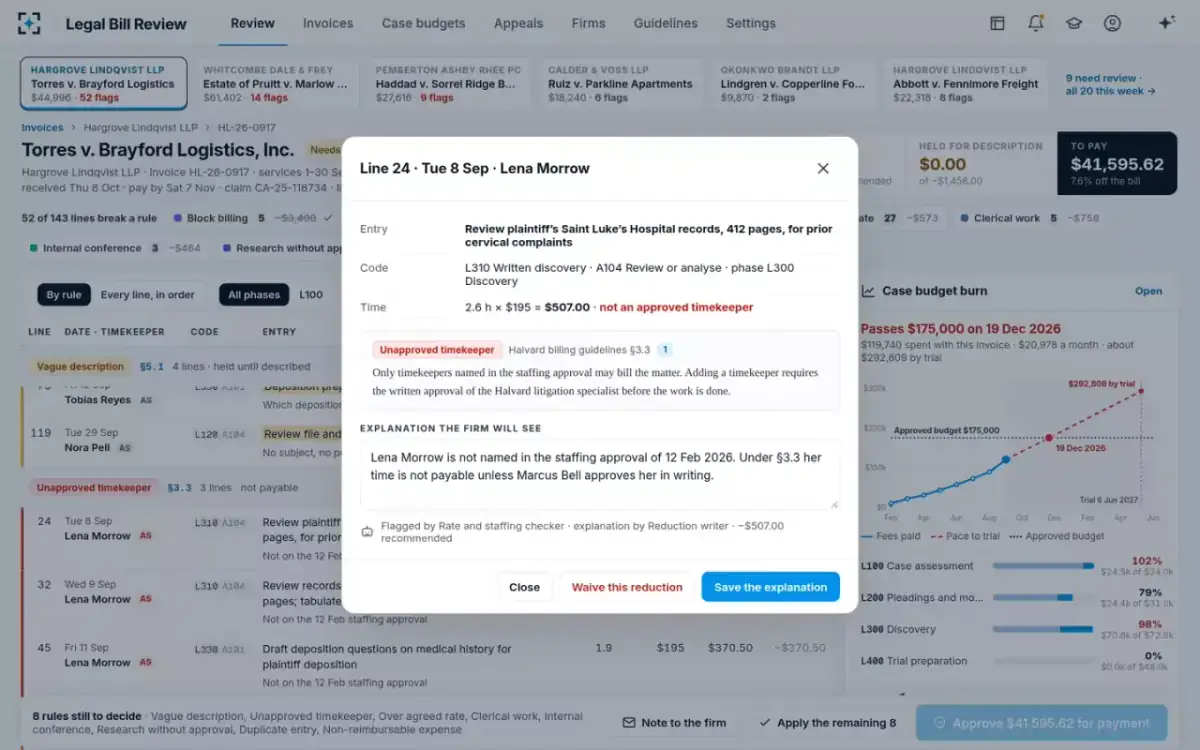
How a phase budget becomes a dated forecast, the day the case will pass its budget at the current pace, is worked through in the litigation budget template that projects the crossing date.
Which UTBMS codes trigger billing guideline rules?
Codes do not break rules, entries do; but codes tell a reviewer where to look. A research activity code (A102) under any task is where a research-approval rule applies. An appearance (A109) under depositions (L330) or trial and hearing attendance (L450) is where a second-attendee rule applies, and in-firm communication (A105) is where an internal-conference rule does. Expense codes carry the reimbursement rules: E109 Local travel and E110 Out-of-town travel for a travel rate, E111 Meals for a meals exclusion, E119 Experts for an expert-invoice check.
Some rules live in the code definitions themselves. The ABA's definition of L140 Document/File Management says "Work of outside vendors in building litigation support databases should be an Expense." A vendor's database work billed as fees under L140 is therefore miscoded by the standard's own terms, before any guideline is consulted.
Lines filtered by UTBMS phase in Legal Bill Review, each with its task and activity code beside the entry
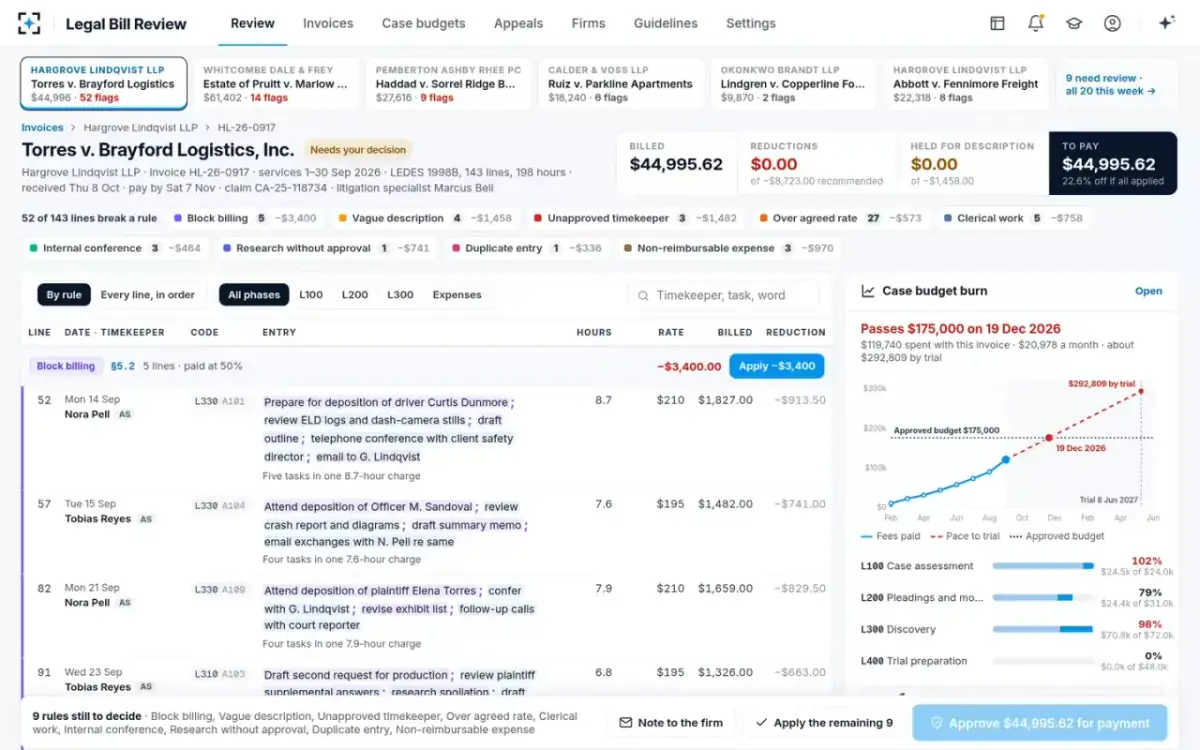
When a task code and its description disagree
Trust the description and flag the code, because the description is what the firm says it did. The ABA definitions give the tests. Interrogatories and requests to admit are L310 Written Discovery; requests for documents are L320 Document Production. Preparing for an expert's deposition is L340, not L130 Experts/Consultants, whose definition "Does not include preparing for expert depositions (L340) or trial (L420)." A settlement conference is L160, not L230 Court Mandated Conferences.
Stage matters too. Time coded to L400 months before trial is plausible only if trial preparation has really begun; time coded to L460 Post-Trial Motions before any verdict is wrong on its face. A mismatch is not always a reduction: the work may be payable and only misfiled. But it should be corrected, because a misfiled line spends the wrong phase of the budget and hides the phase that is actually running out. Whether a code is a valid code at all, and paired correctly with its activity code, is a format question that comes earlier, in the checks a LEDES file must pass before the guideline checks.
Who maintains UTBMS codes?
The LEDES Oversight Committee hosts and maintains them, alongside code sets created by other bodies; the original litigation, activity and expense sets are the ABA's. Several sets matter to insurers in particular, including a revision made for them.
UTBMS code sets an insurer's bill review is likely to meet
| Code set | Year | What it is |
|---|---|---|
| ABA Litigation, Activity and Expense codes | 1997 | 5 phases and 29 tasks; 11 activities; 24 expenses |
| DRI Revised Litigation Codes | 2007 | 5 phases and 28 tasks; a revision of the ABA set "intended for use by insurers" |
| ABA Workers’ Compensation Codes | 2010 | 5 phase codes and 27 task codes |
| LOC Revised Activity and Expense Codes | 2013 | For all legal vendors; revised expense codes start with X, and X900–X998 are reserved for client customisation |
| EW-UTBMS J-Codes | 2014 | Litigation codes for England and Wales, endorsed by the LEDES Oversight Committee |
The England and Wales set is a reminder of what the codes are for. The committee describes its purpose as helping courts analyse costs "including the comparison of actual costs to budgeted costs." That is the same comparison an insurer makes on every suit, and the reason a guideline that requires task codes pays for itself.
Questions people ask
What is a UTBMS task codes list?
The full list of task codes under each phase of a UTBMS code set; for litigation, the 29 codes from L110 to L530 in the table above. Clients may require all of them or only the five phase codes.
Is there a UTBMS code set for insurance defense?
DRI's 2007 revision of the litigation set, with five phases and 28 tasks, is described by the LEDES Oversight Committee as intended for use by insurers; it uses the original ABA activity and expense codes. Which set applies is the insurer's choice, stated in its guideline.
What is L330 in UTBMS?
L330 Depositions, in the Discovery phase: all work concerning depositions, from choosing deponents and noticing them to preparing, attending and summarising. Expert depositions are L340, and preparing witnesses for trial is L410 or L420.
Can a client add its own UTBMS codes?
For expenses, the LEDES Oversight Committee reserves X900 to X998 in its 2013 revised expense codes for client customisation and asks clients to customise only within that range. Task codes are best left standard, because budgets and comparisons depend on them.
Are UTBMS codes required on a LEDES invoice?
The format carries fields for them; whether they are required is the client's choice. The 1998B specification marks the task code as required for task items and the expense code for expense items, and the client decides which code sets it accepts.