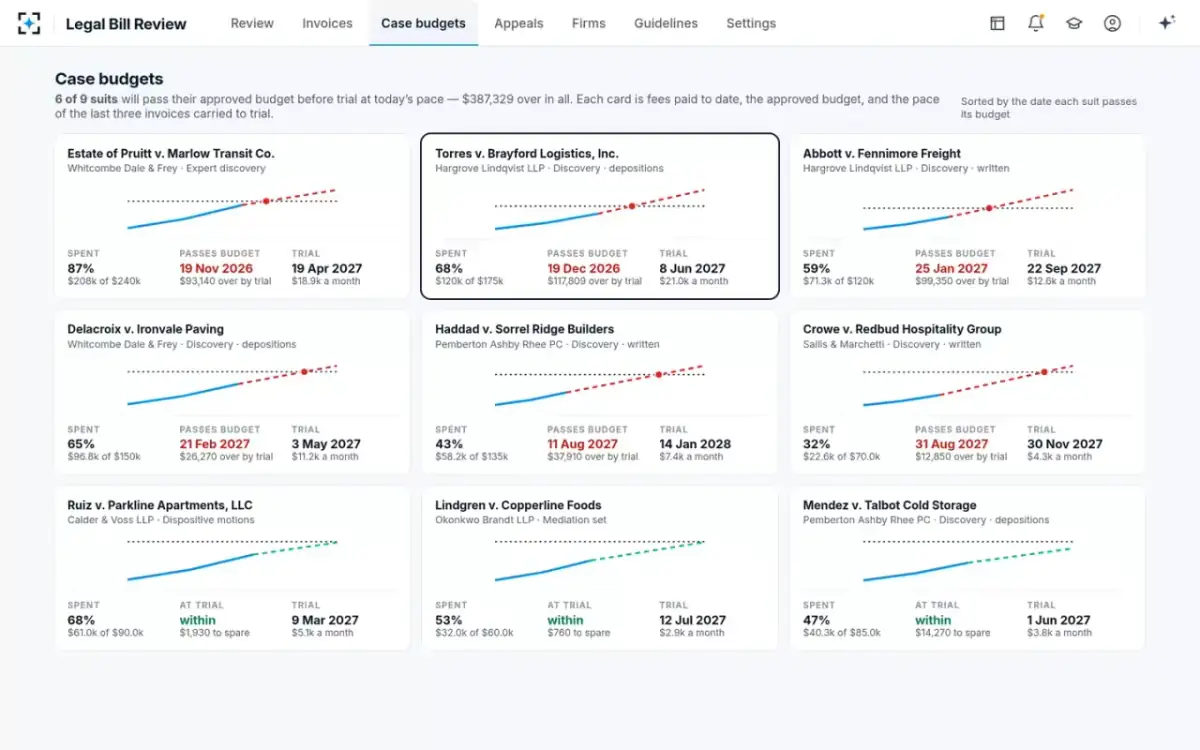
A litigation budget template is the form defense counsel and the client use to agree, phase by phase, what a lawsuit should cost: hours and rates by timekeeper class for each stage from case assessment to trial and appeal, expenses, the assumptions behind them, and the total the client approves. For an insurer defending policyholders through panel firms, the template is the easy part. What fails is the follow-through: the approved budget sits in a folder while invoices are paid, and the case is found to be over budget when the firm asks for more money or when trial arrives. A budget becomes useful when each invoice line is applied to its phase by its task code and the recent pace is projected forward, which gives the date the case will pass its budget while there is still time to revise it. Botminds' Legal Bill Review does that on every invoice. Across one sample panel, it shows six of nine suits passing their budgets before trial.
Projected overrun by trial, six of nine sample suits, at the pace of each suit's last three invoices
What is a litigation budget?
It is an estimate of what a case will cost to defend, broken into the stages of the case and approved by the client before the work is done. The standard UTBMS litigation codes give budgeting its own task, L150, for the work of drafting, negotiating and revising a matter's budget. Courts use budgets too. In England and Wales, parties to most multi-track civil claims must file budgets in a set form before the first case management conference. In the U.S. federal courts, judges are encouraged to budget appointed defense counsel's costs in criminal cases expected to run past 300 hours of attorney time.
The phase is the unit that matters. A total tells you a case has spent 68% of its budget; the phases tell you whether that is 68% of each, or discovery nearly gone with depositions still to take. That is why the template should be built on the same phases the invoices are coded in.
What should a litigation budget template include?
Phases, the work and staff in each, the assumptions that drive the numbers, a line for contingencies, and the approval and version that make it a budget rather than a guess. The table lists the fields, with where each one is checked once invoices start to arrive.
What a litigation budget template should include, and what each field is checked against
| Field | What goes in it | Checked against |
|---|---|---|
| Case header | Court, firm, client claim number, trial date, mediation date, approval date | The case’s docket, as dates move |
| Phases | UTBMS L100 to L500 (or the client’s phase list), each with its own total | Each invoice line’s task code |
| Staffing plan | Timekeepers by class with hours and agreed rates per phase | The staffing approval and rate agreement |
| Expenses | By expense code: experts, transcripts, travel, vendors | Each expense line’s code |
| Assumptions | Number of depositions, experts and motions; trial length | What actually happens; the trigger for revision |
| Contingencies | Costs more likely than not but outside the main phases | Kept separate, not spread across phases |
| Approval and version | Who approved what, when; each revision as a new version | Every later projection |
| Actuals and pace | Fees paid to date by phase; the pace used to project | The next invoice |
Two of those rows do most of the work later. The assumptions are what a revision is argued about: a budget that assumed six depositions and now faces eleven has an objective reason to change. The staffing plan is what turns hours into money; the LEDES Oversight Committee's XML budget format, approved in 2006, was built to carry timekeeper or task- and activity-based budgets and matter staffing plans in one file.
What is a phase-based legal budget, and how do courts use one?
It is a budget set and controlled phase by phase rather than as a single figure, and two court systems run them in public. In England and Wales, a costs management order "concerns the totals allowed for each phase of the budget", not the hourly rates behind them. The U.S. federal judiciary's criminal defense budgeting asks counsel for "a proposed initial litigation budget for court approval, subject to modification in light of facts and developments that emerge as the case proceeds."
Two public litigation budget templates: England and Wales civil costs budgets, and U.S. federal case budgeting
England and Wales: Precedent H: Part 7 multi-track civil claims, with exceptions such as claims of £10 million or more; filed before the first case management conference
U.S. federal courts: CJA case budgeting: Encouraged in representations likely to exceed 300 attorney hours or a set cost threshold
England and Wales: Precedent H: Pre-action; issue and statements of case; CMC; disclosure; witness statements; expert reports; PTR; trial preparation; trial; ADR and settlement; contingent costs
U.S. federal courts: CJA case budgeting: Set by forms and instructions from circuit case-budgeting attorneys, panel administrators or the court
England and Wales: Precedent H: Only those that significantly affect cost, such as duration, experts, witnesses and interim applications
U.S. federal courts: CJA case budgeting: Not specified in the guideline text
England and Wales: Precedent H: Must be revised up or down on significant developments, with particulars of the variation
U.S. federal courts: CJA case budgeting: Subject to modification as facts and developments emerge
England and Wales: Precedent H: The court records agreed figures and approves the rest by phase
U.S. federal courts: CJA case budgeting: Judges give due weight to the case-budgeting attorney and must state reasons for departing
England and Wales: Precedent H: Recoverable cost capped: the higher of £1,000 or 1% to complete Precedent H; 2% for the rest of the budgeting process
U.S. federal courts: CJA case budgeting: Not specified
How do you track legal spend against budget?
Apply every invoice line to the phase its task code names, as the invoice is reviewed, using what will actually be paid rather than what was billed. A reduction lowers the phase's spend; a held entry is not yet spent. Done on every invoice, the budget is current the day the invoice is approved.
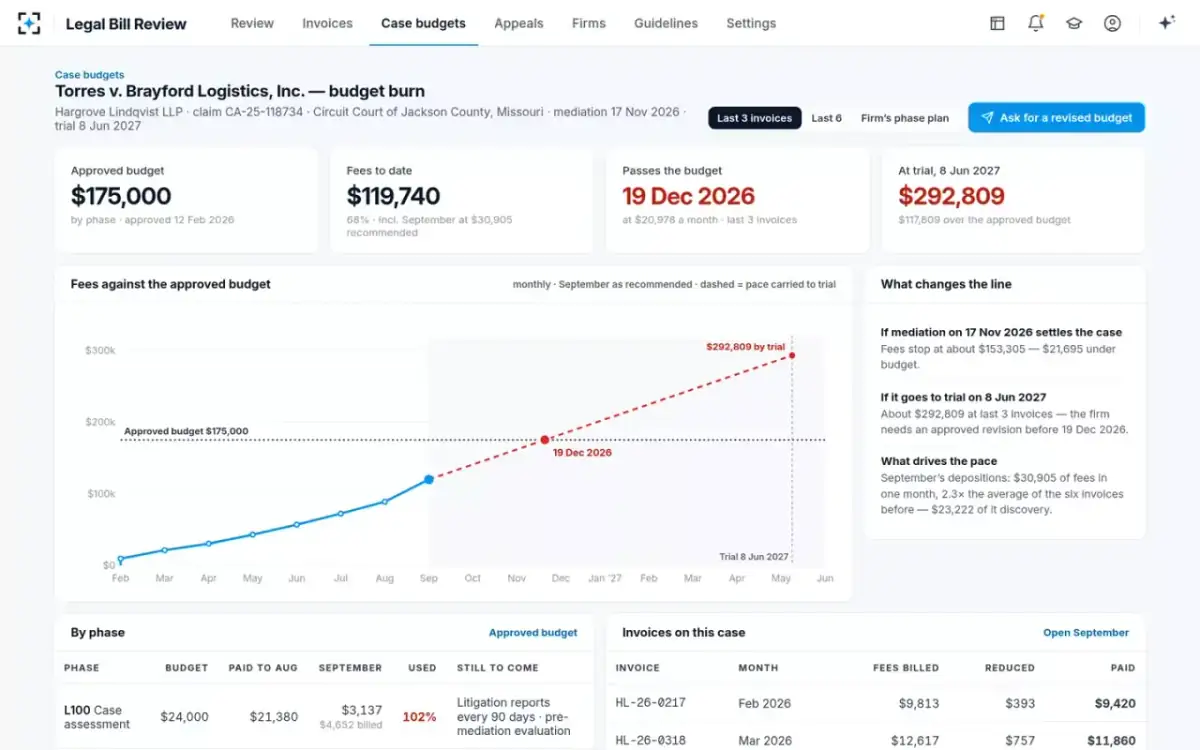
Take the sample suit in Legal Bill Review, on fictional data: Torres v. Brayford Logistics, defended by Hargrove Lindqvist LLP, with a $175,000 budget approved by phase on 12 February 2026 and trial set for 8 June 2027. With September's invoice paid as recommended, fees reach $119,740, 68% of the total. By phase, case assessment has used 102% of its $24,000, pleadings and motions 79% of $31,000, discovery 98% of $72,000, and trial preparation none of its $48,000.
A case budget in Legal Bill Review: fees by month against the approved budget, the pace carried to trial, and what changes the line
How do you forecast litigation costs?
Divide what is left of the budget by the recent monthly pace to get the crossing date, and multiply the pace by the months to trial to get the cost at trial; then say which pace you used. It is simple arithmetic, and that is its strength: anyone can check it, and anyone can argue with the pace.
Forecasting the sample suit's budget crossing date and cost at trial, step by step
| Step | Calculation | Result |
|---|---|---|
| 1. Budget left after September | $175,000 − $119,740 | $55,260 |
| 2. Pace | Average monthly fees over the last three invoices | $20,978 a month |
| 3. Months to the crossing | $55,260 ÷ $20,978 | 2.6 months |
| 4. Crossing date | End of September + 2.6 months | 19 Dec 2026 |
| 5. Months to trial | 30 Sep 2026 to 8 Jun 2027 | about 8.25 months |
| 6. Fees at trial | $119,740 + $20,978 × 8.25 | about $292,809, $117,809 over |
| 7. If mediation settles it | Fees to 17 Nov 2026 at the same pace | about $153,305, $21,695 under |
The sample suit's year at the last three invoices' pace: inside the budget until 19 December, then over it until trial
- Feb–Sep: $119,740 paid8 months
- Within budget2.6
- Over budget until trial5.6 months
- Feb–Sep: $119,740 paid8 months
- To 17 Nov1.6
The pace is the judgment in the forecast, and it should be visible. September was a deposition month, 2.3 times the average of the six invoices before it, and it pulls a three-invoice pace up; a six-invoice pace would give a later crossing date. Legal Bill Review offers the last three invoices, the last six, or the firm's own phase plan, and shows on every case which one it is using. Its budget tracker drafts a request for a revised budget but never changes an approved one.
When should counsel ask for a revised budget?
When the case changes, and before the work that the change requires. The English rule is direct: a party "must revise its budgeted costs upwards or downwards if significant developments in the litigation warrant such revisions." Once a budget is approved there, a court assessing costs will "not depart from such approved or agreed budgeted costs unless satisfied that there is good reason to do so", which is why revising late is expensive for the party that waited.
An insurer's panel budgets can borrow the discipline without the court. Tie the revision to the assumptions row: more depositions, a new expert, a motion nobody planned. Ask for it when the forecast shows the crossing, not when the invoice arrives over the line. In the sample carrier's settings, the litigation specialist is alerted before trial when a case will pass its budget, a weekly budget watch runs on Monday mornings, and lines past an exhausted phase wait for approval.
Reading budgets across a panel
Sort the suits by the date each will pass its budget, not by how much each has spent. The suit that has spent the most may be nearest trial and well inside its budget; the one that will cross first needs the conversation now. In the sample panel the first to cross is Estate of Pruitt v. Marlow Transit, on 19 November 2026, with expert discovery under way.
Every suit's budget in Legal Bill Review, sorted by the date each will pass it at today's pace
Time horizons make this worth doing. In the federal courts, civil cases that ended during trial in the year to September 2025 took a median of 30.7 months from filing; a budget approved early in a case of that length will meet several significant developments. The codes that let invoices be applied to phases at all are explained in UTBMS task codes: mapping each invoice line to its budget phase.
Why a spreadsheet template stops working
Because nobody applies the invoices to it. A litigation budget template in Excel is a fine way to agree a budget and a poor way to track one: each month someone has to recode the invoice lines into phases, deduct the reductions, carry the pace forward and notice the crossing, for every suit on the panel. When that stops, the budget becomes a document again.
The fix is to make the invoice review do it. Every line is already read for its task code when it is checked against the guideline, and the reduction is already known when the line is approved. Applying it to the phase is one more step on the same line, which is how the budget tracker in Legal Bill Review works. What it adds to a reviewer's month is visible on the invoice itself: a budget burn beside every bill, as described in which legal bill review checks move to agents.
Questions people ask
Is there a litigation budget template in Excel?
England and Wales publish one: Precedent H, the form courts use for costs budgets, is available in Excel from the Ministry of Justice and totals the phases automatically. For U.S. insurance defense, a template built on the UTBMS phases L100 to L500 matches how the invoices are coded.
What does a sample litigation budget look like?
The fictional sample suit in this guide: $175,000 approved by phase, $24,000 for case assessment, $31,000 for pleadings and motions, $72,000 for discovery and $48,000 for trial preparation, with a staffing approval naming one partner, two associates and a paralegal at agreed rates.
Who approves a litigation budget in insurance defense?
The insurer's litigation specialist or claims professional, on the firm's proposal; revisions follow the same path. In Legal Bill Review the litigation specialist approves budget revisions, timekeepers and research before the work is done.
How much should preparing a budget cost?
England's rules cap what a winning party can recover for it: the higher of £1,000 or 1% of incurred and budgeted costs to complete Precedent H, and 2% for the rest of the budgeting process. That is a useful yardstick for how much effort a budget deserves.
How accurate are litigation cost forecasts?
As accurate as the pace and the assumptions; that is why a forecast should state both. A projection that shows its pace can be challenged and corrected, and one tied to the assumptions row will move for a stated reason when the case does.