Medical bill review services are outside firms that review provider bills for a payer and recommend what not to pay; for a health plan, the core service is clinical review of high-dollar hospital bills against the medical record and the provider contract, often paid as a share of the savings. Buying one is easy. Owning its results is harder, because when the hospital disputes a reduction it disputes it with the plan, under the plan's contract, and the plan has to defend a finding it did not make. The way through is to buy evidence, not conclusions, and to re-review a sample of the service's work every quarter. Botminds' Itemized Bill Review gives a plan's own auditors the same line-by-line capability, with every finding cited and signed; this guide applies equally to judging a service and to deciding whether to bring the work in.
A note on words: "medical bill review" also names the workers' compensation and auto-injury trade, where services reprice bills against state fee schedules, and patient advocates who check bills for families. This guide is about services working for health plans on hospital bills. Examples use the solution's fictional sample plan.
What a bill review service delivers decides what the plan can defend
A findings summary: Total reduction, a list of charge codes and a short reason per category.
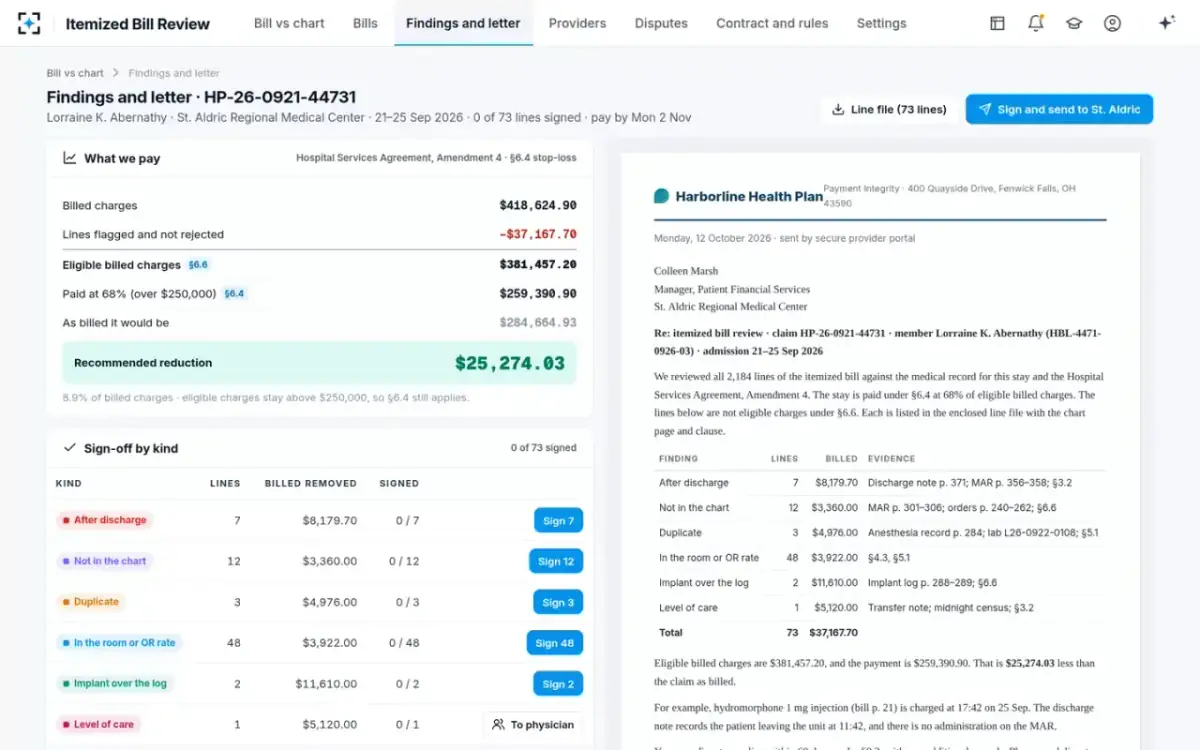
A line file with evidence: Every flagged line with the bill page, chart page and time, the clause and amendment, the payment effect and the reviewer’s name.
A findings summary: The plan calls the service and waits for its work papers.
A line file with evidence: The plan’s analyst opens the cited page, reads the hospital’s new pages against it and decides.
A findings summary: Only if the service reports it.
A line file with evidence: The plan can count findings by hospital and kind itself.
A findings summary: History leaves with the service.
A line file with evidence: History stays with the plan.
What are medical bill review services?
They are firms that take a payer's bills and return recommended reductions, using their own nurses, coders and physicians, and sometimes software. For health plans the menu can include clinical itemized bill review of inpatient and outpatient facility bills, coding and DRG validation, and post-payment recovery. Some work before payment, holding the claim until they finish; others review paid claims and recover.
Services may be paid a contingency fee, a percentage of the savings they identify or realize, or a fee per review. The fee basis shapes behaviour. A service paid on identified savings gains from every finding it writes, sustained or not; one paid on realized savings net of reversals gains only from findings that hold. How contingency and in-house models compare in cost and control is in payment integrity vendors, in-house auditors or agents.
The plan owns the finding the hospital disputes
Whatever the service writes, the plan pays the claim and answers the hospital. The payment terms are the plan's: in Medicare Advantage, every provider contract must carry a prompt payment clause both sides agreed, and the plan must pay on the contract's terms (42 CFR 422.520(b); what a late or short payment then costs is worked through in the guide to prompt pay interest). A service's turnaround and its reductions both have to fit those terms, because the plan, not the service, is the party to them.
Federal oversight has been explicit about the evidence behind a reviewer's decision, in a neighbouring setting. In its 2025 audit report on Medicare Advantage and Part D plans, CMS recorded that reviewers had not fully considered relevant clinical documentation, and told plans to give reviewers the complete records so that no denial rests on an abbreviated summary (CMS, CY 2025 Part C and Part D program audit and enforcement report; the tip is quoted in the guide to medical necessity review). That guidance was written about coverage decisions, not bill review, but the principle carries: a reduction resting on a summary, rather than the page, is a reduction the plan may not be able to defend.
What credentials should medical bill reviewers have?
Clinical credentials matched to the kind of finding. Charge-against-chart findings need reviewers who read medication records, operative notes and nursing documentation fluently, often registered nurses, with certified coders for code and unit questions. Findings that rest on clinical judgment, such as level of care or necessity, need a physician. Ask the service to name the reviewer and their credential on every finding, and the physician on every clinical one.
Credentials are necessary and not sufficient. A nurse who does not know your contracts will flag supplies your contract pays separately, and one who does not know a hospital's charting habits will flag doses charted late but given on time. Ask how the service trains reviewers on your contracts and billing rules, and how it applies the amendment in force on each date of service. The full division of signatures on a finding is in hospital bill auditor: who signs each finding.
What reports should a bill review service provide?
A line file for every bill and a quarterly report that lets the plan check the service. The table below is the minimum; a service that cannot produce any row on request is asking the plan to trust rather than verify.
Reports a medical bill review service should deliver, and what each lets the plan check
| Report | What it contains | What the plan checks with it |
|---|---|---|
| Line file, per bill | Each flagged line: bill page, chart page and time, clause and amendment, payment effect, reviewer | Any finding, in under a minute, without calling the service |
| Cleared bills, per period | Bills reviewed with no findings, and lines reviewed | Coverage, and a sample for missed-error re-review |
| Identified and realized, by hospital and kind | Reductions written, paid at the reduced amount, and reversed | Whether fees follow sustained findings |
| Disputes and outcomes | Each disputed line, the hospital’s new pages, upheld or reversed, and why | Which kinds of finding do not hold |
| Turnaround against prompt-pay dates | Days from referral to findings, by claim | Whether reviews put the plan at risk of late-payment penalties |
| Reviewer register | Names, credentials and the kinds of finding each signs | That clinical calls are signed by clinicians |
How to audit the auditor: a quarterly re-review
Re-review a sample of the service's work against the record each quarter, in both directions: findings it wrote, to measure whether they hold, and bills it cleared, to measure what it missed. An audit that checks only the first measures precision and leaves the misses invisible. The re-review below fits in a few days of one auditor's time a quarter.
Draw 40 findings, stratified by kind so that small kinds such as level of care are represented, and re-check each against the cited page: does the page say what the finding says, is the clause the one in force, is the payment effect right. Then draw 10 bills the service cleared or reviewed lightly and review them in full. Report three numbers: the share of sampled findings that hold, the share with a correct citation, and the findings per cleared bill that the service missed. Track them by quarter. A falling hold rate means findings are getting looser; rising misses mean the service is sampling.
Share of disputed findings upheld, by hospital: the number a service should report
Before signing with a medical bill review service: what to require
- A line file with evidence for every finding
Bill page, chart page and time, clause and amendment, payment effect, reviewer name and credential.
- Fees on realized savings, net of reversals
With fees returned on findings later reversed.
- Clinical calls signed by named physicians
Level of care and medical necessity, never by a nurse or coder alone.
- The contract version in force on the date of service
The service must load your amendments by effective date and cite the one it applied.
- Dispute support inside the contract window
Each disputed line re-checked against the hospital’s new pages, with a recommendation the plan’s analyst signs.
- Turnaround inside prompt-pay dates
Measured per claim, with the plan told in time to pay on schedule.
- A quarterly audit right
Access to the records and work behind any sampled finding, and to a sample of cleared bills.
- Data limited to the stay under review
No use of member records for other clients, deletion on a stated schedule.
How do providers dispute bill review findings?
Under the provider contract: the hospital receives the findings letter, has a window to dispute (60 days by default on the sample plan's settings), and sends its reasons with any new pages of the record. The plan re-checks each disputed line against the new pages, decides to uphold or reverse, and answers. Disputes that do not settle go to the contract's escalation or arbitration terms.
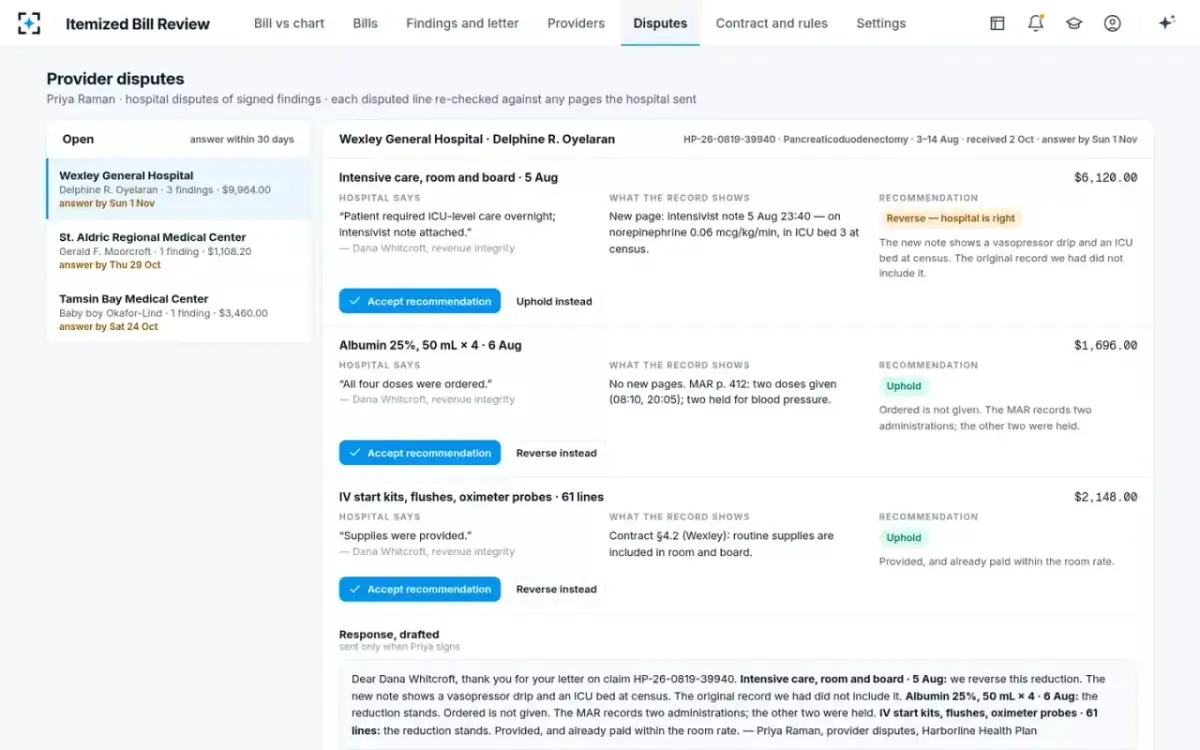
The quality of the answer depends on the evidence the original finding carried. In a sample dispute in Itemized Bill Review, a hospital contested three findings on one stay. A new intensivist's note showed an intensive care day was justified, so that reduction was reversed; the medication record showed two of four albumin doses held, so that reduction stood; and the contract put routine supplies in the room rate, so 61 supply lines stayed out. The response went out only when the plan's dispute analyst signed it.
Each disputed line re-checked against the hospital's new pages
Outsourced reviewers and overturns: what the federal record shows
There is no public study of outsourced hospital bill review, but federal auditors have looked closely at outsourced clinical review in prior authorization, and the lesson transfers. HHS's Inspector General found in June 2026 that when enrollees appealed Medicare Advantage denials of skilled nursing admissions, plans overturned 95% of them in the enrollee's favour, and that "MAOs later overturned 97 percent of SNF denials issued by naviHealth when enrollees appealed", adding: "This raises concerns about whether contractors are receiving appropriate training and oversight from MAOs" (HHS-OIG, OEI-09-24-00331).
Those were coverage denials, not bill reductions, and the figures say nothing about any bill review firm. What they show is a pattern a plan can test for in its own data: decisions made by a contractor, reversed at a high rate when challenged, with the plan answerable for both. OIG's recommendation was that CMS collect data that include "service type and contractor information"; a plan can do the same for its bill review by reporting disputes and reversals by service, hospital and kind.
When to bring the review in-house: four signals in the service's reports
The reports above are also the evidence for whether to keep the service. Four signals say the plan should consider taking facility bill review in-house, or at least running its own check beside the service. The first is a falling ratio of realized to identified savings: findings are being written that do not hold, and if fees follow identified savings, the plan pays for them. The second is reversals concentrated in one kind of finding or one hospital, which points to a gap in the service's contract loading or its records.
The third is turnaround creeping toward prompt-pay dates, which turns a savings program into an interest cost. The fourth is coverage: the share of bills above the threshold the service actually reviews in full. A service that samples is doing what an in-house desk by hand would do, at a percentage of the savings. When reviewing every line no longer needs a proportional headcount, that is the comparison to price.
Where Itemized Bill Review fits beside a service
There are three ways to use it. As a replacement, the plan's own auditors review every bill above the threshold, with agents reading the bill, matching each charge to the chart by item and time, applying the contract in force and drafting the letter from signed findings. As a check, the plan runs it on a sample of bills the service also reviewed and compares line by line; differences are the quarterly re-review, done on every sampled line instead of a handful. And as a split, the service keeps the work where it adds most, and the plan reviews its high-dollar facility bills itself.
It is not a service: it does not supply reviewers, and it does not reprice workers' compensation or auto bills. The plan needs its own clinical bill auditors and a physician advisor, and the records for each stay. How to test a product, or a service, on planted errors before relying on it is in medical bill review software, tested.
A line file the plan keeps: each Itemized Bill Review finding with its page and clause
Questions people ask
How do medical bill review companies get paid?
Often by contingency fee, a percentage of the savings they identify or realize; others charge per review or a fixed fee. Ask whether the fee is calculated on identified or realized savings, and whether it is returned when a finding is reversed.
Who is liable for a bill review finding?
The plan, toward the hospital: it reduced the payment under its contract and must answer the dispute. The service's liability to the plan depends on the service agreement, which should cover errors, reversals and fees.
How do you evaluate a medical bill review company?
Give it a seeded set of your own closed bills with known errors and traps, then compare catches, false flags, citation accuracy and turnaround with other bidders. After signing, re-review a sample of its findings and its cleared bills each quarter.
Is a medical bill review service the same as a patient bill advocate?
No. A bill review service works for the payer and recommends what the plan should not pay. A patient advocate works for the patient, checking the bill and negotiating what the patient owes.
Can a plan use a bill review service and its own auditors at once?
Yes, if the split is written down: by bill size, hospital, contract type or kind of finding. Without a clear split, some bills are reviewed twice and some not at all, and the plan cannot compare the two.