Itemized bill review is the payment integrity check a health plan runs on a high-dollar hospital claim: the hospital's itemized bill, which lists every drug, supply, test, room day and implant with its code, units, time and charge, is read line by line against the patient's medical record for the stay and the plan's contract with the hospital. It finds charges that were never given, were billed twice, fall inside a bundled rate, or were posted after the patient went home. It is hard because the bill can run past 2,000 lines and none of its columns says whether the charge is right; the evidence sits in the chart and the contract. Botminds' Itemized Bill Review reads every line of every bill over the plan's threshold, matches each charge to the chart by item and time, cites the clause, and has a clinical bill auditor sign each finding.
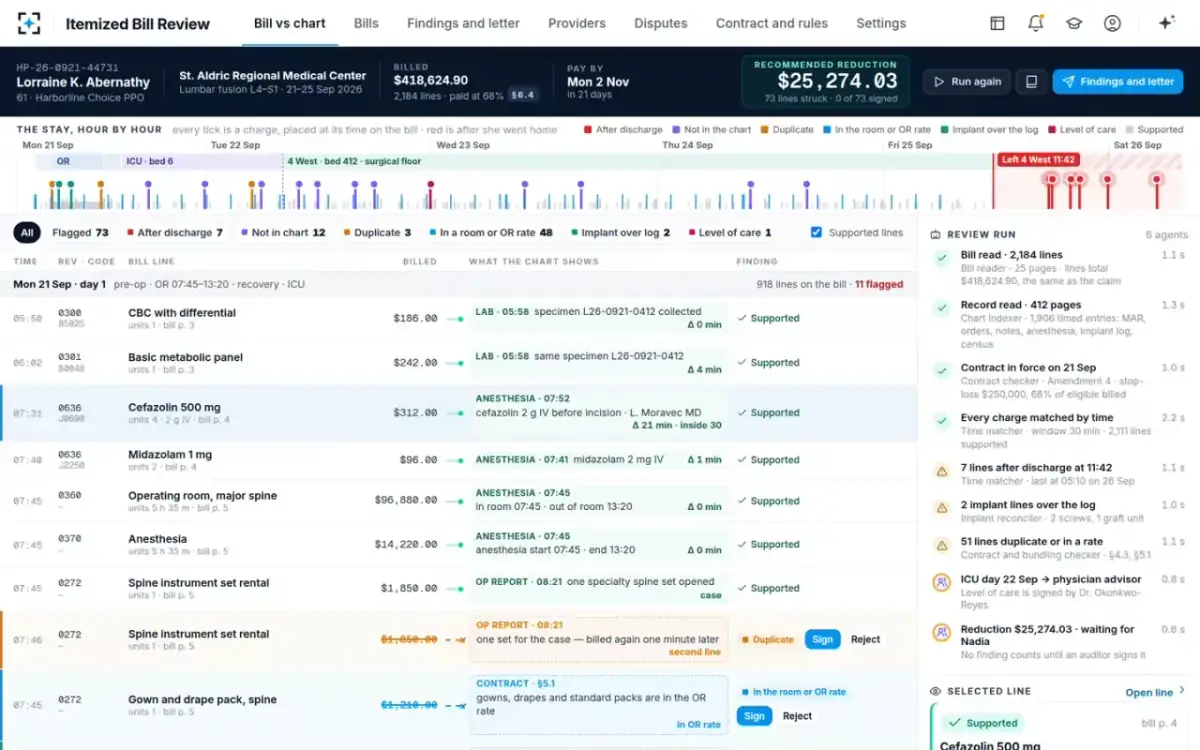
The figure below is five lines from the solution's sample bill for a five-day spinal fusion: fictional hospital and patient. Each column carries part of the evidence; the last column is what the review adds.
Five lines of an itemized hospital bill, and what Itemized Bill Review adds to each
Time: 21 Sep 07:31
Revenue code: 0636
Charge code: J0690
Description: Cefazolin 500 mg
Units: 4
Charge: $312.00
Review: Supported: given 2 g IV at 07:52, 21 minutes later
Time: 21 Sep 07:45
Revenue code: 0360
Charge code: —
Description: Operating room, major spine
Units: 5 h 35 m
Charge: $96,880.00
Review: Supported: in room 07:45, out 13:20
Time: 21 Sep 08:30
Revenue code: 0278
Charge code: C1713
Description: Pedicle screw, polyaxial
Units: 8
Charge: $29,440.00
Review: Flagged: implant log shows 6
Time: 25 Sep 17:42
Revenue code: 0250
Charge code: J1170
Description: Hydromorphone 1 mg injection
Units: 1
Charge: $286.00
Review: Flagged: no dose; patient left at 11:42
Time: 25 Sep
Revenue code: 0120
Charge code: —
Description: Room and board, semi-private
Units: 1 day
Charge: $6,840.00
Review: Flagged: day of discharge
What is itemized bill review?
It is a test of each charge against three questions: was it ordered and given, was it billed once, and is it payable under this contract on this date. The first two are the same questions Medicare's regulation asks of its own expensive inpatient cases, which a reviewer checks "using the medical records and itemized charges":
“Services were ordered by the physician, actually furnished, and not duplicatively billed.”
42 CFR 412.84(f)(3), Medicare cost outlier review
The third question is the commercial plan's own. A drape pack that was really used may still not be payable if the contract counts it as part of the operating room rate; an intensive care day may be payable only at the floor rate if the patient had moved. That is why itemized bill review reads the contract as closely as the chart, and why it applies the amendment in force on the date of service rather than today's.
The work is done by clinical bill auditors, often nurses or certified coders, at the plan or at a review vendor, with a physician advisor for clinical calls. Who signs what is set out in hospital bill auditor: who signs each finding.
What is an itemized hospital bill?
It is the hospital's line-by-line statement of every charge for a stay, drawn from its price list: each dose, supply, test, procedure, room day and device, with its date (and on most bills its time), revenue code, charge code where one applies, units and charge. It is longer than the claim the plan receives, because the claim is a summary.
The prices on it come from the hospital's chargemaster. Federal price transparency rules define a chargemaster as "the list of all individual items and services maintained by a hospital for which the hospital has established a charge", and a gross charge as "the charge for an individual item or service that is reflected on a hospital's chargemaster, absent any discounts" (45 CFR 180.20). Every line on the itemized bill is a gross charge. What the plan pays depends on the contract, which may ignore the lines entirely or pay a percentage of them.
Itemized bill vs UB-04: one is a summary
The UB-04 claim (form CMS-1450, or its electronic equivalent) groups the charges by revenue code; the itemized bill lists them one by one. The claims manual tells hospitals to keep the claim short: "To limit the number of line items on each bill, it should sum revenue codes at the “zero” level to the extent possible", and the last line, revenue code 0001, "represents the grand total of all charges billed" (Medicare Claims Processing Manual, ch. 25). A pharmacy section of 400 lines can appear on the claim as one line under 0250.
The itemized bill and the UB-04 claim, side by side
| Itemized hospital bill | UB-04 claim | |
|---|---|---|
| What it lists | Every charge: each dose, supply, test, room day and device | Charges summed by revenue code, plus diagnoses and procedures |
| Length for a five-day surgical stay | The sample: 2,184 lines on 25 pages | A page or two of revenue code lines |
| Times | Often a time for each charge | Dates; inpatient claims need not date each line |
| What it is for | Proving each charge | Getting paid: the payer prices the claim |
| How they must agree | Its lines total the claim | Its 0001 line is the grand total |
| Who asks for it | The plan, for review; the patient, to check charges | Every payer, on every claim |
Outpatient claims are more detailed: the manual requires "a single line item date of service (LIDOS) for every iteration of every revenue code on all outpatient bills". Even so, only the itemized bill carries the times that let a charge be put beside a chart entry. That is why the first check in any review is that the itemized lines total the claim: a bill that does not tie to the claim is not the bill the plan is paying.
What are revenue codes on a hospital bill?
Revenue codes are four-digit codes that name the hospital department or type of charge for each line; the claims manual points hospitals to the National Uniform Billing Committee's UB-04 specifications for the list (ch. 25, form locator 42). CMS's manuals use 0250 for drugs and biologicals and 0278 for other implants; on the sample bill, 0360 is the operating room and 0120 a semi-private room day. The charge code beside it, usually a HCPCS code, names the specific item where one applies.
For the reviewer, the revenue code decides which test applies. Room and board codes are tested against the unit the patient was in at midnight; pharmacy codes against the medication record; implant codes against the implant log; supply codes against the contract's bundling clauses. Medicare's cost rules supply the default for the last test: "Included in routine services are the regular room, dietary and nursing services, minor medical and surgical supplies, medical social services, psychiatric social services, and the use of certain equipment and facilities for which a separate charge is not customarily made" (PRM-1, §2202.6). The drug lines get their own guide: pharmacy charges on a hospital bill.
The itemized bill as the review sees it: every charge beside its chart entry or the gap
Who can request an itemized bill, and how fast must it come?
A patient can ask the hospital for one, and in Medicare the law sets a deadline. Under the Social Security Act, an individual may request "an itemized statement for any item or service provided to such individual" for which Medicare has paid, and the provider must furnish it "Not later than 30 days after the date on which a request under paragraph (1) has been made", on pain of "a civil money penalty of not more than $100 for each such failure" (42 U.S.C. 1395b-7).
A health plan's right is different: it comes from the provider contract, which can name the threshold above which the hospital must send an itemized bill and the records, and the time it has to do so. HIPAA allows the hospital to disclose them for the plan's payment activities. The sample plan in Itemized Bill Review requests the record automatically when an itemized bill over the threshold arrives, because waiting for records can be the longest part of the review.
What itemized bill review finds: six kinds
It finds six kinds of charge that should not be paid as billed, and each kind needs different evidence. On the sample bill, 73 of 2,184 lines are flagged, worth $37,167.70 in billed charges; the split below shows where those dollars sit.
Where the flagged dollars sit on one bill in Itemized Bill Review, by kind of finding
Sample spinal fusion, $37,167.70 flagged on 73 lines
- Implant over the log, 2 lines · 31%
- After discharge, 7 lines · 22%
- Level of care, 1 line · 14%
- Duplicate, 3 lines · 13%
- In the room or operating room rate, 48 lines · 11%
- Not in the chart, 12 lines · 9%
This is one sample bill, not a statistic, but its shape makes the case for reading every line: a few large lines (implants, a room day) and many small ones (supplies). A review that samples the large lines finds most of the dollars and misses the pattern, and a hospital that bills every gown pack separately is likely to do so on every stay. Implants get their own guide in implant invoice vs implant charge.
How a review reads the bill: four checks before any finding
Before any line is judged, the bill itself is tested, because a wrong bill produces wrong findings. Four checks come first. The lines must total the claim to the cent, or something was missed or read twice. Every line must fall inside the stay: a charge dated after discharge, or before admission, is a question before it is a finding. Lines that repeat the same item in the same minute, or the same specimen accession, are paired up for the duplicate test. And the units on each line are converted to what the record would show, a dose, a count or minutes in the room, so that the chart comparison compares like with like.
The stay boundary has a front edge as well as a back one. Medicare bundles a hospital's own outpatient services into the inpatient stay when they are furnished on the day of admission or "during the 3 calendar days immediately preceding the date of the beneficiary's admission to the hospital" (42 CFR 412.2(c)(5)), with conditions. A commercial contract may adopt a similar window, and when it does, a pre-admission test billed separately is a duplicate of the stay.
Only then does the line-by-line comparison start. On the sample bill, the bill reader turns 25 pages into 2,184 lines that total $418,624.90, the same as the claim, and only then are the charges matched to the chart; if they had not totalled, the review would have stopped there and reported why.
What is not itemized bill review
Several neighbouring checks share its vocabulary. It is not coding or DRG validation, which tests whether the diagnoses and procedures on the claim are supported and leaves the charge lines alone. It is not utilization review, which decides whether the stay or service was medically necessary, usually before or during the stay. It is not claims editing, which tests codes against codes on every claim without opening the record. And it is not repricing against a fee schedule, the core of workers' compensation bill review.
It also does not always change the payment. Under a case rate or DRG payment, removing lines matters only when the charges cross a stop-loss or outlier threshold or a carve-out pays an item separately; high dollar claim review works through which contract terms make a review pay.
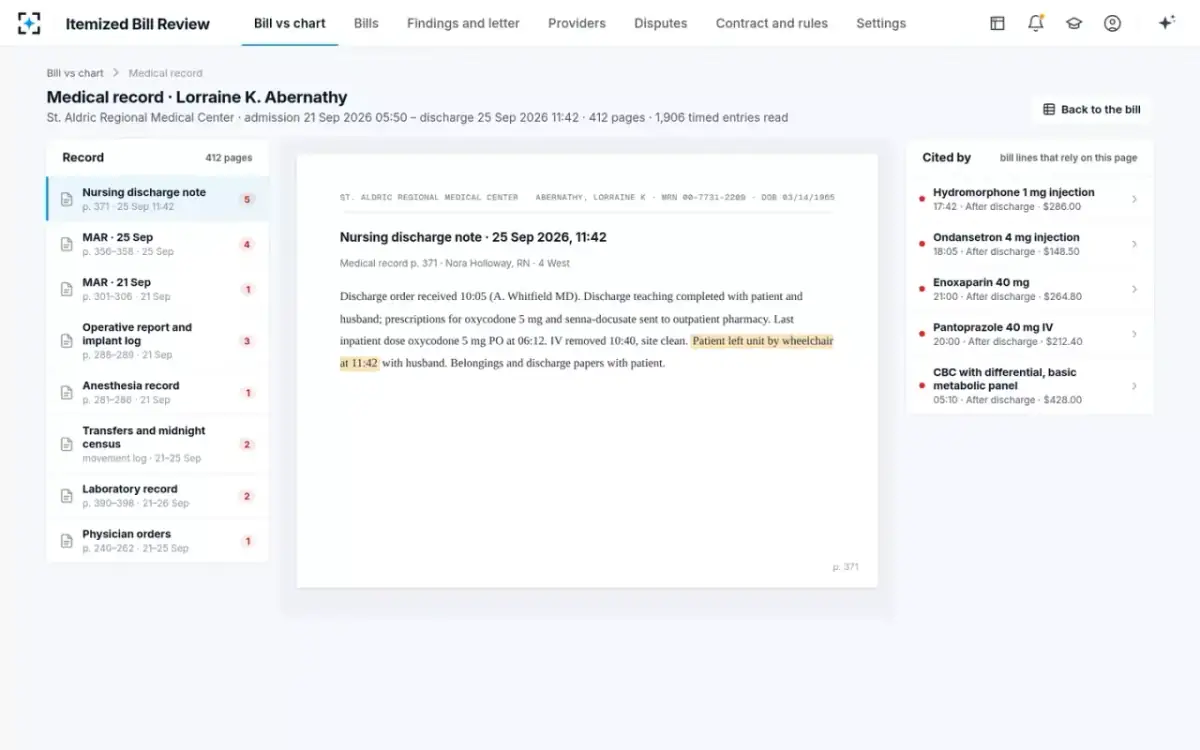
The record behind the bill: each page and the lines that rely on it
Questions people ask
What does IBR stand for in payment integrity?
IBR stands for itemized bill review: the line-by-line check of a hospital's itemized bill against the medical record and the provider contract, usually on claims above a dollar threshold. Plans run it before payment, holding the claim, or after payment, recovering the difference.
Is an itemized bill the same as an itemized statement?
In practice, yes: both list each item or service with its charge. Medicare's statute uses "itemized statement" for what a beneficiary may request; hospitals and plans also say itemized bill. The UB-04 claim is a different, summarised document.
Do I have a right to an itemized medical bill?
Medicare beneficiaries have a statutory right to an itemized statement within 30 days of a written request, for items and services Medicare paid for. Other patients' rights depend on state law and the hospital's policy, so ask the hospital's billing office in writing.
How many lines are on an itemized hospital bill?
It depends on the stay. The fictional five-day spinal fusion in Itemized Bill Review has 2,184 lines on 25 pages, and its first day alone, the day of surgery, has 918 lines.
What is the difference between itemized bill review and a DRG audit?
A DRG audit tests whether the diagnosis and procedure codes support the DRG the claim was paid under; itemized bill review tests the charge lines. They answer different questions and can both apply to the same stay.