A hospital bill auditor, often called a clinical bill auditor, is the person at a health plan or its review vendor who reads the itemized bill for a high-dollar hospital stay line by line against the patient's medical record and the hospital's contract, and decides which charges the plan will not pay. The job is hard for a plain reason: a five-day surgical stay can run past 2,000 lines, the evidence for each line sits somewhere in a 400-page record, and the rule that decides it sits in a contract amendment. So a careful auditor samples, and the finding they do write has to survive the hospital's dispute. Botminds' Itemized Bill Review exists to change that arithmetic: agents read the bill, match every charge to the chart entry that supports it or the gap where one should be, and cite the clause, and the auditor signs each finding by name.
The auditor is not the only signature. Clinical calls go to a physician advisor, large letters get a second auditor, disputes go to an analyst who must defend or reverse the finding, and a director owns the rules that send a bill to review at all. Each signature asserts something different. The figure below follows one finding through all four desks; the people and the stay in it are fictional, sample data in the solution.
Four people sign for one hospital bill finding, and each signs for something different
Today
Reads the pharmacy and implant pages of a 2,000-line bill by hand, with the bill, the chart and the contract in three windows, and samples the rest.
With agents
Opens a bill already matched line by line, reads the flagged lines with their chart page and clause, and signs or rejects each finding, one line or a whole kind at a time.
Still theirs: whether each charge is payable under the bill, the record and the contract.
Today
Gets a packet with no index and has to rebuild the stay before deciding one ICU day.
With agents
Gets only clinical calls: level of care, medical necessity and, on the sample settings, any reduction over $50,000, each with the transfer note and orders attached.
Still theirs: every judgment about what care the patient needed.
Today
Pulls the record and the contract all over again when the hospital disputes, weeks after the letter went out.
With agents
Receives each disputed line re-checked against any new pages the hospital sent, with a drafted answer to uphold or reverse.
Still theirs: the plan’s answer to the hospital, and the decision to reverse.
Today
Sees identified savings, not realized ones, and cannot tell which hospitals bill after discharge.
With agents
Sees identified and realized savings by hospital and kind, dispute outcomes, and approves every change to thresholds and windows.
Still theirs: which bills are reviewed, and how strict the matching is.
What does a hospital bill auditor do?
A hospital bill auditor checks that each charge on an itemized hospital bill was ordered, given, billed once and payable under the plan's contract with that hospital, then writes the findings the plan sends to the hospital. The work starts when a claim crosses a review threshold: the plan asks the hospital for the itemized bill and the medical record for the stay, ties the bill's lines to the claim total, and works through the lines.
These are the same tests Medicare applies to its own expensive inpatient cases. When a stay is paid an outlier amount because its charges are extraordinarily high, the regulation tells the reviewer to work from the medical records and the itemized charges and confirm, among other things, that services were ordered by the physician, actually furnished and not billed twice (42 CFR 412.84). A commercial plan's auditor adds a fourth source Medicare does not need: the provider contract, which decides whether a charge that was really furnished is still separately payable, for example a gown pack that the contract counts as part of the operating room rate.
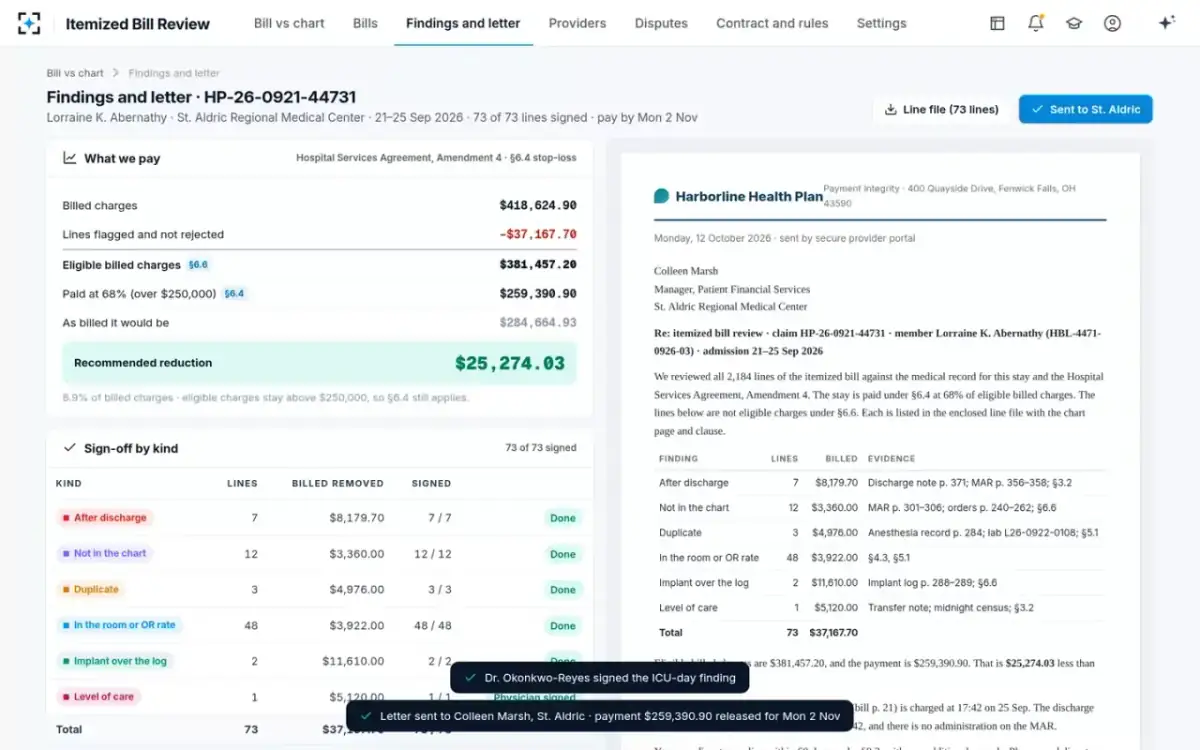
The day's output is a set of findings, not a number. Each one names a bill line, the chart entry or gap behind it, the contract clause or billing rule it rests on, and what it does to the payment. The total reduction is just the sum, recalculated under the contract's payment terms. On the sample spinal fusion bill in Itemized Bill Review, 73 of 2,184 lines are flagged, worth $37,167.70 in billed charges; because that stay pays 68% of eligible charges under a stop-loss clause, the plan's recommended reduction is $25,274.03, 8.9% less than paying as billed.
The four signatures behind one hospital bill finding
A finding is only as strong as the weakest claim it makes, so a well-run desk separates the claims and has the right person sign each. The auditor asserts a fact about documentation; the physician advisor asserts a clinical judgment; the dispute analyst asserts that the finding still stands after the hospital's reply; the director asserts that the rules which produced it are the plan's rules. Mixing them is how findings get reversed: an auditor who writes "not medically necessary" has signed something they were not positioned to sign.
What each signature on a hospital bill finding asserts, and the evidence it needs
| Who signs | What the signature asserts | Evidence it needs | Where it stops |
|---|---|---|---|
| Clinical bill auditor | This charge is not payable as billed under this bill, this record and this contract | The bill line; the chart entry or the gap, with page and time; the clause or billing rule in force on the date of service | Any judgment about what care the patient needed |
| Physician advisor | The level of care or the service billed was not the one the patient needed | Orders, transfer notes, nursing and physician notes, the unit the patient occupied at midnight | Arithmetic and contract terms |
| Second auditor | The letter is correct: lines, totals and the recalculated payment | The signed findings and the payment terms | Re-deciding individual findings |
| Dispute analyst | After the hospital’s reply, the finding stands or is reversed | The hospital’s new pages read against the original evidence | Changing the rules for future bills |
| Director of payment integrity | These thresholds, windows and signing rules are the plan’s | Results by hospital and kind, signed and rejected rates, dispute outcomes | Signing individual findings |
Do hospital bill auditors need to be nurses?
No federal rule requires a registered nurse to check whether a charge on a hospital bill matches the chart, and teams staff the desk with nurses, certified coders or both. Plans favour clinical backgrounds because the evidence is clinical: reading a medication administration record, an anesthesia record or an operative note quickly takes training. What the rules do require is a clinician wherever the finding turns into a medical judgment.
Medicare Advantage sets the clearest line. Before a plan issues a partly or fully adverse medical necessity decision, a physician or other appropriate health care professional with expertise in the service must review it (42 CFR 422.566(d)); the guide to the prior authorization workflow sets out the full rule and what it still lets a nurse approve. Employer plans meet the same idea at appeal: when an appeal rests on a medical judgment, including whether a service was necessary or appropriate, the plan's named fiduciary must consult a health care professional trained and experienced in that field (29 CFR 2560.503-1(h)(3)(iii); the guide to the ERISA appeals process quotes the rule).
Neither rule was written for itemized bill review, and a contracted hospital's payment dispute usually runs under its contract. But a bill review finding that rests on necessity is the same kind of decision, and building the desk to that standard is what keeps it defensible.
Where the auditor's authority stops: medical necessity and level of care
The auditor's authority ends where documentation ends and judgment begins. "The MAR has no administration of this drug within 30 minutes of the charge" is documentation: anyone can check it against the page. "The patient did not need intensive care that day" is judgment, even when the documentation points strongly one way. The first is the auditor's to sign. The second belongs to the physician advisor.
Room charges show the line most often. On the sample stay, the bill charges an intensive care day on 22 September at $11,960.00, while the transfer note moves the patient to the surgical floor at 08:15 and the patient is on the floor at midnight; the contract pays the floor rate of $6,840.00, a $5,120.00 difference. The agents can lay out the transfer note and the midnight location, and the auditor can confirm the arithmetic, but the finding goes to the physician advisor because it is a statement about the level of care. How that day-by-day comparison is built is the subject of the level of care audit.
Seventy-three findings signed: the auditor by kind, the physician advisor for the ICU day
What the hospital must hand over, and why it may
The auditor's raw material is the hospital's itemized bill and the medical record for the stay, and the hospital may send both to the plan without asking the patient. HIPAA's definition of payment includes "Review of health care services with respect to medical necessity, coverage under a health plan, appropriateness of care, or justification of charges" (45 CFR 164.501), and a hospital may disclose records to a health plan for the plan's payment activities (45 CFR 164.506(c)(3)). The plan's right to demand them, and the deadline for sending them, normally come from the provider contract.
The same rules limit what the auditor should read. The minimum necessary standard applies to payment, so the request should be for the record of the stay under review, not the patient's history. Itemized Bill Review is built that way: the agent that indexes the chart reads only the stay on the bill, and every step is on the activity trail.
How do hospital bill auditors find errors on a 2,000-line bill?
They find errors by asking each line the same few questions in a fixed order: does the bill tie to the claim, is there a chart entry for this item at this time, is the item separately payable under the contract, does the count match the log, and was the patient where the room charge says they were. The order matters because the first failure explains the line; a drug with no administration in the chart does not need a contract argument.
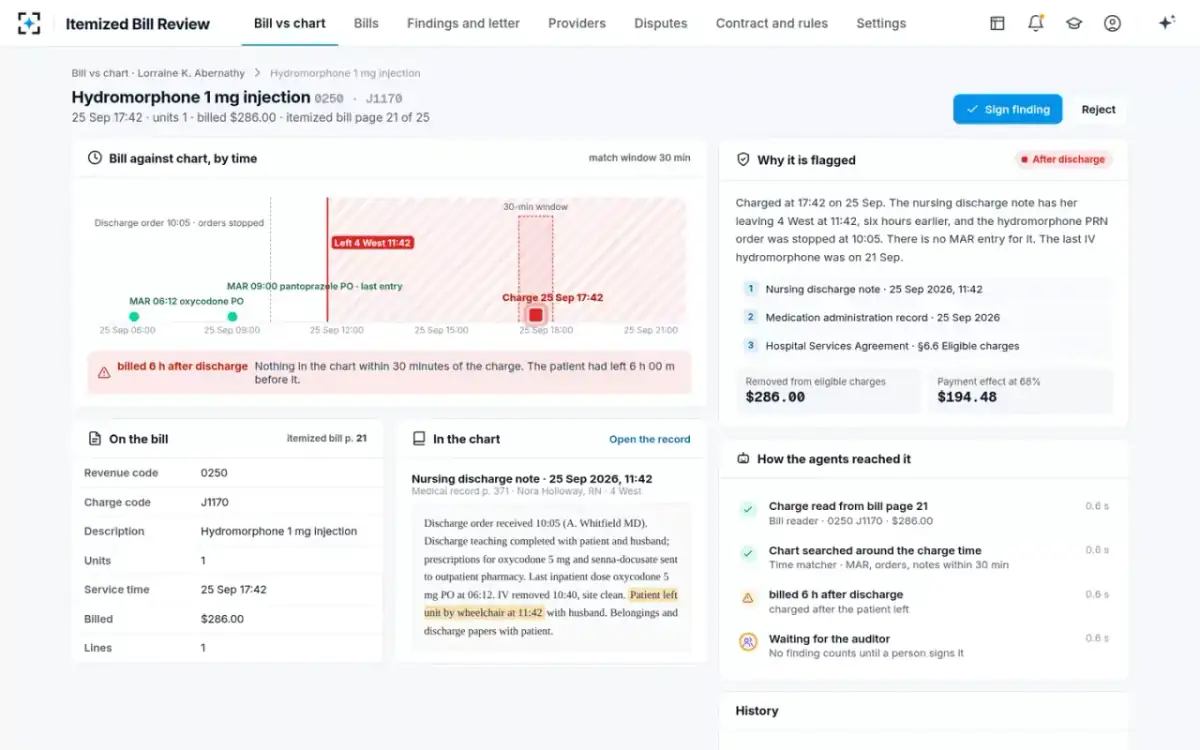
Time is the strongest test, because the record is timed by rule: Medicare's hospital conditions require every medical record entry to be "dated, timed, and authenticated" (42 CFR 482.24(c)(1)). A charge timed after the patient left is visible at once if the auditor has the time of departure next to it. On the sample stay, hydromorphone 1 mg is charged at 17:42 on the day of discharge; the nursing discharge note has the patient leaving the unit at 11:42, the order for the drug was stopped at 10:05 and the medication record has no dose. Six more lines follow it that evening and the next morning.
By hand, that kind of check is where the hours go. Our estimate for a careful manual review of a 2,000-line bill is four to six hours, two of them spent finding the chart entry for each charge. That is why desks sample pharmacy and implants and leave the room, supply and laboratory lines unread.
One line in depth: the charge, the chart and the clause on one page
Itemized Bill Review: what changes in the hospital bill auditor's day
The auditor stops searching and starts deciding. In Itemized Bill Review, six agents do the reading and matching, and every step that commits the plan stays with a named person. The chain below is the order a finding travels, with what each agent is never allowed to do.
From itemized bill to signed letter in Itemized Bill Review
Agent
Bill readerTurns the bill into lines with revenue code, charge code, units, amount and time, and checks that the lines total the claim.
Never: changes an amount or a unit; it stops if the lines do not total.
Agent
Chart indexer and time matcherExtract the timed entries from the record for the stay and match each charge by item and time.
Never: flags a charge that has a matching entry inside its window, or judges medical necessity.
Agent
Contract checker and implant reconcilerApply the contract version in force on the date of service and compare implant charges with the log scanned at the table.
Never: applies a superseded amendment.
A person decides
Clinical bill auditorSigns or rejects each finding by name. A rejected line is paid as billed.
A person decides
Physician advisorSigns level of care, medical necessity and the largest reductions.
Agent
Findings letter writerRecalculates the payment from signed findings only and drafts the letter with the page and clause for every line.
Never: sends anything.
A person decides
Auditor, and a second auditor above the plan’s limitSign the letter; only then does it go to the hospital.
The change is not only speed. Because every line is matched, the director can stop choosing which bills to sample, and because each finding carries its evidence, the dispute analyst starts from the original citations instead of a summary. Why the agent that reads a bill must never be the one that confirms a finding is argued in hospital bill review with agents; how to hold an outside review service to the same standard is in medical bill review services.
What a signed finding must carry
A signed finding must let a stranger at the hospital check it in under a minute without calling anyone. That means the evidence travels with the finding, not in the auditor's notes. The checklist below is what each line in a findings letter should carry before anyone signs it.
Before a hospital bill auditor signs: what every finding should carry
- The bill line, exactly as billed
Bill page, revenue code, charge code, units, date and time of service, amount. The hospital must be able to find it in its own system.
- The chart entry, or the gap
Document, page and time, or the window searched and found empty. “Not documented” without a window is an opinion.
- The rule, with its version
The contract clause or billing rule, and the amendment in force on the date of service, not today’s.
- The payment effect
Billed charges removed, and the effect under the contract’s payment terms. On a stop-loss stay, a $286.00 line is a $194.48 effect at 68%.
- The kind of finding
After discharge, not in the chart, duplicate, in the room or operating room rate, implant over the log, level of care. The kind decides who signs.
- The right signer
The auditor for documentation; the physician advisor for level of care and medical necessity.
- A reason a non-clinician can follow
“Charged at 17:42; the patient left the unit at 11:42” settles more disputes than a code.
A desk that meets this standard on every line has also built its own audit file: every reduction can be traced to a page, a clause and a person. How itemized bills are laid out, and which columns carry the evidence, is in what is itemized bill review.
Questions people ask
What qualifications does a hospital bill auditor need?
Most plans hire registered nurses, certified coders or both, because the evidence is clinical and coded at once. No federal rule sets a credential for checking charges against the chart. Where a finding is a medical judgment, Medicare Advantage requires review by a physician or other appropriate health care professional before an adverse medical necessity decision (42 CFR 422.566(d)).
Who reviews hospital bills for insurance companies?
Clinical bill auditors in the plan's payment integrity department, a review vendor working for the plan, or both. Physician advisors sign the clinical findings, and dispute analysts handle the hospital's reply. Whoever does the reading, the plan pays the claim and answers the dispute.
What is a clinical bill auditor?
The usual title for a hospital bill auditor with a clinical license, typically a nurse, who reviews itemized bills against the medical record. The word clinical marks the difference from a pricing or claims analyst, who checks the payment arithmetic but does not read the chart.
Can a hospital bill auditor deny medical necessity?
They should not. An auditor can find that a charge has no supporting entry, was billed twice or falls inside a bundled rate; whether the patient needed a service is a clinical judgment for a physician advisor. Medicare Advantage and the federal rule for employer plan appeals both put that judgment with a qualified clinician.
What is a physician advisor in payment integrity?
A physician who signs the findings that rest on clinical judgment, such as an intensive care day billed after the patient moved to the floor. In Itemized Bill Review the physician advisor receives only those findings, each with the transfer note, orders and the unit the patient occupied at midnight attached.