Payment integrity vendors are the companies health plans hire to stop or recover payments that should not have been made: claims editing, coordination of benefits, data mining for overpayments, clinical review of high-dollar hospital bills, and recovery. For itemized bill review, the line-by-line check of a large hospital bill against the medical record and the contract, a plan has three real choices: send the bills to a vendor paid a share of the savings, staff its own desk of clinical bill auditors, or keep its auditors and give them agents that do the reading and matching. Botminds' Itemized Bill Review is the third model. This guide is honest about all three, because the right answer differs by plan size, contract mix and how much of the hospital relationship the plan wants to keep in its own hands.
Where an example helps, it uses the sample plan in the solution: fictional hospitals, people and figures.
Three ways to run itemized bill review, compared on the same high-dollar bill
| What differs | Contingency-fee vendor | In-house auditors, by hand | In-house auditors with agents |
|---|---|---|---|
| Bills covered | Those the vendor selects or the plan refers, usually above a threshold | A sample: the auditors’ hours set the limit | Every bill above the threshold, every line |
| Who signs each finding | The vendor’s reviewer | The plan’s auditor | The plan’s auditor; physician advisor for clinical calls |
| Evidence the plan keeps | What the contract requires the vendor to deliver | The auditor’s work papers | Each finding with its chart page, clause and signer |
| Who answers the hospital | The plan, often with vendor support | The plan | The plan, with each disputed line re-checked |
| How cost behaves | A percentage of savings, for as long as the contract runs | Salaries; coverage rises only with headcount | Software and auditors; coverage no longer tied to headcount |
| Data leaving the plan | Bills and records go to the vendor | None | Processed for the plan under its agreements |
| What it does well | Starts fast, no hiring, brings reviewers the plan lacks | Plan judgment and relationships | Plan judgment at full coverage |
What do payment integrity vendors do?
They do the checks a plan has not built itself, before or after payment. The usual menu runs from automated claim edits and coordination-of-benefits checks, through data mining of paid claims for overpayments, to clinical work that needs nurses and coders: itemized bill review, diagnosis and DRG validation, and medical record review. Some vendors also run recovery: letters, offsets against future payments and collections.
Whatever the vendor does, the plan answers for it. Medicare Advantage states the principle outright: whatever it delegates to a contractor, the plan remains ultimately responsible for every term of its contract with CMS (42 CFR 422.504(i)(1); the guide to utilization management outsourcing shows what that oversight looks like for a delegated review desk). Commercial and employer plans carry the same exposure through their provider contracts and claims rules. A vendor's wrong finding is the plan's dispute, the plan's provider relations problem and, for an employer plan, potentially the plan's claims-procedure problem.
How do payment integrity vendors get paid?
Most are paid a contingency fee: a percentage of the savings or recoveries they produce. Others charge per claim reviewed, per member per month, or a software licence. The contingency model's appeal is that it costs nothing until it saves something. Its risk sits in the definitions: savings "identified" on a findings letter are not savings realized after the hospital disputes, and a fee calculated on the first number pays for findings the plan later reverses.
Read three definitions in any contingency contract before the rate. What counts as savings: identified, paid at the reduced amount, or net of reversals. When the fee falls due, and whether it is returned when a finding is reversed. And whether savings on a claim the plan would have reduced anyway, through its own edits, also earn a fee. The formula below compares the two cost structures on terms a plan can fill in.
Net value of itemized bill review under a contingency vendor or an in-house desk
Realized savings
signed findings × contract payment effect × share not reversed
The same under any model if the findings are the same; coverage and accuracy move it.
Director of payment integrity
Cost of the model
contingency: fee rate × the savings base the contract defines · in-house: auditors × loaded cost + physician advisor time + software + record retrieval
A fee on identified savings exceeds one on realized savings; in-house cost is fixed in the short run, and coverage depends on the time each review takes.
Procurement and payment integrity
Dispute handling
disputes × hours to answer, under any model
Vendors may support it; the plan still signs the answer.
Provider dispute analyst
Who owns the finding when a vendor makes it?
The plan does, from the moment it reduces the payment. The hospital's dispute comes to the plan, the provider relations team takes the call, and the plan's own clocks keep running. For an employer plan, the federal claims rule gives the plan a reasonable period, "but not later than 30 days after receipt of the claim", to decide a post-service claim, and "This period may be extended one time by the plan for up to 15 days" (29 CFR 2560.503-1(f)(2)(iii)(B)), with conditions. A vendor's turnaround has to fit inside the plan's obligations, not the other way round.
Ownership is also about evidence. If the vendor's letter cites its own work papers, the plan has a conclusion it cannot defend without calling the vendor. If each finding arrives with its bill line, chart page, clause and signer, the plan can answer a dispute itself, switch vendors without losing the history and see which hospitals bill after discharge. What to demand from an outside reviewer, and how to re-review its work, is in medical bill review services: how to audit the auditor.
What a payment integrity vendor's savings figure does and does not show
A vendor's savings figure shows what it reported on its clients' claims under its own definitions; it does not show what it would save on yours. No government or academic source measures how often commercial hospital bills carry charges that should not be paid, so a vendor's error rate or average savings cannot be checked against a public benchmark, and Medicare's published improper payment rate measures fee-for-service claims, not commercial itemized bills.
Three questions turn a marketing figure into something a plan can use. What is the denominator: all claims, claims over a threshold, or claims the vendor chose to review? Is the figure identified or realized, before or after disputes? And what would the plan's own contracts have paid: a reduction on a case-rate stay below its stop-loss point saves nothing. The only figure that answers all three is the one from a test on the plan's own closed bills, which is the method in medical bill review software, tested.
The data a vendor sees, and the minimum it needs
An itemized bill review needs the bill and the medical record for one stay, and nothing more. HIPAA's minimum necessary standard requires a covered entity or business associate to make reasonable efforts to limit what it uses, discloses or requests to what the purpose needs (45 CFR 164.502(b)), and it binds the asking side too, as the guide to the insufficient documentation denial shows for records requests. A vendor that asks for whole-member claims histories to review one hospital bill should explain why.
Three questions belong in every business associate negotiation for this work: how long the vendor keeps the records after the review closes, whether it uses your members' records to build or train products for other clients, and where the work is done. The in-house models answer them by design; in Itemized Bill Review, the agent that indexes the chart reads only the stay under review, and every agent step and every person's decision is on the activity trail.
Should a health plan bring payment integrity in house?
Bring in-house the work where the plan's own judgment and provider relationships decide the outcome, and buy the work where scale or outside data decides it. Itemized bill review of facility claims sits in the first group: it turns on the plan's contracts, its own billing rules and how it wants to treat each hospital. Coordination of benefits and some data mining sit in the second, because the vendor brings data or volume a single plan does not have.
The obstacle to bringing bill review in-house used to be arithmetic: at four to six hours per 2,000-line bill by our estimate, a desk covers a fraction of the bills a vendor can. That is the gap agents close. With the reading and matching done before the auditor opens the bill, our estimate of auditor time falls to well under an hour, and the desk can cover every bill above its threshold. The plan still needs clinical auditors and a physician advisor; what it no longer needs is a headcount that grows with the number of lines.
It is not right for every plan. A plan with few high-dollar claims, no clinical staff and no appetite to build a desk will do better with a well-written contingency contract. And a plan whose hospital contracts are case rates without stop-loss or carve-outs has little to gain from line review at all; high dollar claim review shows how to test that before buying anything.
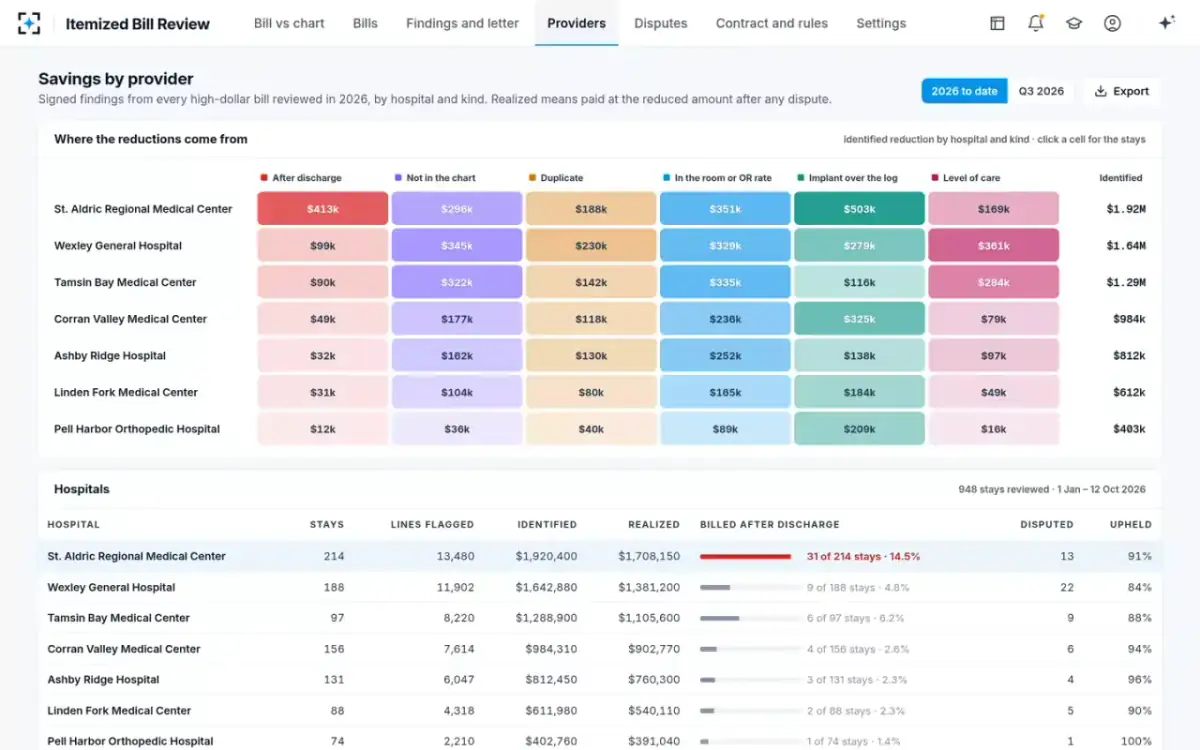
Identified and realized savings by hospital and kind
How do you switch payment integrity vendors? A 120-day plan
Switch in overlapping phases, never on a single date, because the outgoing vendor's open findings, disputes and recoveries run for months after its last referral. The plan below assumes a move from a contingency vendor to an in-house desk for itemized bill review; the same shape works for a change of vendor.
Switching itemized bill review without losing open findings: a 120-day plan
- Notice, data return terms, open-item list30 d
- Referrals continue above a raised threshold45 d
- No new referrals; disputes and recoveries close out45 d
- Contracts, rules and settings loaded; records access30 d
- Back-test on closed bills and parallel run45 d
- Full coverage above the threshold45 d
Two steps decide whether the switch is safe. The back-test runs the new model on bills the old vendor already reviewed, so the plan can compare findings line by line before it relies on them; the seeded test in medical bill review software, tested adds planted errors to the same set. And the open-item list makes the outgoing vendor deliver every finding still in dispute with its evidence, so the plan's analysts can answer the hospital after the vendor has gone.
What to put in any payment integrity vendor contract
Whatever model a plan chooses, the contract terms below keep the findings defensible and the plan in control. Most of them cost a vendor nothing if its work is sound, which makes a refusal informative.
Contract terms for itemized bill review, whoever does the reviewing
- Savings defined as realized
Paid at the reduced amount, net of reversals, with any fee on a reversed finding returned.
- Evidence with every finding
Bill line, chart page and time, clause and amendment, payment effect and the reviewer’s name, delivered in a file the plan keeps.
- Clinical calls signed by clinicians
Level of care and medical necessity signed by a physician advisor, named on the finding.
- Dispute support inside the window
Re-review of every disputed line against the hospital’s new pages within a set number of days, at no extra fee.
- Minimum necessary data, limited use
Records of the stay only; no use of the plan’s data for other clients; deletion on a stated schedule.
- Audit right
The plan may re-review a sample of findings each quarter and see the reviewer’s accept and reject rates.
- Exit terms
An open-item list with evidence on notice, and a defined tail for disputes and recoveries in flight.
Where Itemized Bill Review fits
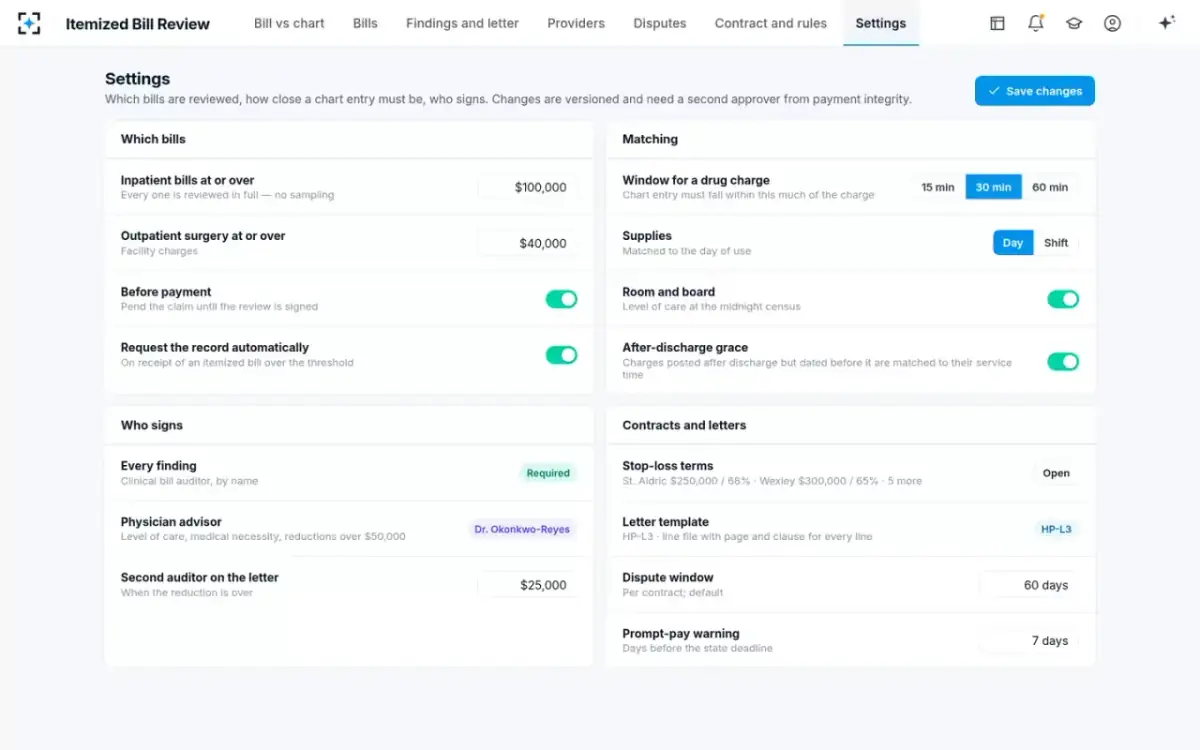
Itemized Bill Review is the in-house model with agents. Six agents read the bill, index the chart for the stay, match every charge by item and time, apply the contract amendment in force on the date of service, reconcile implants with the log and draft the letter from signed findings. The plan's clinical bill auditor signs each finding, the physician advisor signs clinical calls, and nothing reaches a hospital until a person signs it. Thresholds, matching windows and signing rules are settings, versioned with a second approver.
It also works beside a vendor. A plan can keep a vendor for the services where scale matters and run facility bill review itself, or run Itemized Bill Review on bills below the vendor's threshold first and compare. What it does not replace: claim edits, coordination of benefits, DRG validation and the auditors themselves.
The plan's review rules in Itemized Bill Review, as settings with a second approver
Questions people ask
Who are payment integrity vendors?
Companies that review health plan claims for payment errors and recover overpayments, ranging from claim-editing software firms to clinical review and recovery services. Some offer several services at once. A plan should judge each service on its own evidence rather than the vendor's overall savings figure.
What is contingency fee payment integrity?
An arrangement in which the vendor is paid a percentage of the savings or recoveries it produces instead of a fixed fee. Its cost depends on how the contract defines savings: identified, paid at the reduced amount, or net of reversals after the hospital disputes.
What are the risks of payment integrity vendors?
Fees paid on findings later reversed, findings the plan cannot defend without the vendor, member data held outside the plan, and friction with hospitals the plan must keep in its network. For Medicare Advantage, the plan remains fully responsible for its CMS contract whatever the vendor does.
Can a plan use a vendor and an in-house desk together?
Yes. One workable split is by service: a vendor for coordination of benefits or data mining, an in-house desk for facility bill review. Split by clear rules, such as contract type or threshold, so that no bill is reviewed twice or not at all.
What is the difference between identified and realized savings?
Identified savings are reductions on a findings letter; realized savings are what the plan actually paid less after disputes and reversals. On the fictional sample plan in Itemized Bill Review, one hospital shows $1,920,400 identified and $1,708,150 realized for 2026 to date.