A high dollar claim review is a health plan's line-by-line check of a hospital claim whose billed charges cross a threshold the plan sets, typically by reading the itemized bill against the medical record and the provider contract before the claim is paid. Whether it is worth doing depends on two numbers most desks never put side by side: the hours a careful review takes, and how much of the bill the contract actually pays from charges. Under a fixed case rate, removing lines may change nothing; under a stop-loss clause that pays a percentage of every eligible charge, each wrongly billed dollar costs the plan that percentage. Botminds' Itemized Bill Review exists for the second case: its agents match every charge to the chart and the contract so an auditor can review every bill over the threshold instead of a sample. This guide builds the economics from the contract up.
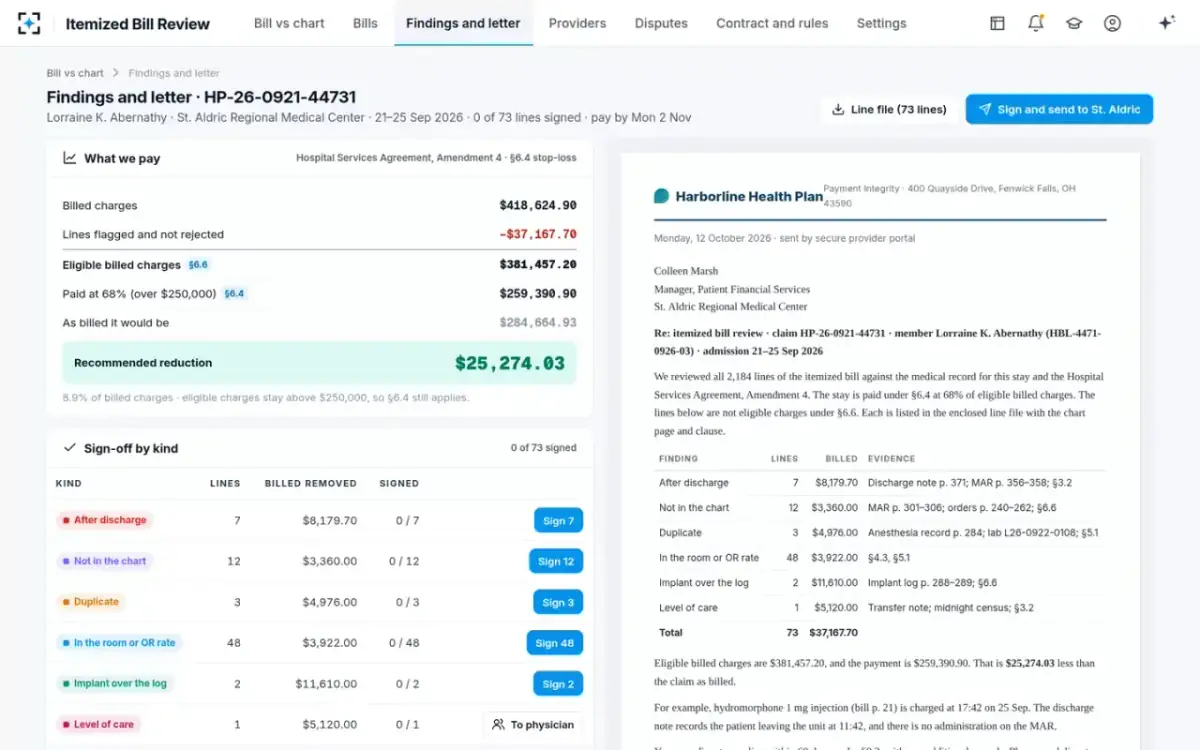
The worked example is the sample spinal fusion stay in the solution: fictional hospital, patient and plan, billed $418,624.90 and paid under a stop-loss clause at 68% of eligible charges.
Where the billed dollars on one high dollar claim go, before and after review
Paid as billed under the stop-loss clause
- Plan pays · 68%
- Contractual discount · 32%
Paid after 73 lines are removed
- Plan pays: $259,390.90 · 62%
- Contractual discount on eligible charges · 29%
- Removed by signed findings: $37,167.70 · 9%
What is a high dollar claim?
A high dollar claim is any claim whose billed charges cross the review threshold a plan, a contract or a stop-loss policy sets; there is no single industry figure. A plan can set separate thresholds for inpatient stays and for outpatient surgery, because a one-day surgical claim with implants can bill as much as a week on a medical floor. The sample plan in Itemized Bill Review reviews every inpatient bill of $100,000 or more and every outpatient surgical claim of $40,000 or more in full.
Medicare draws its own line, and it is drawn in cost, not charges. For fiscal year 2027, an inpatient case qualifies for an outlier payment when its estimated cost exceeds the DRG payment plus "the fixed-loss amount of $49,346" (FY 2027 IPPS final rule, 91 FR 49570), and CMS projects outlier payments at 5.1% of operating DRG payments. The size of the charges behind that line keeps growing: the same rule puts Medicare's average covered charge per inpatient case at $97,536.48 in fiscal year 2025, up 7.3% from $90,928.19 a year earlier.
How are high dollar claims paid? Charges matter only under some terms
They are paid under whatever the contract says, and the first question in any high dollar claim review is which of those terms make charges count. Hospital contracts mix several payment methods. Only some of them turn a wrongly billed line into money, and a review that does not start there will spend hours finding errors that change nothing.
Which contract terms make a line-by-line review change the payment
| Contract term | How it pays | Does removing a charge line change the payment? |
|---|---|---|
| DRG or case rate | A fixed amount for the stay, by diagnosis group or procedure | No, unless the charges also trigger an outlier or stop-loss term |
| Per diem | A rate per day, often by level of care | Only through the days and levels billed: a room day or an intensive care day removed changes it |
| Stop-loss provision | Above a charge threshold, a percentage of eligible charges for the stay | Yes: every eligible dollar removed saves the contract percentage, unless the stay falls back below the threshold |
| Percent of charges | A percentage of billed charges from the first dollar | Yes, line for line |
| Carve-out | Named items, often implants or high-cost drugs, paid separately at invoice plus a markup or a percentage of charges | Yes, for the carved-out items |
| Outlier provision | An extra payment once costs, estimated from charges, cross a threshold | Yes, above the threshold |
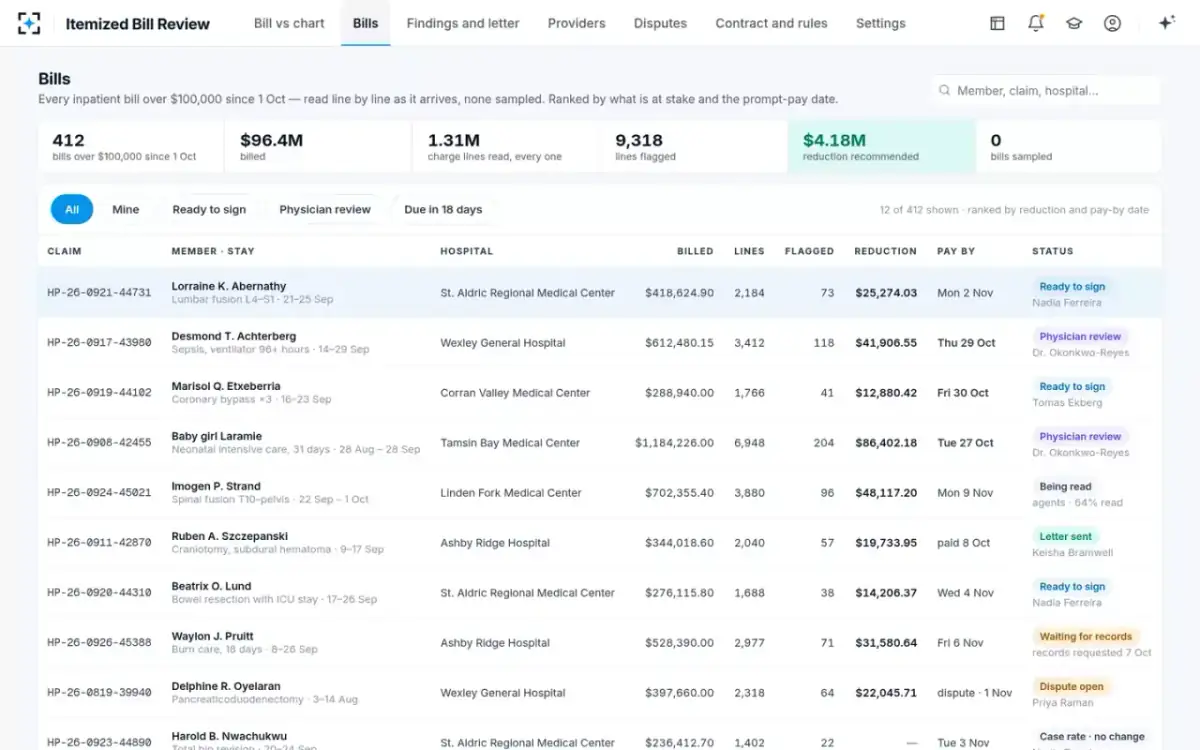
The sample queue in Itemized Bill Review shows the point in one row: a total hip revision billed at $236,412.70, with 22 lines flagged, carries the status "case rate, no change". The errors are real and the plan pays the same. That bill still teaches the director something about the hospital, but it is not where review hours earn their keep.
What is a stop loss threshold in a hospital contract?
A stop-loss threshold is the level of billed charges above which a hospital contract stops paying its usual fixed rate and pays a percentage of charges instead, to protect the hospital on extraordinarily expensive stays. In the sample contract, once billed charges exceed $250,000 the stay pays 68% of eligible billed charges; another sample hospital's contract sets $300,000 and 65%. The word "eligible" is where review does its work: the contract decides which charges count.
The threshold creates a cliff the review must recompute. If removing ineligible charges takes a stay below the threshold, the contract may fall back to its case rate, and the payment can change by far more than the lines removed. On the sample stay, eligible charges after the findings are $381,457.20, still above $250,000, so the stop-loss clause still applies and the payment is 68% of the lower figure. A review that only totals the findings and multiplies by 68% would be right here and badly wrong on a stay that crossed the line.
The same words mean something else in an employer plan. Stop-loss insurance reimburses a self-funded plan for large claims, and HIPAA lists "obtaining payment under a contract for reinsurance (including stop-loss insurance and excess of loss insurance)" among a plan's payment activities (45 CFR 164.501). That policy's insurer often asks for the same itemized review before it reimburses, which is another reason to do it once and keep the evidence.
Why charges are not cost: Medicare's own ratios
Charges are list prices, and for most departments they sit several times above cost. CMS publishes national average cost-to-charge ratios every year to set DRG weights. For fiscal year 2027, a dollar of drug charges carries about 18 cents of cost, a dollar of laboratory charges about 9 cents, and a dollar of operating room charges about 15 cents.
How much cost sits behind a dollar of hospital charges, by department (FY 2027)
This is why the contract percentage misleads. A stop-loss clause paying 68% of charges sounds like a discount; on drug lines carrying 18 cents of cost per dollar, it pays several times cost, and on a wrongly billed drug line it pays 68 cents for nothing. It is also why commercial prices sit well above Medicare's: across studies reviewed by KFF, "Private insurance payment rates for inpatient hospital services averaged 189% of Medicare rates across studies" (KFF, April 2020). The richer the contract, the more each ineligible line costs.
Medicare reviews its high-cost cases this way too
Medicare's outlier rules are a working model of high dollar claim review. Outlier cost is estimated from charges: the contractor bases the costs of the discharge "on the billed charges for covered inpatient services adjusted by the cost to charge ratios" and pays 80% of the cost above the threshold (42 CFR 412.84). So an ineligible charge on an outlier claim can raise Medicare's payment, which is why the rules provide for review.
The review is targeted, then tightened. The claims manual says "The A/B MAC (A) may review a sample of cost outlier cases after payment", and that "If the A/B MAC (A) finds a pattern of inappropriate utilization by a hospital, all cost outlier cases from that hospital may be subject to medical review, and this review may be conducted prior to payment until the A/B MAC (A) determines that appropriate corrective actions have been taken" (Medicare Claims Processing Manual, ch. 3, §20.1.2.9). Sample, find a pattern, move that hospital to prepayment review: a plan can run the same escalation, and with every line matched it can see the pattern sooner.
What one high dollar claim review costs
The cost of one review is the auditor's hours times the loaded hourly cost, plus the share of physician advisor time, record retrieval and any dispute handling it triggers. Our estimate for a careful manual review of a 2,000-line inpatient bill is four to six hours; with Itemized Bill Review reading the bill and matching it to the chart, our estimate of the auditor's time is about 0.7 hours, spent on the flagged lines and the letter. Neither is a measured customer result, and your own times belong in the formula below.
The value of one high dollar claim review
Realized payment effect
eligible charges removed × the contract percentage (or the change in per diem days and levels) × share not reversed on dispute
Recompute the stop-loss threshold: a stay that drops below it may pay its case rate instead. Identified is not realized.
Clinical bill auditor and dispute analyst
Review cost
auditor hours × loaded rate + physician advisor minutes + record retrieval
Use your own loaded rates; by hand, the chart search dominates.
Payment integrity manager
Dispute and relationship cost
disputes opened × hours to answer each, plus findings reversed
False findings cost more than missed ones.
Director of payment integrity
When a review pays: setting the threshold
A review pays when its expected payment effect exceeds its cost, and the threshold is the bill size at which that first happens for each contract type. Two forces move it. The first is the contract: on a percent-of-charges or stop-loss contract, the payment effect grows with the bill; on a case rate, it is near zero below the stop-loss point. The second is the review cost: at four to six hours by hand, only the largest bills clear the bar, so desks sample; at well under an hour, the bar falls and the plan can review every bill above a much lower figure.
The practical method is to back-test. Take last year's closed high-dollar claims, record the contract term each paid under, and plot the realized reduction per review against billed charges for each term. Where the line crosses your cost per review is your threshold for that term. Expect at least two thresholds, one for stop-loss and percent-of- charge contracts and one for case rates near their stop-loss point, and expect implant carve-outs to justify review at lower bill sizes; implant invoice reconciliation shows why.
Itemized Bill Review recalculates the payment under the stop-loss clause
Setting your threshold with Itemized Bill Review
In Itemized Bill Review the threshold is a setting, versioned and changed only with a second approver from payment integrity: inpatient bills at or over a figure, outpatient surgery at or over another, and whether to pend the claim until the review is signed. The queue then ranks bills by what is at stake under each contract and by the prompt-pay date, so the auditor works the largest payment effect that is closest to its deadline first, and no bill above the line is sampled.
Every bill over the threshold, ranked by what is at stake and when it must be paid
Whether to run that review in-house, buy it from a contingency-fee vendor or combine the two is the subject of payment integrity vendors, in-house auditors or agents. What the review reads on the bill itself is in what is itemized bill review.
Questions people ask
Who performs high dollar claim reviews?
Clinical bill auditors in a health plan's payment integrity department, review vendors working for the plan, or a stop-loss insurer's reviewers for a self-funded employer plan. Clinical judgments, such as level of care, go to a physician advisor. The plan answers the hospital's dispute whoever did the review.
What is reviewed in a high dollar claim?
The itemized bill line by line, against the medical record for the stay and the contract amendment in force on the date of service. The usual findings are charges after discharge, drugs with no administration, duplicates, supplies already in the room or operating room rate, implants above the log and room days above the level of care.
What is the high dollar claim review process?
The claim crosses the threshold, the plan requests the itemized bill and record, and the claim is pended or paid subject to review. The reviewer ties the bill to the claim, matches each charge, recalculates the payment under the contract, and sends a findings letter; the hospital may dispute within the contract's window, 60 days by default on the sample plan.
How much does a high dollar claim review save?
No public source measures it for commercial plans. On the fictional sample stay in Itemized Bill Review, signed findings of $37,167.70 in billed charges reduce the payment by $25,274.03 under a 68% stop-loss clause. On a pure case-rate stay the same findings would save nothing.
Is a stop-loss provision the same as stop-loss insurance?
No. A stop-loss provision is a clause in a hospital contract that switches payment to a percentage of charges above a threshold. Stop-loss insurance is a policy that reimburses a self-funded employer plan for large claims. Both make the charges on a high dollar claim matter.