Pharmacy charges on a hospital bill are the lines for every drug the hospital dispensed during a stay, usually under revenue codes 0250 and 0636, and on a high-dollar inpatient bill they are often the longest section. A health plan's clinical bill auditor checks them against the medication administration record (MAR), where nurses record each dose given, with its time, dose and route. The check is simple to describe and slow by hand: hundreds of drug lines, each to be found on a MAR spread over several days. So reviewers sample, and drugs charged but never given are paid. Botminds' Itemized Bill Review matches every pharmacy charge to the MAR by drug and by time, flags the ones with no administration inside the window, a different route or more units than were given, and leaves each finding for a clinical bill auditor to sign.
The example throughout is the last day of the solution's sample stay: a fictional patient who left the hospital at 11:42, and four drug charges posted that evening.
One day of pharmacy charges against the medication record, in Itemized Bill Review
- Doses recorded06:00–11:42
- No entries: she left at 11:4211:42–21:00
- Morning charges, matched2 matched
- Evening charges, no dose4 flagged
Why are pharmacy charges so high on a hospital bill?
Because hospital drug charges are list prices set well above cost, and every dose, flush and premixed bag is a separate line. Each line's price comes from the hospital's price list, not from what the drug cost. CMS's national average cost-to-charge ratio for drugs in fiscal year 2027 is 0.178 (FY 2027 IPPS final rule): on average, a dollar of drug charges reflects about 18 cents of the hospital's cost, a lower ratio than for room days or supplies.
On the sample bill, a single 1 mg injection of hydromorphone is charged at $286.00 and a 4 mg injection of ondansetron at $148.50. Under a contract paying 68% of eligible charges, each of those lines costs the plan 68% of its charge, whatever the drug cost, which is why a drug charged and not given is worth finding even when the line looks small.
What is revenue code 250 (and 636)?
Revenue code 0250 is the general pharmacy code: CMS's manuals list it as "Drugs and Biologicals" and note that "Revenue code 0250 does not require HCPCS coding" (Medicare Claims Processing Manual, ch. 4). Revenue code 0636 is for drugs that do carry a HCPCS code; the drug chapter describes it as "Drugs requiring detailed coding" (ch. 17), and the inpatient chapter notes that "Some other inpatient drugs continue to be billed without HCPCS codes under pharmacy" (ch. 3).
For a reviewer the difference matters because a 0636 line names the drug and its billing unit through the HCPCS code, which makes units testable against the dose given. A 0250 line may carry only a description. On the sample bill, hydromorphone sits under 0250 with a HCPCS code beside it, and ondansetron under 0636; both are matched to the MAR the same way, by drug name and time.
What is a medication administration record?
The MAR is the part of the medical record where each dose given to an inpatient is recorded: the drug, dose, route, time and the nurse who gave it, along with doses held, refused or missed and the reason. Hospitals must keep it. Medicare's conditions of participation require the record to contain "All practitioners' orders, nursing notes, reports of treatment, medication records, radiology, and laboratory reports" (42 CFR 482.24(c)(4)(vi)), and require that "Drugs and biologicals must be prepared and administered in accordance with Federal and State laws, the orders of the practitioner or practitioners responsible for the patient's care, and accepted standards of practice" (42 CFR 482.23(c)(1)).
The MAR is the right evidence for a pharmacy charge because it records the act the plan is paying for: a dose given to the patient. The pharmacy's dispensing record shows what left the pharmacy, and the order shows what was prescribed; neither shows that the patient received it.
Before each dose, hospital policy must confirm what is “often referred to as the ‘five rights’ of medication administration practice”: right patient, medication, dose, route and time.
CMS State Operations Manual, Appendix A, A-0405
How do auditors check pharmacy charges? Dose by dose, by time
They test each charge against the same rights the nurse confirmed at the bedside, using the MAR as the record of them. Right medication: is there an administration of this drug? Right time: is it close enough to the charge to be the same dose? Right dose: do the billed units match the dose given? Right route: does the bill charge the route the MAR records? The State Operations Manual defines the route test as "the method of administration – orally, intramuscular, intravenous, etc." (A-0405), and an intravenous charge for a dose the MAR records by mouth fails it.
The sample day shows two of these failing at once. Pantoprazole was given by mouth at 09:00; the bill charges an intravenous dose at 20:00, more than eight hours after the patient left. The table below lists the gaps reviewers find most often on drug lines, what the MAR shows for each, and how a reviewer should treat it.
Gaps between pharmacy charges and the MAR, and how a reviewer treats each
| Gap | What the MAR shows | Treatment |
|---|---|---|
| Charged, never given | No administration of the drug inside the window, or none at all | Not payable as a dose; check for a documented waste or a late entry first |
| Held or refused dose | The dose recorded as held, refused or omitted, with a reason | Not payable: ordered is not given |
| Charged after discharge | No entries after the time the patient left | Not payable for the stay |
| Route differs | Given by mouth where the bill charges intravenous, or the reverse | Pay the route given, if the contract prices them differently |
| Units above the dose | Dose given smaller than the billed units represent | Pay the units given, plus documented waste where the rules allow it |
| Same dose charged twice | One administration; two charge lines minutes apart | Pay one line |
How wide should the matching window be?
Wide enough that a correctly given dose charted a little late still matches, narrow enough that one dose cannot cover another hours later. A useful anchor is the window hospitals already work to. CMS's interpretive guidance says time-critical medications "must be administered within thirty minutes before or after their scheduled dosing time, for a total window of 1 hour" (State Operations Manual, Appendix A, A-0405), and gives wider windows for medicines given less often.
How far from its scheduled time a dose may be given, by CMS's hospital guidance
The sample plan's setting is 30 minutes for a drug charge, with 15 and 60 minutes as alternatives. On the first day of the sample stay, cefazolin is charged at 07:31 and given before incision at 07:52, 21 minutes apart, so the charge is supported and never reaches the auditor. A charge with no dose inside the window is flagged with the window drawn on screen, so the auditor can see in one glance whether a dose sits just outside it. How the time match fits with the other checks on a bill is in hospital bill review with agents.
The page behind the pharmacy findings in Itemized Bill Review
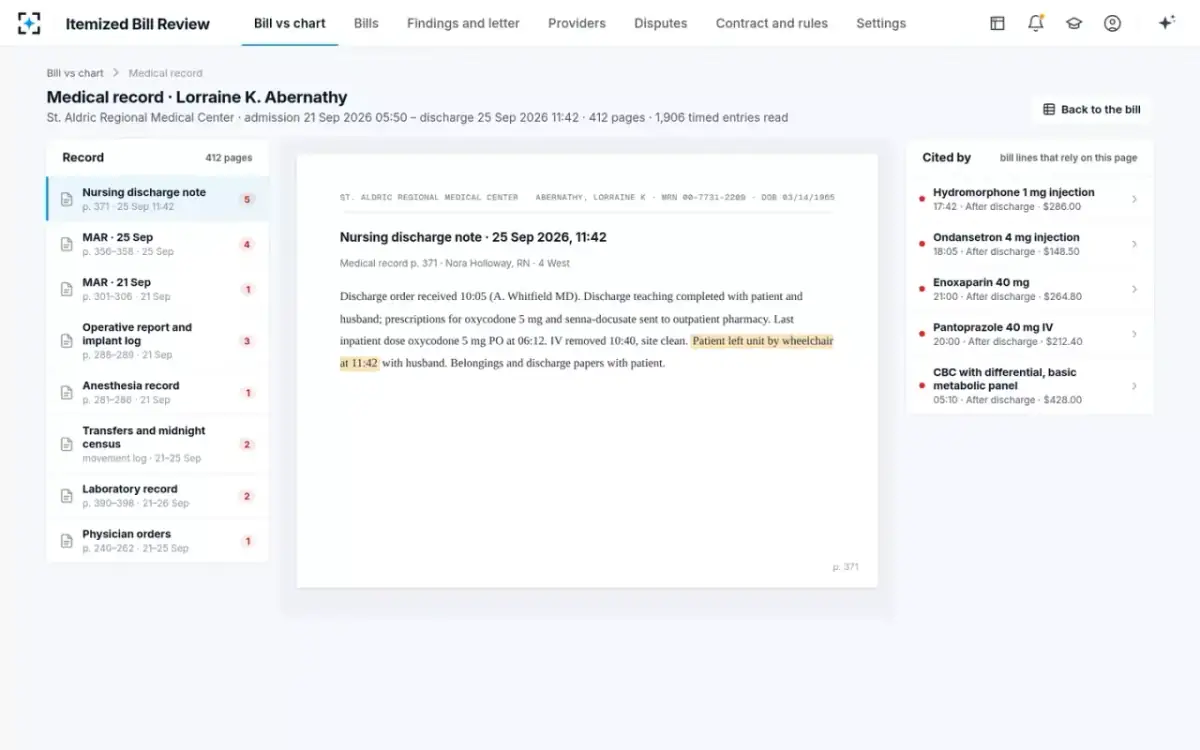
Can a hospital charge for medication not given?
Not as a dose given to the patient. A drug that was ordered and dispensed but never administered, or a dose recorded as held or refused, was not a service furnished to the patient, and Medicare's own review of high-cost cases checks that services were actually furnished. The one exception that is real and billable in Medicare is documented waste from a single-dose container, covered below.
Disputes on this point usually turn on a sentence the hospital writes and a page the reviewer cites. In a sample dispute in the solution, a hospital contested an albumin reduction with "All four doses were ordered."; the MAR recorded two doses given and two held for low blood pressure, and the recommendation was to uphold the reduction: ordered is not given. The same dispute shows the reviewer's duty in the other direction, covered in the level of care audit: when the hospital's new page proves the charge, the finding is reversed.
Are wasted drugs billable?
In Medicare Part B, yes, within limits and with documentation. When a provider "must discard the remainder of a single-dose container or single-use package after administering a dose to a Medicare patient, the program provides payment for the amount of drug or biological discarded as well as the dose administered, up to the amount of the drug or biological as indicated on the vial or package label" (Medicare Claims Processing Manual, ch. 17, §40). The discarded amount is billed on its own line with the JW modifier, "Providers must record the discarded amounts of drugs and biologicals in the patient’s medical record", and since July 2023 the JZ modifier attests that nothing was discarded.
The rules also stop waste being billed twice. The manual's example: where one billing unit is 10 mg and a 7 mg dose is given, the single unit already pays for the 3 mg discarded, so a separate waste line "is not permitted because it would result in overpayment". Commercial contracts may or may not follow Medicare's waste rules; where they are silent, the record of the waste is still the evidence, and a waste line with no record behind it is a finding.
Units: the error edits were built for
Units are where drug lines go most wrong in Medicare's own audits, and where code edits help most. A billed unit is the HCPCS code's unit, not the dose: a code defined per 10 mg billed with units equal to the milligrams given overstates the line tenfold. Medicare's medically unlikely edits catch the grossest of these on outpatient claims, but not every code has one; how much an edit catches, and how to test a product on the rest, is in medical bill review software, tested.
On an itemized inpatient bill, units are tested the same way as time: against the dose on the MAR, converted to the code's billing unit. The sample plan's rules flag units above the documented dose and route differences as separate kinds, so a director can see which hospitals' pharmacies post wrong units and which post charges with no dose at all. On the sample plan, one hospital had charges dated after discharge on 31 stays; 26 of those 31 are pharmacy lines posted four to twelve hours after the patient left.
One pharmacy finding in depth: charge, record and clause on one page
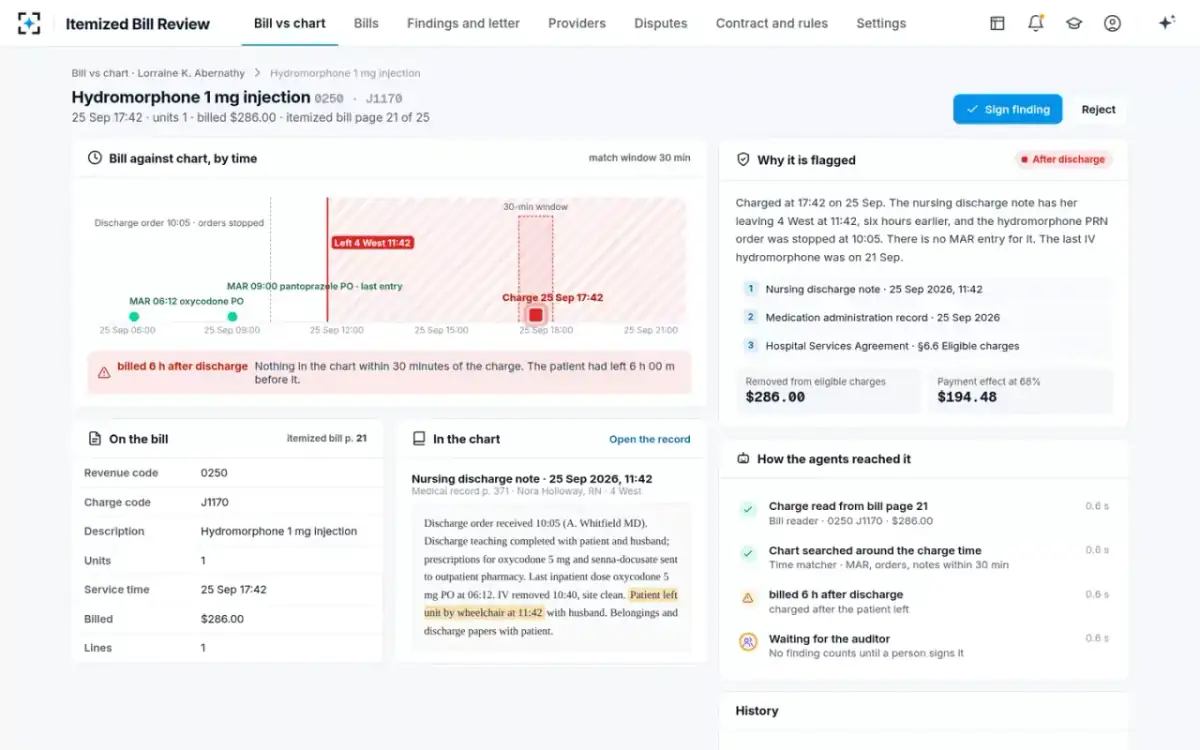
Questions people ask
How are hospital pharmacy charges priced?
From the hospital's price list, which sets a gross charge for each drug and dose regardless of the payer. The plan pays according to its contract: a fixed rate that ignores the drug lines, or a percentage of charges under which every line counts. CMS's FY 2027 national ratio puts drug cost at about 18 cents per dollar of drug charges.
How do I check the pharmacy charges on my own hospital bill?
Ask the hospital for the itemized bill and, if you need it, your medical record, including the medication administration record. Medicare patients have a right to an itemized statement within 30 days of asking. Compare the drug lines with the doses recorded, and ask the hospital about any line with no dose.
Can a hospital charge for medication I brought from home?
A drug the hospital did not supply should not appear as a hospital pharmacy charge. Where a hospital lets patients use their own medication, the orders and the MAR are the evidence to compare against the bill.
Why is IV medication charged more than the same drug by mouth?
Intravenous and oral forms are different products on a hospital's price list, each with its own charge. That is why a route difference between the bill and the MAR is a finding: the bill should charge the route given.
What does the JZ modifier mean?
On Medicare Part B drug claims since 1 July 2023, the JZ modifier attests that no amount of a drug from a single-dose container was discarded. The JW modifier, on a separate line, bills a discarded amount, which must be recorded in the medical record.