Hospital bill review is the check a health plan runs on a high-dollar hospital claim: the itemized bill is read line by line, and each charge is tested against the medical record for the stay and the plan's contract with the hospital, so that charges which were not given, were billed twice or are already inside a bundled rate are not paid. It is slow by hand because the three documents never line up on their own. When software or agents take over the reading, the design question changes from speed to independence: if the same reader extracts a charge and then confirms that the charge is wrong, one misread becomes a finding against the hospital. Botminds' Itemized Bill Review is built so that the agent that reads the bill never confirms a finding, each conclusion is reached by a different reader against a different document, and a clinical bill auditor signs.
The comparison below shows the difference on one stay. The bill, record and contract terms are fictional, sample data in the solution.
Hospital bill review: one reader against a split of duties
One reader does everything: The same person or model that will judge the charges reads them, often from a scanned PDF.
Reader, matcher, checker and a person: The bill reader extracts lines and must total the claim to the cent before anything else runs; it stops if it cannot.
One reader does everything: Becomes the basis of a finding: the reviewer checks the chart against their own misreading.
Reader, matcher, checker and a person: Fails the match: the time matcher searches the chart around the charge time and finds the entry, so no finding is raised.
One reader does everything: Applied from memory or from the current contract.
Reader, matcher, checker and a person: Applied by a separate checker from the amendment in force on the date of service, cited on every flag.
One reader does everything: Folded into the same review as the arithmetic.
Reader, matcher, checker and a person: Routed to the physician advisor with the transfer note and orders attached.
One reader does everything: A total and a list of codes.
Reader, matcher, checker and a person: Signed findings only, each with the chart page and the clause.
How does hospital bill review work?
It works in eight steps, from the threshold that selects the bill to the hospital's reply. The plan sets a dollar threshold, asks the hospital for the itemized bill and the record when a claim crosses it, and either holds the claim until the review is signed (prepayment) or pays and recovers afterwards (post-payment). The reviewer ties the bill to the claim, matches each charge to the chart, applies the contract, recalculates the payment, writes the findings letter and answers any dispute inside the contract's window.
Prepayment review is cleaner, because nothing has to be clawed back, but it runs against the contract's prompt-pay clock. On the sample plan's settings in Itemized Bill Review, inpatient bills of $100,000 or more and outpatient surgery of $40,000 or more are reviewed in full, the claim is pended until the review is signed, and the queue warns seven days before the state deadline. A review that cannot finish in time is a business problem, not a reason to sample.
The step that decides whether any of this changes the payment is the contract. Under a case rate or a diagnosis related group (DRG) payment, removing lines changes nothing unless the charges cross a stop-loss or outlier threshold or a carve-out pays an item separately. On the sample queue, a total hip revision at one hospital shows 22 flagged lines and the status "case rate, no change": the review was done, and the payment stays the same. High dollar claim review works through which contract terms make a review pay.
Why the agent that reads the bill must not confirm the finding
Because errors in reading are correlated with errors in judging. If one model reads 17:42 where the bill says 07:42, the same model will search the chart around 17:42, find nothing, and confirm that the charge has no support. A second reader, working from the chart rather than from the first reader's notes, finds the 07:52 dose and closes the line. Independence is what turns a misread into a non-event instead of a finding.
The bill reader has its own check that does not depend on anyone else: its lines must add up to the claim. A UB-04 claim summarises charges by revenue code; the itemized bill lists every charge. If the lines do not total the claim, something was missed or read twice, and the reader stops and reports instead of passing a partial bill downstream. On the sample stay, 2,184 lines from 25 bill pages total $418,624.90, the same as the claim.
Medicare holds hospitals to the same discipline when it reviews high-cost cases. Its claims manual says that when a hospital sends records for an outlier review, "the hospital must indicate the precise revenue code for each charge billed", and that "If the correct revenue codes are not provided, the A/B MAC (A) will deny the bill" (Medicare Claims Processing Manual, ch. 3, §20.1.2.9). A review that cannot tie each charge to its line and code cannot be checked by anyone else.
Itemized Bill Review sweeps the bill: lines matched and struck as the reduction counts up
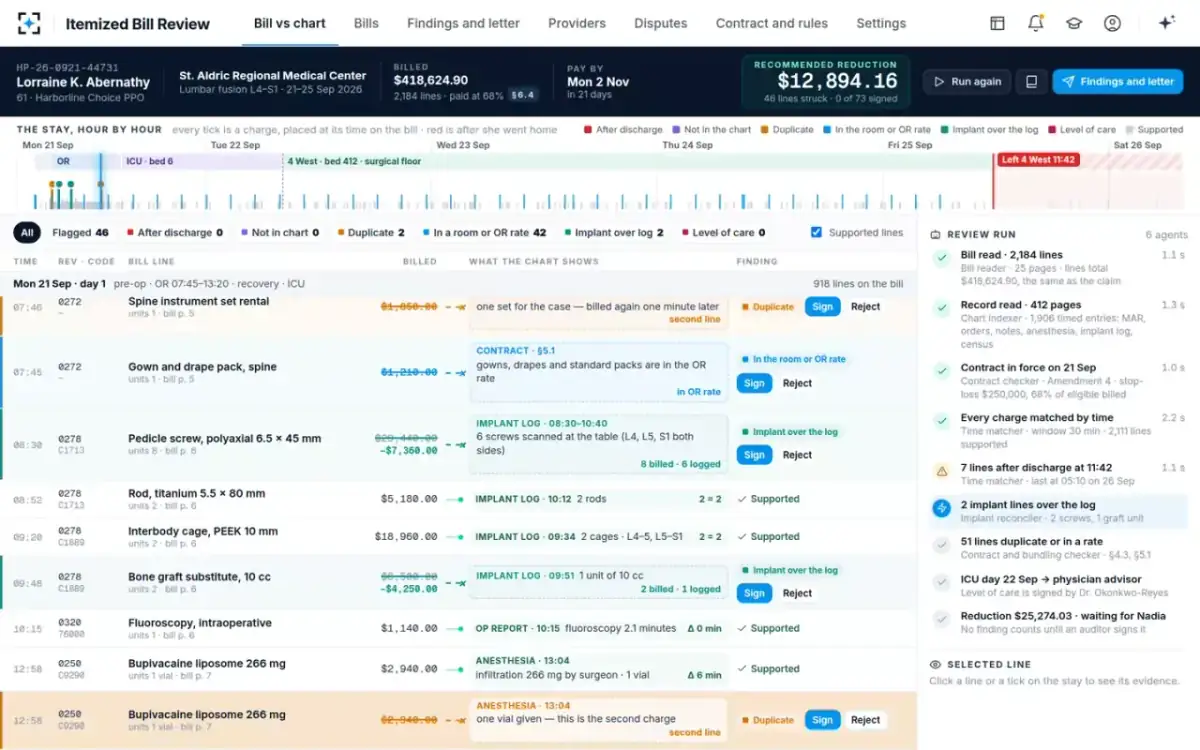
What records are needed for a hospital bill review?
Four sets of documents: the itemized bill and the claim, the medical record for the stay, the contract with its amendments, and the billing rules the plan applies. Missing any one of them changes what the review can conclude. Without the record, the review can only find duplicates and contract issues; without the amendment in force, it can apply the wrong room rate to every day of the stay.
What a hospital bill review reads, and what each document settles
| Document | What it settles | What goes wrong without it |
|---|---|---|
| Itemized bill, tied to the UB-04 claim | Every charge with revenue code, charge code, units, date and time | Lines are missed or double counted; nothing ties to the claim total |
| Medication administration record and orders | Whether each drug was ordered and given, when, by which route and in what dose | Drug lines can only be sampled, and doses dispensed but not given are paid |
| Anesthesia record, operative report and implant log | Room times, drugs in theatre, which devices went in and how many | Operating room minutes and implant counts are taken from the bill on trust |
| Transfer orders, unit movements and nursing notes | Where the patient was each midnight and at discharge | Intensive care days and the day of discharge are paid as billed |
| Laboratory record | Which specimens were collected and when | Repeat panels without a specimen are paid |
| Contract and amendments by effective date | What is separately payable, room rates by level, stop-loss terms | The current terms are applied to a stay under older ones |
| Billing rules | The plan’s written rules for duplicates, routine supplies and the day of discharge | Each reviewer applies their own version |
Matching by time, because the chart is timed
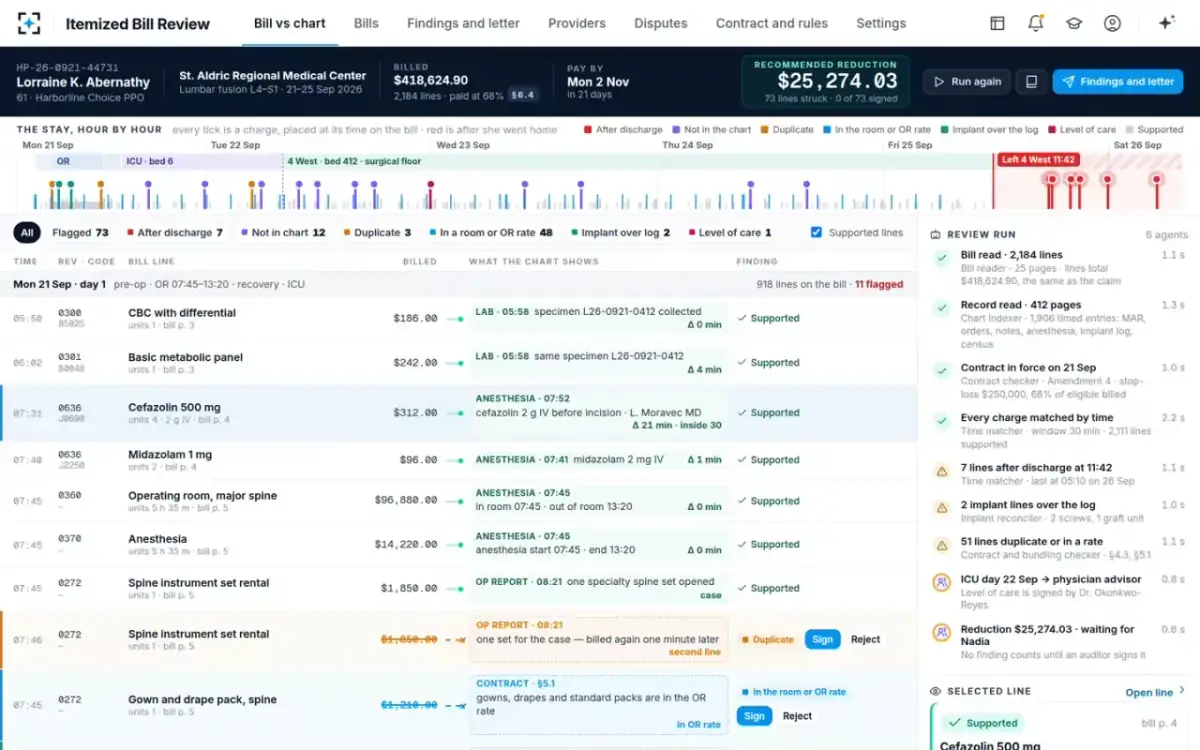
The record can be matched by time because hospitals must time it. Medicare's conditions of participation require that "All orders, including verbal orders, must be dated, timed, and authenticated promptly by the ordering practitioner" (42 CFR 482.24(c)(2)), and medication records, nursing notes and the anesthesia record carry times as a matter of practice. A charge carries a time too. Putting the two side by side turns "is this drug in the chart somewhere?" into a sharper question: is there an administration of this drug close enough to this charge to be the same event?
How close is a setting, not a guess. The sample plan uses 30 minutes for drugs, the day for supplies and the unit at midnight for rooms. A tight window raises false flags on legitimate late charting; a loose one lets a dose given at 09:00 cover a charge at 17:42. The argument for 30 minutes, which mirrors Medicare's own window for time-critical medications, is in pharmacy charges on a hospital bill.
Matched by time: supported lines go quiet
Hospital bill review vs claims editing
Claims editing checks codes against codes; hospital bill review checks charges against the chart. An edit can tell that two procedure codes should not be billed together, or that a unit count is implausible for one day. It cannot tell whether the drug was given, whether the patient was still in the building, or whether the contract folds the supply into the room rate.
The best-known edits make the boundary clear. Medicare's National Correct Coding Initiative says of itself: "CMS developed the NCCI program to promote national correct coding of Medicare Part B claims" (CMS, NCCI edits). Its edits run on physician and outpatient claims. An inpatient stay paid by DRG is not priced line by line, so the long itemized bill behind it reaches a payer's edit engine only as a claim summarised by revenue code. Edits and bill review are layers: the edits run first, on every claim, and the bill review reads what edits cannot see. How to test a product on that boundary is in medical bill review software, tested.
Can AI review hospital bills? What each agent may conclude
Yes, if each agent's conclusion is narrow enough to be checked and none of them decides. The useful design question is not whether an agent can read a bill, but what it is allowed to conclude from what it read. In Itemized Bill Review each agent has one job, one kind of conclusion and a list of things it may never do.
What each agent in Itemized Bill Review may conclude, and what it may not
| Agent | May conclude | May never |
|---|---|---|
| Bill reader | These are the lines on the bill, and they total the claim | Change an amount or a unit, or pass on a bill that does not total |
| Chart indexer | These timed events are written in the record for this stay | Infer an event that is not written, or read beyond the stay under review |
| Time matcher | This charge has, or lacks, a chart entry for the same item inside its window | Flag a charge with a matching entry inside the window, or judge medical necessity |
| Contract and bundling checker | Under the amendment in force on this date, this item is or is not separately payable | Apply a contract version not in force on the date of service |
| Implant reconciler | The billed count matches, or exceeds, the implant log | Accept units above the log without an invoice and a wastage note |
| Findings letter writer | This is the payment recalculated from the signed findings | Use an unsigned finding, or send anything |
Where a person must decide
A person decides every finding, and a different person decides every clinical one. The clinical bill auditor signs or rejects each flagged line by name, one line or a whole kind at once; a rejected line is paid as billed and the reduction falls. Level of care, medical necessity and, on the sample settings, any reduction above $50,000 go to the physician advisor. Settings changes need a second approver from payment integrity, so no one can quietly widen a window.
The agents can be wrong in either direction. The design makes their mistakes visible: a missed finding shows up in the sample the auditor re-reads, and a false one dies when the auditor rejects it.
Rejections are also the measurement. On the sample plan's September test of its eight billing rules, 8,871 of 9,102 hits were signed and 231 rejected, a signed rate of 97.5%; the rule that compares the room rate with the unit the patient occupied at midnight was lowest, at 91.2%, because its edge cases go to the physician advisor. A rule whose signed rate falls is a rule to rewrite, and the auditor's rejections are what show it.
How long does a hospital bill review take?
By hand, a careful review of a 2,000-line bill takes four to six hours on our estimate, and most of that is finding the chart entry for each charge. With the reading and matching done by agents, the auditor's time goes on the flagged lines and the letter. The split below is our estimate for one high-dollar inpatient bill, not a measured result.
Where the hours go on one 2,000-line hospital bill review
By hand: about 5 hours
- Reading the bill and tying it to the claim · 15%
- Finding the chart entry for each charge · 40%
- Contract, room rate and bundling · 15%
- Implants against the log · 10%
- Findings letter · 20%
With Itemized Bill Review: about 0.7 hours
- Checking the bill read · 7%
- Reading flagged lines and their evidence · 29%
- Contract flags · 14%
- Implant flags · 7%
- Signing and the letter · 43%
The calendar time is set by the hospital, not the reviewer: the record request is usually the longest wait. That is why the sample settings request the record automatically as soon as an itemized bill over the threshold arrives. How a bill is laid out, column by column, is in what is itemized bill review.
Questions people ask
Is hospital bill review done before or after payment?
Either. Prepayment review holds the claim until the findings are signed, which avoids recoveries but runs against the contract's prompt-pay clock. Post-payment review pays first and recovers later, which is easier on the clock and harder on the hospital relationship.
Does hospital bill review change DRG payments?
Usually not by itself. A DRG or case rate pays a fixed amount for the stay, so removing charge lines matters only when charges trigger a stop-loss or outlier payment or when an item, such as an implant, is paid separately. Medicare itself recovers outlier payments for charges its reviewers find noncovered.
Can a hospital refuse to send the medical record?
The plan's right to records for review normally comes from the provider contract, and HIPAA lets a hospital disclose them for the plan's payment activities. A hospital that will not send the record leaves the review to the bill and the contract alone, and most contracts give the plan a remedy for that.
How many lines does an itemized hospital bill have?
It depends on the stay. The sample five-day lumbar fusion in Itemized Bill Review has 2,184 lines on 25 pages, and long intensive care stays run to several thousand. The UB-04 claim for the same stay summarises those lines by revenue code.
What happens when a hospital bill review finds nothing?
The claim is paid as billed and the review is filed with its evidence. A review that clears a bill is still useful: it is the base rate that tells the director whether a hospital's bills need full review or a lighter threshold.