Medical bill review software for health plans checks the charges on a hospital bill before or after the plan pays it, and the products sold under that name do three very different jobs: code edits that test a claim against coding rules, repricing tools that apply a fee schedule, and chart-matching review that tests each charge on the itemized bill against the medical record and the contract. A buyer cannot rank them on published accuracy, because no government or academic source measures error rates in commercial high-dollar hospital bills and vendors' own figures cannot be checked. The test that works is one you run yourself: plant known errors in bills you have already reviewed, and count. Botminds' Itemized Bill Review is a chart-matching product, with agents that match every line to the chart and a clinical bill auditor who signs each finding; this guide shows how to test it, and its competitors, on the same terms.
A note on words: "medical bill review" also names the workers' compensation and auto-injury trade, where bills are priced against state fee schedules. That is a different job. This guide is about health plans and itemized hospital bills. Screens show the solution on a fictional sample plan.
Edits stop some errors; the rest need the record: OIG's drug overpayment audit
What is medical bill review software? Three kinds under one name
It is any software that decides, line by line, how much of a provider's bill a payer should pay, and the three kinds differ in what they compare the bill with. The comparison decides the catch: an engine that never sees the medical record cannot find a charge the record contradicts, however good its demonstration.
Code editing engines compare a claim with coding rules: procedure pairs that should not be billed together, units beyond what is plausible for one day, modifiers, and payment policies. They run on every claim and are fast. They never open the medical record. Repricing tools compare a bill with a price list, such as a fee schedule or a contract rate table, and are the core of workers' compensation bill review. They answer "what should this cost?" but not "did this happen?". Chart-matching review compares each charge on the itemized bill with the record of the stay and the contract: whether the drug was given, whether the patient was still admitted, whether the supply is inside the room rate. By hand this is nurse review; with agents, it is what Itemized Bill Review does on every line of every bill over the plan's threshold.
Most plans need the first kind regardless and add the third for high-dollar facility claims. The test below is designed for the third kind, but it also shows a buyer exactly where an edit-only product stops.
How accurate is medical bill review software? Why no published figure settles it
Nobody outside the vendor can say, because the denominator is private. Accuracy on hospital bills means two numbers: the share of real errors a product finds, and the share of its flags that are real. Both need an answer key built from records the public never sees. The figures in vendor marketing describe the vendor's own client bills, under its own definitions, with no way to check either.
The one large, public measurement of payment error is Medicare's. CMS estimates the fee-for-service improper payment rate every year: "The fiscal year (FY) 2025 Medicare FFS estimated improper payment rate is 6.55 percent, representing $28.83 billion in improper payments" (CMS, CERT program). It is a sound measurement of Medicare fee-for-service claims, and it is not an error rate for itemized commercial hospital bills. Anyone quoting it as one, or quoting a vendor's percentage as an industry fact, is selling. Your own bills are the only test set that answers your question.
What errors does bill review software find? Eight kinds, and the evidence each needs
Each kind of error needs a specific piece of evidence, and a product that never reads that evidence cannot find the error, however good its rules. The table lists the eight kinds most itemized bill reviews look for, what proves each, and whether a code edit alone could see it.
Eight kinds of hospital bill error, the evidence that proves each, and what an edit can see
| Kind of error | Evidence that proves it | Can a code edit alone see it? |
|---|---|---|
| Duplicate line | Same item, same minute or same specimen accession on the bill; one event in the chart | Partly: identical lines, yes; a second line one minute later under another code, rarely |
| Units above what was given | Dose or count in the medication record, implant log or anesthesia record | Only beyond a plausibility limit, and not every code has one |
| Charge after the patient left | The time the patient left the unit, from the discharge note or movement log | Only if the bill carries times and the claim carries the discharge hour |
| Drug with no administration | No entry for the drug inside the matching window on the medication record | No |
| Route or form differs | Medication record shows oral where the bill charges intravenous, or the reverse | No |
| Routine supply inside a bundled rate | The contract’s room-and-board or operating room clause and the plan’s supply rule | Only if the contract’s bundling is coded into the edit library |
| Implant over the log | Operative report implant log scanned at the table; invoice where needed | No |
| Room level above the care given | Transfer orders, unit at midnight, nursing notes; a physician advisor’s judgment | No |
Edits catch some errors, the chart catches the rest
Edits are necessary and incomplete, and the federal record shows both halves. Medicare's medically unlikely edits are defined this way: "An MUE is the maximum units of service (UOS) reported for a HCPCS/CPT code on the vast majority of appropriately reported claims by the same provider/supplier for the same beneficiary on the same date of service." The same page adds that "Not all HCPCS/CPT codes have an MUE", and that some values are kept confidential (CMS, Medically Unlikely Edits). An edit like this catches a gross unit error and passes a plausible one.
When OIG audited Medicare payments for selected outpatient drugs, it found $35.8 million in overpayments across 13 contractor jurisdictions, and "For the majority of the overpayments (88 percent), providers billed either incorrect units of service or a combination of incorrect units of service and incorrect HCPCS codes". It then modelled the edits CMS had added since: had they been in place, "$23.7 million, or 66 percent, of the $35.8 million in total overpayments could have been prevented" (HHS-OIG, A-09-14-02024). That is the shape of the problem in one audit: two thirds stoppable by rules, one third that even the improved rules would have paid. These were Medicare outpatient drug lines that OIG selected because their units looked higher than a provider would reasonably give in a day; the split will differ on your bills, which is the point of testing.
How do you test bill review software? Seed, then count
Take bills you have already reviewed, plant errors you know about, add traps that look like errors but are not, and run every product on the same set. The planted errors measure what each product finds; the traps measure what it wrongly flags; your existing findings measure whether it finds what your auditors found. The protocol below fits in a two-week evaluation.
A seeded-error test for medical bill review software, step by step
- Choose 25 to 40 closed bills with records
High-dollar inpatient stays your auditors reviewed in full, across at least four hospitals and both surgical and medical stays. You need their findings as the base key.
- Plant 40 to 60 known errors across the eight kinds
Copy a line one minute later; move a drug charge past the discharge time; raise an implant count above the log; add a room day for the day of discharge; change a route. Record each in a key only the evaluator sees.
- Plant 15 to 20 traps
Legitimate lines that look wrong: a dose charted 25 minutes late, a documented waste line, a second implant opened and logged as wasted, a patient boarded in intensive care with the overflow documented.
- Give every product the same inputs
The bill, the record for the stay, the contract and amendment in force, and your written billing rules. A product that needs more must say what and why.
- Count catches by kind, not in total
A product that finds every duplicate and no drug without administration has a high total on the wrong bills.
- Count false flags on the traps
Each false flag is auditor time spent rejecting it, and a dispute if nobody does.
- Check every citation
Open the page and clause each finding cites. A right answer with the wrong page will lose the dispute.
- Recompute the payment
Apply the contract to the signed findings yourself and compare with the product’s figure, especially on stop-loss stays.
- Time the auditor, not the software
What matters is how long your auditor needs to sign or reject everything the product raised.
Planting errors in copies of closed bills keeps the test off live claims and gives you a key no vendor has seen. Use the same set for every product, and keep it: next year it measures whether a product has improved or drifted. How the work inside a chart-matching product should be divided, so that a misread does not become a finding, is in hospital bill review with agents.
What is a false positive in bill review?
A false positive is a flag on a charge that should be paid: the drug was given, the dose was charted late but inside the window, the supply is separately payable under this hospital's contract. False positives cost twice. Your auditor spends time rejecting each one, and any that slip through become disputes the plan loses, with the hospital's trust in every later finding a little lower.
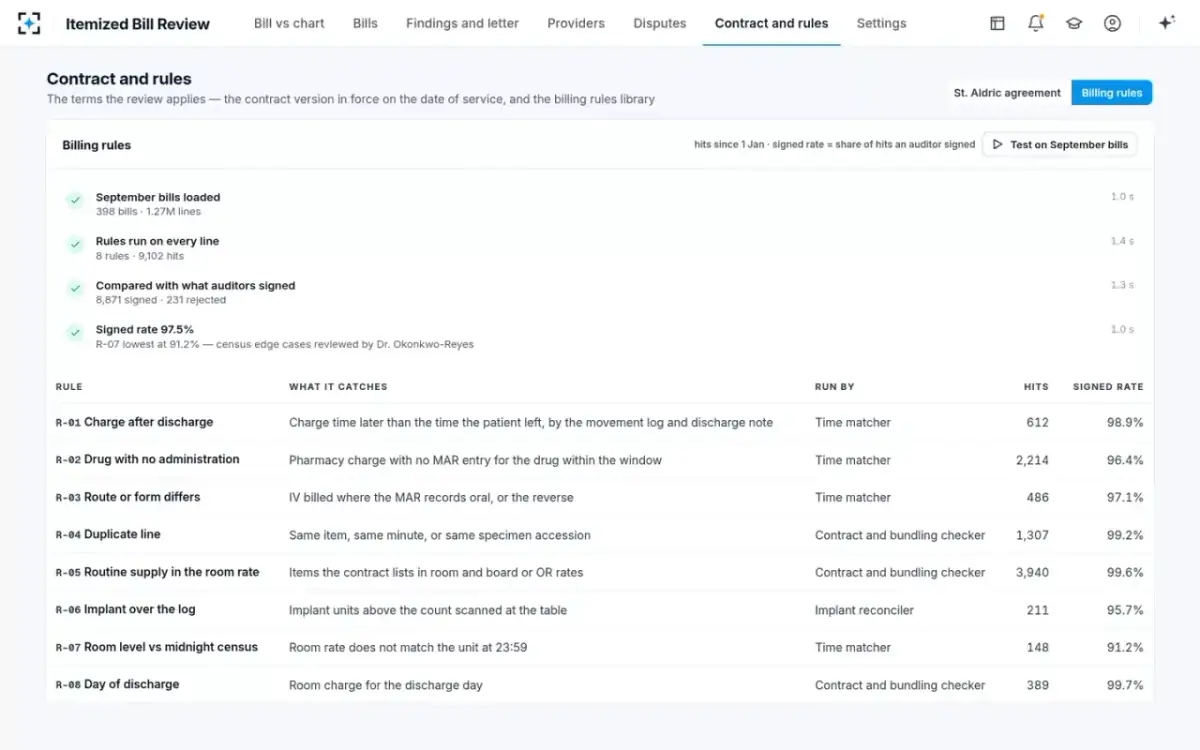
In production, the auditor's rejections measure false positives continuously. On the sample plan in Itemized Bill Review, the eight billing rules were re-run on September's bills (398 bills, 1.27 million lines) and compared with what auditors had signed: 9,102 hits, 8,871 signed, 231 rejected, a signed rate of 97.5%. The rule comparing the room rate with the patient's unit at midnight was lowest, at 91.2%. Those are sample-data figures, shown to explain the measure; ask any vendor for the same table on your test set.
Billing rules in Itemized Bill Review, tested against what auditors signed
Scoring a vendor: catches, false flags and citations
Score each product on four terms and keep them separate; a single accuracy number hides the trade-off between finding more and flagging wrongly. The formula below is the scorecard we suggest for the seeded test, with the weights left to you.
A scorecard for a seeded medical bill review software test
Catch rate, by kind
planted errors found ÷ planted errors, for each of the eight kinds
Report the lowest kind as well as the average.
Evaluator, from the key
Citation accuracy
findings citing the right page and clause ÷ findings
A finding with a wrong citation counts as half a catch at most.
Clinical bill auditor
False flags
traps flagged ÷ traps, plus unplanted flags rejected on review
Every false flag costs auditor time and a possible dispute.
Clinical bill auditor
Auditor minutes per bill
time to sign or reject everything raised, plus the letter
Measured on your staff, not the vendor’s.
Payment integrity manager
Where Itemized Bill Review fits, and where it does not
Itemized Bill Review fits high-dollar facility bills where the plan can obtain the record for the stay and the contract pays, at least in part, from charges: stop-loss provisions, percent-of-charge terms, implant carve-outs and outpatient surgery paid from charges. There it reads every line, matches it to the chart by item and time, applies the amendment in force on the date of service, and leaves a clinical bill auditor to sign each finding. It never changes a payment, contacts a hospital or decides medical necessity.
It is the wrong tool for four jobs. It does not validate diagnosis coding or DRG assignment, which needs a coder's review of the whole record. It does not reprice workers' compensation or auto bills against state fee schedules. It does not replace the code edits that run on every professional claim. And on a stay paid by a pure case rate with no stop-loss or carve-out, it can find errors that do not change the payment; that is worth knowing about a hospital, but it is not savings. High dollar claim review works through which contract terms make a review pay.
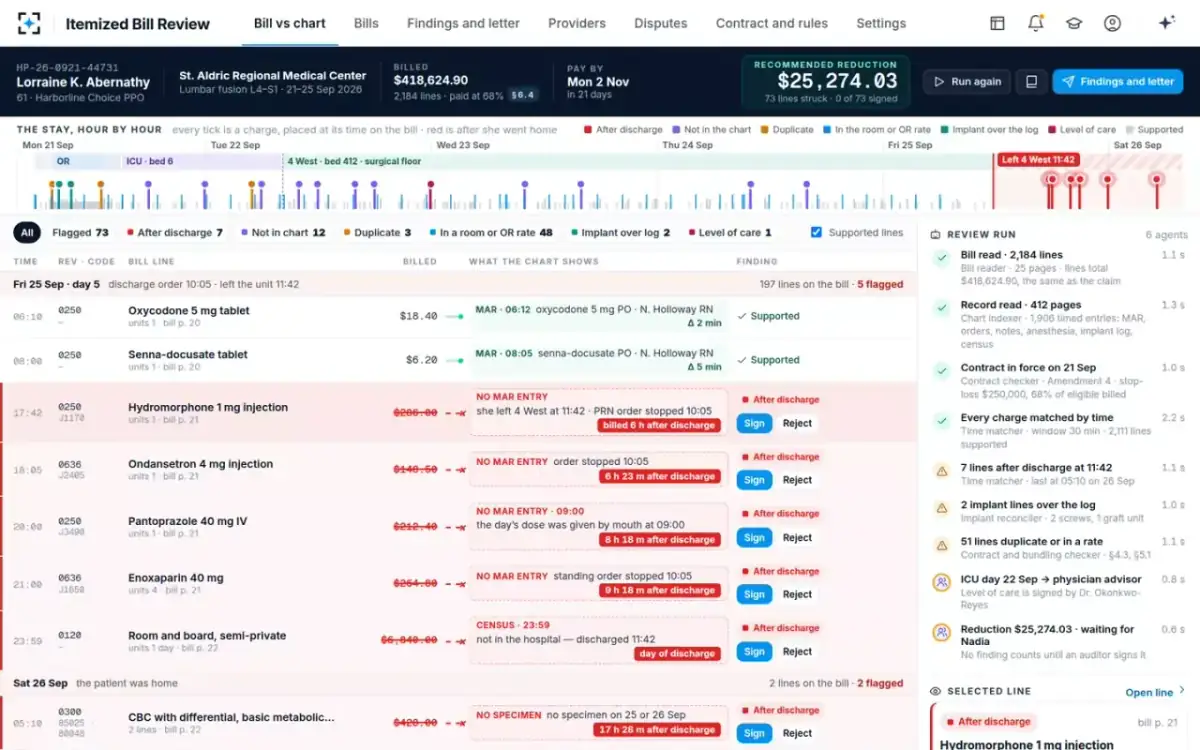
What the auditor sees: every charge beside the chart entry that supports it, or the gap
How much does medical bill review software cost?
List prices are rarely published, so compare against the work and the fee the product replaces. Plans buy itemized bill review in two ways: as a service paid a share of the savings, or as software their own auditors use. The first costs nothing up front and a percentage of every dollar recovered for as long as the contract runs; the second costs a fee and the auditors' time, and the plan keeps the savings and the findings. How those models compare, and how to switch between them, is in payment integrity vendors.
Four things drive the price of any chart-matching product: the number of bills over your threshold, how the records arrive (portal, fax or electronic record access), the connections to your claims system for pending and releasing claims, and the number of contracts and amendments to load. Budget for the evaluation itself, too: the seeded test takes an auditor about two weeks, and it is the cheapest insurance against buying the wrong kind of product.
Questions people ask
Can bill review software review every line?
Edit engines already test every line of every claim, but only against coding rules. Chart-matching review on every line was impractical by hand, which is why nurse review samples pharmacy and implants. With agents doing the matching, every line of every bill over the threshold can be checked, and the auditor reads only the flagged ones.
How do you compare bill review vendors?
Run each on the same seeded set of your own closed bills and compare catch rate by kind, false flags, citation accuracy and auditor time. Ask each to show its finding for one planted error on screen, with the page it cites opened.
Does medical bill review software work for workers' compensation bills?
Workers' compensation bill review is mostly repricing against state fee schedules, which is a different product. A chart-matching tool can still check a hospital bill against its record, but it does not apply a state fee schedule.
Is AI allowed to deny a hospital charge?
The safer design never lets it. In Itemized Bill Review, agents propose findings and a named auditor signs or rejects each one, and clinical calls go to a physician advisor. Medicare Advantage requires a physician or other appropriate professional to review any adverse medical necessity decision before it is issued.
What is a good false positive rate for bill review?
There is no published benchmark. Measure it as the share of flags your auditors reject, by rule. A rule whose rejections rise is drifting, and a product that cannot show you rejections by rule cannot show you its false positives.