A level of care audit, on a hospital bill, checks that every room-and-board day was charged at the level of care the patient actually received, by comparing the room charges day by day with the transfer orders, the unit the patient occupied at each midnight, and the nursing and physician notes. (The same phrase is used in long-term care for assessing a resident's needs; this guide is about hospital bills.) It matters because room charges are among the largest lines on a high-dollar bill and the gap between an intensive care day and a floor day is thousands of dollars. It is hard because the facts sit in several documents and the final call is clinical. Botminds' Itemized Bill Review does the assembling: its agents line up the room charges with the unit at each midnight and the transfer notes, and send any level of care finding to a physician advisor to sign.
The sample stay in the solution shows the shape of it. A fictional patient has a lumbar fusion on 21 September, goes from the operating room to intensive care bed 6, moves to the surgical floor at 08:15 the next morning and leaves at 11:42 on 25 September. The bill charges an intensive care day for 22 September and a floor day for 25 September; the record supports neither.
Where the chart puts her, and the room days that follow, in Itemized Bill Review
- OR7.5 h
- ICU bed 619 h
- Surgical floor, 4 West3 d 3 h
- ICU: night of 21 Sep1 day
- Floor: nights of 22–24 Sep3 days
What is a level of care audit?
A level of care audit is the part of an itemized bill review that tests the accommodation lines: each day's room charge against where the patient was and what care the record shows. It asks three questions in order. Which unit was the patient in at midnight? Does the contract pay that unit's rate for that day? And, if the bill charges a higher level than the unit, did the care given that day still meet the higher level?
The first two questions are documentation and arithmetic, and an auditor or an agent can answer them from the record and the contract. The third is a clinical judgment, which is why a level of care finding is the one kind of finding the clinical bill auditor does not sign alone. On the sample stay, the intensive care charge for 22 September is $11,960.00 against a floor rate of $6,840.00 under the contract, a $5,120.00 difference that goes to the physician advisor with the transfer note and the floor location at midnight attached.
What is a level of care on a hospital bill?
It is the type of accommodation each room day is billed at: general medical-surgical, intensive or coronary care, step-down, and so on, each with its own revenue code and daily rate. On the UB-04 claim, the inpatient accommodation lines carry the rate and the day count; the claims manual says that "On inpatient hospital bills the accommodation rate is shown here", and that the units column quantifies services such as the "number of days in a particular type of accommodation" (Medicare Claims Processing Manual, ch. 25). The itemized bill lists each day separately, which is what lets a reviewer test them one at a time.
Medicare's cost rules split room care into two families. The Provider Reimbursement Manual says "Routine services are composed of two board components; (l) general routine services, and (2) special care units (SCU's), including coronary care units (CCU's) and intensive care Units (ICU's)" (PRM-1, §2202.6). A commercial contract may pay a separate rate for each, and sometimes a third rate for step-down, which is where the hardest level of care questions sit.
What documentation supports intensive care days?
Documentation that the patient needed, and received, care only an intensive care unit gives: life-saving interventions that must be immediately available, continuous registered nursing, and close monitoring and titration. Medicare's definition is the clearest public standard. For a unit to count as intensive care, it "must furnish services to critically ill patients", and "A critically ill patient is defined as a person with a serious illness or injury who requires special life-saving techniques and equipment immediately available" (PRM-1, §2202.7).
The same section sets the staffing that makes a unit intensive care: "Registered nursing care must be furnished on a continuous 24-hour basis", and "A minimum nurse-patient ratio of one nurse to two patients per patient day must be maintained; i.e., 12 hours of nursing care per patient day". Those are tests of a unit for cost reporting, not of a single patient-day, but they tell an auditor what the record of an intensive care day should look like: vasoactive or other drips being titrated, ventilation, frequent assessments, an intensivist's notes.
What the record should show for each intensive care day billed
- An order placing or keeping the patient in intensive care
Dated and timed, with the transfer order that ends it. The transfer time decides the unit at midnight.
- The unit at midnight
From the unit movement log or bed assignment, not from the room charge. A patient who moved at 08:15 was on the floor that night.
- Interventions only intensive care gives
Vasoactive infusions with titration, mechanical ventilation, invasive monitoring, frequent neurological checks.
- Nursing intensity
Assessments and vital signs at intensive care frequency, recorded through the day.
- Physician notes for that day
An intensivist’s or attending’s note describing why the patient still needed that level.
- Overflow documented, if it was overflow
If the patient was in an intensive care bed only because no floor bed was free, the record should say so.
How do auditors check ICU charges? Day by day, at midnight
They put the room charges for each date beside the unit the patient was in at the midnight that ends it, then read the record for any day where the two disagree. Midnight is the counting point Medicare's day-count rules imply, since the day of admission counts and the day of discharge does not, and the sample plan's contract and settings pay the room rate for the unit the patient occupied at midnight.
The comparison below is the sample's disputed day. Everything on the left is on the bill; everything on the right is in the record, and none of it requires a judgment until the last row.
One intensive care day, the bill against the record
What the bill says: Intensive care, 1 day, $11,960.00.
What the record says: Transfer note: moved to 4 West, surgical floor, at 08:15.
What the bill says: Not on the bill.
What the record says: 4 West, bed 412, from the unit movement log.
What the bill says: Not on the bill.
What the record says: Surgical floor rate, $6,840.00, under the room clause of the amendment in force on 21 September.
What the bill says: $11,960.00 billed.
What the record says: $5,120.00 above the rate for the unit she occupied.
What the bill says: The bill asserts the level; it does not show who decided it.
What the record says: The physician advisor, with the transfer note and location attached. An auditor confirms the arithmetic.
Step-down, overflow and boarding: when the bed is not the care
Three situations break the simple rule that the unit sets the rate. Step-down or intermediate care is the first: Medicare excludes "subintensive or intermediate care units" from intensive care and says "Subintensive care type units are considered part of the total spectrum of general routine care" (PRM-1, §2202.7). A commercial contract may pay step-down at its own rate, but a step-down unit billed at the intensive care rate is a finding.
Overflow is the second. When a hospital puts a floor patient in an intensive care bed because the floor is full, the bed is intensive and the care is not. Medicare's rule for exactly this case is plain:
“… where Medicare patients requiring only general care are placed in the special care units, the program will reimburse only at the level of cost associated with general inpatient routine care … Program charges for these patients should reflect the general level of routine care.”
Provider Reimbursement Manual, Part 1, §2217
The same section requires that "The hospital must be able to furnish sufficient documentation to satisfy the intermediary that only overflow general care patients are being placed in the special care units." That cuts both ways for an auditor: an overflow patient should be billed at the floor rate, and the hospital should be able to show which patients were overflow. Boarding is the third case, a patient held in recovery or the emergency department waiting for a bed; the contract decides which rate applies, and the review applies it.
Is the day of discharge billable?
Not as a room day, in Medicare's rules or in contracts that follow them. The claims manual says the contractor "does not count the day of discharge or death for cost report, utilization or Pricer purposes unless the admission and discharge day are the same day" (Medicare Claims Processing Manual, ch. 3, §40.1), and that "There are no accommodation charges on the day of discharge" (§20.7). Ancillary services given on the day of discharge, such as drugs before the patient leaves, are billable; the room is not.
The sample stay carries the common version of this error: a floor day for 25 September at $6,840.00, the day the patient left at 11:42. In Itemized Bill Review it is caught twice over: by the time matcher, because the patient was gone long before midnight, and by the plan's written day-of-discharge rule. It is the largest of the seven lines on that bill charged for the day of discharge or after; the drug lines that follow it are the subject of pharmacy charges on a hospital bill.
The stay hour by hour, with every charge after the patient left

Can a plan dispute room charges after approving the stay?
It depends on what was approved and what is being disputed. Approving an inpatient stay is a decision that the stay was necessary. In Medicare Advantage, once a plan approves a service through prior authorization it may not later deny it for lack of medical necessity, and may reopen the approval only for good cause (42 CFR 422.138(c); the rule is quoted in the guide to medical necessity review). A later argument that the patient did not need the hospital at all runs straight into that rule.
A level of care finding that rests on documentation is a different question: not whether the stay was needed, but whether the bill charges the unit the patient was actually in. A transfer at 08:15 to the floor is a fact the approval did not decide. Where the plan's concurrent review did approve intensive care for a specific day, the bill review should honour that approval and look elsewhere; a good system shows the reviewer the approval next to the charge so the question never reaches the hospital.
Who signs a level of care finding in Itemized Bill Review
A physician advisor, every time. Even where the documentation is one-sided, the finding states that the patient did not need the level billed, and that is a clinical statement. In Itemized Bill Review, level of care findings never go to the auditor's sign-off: they are routed to the physician advisor with the transfer note, the unit at midnight and the day's notes attached, and the letter cannot go until the physician signs.
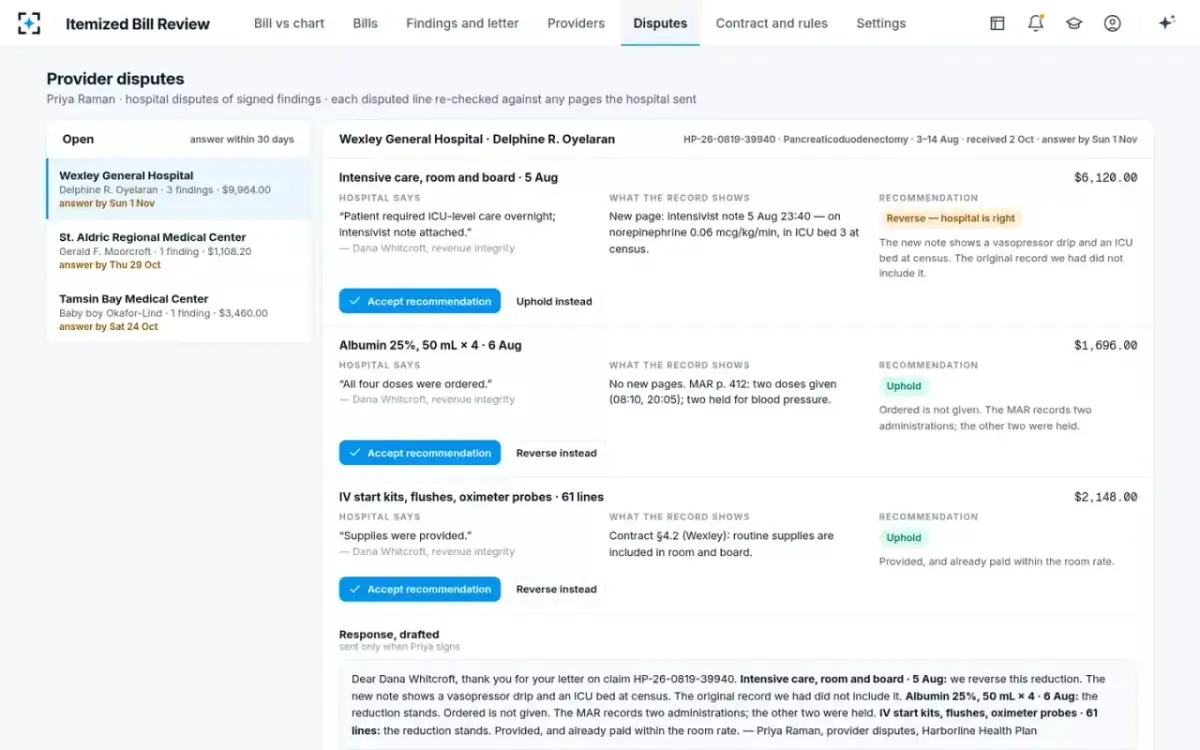
Hospitals win some of these disputes, and they should when the record supports them. In a sample dispute in the solution, a different hospital contested an intensive care reduction on 5 August and sent a new page: an intensivist's note at 23:40 recording a norepinephrine infusion at 0.06 mcg/kg/min and the patient in an intensive care bed at midnight. The recommendation was to reverse, and the response said so. The roles behind each signature are set out in hospital bill auditor: who signs each finding.
A disputed intensive care day reversed on the hospital's new page
Questions people ask
How do concurrent review approvals affect bill audits?
An approval for a level of care on a given day is the plan's own decision, so the bill review should honour it and not dispute that day's rate on necessity grounds. It does not settle facts the reviewer did not see, such as a transfer to the floor that morning. Putting the approval beside the charge avoids findings the plan cannot sustain.
What is the difference between ICU and step-down billing?
Intensive care is billed at the special care rate for critically ill patients needing life-saving care immediately available; step-down or intermediate care is billed at its own rate where the contract has one. Medicare treats step-down units as part of general routine care, not intensive care.
Can a hospital bill the ICU rate when no floor bed was available?
Medicare's answer is no: overflow patients needing only general care are paid at the general level, and charges for them should reflect it. A commercial contract may say otherwise, which is why the review applies the contract's room clause for the date of service.
How large is the difference between an ICU day and a floor day?
It depends on the contract. On the fictional sample contract in Itemized Bill Review, an intensive care day is billed at $11,960.00 and the surgical floor rate is $6,840.00, a $5,120.00 difference for one day.
What does level of care mean in long-term care audits?
In nursing homes and home care, a level of care assessment measures a resident's needs to set services or payment. It shares the name but not the method: a hospital level of care audit tests billed room days against the hospital record.