Legal order processing is a bank's handling of a writ, levy or other order served on it to reach a customer's account, from the moment the order arrives until the money is remitted or released. On a creditor's writ against a customer who receives Social Security, that is about eleven decisions inside clocks the federal benefits rule sets in business days, and most of them can now be automated. Botminds' Garnishment & Levy Processing hands the reading, the account search, the lookback arithmetic and the drafting to six agents, and puts every freeze, notice, court answer and remittance in front of a maker and a second specialist, because the bank's legal protection under the federal rule depends on reasonable procedures, not on a program.
Take one order as it runs through the solution at a fictional sample bank, Corvane National Bank: a writ of execution for $8,412.55 against Walter J. Pruitt, a Social Security recipient, served by a deputy sheriff at a branch on Wednesday, September 30, 2026, at 10:42 a.m. Every name, account and amount in it is sample data.
One writ, from service to the court answer, against the deadlines it had to beat
- Hold signed Thu, notice mailed Fri2 d
- Waiting on the court answer date18 d
- Review due Oct 22 d
- Notice due Tue Oct 64 d
- Answer due Tue Oct 2014 d
What is legal order processing? Eleven decisions between service and remittance
Acting as garnishee, the desk works through eleven decisions on this writ: what the order is, who issued it, whether a federal notice is attached, whose accounts it reaches, which deposits are protected benefits, how much is protected, what the state adds, what to freeze, what to tell the customer, what to tell the court, and when to pay. The first seven are reading and arithmetic. The last four change a balance or speak for the bank, and the rest of this page follows each one on the sample order, with the rule it answers to and who signs it.
Can garnishment processing be automated? Up to the signature
Yes: the reading, matching, arithmetic and drafting can be automated, and the regulators have not written a rule against it. GAO reported in 2025 that the federal banking regulators supervise AI mainly with the laws, guidance and risk-based examinations they already had, rather than with new AI rules (GAO-25-107197; how examiners apply that to agent-checked work is set out in AI audit software for branch reviews). For a legal order desk the existing law is precise. Treasury's rule tells the bank what to compute and by when; it does not say who or what computes it.
The limit comes from the safe harbor. A bank that complies "in good faith" is not liable for "Bona fide errors that occur despite reasonable procedures maintained by the financial institution to prevent such errors" (31 CFR 212.10(d)(1)). A procedure in which a model freezes accounts on its own reading is hard to call reasonable when that model can be confidently wrong; Treasury's December 2024 report on AI in financial services warns that generative models can invent output and state it with full confidence (U.S. Treasury, December 2024), the failure traced on a cited answer in AI hallucination in finance. The design that follows is plain: agents prepare, people decide, and a second computation checks the first.
How does a bank garnishment work? The clock starts at the branch
A bank garnishment starts when the order is served on the bank as garnishee, and the clock starts then too, wherever the order lands. Treasury's rule counts from "receipt of the order" (31 CFR 212.4(a)). The IRS says the same of its levies served in person: whoever signs for one is expected to acknowledge it, process it immediately and freeze the affected accounts (IRM 5.11.4.11). A writ that sits in a branch drawer overnight has used half of a two-day clock.
In the sample, the branch scanned the writ at 10:42 a.m. and it reached document imaging as order LO-26-118204. The first decision belongs to software in the sense that it is mechanical: open a case, stamp the receipt time, start the clocks. The solution read the 204 orders the desk received that Wednesday overnight and opened their clocks by 6:40 p.m.
Decisions one to three: what the order is, who issued it, and whether a federal notice is attached
The first three decisions are reading decisions, and they decide which rules apply. A creditor's writ from a state court gets the federal benefits review. An IRS levy does not: the Bureau of the Fiscal Service states that IRS tax levies fall outside the rule. An order obtained by the United States or a state child support agency with a Notice of Right to Garnish Federal Benefits attached goes to the bank's customary procedures (31 CFR 212.4(b)).
What the Intake agent read from the writ, field by field, with its confidence
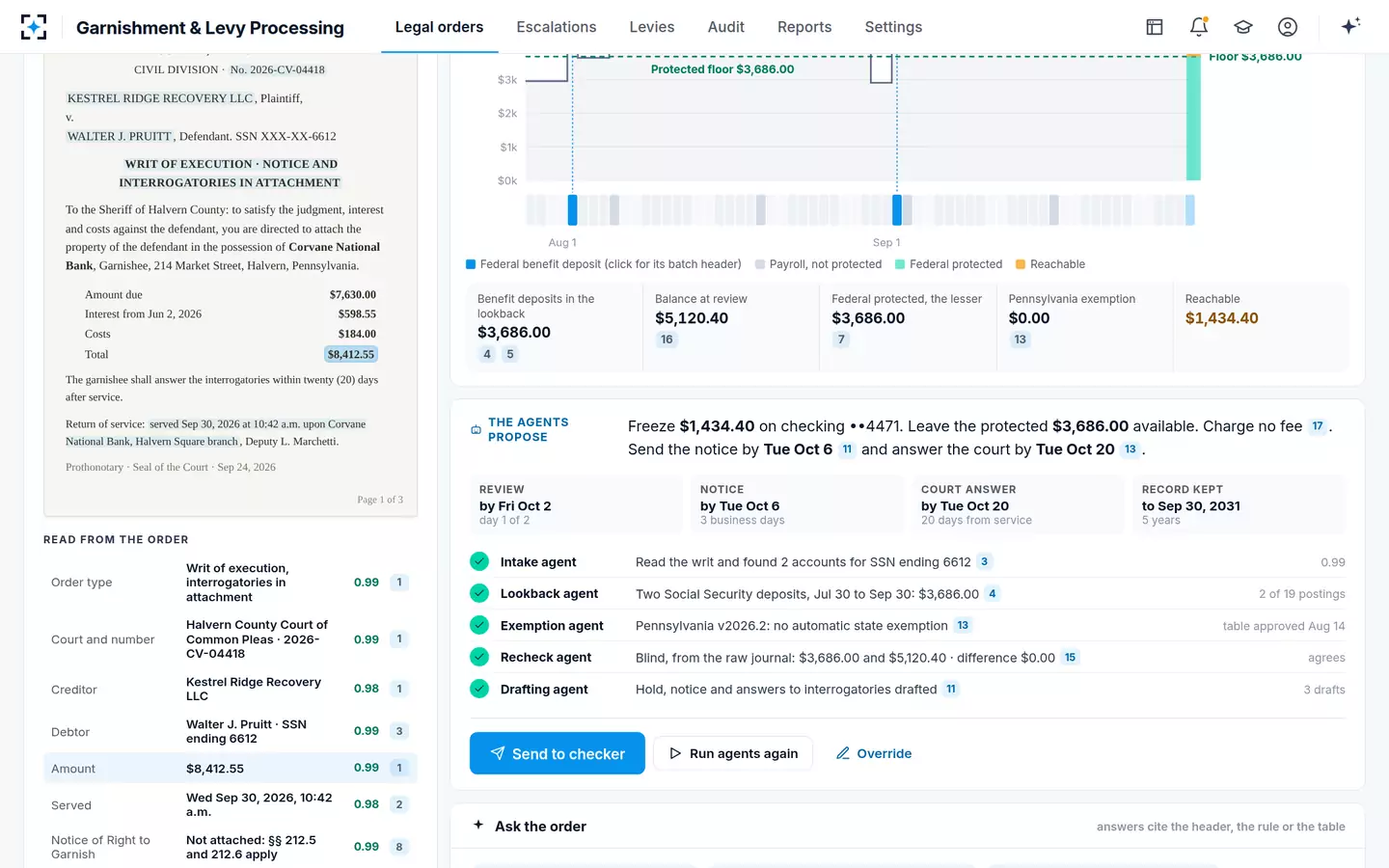
Reading is where automation earns its keep and where it needs the firmest limits. The agent in the sample reads seven fields and scores each. It never guesses an amount from an unreadable image, and it finds the debtor's accounts by SSN or date of birth, never by name alone: Walter's checking account ending 4471, and a savings account closed in 2025 with nothing in it.
How long does a bank have to review a garnishment order? Two business days
A bank has two business days to review the account, counted from receipt of the order and of enough information from the creditor to tell whether the debtor is a customer. The rule allows one exception: when a creditor serves "a batch of a large number of orders", the bank may review by "a later date that may be permitted by the creditor", and must keep records of the batch and the permission (31 CFR 212.5(a)).
During those two days the bank is protected. A bank that complies in good faith is not liable "for account activity during" the examination window or the time before the review is due (31 CFR 212.10(a)). That protection is why the review must come first: the rule says the bank "shall perform the account review prior to taking any other actions related to the garnishment order that may affect funds in the account" (212.5(e)).
Decisions four to six: whose accounts, which deposits, how much is protected
The lookback is pure arithmetic once the dates are right, and that is why it suits an agent. The review ran on Thursday, October 1, so the lookback period ran from Wednesday, September 30, the day before, back to July 30, the same date two months earlier, as the rule's definition requires. Two Social Security deposits of $1,843.00 posted on August 3 and September 3: $3,686.00 in benefits. The balance at review was $5,120.40. The protected amount is the lesser of the two, $3,686.00, and only the $1,434.40 above it could be frozen.
The two-month lookback, drawn with the protected floor
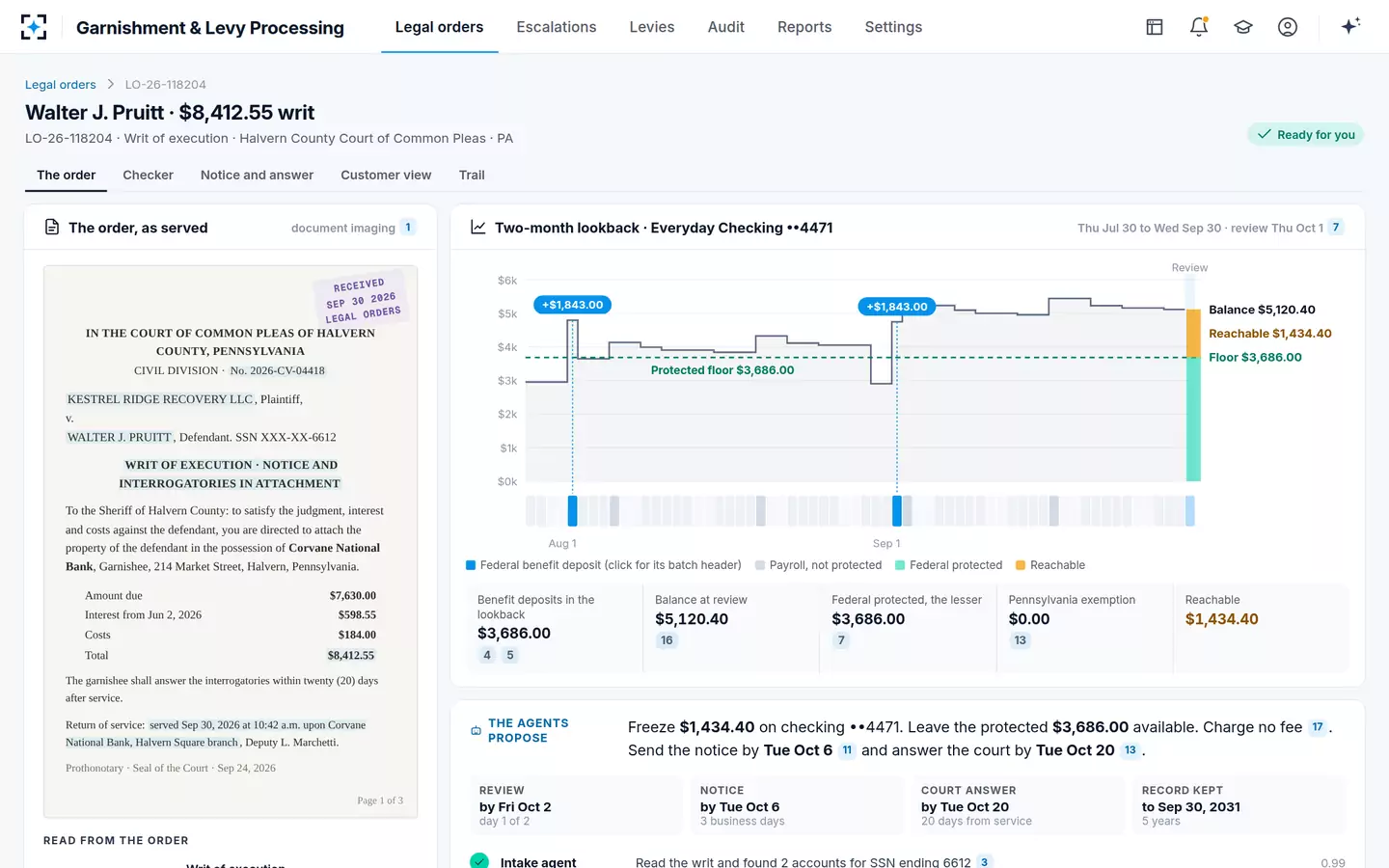
What the agent counts is decided by two characters, not by the deposit's name. A deposit is a protected benefit payment only when it carries "XX" in positions 54 and 55 of the Company Entry Description and "2" in the Originator Status Code of the ACH batch header (31 CFR 212.3). Four payroll credits of $486.20 from the customer's employer carried status code 1 and were not counted. A Treasury check deposited at a branch would not have been either: the Fiscal Service's guidelines leave benefits paid by check outside the bank's review, so the customer has to claim them through the court (Fiscal Service guidelines; the cases to plant are in testing the protected amount).
Decision seven, and a blind recheck: what the state adds to the federal amount
The state's rules come next, and they live in a table, not in a model. The Exemption agent applied the sample bank's Pennsylvania table, version 2026.2, approved by its Legal team on August 14, 2026, and put the table's version on the order beside its result, so a checker or an examiner can see which rules were used. The notice tells the customer how to claim any further exemption through the court. A state with no approved table goes to a specialist. Where states differ, the hard question is often which state's law applies at all, which is the subject of what states prohibit bank account garnishment.
Then a second agent recomputes the protected amount from the core's raw posting journal without seeing the first result. On this order both said $3,686.00, a difference of $0.00. On another order that morning they did not agree: the first counted $3,129.00 of VA deposits, the second found a $1,312.00 credit returned on September 2 and computed $1,817.00. Whether a returned credit still counts is a reading of the rule, so nothing moved and a supervisor decided. Across the 63 accounts with federal benefits the desk reviewed overnight, 62 rechecks agreed to the cent and one went to a person.
Who does what on one writ in Garnishment & Levy Processing
Agent
Intake agentReads the order, classifies it, checks for a Notice of Right to Garnish Federal Benefits, finds the debtor's accounts.
Never: Matches on a name alone, or guesses an unreadable amount.
Agent
Lookback agentSets the lookback dates, finds the coded benefit deposits, sets the protected amount.
Never: Traces funds between accounts.
Agent
Exemption agentApplies the state's Legal-approved rule table on top of the federal amount.
Never: Uses an unapproved table version.
Agent
Recheck agentRecomputes the protected amount blind from the posting journal.
Never: Adjusts the first result; any difference goes to a person.
A person decides
MakerApproves the plan, overrides with a reason code, or escalates.
Never: Checks her own order.
A person decides
CheckerChecks the same evidence and both computations, then signs.
Never: Signs an order he made.
Agent
Drafting agentDrafts the hold instruction, the account-holder notice and the court answer.
Never: Sends anything.
Agent
Remittance and release agentDrafts turnovers and releases and matches each release to its hold.
Never: Pays or releases.
Decisions eight to ten: who approves a garnishment hold at a bank?
A specialist approves the hold as maker and a second specialist checks it; neither can do both on one order. In the sample, Renata Okafor approved at 9:14 a.m. on Thursday: freeze $1,434.40 with the hold code for writs, leave $3,686.00 available, charge no fee, because the bank waives its $125.00 legal process fee on any order with a protected amount and the rule forbids a fee against protected funds. Dmitri Halloran checked the same evidence and both computations and signed at 9:21 a.m. Only then did the hold post to the core.
The checker signs, and only then does anything post
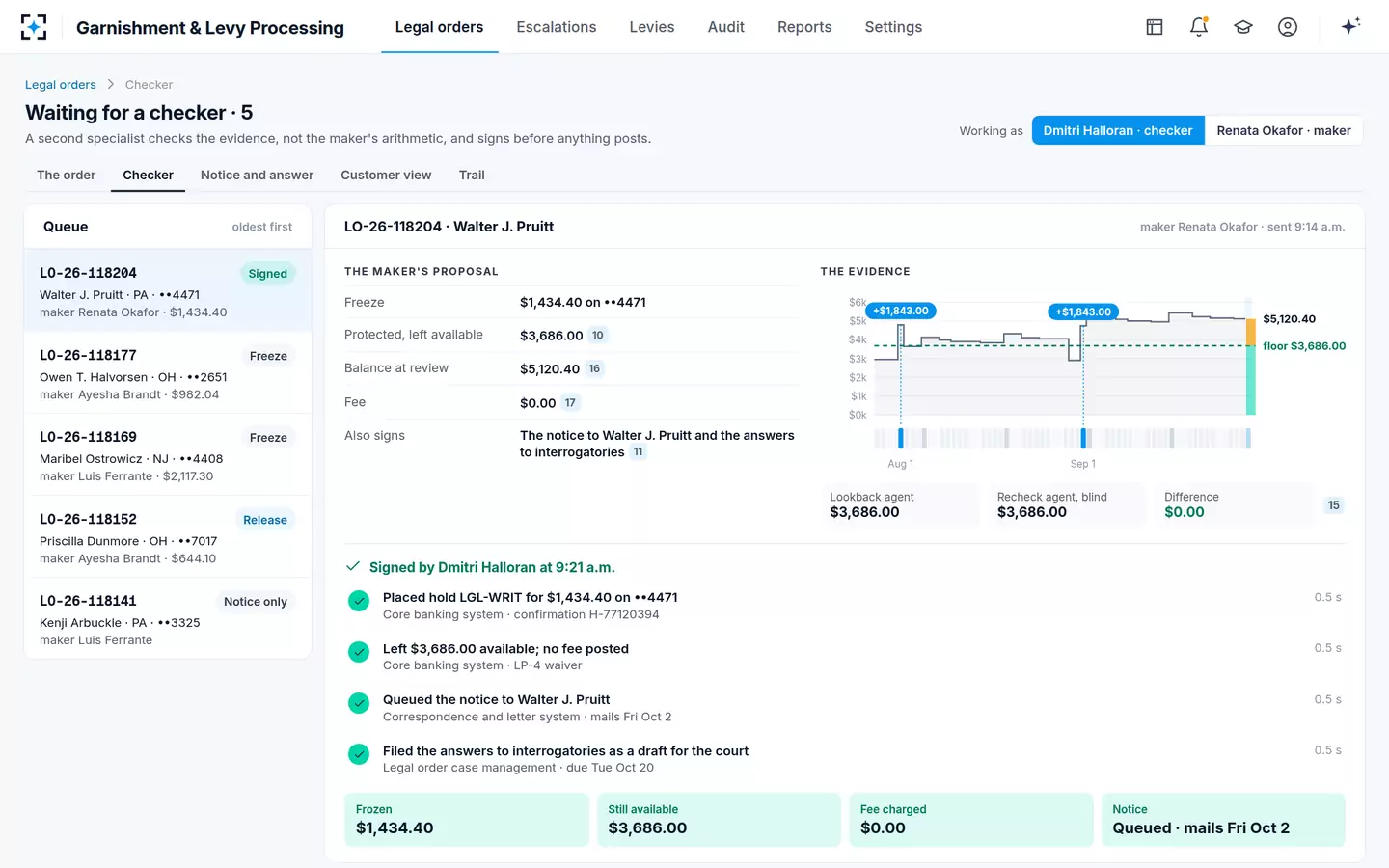
The notice and the court answer follow the same path. The rule requires the notice within three business days of the review, with eleven specified items (31 CFR 212.7). The Drafting agent wrote it from the rule's Appendix A model, ticked each item, and the checker signed it; it mailed Friday, October 2, four days before it was due. The answers to the court's interrogatories were filed as a draft, due October 20, and wait for their own signatures.
Eleven decisions on one writ, and who makes each
| Decision | Rule it answers to | Prepared by | Decided by |
|---|---|---|---|
| 1. Is this a legal order, and when was it received? | 31 CFR 212.4(a) | Intake agent | Automatic; a person if unreadable |
| 2. Who issued it? | 212.4; IRS levies outside the rule | Intake agent | Agent, confirmed by the maker |
| 3. Is a Notice of Right to Garnish attached? | 212.4(b), (c) | Intake agent | Agent, confirmed by the maker |
| 4. Which accounts does the debtor own? | 212.5(f) | Intake agent | A person when identifiers do not match |
| 5. Which deposits are benefit payments? | 212.3 | Lookback agent | Automatic; uncoded benefits go to a person |
| 6. What is the protected amount? | 212.3, 212.6(a) | Lookback and Recheck agents | Automatic only if both agree to the cent |
| 7. What does state law add? | 212.9(b) | Exemption agent | Approved table; no table goes to a person |
| 8. What is frozen? | 212.6(d) | Drafting agent | Maker and checker |
| 9. What does the customer get told? | 212.7 | Drafting agent | Maker and checker |
| 10. What does the court get told? | State procedure | Drafting agent | Maker and checker |
| 11. When is money paid or released? | Court order or agency instruction | Remittance and release agent | Maker and checker; manager above $25,000 |
What happens after a writ of garnishment is served on a bank? Hold, answer, then turnover or release
After the hold, the bank waits on the court. The frozen funds stay frozen until the court orders them turned over or released, under the state's procedure; the account holder may claim further exemptions in the meantime, which is why the notice tells them how. The rule adds two limits that automation must respect: the review is done once, "upon the first service of a given garnishment order", and deposits that arrive after the review may not be garnished under the same order (31 CFR 212.6(f), (g)). A system that re-runs a review every time the same writ is re-served, or keeps freezing new deposits, breaks the rule by being diligent.
When the turnover order comes, the Remittance and release agent drafts the payment and the general ledger entry, and a release must match the order number, the court and the amount before it is drafted at all. The money moves on two signatures, with the deposit operations manager added above $25,000 at the sample bank.
Where a legal order processing department spends its minutes, by hand and with the agents
Most of the time on a writ goes on reading and counting, which is the part that automates. The split below is our estimate for one creditor garnishment with federal benefits, built step by step from the sample bank's desk; the solution's September report on its sample data showed a median of 7.6 specialist minutes per order.
Where a specialist's minutes go on one writ, by hand and with Garnishment & Levy Processing
By hand, about 28 minutes
- Reading and keying the order · 14%
- Searching the core · 14%
- Two months of statements · 32%
- State exemption lookup · 11%
- Hold, notice and answer · 22%
- Second check · 7%
With the agents, about 7.5 minutes
- Reviewing what was read · 7%
- Confirming accounts · 7%
- Reviewing the lookback · 27%
- Exemption · 6%
- Approving the drafts · 33%
- Second check · 20%
The row to notice is the last one. With the counting gone, the checker's share of the work grows from under a tenth to a fifth. That is the point of automating a legal order desk: the time saved pays for a second person on every order, which is the procedure the safe harbor rewards. Before relying on the arithmetic, a bank should test it; how to test the protected amount with planted cases sets out the cases to plant.
Can AI read a garnishment order? What to check before you rely on it
It can, if it says how sure it is and stops when it is not. Orders arrive as scans, faxes and court e-service files in every state's format, and a misread amount or debtor is the costliest kind of error, because every later step inherits it. The checks below are the ones we would put to any system, including the one described here.
Eight checks before trusting garnishment automation with a live desk
- Does every value it reads show where on the image it came from?
A checker cannot verify a number without seeing the page.
- Does it score its confidence and stop below a threshold?
On the amount, the debtor and the service date at least, the fields that start clocks and decide money.
- Does it refuse to match a debtor on name alone?
Require the SSN or date of birth, and send near-misses to a person.
- Does it count only coded direct deposits as benefits?
"XX" and "2" in the batch header; not the deposit's description, not Treasury checks.
- Is the protected amount computed twice, independently?
A second computation that cannot see the first catches the errors a reviewer skims past.
- Can it place a hold, send a notice or pay on its own?
If yes, it is not a tool for a regulated desk. Those actions need a maker and a checker.
- Does it review an order once, and never keep garnishing?
31 CFR 212.6(f) and (g) forbid repeat reviews and continuing garnishment.
- Can you export every order's evidence for an examiner?
The rule asks for records sufficient to demonstrate compliance for at least two years.
The trace above is the case for automation and its limit at once. The agents did in minutes what takes a specialist most of half an hour, and every step that changed a customer's balance or spoke for the bank waited for two people. To see the same order screen by screen, start from Garnishment & Levy Processing; to see how its arithmetic is proven, read 31 CFR Part 212 in plain words.
Questions people ask
Is legal order processing the same as garnishment processing?
Garnishment is the largest part of it, but a legal order desk also handles IRS and state tax levies, child support liens and freeze orders. Treasury's rule counts most of those as garnishment orders and reviews them the same way; IRS levies sit outside it and run on the IRS's own 21-day holding period before surrender (26 U.S.C. 6332(c)).
Does automation change the two-business-day deadline?
No. The deadline runs from receipt of the order, and the only extension the rule allows is for large batches where the creditor permits a later date. Automation helps by opening the clock the moment the order is scanned, not by moving it.
Can the protected amount be calculated automatically?
Yes, because the rule defines it exactly: the lesser of benefit deposits coded "XX" and "2" during the lookback period and the balance when the review is performed. The risk is in the inputs, the lookback dates and the coding, so a bank should compute it twice independently and test it against the rule's own examples in Appendix C.
Do examiners accept automated garnishment reviews?
Examiners test outcomes and procedures: the OCC's worksheet asks whether each obligation was met, and a "no" in expanded procedures is a violation. GAO reports that regulators oversee AI mainly through existing laws and risk-based examinations, so an automated review is judged by the same questions as a manual one, plus the bank's controls over the tool.
What happens if the automated review is wrong?
The bank is liable for the error unless it falls within the safe harbor for bona fide errors despite reasonable procedures. A protected amount frozen by mistake has to be restored to the customer; funds released that should have been held can leave the bank owing the creditor. That is why the money-moving steps stay with two people.