The CFPB's garnishment findings turn on one question for a bank's legal order desk: which states prohibit bank account garnishment across state lines. Those are the states whose law stops an order issued by their courts from reaching a deposit account located in another state. In its May 2022 consent order against Bank of America, the CFPB defined these "Restriction States" and named five as examples: "Alabama, Arizona (before August 2019), California, Florida (after August 2014), and Oregon" (CFPB consent order 2022-CFPB-0002). Other states do not forbid garnishment but protect part of every account automatically, as Washington and New York do. The enforcement record shows that the costly errors are about the wrong state rather than the wrong sum: answering an out-of-state order the issuing state forbids, or applying the court's state's exemptions to a customer who lives elsewhere. Botminds' Garnishment & Levy Processing keeps each state's rules as a versioned table its Legal team approves, and sends any state it has no table for to a specialist.
Four entries in the public record on bank account garnishment by state
Enforcement · May 4, 2022
CFPB v. Bank of America, N.A.
Out-of-state garnishment notices processed against the issuing state's prohibitions; the issuing state's exemptions applied instead of the customer's own state; a deposit agreement that told customers to waive their garnishment rights.
$10 million penalty; at least $592,000 in fees refunded or cancelled
Supervision · Fall 2022
CFPB Supervisory Highlights, Issue 28
Indicators of risk at over two dozen depository institutions in how pandemic relief funds were garnished or set off; follow-up assessments identified unfairness risks at multiple institutions, including out-of-state garnishments and missed state exemptions.
Refunds and rewritten policies and procedures, by supervisory direction
State law · since 2021
Washington, RCW 6.15.010
Bank account exemptions the garnishee bank must protect automatically, set by the type of debt: $500 in general, $2,000 for consumer debt, $1,000 of $2,500 for private student loans.
Current text in effect since July 1, 2025
State law
New York, CPLR 5222(i) and (j)
A restraining notice does not reach an amount tied to 240 times the minimum hourly wage; where the bank cannot lawfully restrain the account, it may charge no fee, whatever the account agreement says.
Most recent revision 2022-05-06
What states prohibit bank account garnishment? The question a bank should ask instead
The useful question for a bank is not whether a state allows garnishment at all but which orders from which states it may honor, and under whose exemptions. The CFPB's order explains the starting point: "Bank account garnishments are governed by state law. Each state has a judicial process by which a judgment creditor can freeze or hold and then seize money from a judgment debtor's deposit account to enforce a civil judgment." It then adds the condition that most errors break: "To garnish a bank account lawfully, a state court must have jurisdiction over the garnishee (the bank that holds a deposit account) and the property to be garnished (the deposit account)" (CFPB consent order, paragraphs 7 and 8).
Many people who search this question are thinking of wages, not accounts. Wage garnishment is withheld by an employer from pay, within federal limits the Department of Labor administers: generally no more than the lesser of 25% of disposable earnings or the amount above 30 times the federal minimum wage (DOL Fact Sheet #30), with state laws that can be stricter. Bank account garnishment reaches money already deposited, and a different set of protections applies: the federal benefits rule, state account exemptions, and the out-of-state limits this guide is about.
Can a creditor garnish an out-of-state bank account?
Sometimes, and a bank cannot assume either way. Whether an order from one state reaches an account in another depends on the issuing state's law, and the CFPB's definition of a Restriction State is a state "that prohibited or otherwise restricted garnishment of Out-of-State Accounts" at the time the bank acted. Its list is expressly incomplete ("include but are not limited to"), and two of its five entries carry dates, which tells a desk that the list moves.
The Restriction States the CFPB named, and what each entry tells a bank
| State named | When it applied | What it means for an order from that state |
|---|---|---|
| Alabama | No date given in the order | Its courts' notices should not be treated as reaching accounts located in other states |
| Arizona | Before August 2019 | The answer depends on the date: the restriction applied to notices acted on before then |
| California | No date given in the order | As Alabama |
| Florida | After August 2014 | The answer depends on the date: the restriction applied to notices acted on after then |
| Oregon | No date given in the order | As Alabama |
| Any other state | Check the current law | The order's list is "not limited to" these five |
The order also records how the bank located an account. During the period it covered, the bank's standard deposit agreement "defined the location of the Consumer's account as the branch where the account was opened." Whatever rule a bank adopts, its deposit agreement and its legal order procedures have to say the same thing, and the answer to the court has to state it.
What did the CFPB find on bank garnishments?
The CFPB found five violations of federal consumer financial law in one bank's garnishment practices, three unfair and two deceptive. In its own summary, the bank processed out-of-state notices "in violation of certain garnishment-issuing states' prohibitions against out-of-state garnishment"; failed "to apply the appropriate state exemptions to certain consumers' deposit accounts"; misrepresented exemption rights "by applying the issuing state's exemptions instead of the exemptions of the consumer's state of residence"; used a deposit agreement "that required consumers to direct Respondent not to contest legal process and waive Respondent's liability"; and suggested consumers could not bring legal claims (CFPB consent order).
The mechanics are worth reading because they are ordinary. The order describes a process that "generally treated all Garnishment Notices alike": if a notice came from a state where the bank had a financial center, it reported the customer's accounts and froze them, "regardless of whether the account was located outside of the Issuing State." Its training materials named some Restriction States but "did not include all of the Restriction States identified in this Consent Order", and the bank "did not consistently apply those instructions."
One CFPB order on out-of-state garnishments, in numbers
3,700+
notices from Restriction States answered without telling the court the account was elsewhere
$592K+
in garnishment-related fees paid by the consumers affected, to refund or cancel
$10M
civil money penalty
10.7years
relevant period, August 1, 2011 to March 29, 2022
What was the Bank of America garnishment penalty, and what did the order require?
The bank agreed to pay a $10 million civil money penalty and to refund or cancel at least $592,000 in garnishment-related fees, and the order rewrote how it must handle out-of-state notices (CFPB action page). The conduct provisions are the part a peer bank can use. The bank must answer every facially valid out-of-state notice "by notifying the issuing court or other issuing entity that the relevant Deposit Account is not located in the state from which the Out-of-State Garnishment Notice was issued"; must stop freezing out-of-state accounts on a Restriction State's notice "unless required to do so under state law"; and must tell the customer which accounts were affected, the state of each, the issuing state, and the customer's state of residence on its records (consent order, paragraph 61).
The fees mattered too: the order's definition of garnishment-related fees reached overdraft and insufficient-funds fees that followed a hold. That side of the case, and what the federal and IRS rules say about fees, is in garnishment fee on a bank account.
Was it one bank? What the CFPB's examiners found elsewhere
No. In the fall of 2022 the CFPB reported that, in reviews of how institutions handled pandemic relief deposits, "examiners identified indicators of risk at over two dozen depository institutions" and then ran follow-up assessments (CFPB Supervisory Highlights, Issue 28). Among the unfairness risks it identified at multiple institutions were policies that may have led to out-of-state garnishments the issuing state prohibits, and to state exemptions not being applied after garnishment notices arrived: the same two errors as the Bank of America order, which the report cited.
The report also answered an argument some institutions raised, that federal preemption excused them from state garnishment protections. Its conclusion: "all depository institutions generally must comply with, among other consumer protections, applicable state and territorial laws that govern garnishment and certain setoff practices." That sentence is the reason a legal order desk needs a table for every state it touches.
Which state exemption applies to a bank garnishment?
Where the court's state and the customer's state differ, the CFPB treated the customer's own state as the one whose exemptions apply. Its order describes the bank's policy, in states where the garnishee must apply exemptions for the consumer, as applying "the exemption law of the state that issued the Garnishment Notice—i.e., the Issuing State—rather than the law of the state where the Consumer resides in those instances where the two states differ", and found it deceptive. Where a state leaves exemptions to the customer to claim, the order requires the bank to tell the customer that they "may be entitled to claim exemptions pursuant to the law of their state of residence."
Issuing state or the customer's state: which law governs what
The issuing state's law: Decides whether its courts' orders may reach an account located in another state.
The customer's state's law: Decides how its own courts' orders reach accounts located there.
The issuing state's law: What the court's forms will usually list.
The customer's state's law: What the CFPB treated as governing where the two states differ.
The issuing state's law: The answer must say if the account is not located in the issuing state.
The customer's state's law: Where the account is located under the deposit agreement.
The issuing state's law: That the notice may list the issuing state's exemptions.
The customer's state's law: That they may claim their own state's exemptions, and may wish to consult an attorney.
Bank account garnishment laws by state: how two states protect accounts automatically
States that do not forbid garnishment often protect part of the account without waiting for a claim, and they do it in different ways. Washington sets fixed amounts by type of debt, protected automatically by the bank: $500 for most debts, $2,000 for consumer debt, and $1,000 automatically of a $2,500 exemption for private student loan debt (RCW 6.15.010). Its legislature described the change as "specifying when and how much a garnishee bank is required to hold and release". New York uses a formula tied to the minimum wage: a restraining notice "shall not apply to an amount equal to or less than the greater of" 240 times the federal or the state minimum hourly wage (CPLR 5222(i)).
Two designs for automatic account protection
| Washington | New York | |
|---|---|---|
| How the amount is set | Fixed dollar amounts, by type of debt | A multiple of the minimum hourly wage |
| Who applies it | The garnishee bank, automatically | The banking institution served with the restraining notice |
| How it changes | By statute; current text in effect since July 1, 2025 | With the federal or state minimum wage |
| Fee where the bank cannot restrain | Set by other provisions | No fee, "regardless of any terms of agreement" (CPLR 5222(j)) |
Both stack on federal law rather than replace it. The federal rule leaves room for any state requirement that protects benefit payments at a higher amount, provided the bank can comply with both (31 CFR 212.9(b)). In practice the desk computes the federal protected amount first and then applies the state table on top, which is the order 31 CFR Part 212 in plain words describes.
An out-of-state order procedure, built from the CFPB's order
The order's conduct provisions translate almost line for line into a procedure any bank can adopt, whether or not it has ever been examined on the point. The first requirement is the one every desk needs: a current, accurate account of what each state's out-of-state notices may and may not reach, for every state whose notices the bank processes, with each Restriction State named (the tables a bank brings on day one).
Seven checks for every out-of-state garnishment order
- Where is the account located, under the deposit agreement?
Compare it with the issuing state before anything is frozen.
- Does the issuing state restrict out-of-state garnishment, on the date the bank acts?
From a list Legal maintains and dates, not from memory or training slides.
- Does the answer tell the court the account is elsewhere?
Every facially valid out-of-state notice gets that disclosure.
- Is anything frozen that the issuing state's law does not allow?
If the state restricts, do not freeze unless state law requires it.
- Which state's exemptions are applied?
The customer's state of residence where the two differ and the bank must apply exemptions itself.
- What does the customer's notice say?
The accounts affected, the state of each, the issuing state and the customer's state of residence on record.
- Is the out-of-state notice and the bank's response kept?
Including what was told to the court and whether funds were frozen or turned over.
Where Garnishment & Levy Processing applies state law, and where it stops
In the solution, state law lives in versioned tables, one per state, each approved by the bank's Legal team before it applies; a new version governs orders received after approval, and earlier orders keep theirs. The Exemption agent applies the right table on top of the federal amount and puts the table's version on the order, so an examiner can see which rules governed it. A state with no approved table goes to a specialist instead of being guessed. The sample bank keeps 14.
An order served on the wrong entity goes to a person, with what the agents found
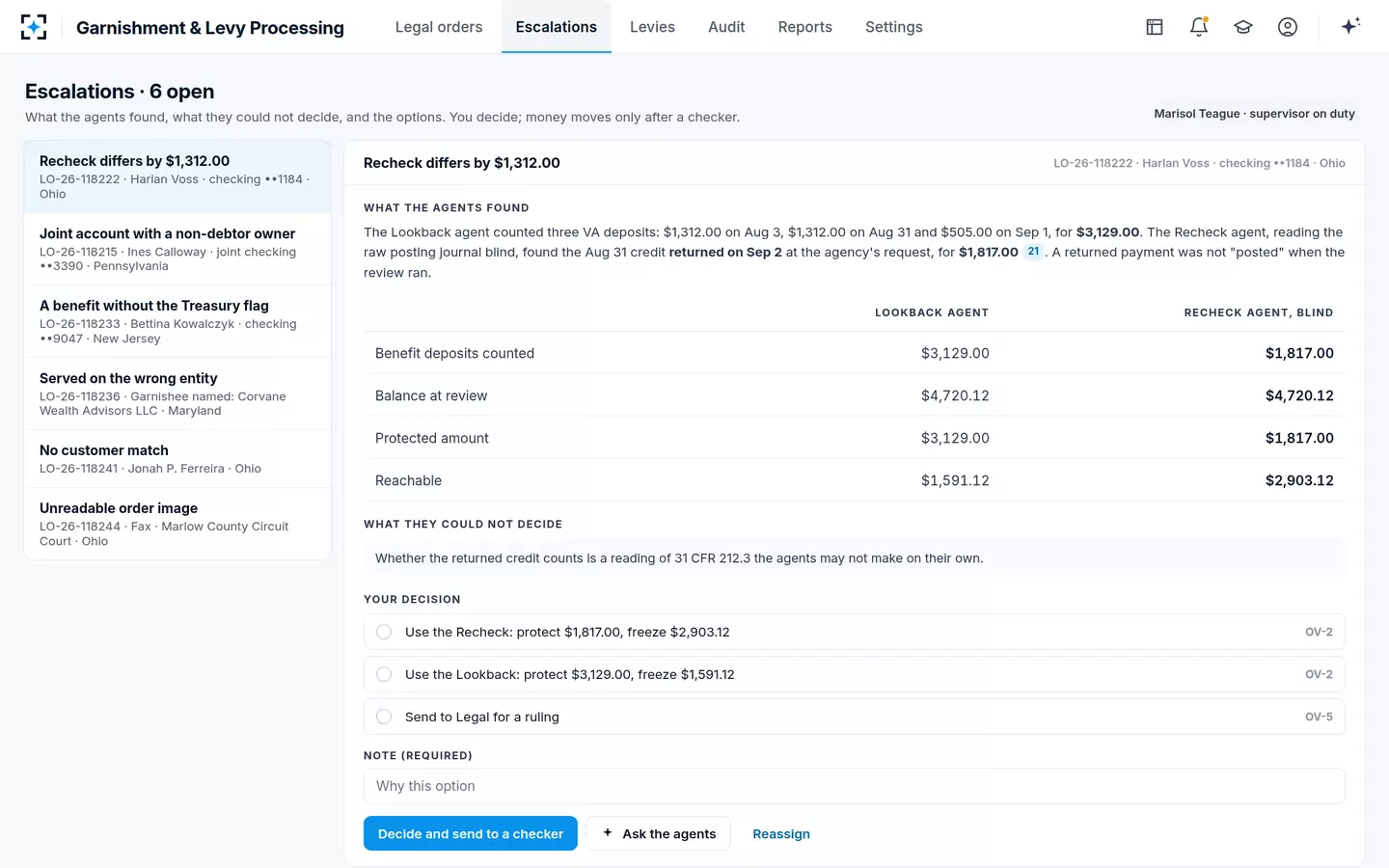
The solution does not decide what a state's law says. That is Legal's job, and the tables are only as current as Legal keeps them. It also does not, on its own, decide whether an order reaches an account in another state; where the issuing state and the account's state differ, the bank's procedure, written into the table, decides, and anything it does not cover goes to a person. To see a state table applied on a full order, start from Garnishment & Levy Processing.
Questions people ask
Does any state ban bank account garnishment completely?
The public enforcement record does not describe a state that does. What it describes are states that restrict their courts' orders from reaching accounts located in other states, which the CFPB named as including Alabama, Arizona before August 2019, California, Florida after August 2014 and Oregon, and states that protect part of an account automatically, such as Washington and New York.
Must a bank freeze an account on another state's garnishment order?
It depends on the law of the state that issued the order and where the account is located. If the issuing state restricts out-of-state garnishment, the bank should tell the court the account is located elsewhere and not freeze it unless state law requires; the CFPB penalized a bank $10 million in 2022 partly for not doing so.
Do federal benefits stay protected in an out-of-state garnishment?
Yes. The federal rule applies to every garnishment order without the federal notice, whichever state issued it: two months of directly deposited benefits are protected automatically, and state law can only add to that protection.
Are joint accounts treated differently by state?
For the federal protected amount, no: the review ignores co-owners and counts every coded benefit in the account. What happens to the rest of a joint account depends on state law, which is why many banks send joint accounts with a non-debtor owner to a specialist.
How often do state garnishment exemptions change?
Often enough to need dated versions. Washington's exemption statute was amended in 2021, 2023 and 2025, and New York's protected amount moves with the minimum wage. A desk's table should record each version's effective date and the orders it governed.