The child support bank levy process is how a state child support agency reaches money that a parent who owes past-due support keeps at a bank or credit union. It runs in two stages. First, a financial institution data match (FIDM): every quarter, the bank compares its accounts with the agency's list of parents who owe past-due support and reports the matches, which "allows the child support agency to freeze and seize the account" (HHS Office of Child Support Services). Second, the agency serves a lien or levy, and federal law requires the bank to "encumber or surrender" the assets it holds for that parent (42 U.S.C. 666(a)(17)). The step that sets this order apart is at the bank's desk: if the agency attaches a Notice of Right to Garnish Federal Benefits, the bank does not run the two-month federal benefits lookback at all and follows its customary procedures instead. Botminds' Garnishment & Levy Processing checks every order for that notice before anything else and routes it accordingly.
The child support bank levy process, from data match to remittance, in Garnishment & Levy Processing
Agent
Quarterly data matchThe bank compares the agency's (or the federal multistate) list of obligors with its accounts and prepares the response file.
Never: Sends the file without a checker.
A person decides
Response reviewed and sentA specialist approves the match response within the 45 days allowed; a second person checks.
Agent
Lien or levy receivedThe order is read and classified as a state child support order; the agent looks for a Notice of Right to Garnish Federal Benefits.
Never: Assumes the notice from the issuer's name alone.
Agent
Notice attached: customary proceduresNo lookback; the plan follows the agency's instructions to hold and remit. Without the notice, the full federal review runs as for any creditor.
A person decides
Hold approved and checkedA maker approves the hold; a second specialist checks it against the order.
A person decides
Remit or release on the agency's instructionDrafted by the remittance and release agent; approved by a maker and a checker.
How does the child support bank levy process work?
It starts with data, not paper. Federal law makes each state set up procedures under which its child support agency enters into agreements with the financial institutions doing business there "to develop and operate ... a data match system", in which each institution provides "for each calendar quarter" identifying information for each noncustodial parent who has an account and owes past-due support (42 U.S.C. 666(a)(17)(A)(i)). The same paragraph requires that, "in response to a notice of lien or levy", the institution "encumber or surrender" the assets it holds for that parent.
A match does not move money by itself. The agency decides whether to act on it, and if it does, it sends a lien or levy, on paper or electronically. Federal law gives state agencies the authority to secure assets for arrears by "attaching and seizing assets of the obligor held in financial institutions" (42 U.S.C. 666(c)(1)(G)(ii)). The bank then handles that order like any other legal order, with one decisive difference at the first step.
What is FIDM child support, and what is a financial institution data match?
FIDM, the financial institution data match, is the quarterly comparison of a bank's accounts with the list of parents who owe past-due child support. The federal child support office describes it plainly: it "requires each state to implement quarterly matching of delinquent noncustodial parents to the accounts maintained at financial institutions", the matches are "conducted every quarter", and "financial institutions must respond within 45 days" (HHS Office of Child Support Services). It was mandated by the Personal Responsibility and Work Opportunity Reconciliation Act of 1996.
The match covers "demand deposit accounts, checking accounts or negotiable withdrawal order accounts, savings accounts, time deposit accounts, and money-market mutual fund accounts". It comes with protections for the bank: a state "may pay a reasonable fee" for the match, "not to exceed the actual costs incurred", and an institution "shall not be liable under any Federal or State law to any person" for disclosing the data, for encumbering or surrendering assets in response to the agency's lien or levy, or for "any other action taken in good faith" to comply (42 U.S.C. 666(a)(17)(B), (C)).
The child support data match, by the numbers in federal law and guidance
4a year
data matches: every calendar quarter
45days
for the institution to respond to a match
48hours
for the federal office to send multistate matches on to the states
2015
year the federal FAST Levy electronic exchange began
Multistate matches and FAST Levy: one exchange for many states
A bank in more than one state can match once, through the federal office, instead of with every state. A 1998 law, the Child Support Performance and Incentive Act, let the federal Office of Child Support Services act as the conduit for multistate financial institutions, which choose between matching centrally and matching with each state (ACF). In the central match, the federal office extracts eligible names and Social Security numbers from a national file states update weekly, checks each name and number against Social Security records and drops invalid pairs, removes duplicates, sends the inquiry file to the institution, and distributes the matches back to the states "within 48 hours" of receiving the institution's response. It does not collect: "OCSE does not take action to collect money from accounts identified though MSFIDM" (ACF, MSFIDM operations).
The levy itself can travel the same way. The federal office's FAST Levy program, implemented in 2015, "allows child support agencies to create levy actions for distribution to multiple financial institutions, and allows financial institutions to receive and respond to levy actions from multiple states — all processed by OCSE." Participation "is voluntary for both child support agencies and financial institutions" (ACF, FAST Levy overview). For a desk, an electronic levy removes the reading problem but not the decision: the notice check and the hold still need a person's sign-off.
Do child support levies follow 31 CFR 212?
Only when the agency does not attach the Notice of Right to Garnish Federal Benefits. Treasury's rule tells the bank to examine every order within two business days for that notice; if it is there, the bank "shall follow its otherwise customary procedures for handling the order and shall not follow the procedures in § 212.5 and § 212.6" (31 CFR 212.4(b)). If it is not, the full review runs, whoever issued the order (212.4(c)). The OCC explains the logic: in such cases the bank follows its customary procedures "since federal benefit payments can generally be accessed or garnished by such agencies" (OCC Comptroller's Handbook).
The notice has fixed wording, set out in the rule's Appendix B, on the agency's letterhead. For a child support order it states that the order was issued by the named agency "pursuant to authority to attach or seize assets of noncustodial parents in financial institutions" under 42 U.S.C. 666, and tells the garnishee it "should comply with the terms of this order, including instructions for withholding and retaining any funds deposited to any account(s) covered by this order" (31 CFR Part 212, Appendix B). A bank that follows those procedures is inside the rule's safe harbor, which protects it when it has determined, under 212.4, that an order was issued by a state child support agency (212.10(b)(2)).
The same child support order, with and without the federal notice
Notice of Right to Garnish attached: Examine within 2 business days; notice found.
No notice attached: Examine within 2 business days; no notice.
Notice of Right to Garnish attached: None. Customary procedures.
No notice attached: Full two-month lookback, as for any creditor.
Notice of Right to Garnish attached: As the agency's order directs, including deposited benefits it may lawfully reach.
No notice attached: Only funds above the protected amount.
Notice of Right to Garnish attached: Not required by the rule.
No notice attached: Within 3 business days of the review, if funds above the protected amount remain.
Notice of Right to Garnish attached: Safe harbor for following 212.4 (212.10(b)(2)).
No notice attached: Safe harbor for protecting and freezing under the rule (212.10(b)(1)).
The first thing the reading agent checks: is the federal notice attached?
Can a child support levy reach Social Security deposits at the bank?
Generally yes, when the agency's order carries the federal notice; that is the point of the notice. Federal law lets child support reach federal payments "based upon remuneration for employment", which includes Social Security retirement and disability benefits, and the federal child support office lists the federal benefits that can and cannot be taken (ACF, DCL-13-06). Veterans' benefits are mostly outside it: Treasury's FAQ notes that VA payments generally are not subject to child support garnishment, other than disability compensation paid to a retiree who waived retired pay to receive it (Fiscal Service FAQ).
For the bank, the notice is what it may rely on. It does not have to work out which federal benefits in the account the agency may lawfully reach; it follows its customary procedures and the agency's order. The duty to avoid taking exempt money sits with the agency, which brings us to SSI.
Can a child support levy take SSI held at a bank?
It should not. Supplemental Security Income is means-tested, not based on employment, and the federal child support office says SSI benefits "are exempt from child support garnishment and income withholding" and that "SSI benefits deposited into a bank account retain their character as protected benefits" (ACF, DCL-13-06, February 27, 2013). It urged state and tribal agencies "to implement automated and manual safeguards to ensure that SSI benefits are not garnished", and "to promptly refund any monies that were inappropriately garnished".
SSI recipients among parents on the federal child support debtor file
Child support debtors on the Tax Refund Offset Debtor File, 2009
- SSI recipients · 3%
- Others · 97%
Here the routing creates a gap the bank should know about. When the federal notice is attached, the bank does not run the lookback, so an SSI deposit in the account is not flagged by the bank's own review. The safeguard is meant to sit with the agency, which can learn from federal records whether a parent receives SSI and block the account before levying. The same letter reports that in "nearly all states", if SSI funds are frozen because the state did not know, "the state has procedures in place to quickly release the funds back to the noncustodial parent." A bank's procedure should give its staff a fast route to the agency when a customer says the frozen money is SSI.
How often can a child support agency levy the same account?
The data match runs every quarter, and each lien or levy the agency serves is its own order. Under the federal benefits rule, a bank reviews an order once, on first service, and may not keep garnishing later deposits under it; a new or different order gets a new review (31 CFR 212.6(f), (g)). That rule governs orders without the federal notice. With the notice, the bank follows its customary procedures and the order's own terms, and state law decides how long a lien lasts and what later deposits it reaches.
For the desk, the practical point is that the match and the levy are separate events with separate clocks. A match is answered within 45 days. A levy starts the two-business-day examination clock on receipt, and the hold follows the agency's instructions. A bank that treats the quarterly match as if it were a levy freezes accounts nobody has ordered frozen.
A child support levy checklist for the legal order desk
- Answer each quarterly match within 45 days
Through the state, or through the federal multistate match if the bank elected it. A match is not an order to freeze.
- Examine every lien or levy for the federal notice within 2 business days
On the agency's letterhead, in the wording of Appendix B to 31 CFR Part 212.
- Notice attached: follow customary procedures
Hold and remit as the order and state law direct; no lookback is owed.
- No notice: run the full review
A child support order without the notice gets the same protected amount as a creditor's.
- Keep a fast route back to the agency
For a customer who says the frozen money is SSI or another exempt benefit.
- Match electronic and paper levies to the same hold
An order received through FAST Levy and again on paper is one order, not two.
- Remit only on the agency's instruction, with two signatures
And keep the order, the notice and the remittance in the order's file.
Where Garnishment & Levy Processing fits on child support orders
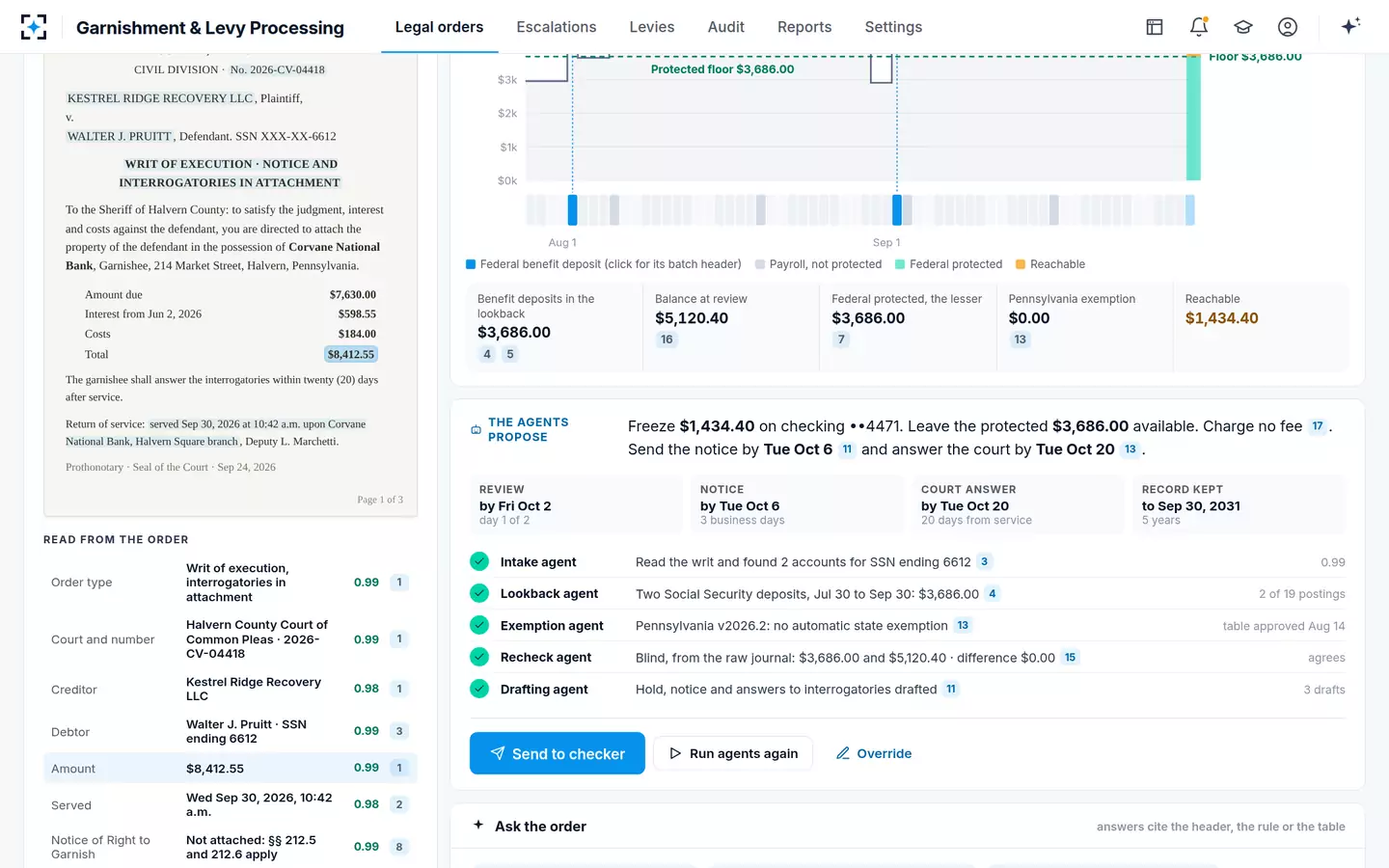
In the solution, the Intake agent reads each order, classifies a state child support order as such, and records whether the federal notice is attached, with its confidence and the page it was read from. With the notice, the plan follows customary procedures and the agency's instructions; without it, the Lookback agent runs the full review exactly as for a creditor. The quarterly data match runs from the same desk: at the fictional sample bank, the third-quarter match covered 18,412 obligor records and returned 37 matches, with the response file waiting for a checker before it goes back.
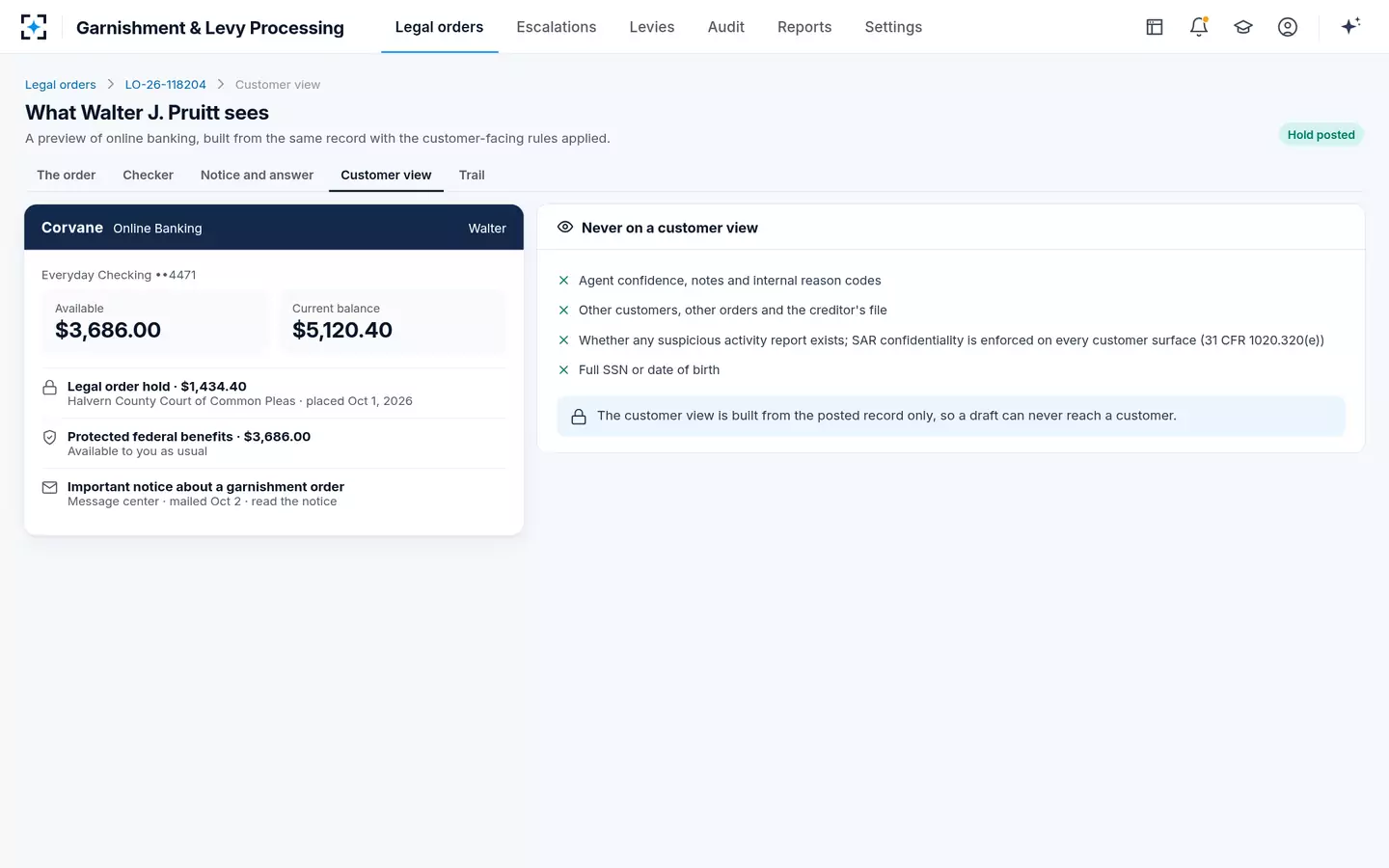
The customer sees the result, not the routing. Whatever path an order took, the online banking view shows what is available, what is held and why, and the notice when one is owed, built from the posted hold rather than from any draft.
What the customer sees once a hold posts
What the solution does not do is decide which benefits an agency may lawfully take; it follows the notice, as the rule allows, and sends anything unusual to a specialist. To compare this path with the creditor's path it skips, read 31 CFR Part 212 in plain words, or follow the IRS's own hold in IRS levy 21 days. To see an order end to end, start from Garnishment & Levy Processing.
Questions people ask
What is FAST Levy in child support?
FAST Levy, the Federally Assisted State Transmitted Levy program, is a federal electronic exchange, begun in 2015, through which state child support agencies send lien and levy actions to financial institutions and receive their responses, all processed by the federal child support office. Participation is voluntary for agencies and institutions.
Does a FIDM match mean the account will be frozen?
No. A match tells the agency the parent has an account; the agency then decides whether to serve a lien or levy. Only that order lets the bank encumber or surrender funds, and federal law protects the bank from liability for doing so in good faith.
Can child support levy a joint bank account?
The agency's order and state law decide how much of a joint account it reaches. If the order lacks the federal notice, the bank's federal benefits review counts every coded benefit in the account, including a co-owner's, as 31 CFR 212 requires.
Do banks get paid for the child support data match?
Sometimes. Federal law lets a state pay a reasonable fee that does not exceed the institution's actual costs, and state law decides whether it does. The federal office publishes a table of states that reimburse multistate institutions.
What if a child support order arrives without the federal notice?
The bank treats it like any creditor's order: it runs the two-month lookback and protects coded federal benefits before freezing anything. The notice, not the identity of the issuer, is what switches the review off.