The garnishment protected amount is the part of a bank account that a creditor's garnishment order cannot touch because federal benefits were deposited into it. Treasury's rule defines it as "the lesser of the sum of all benefit payments posted to an account" during a two-month lookback period, "or the balance in an account when the account review is performed" (31 CFR 212.3). The bank must calculate it within two business days, leave it fully available and freeze nothing below it. The definition is exact, but the inputs are not obvious: which deposits count, which dates bound the lookback, which balance is used. That is why a bank should test whoever computes it, a specialist or a system such as Botminds' Garnishment & Levy Processing, with planted cases whose right answers the rule itself settles, before trusting the result on live orders.
What counts toward the garnishment protected amount, and what does not
Counts: Direct deposits of SSA, SSI, VA, Railroad Retirement Board and OPM benefits carrying the Treasury's coding.
Does not count: Benefits paid by Treasury check, wherever and however deposited.
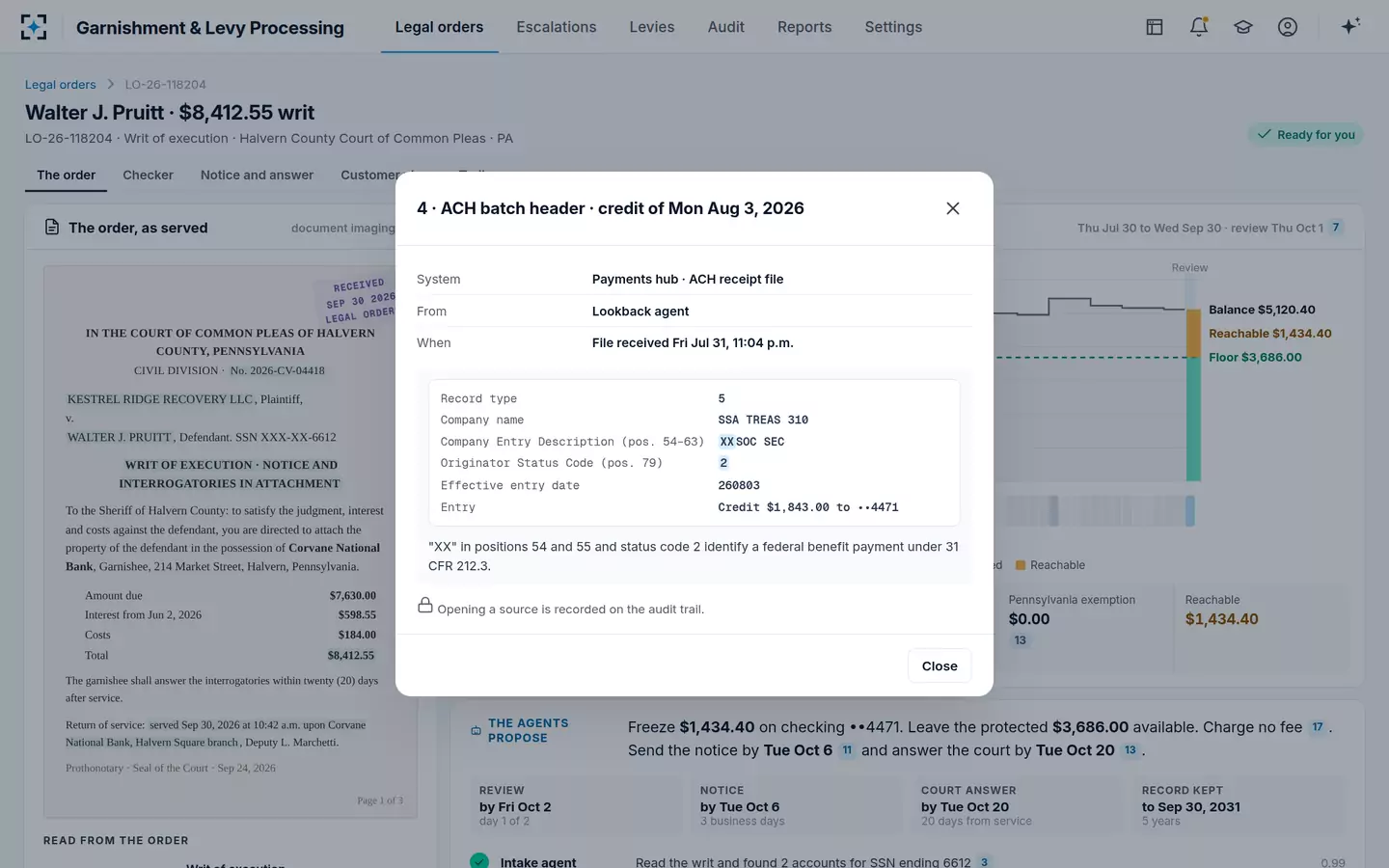
Counts: "XX" in positions 54 and 55 of the Company Entry Description and "2" in the Originator Status Code of the batch header.
Does not count: A deposit described as a benefit without that coding, or a commercial payment that happens to carry "XX".
Counts: Any coded benefit in the account, including a co-owner's or a second beneficiary's.
Does not count: Benefits moved into this account from another one. The bank may not trace transfers.
Counts: From the open of business on the earliest date of the lookback to the close of business on the day before the review.
Does not count: A benefit posted on the day of the review, or before the lookback began.
Counts: The balance when the review is performed, including that day's posted withdrawals and deposits.
Does not count: The opening balance, or the balance on the date the order was served.
How is the garnishment protected amount calculated?
Add up every federal benefit payment that posted by direct deposit during the lookback period, compare the total with the account's balance at the moment of the review, and protect the smaller of the two. If no benefit payment posted in the period, there is no protected amount and the bank follows its customary procedures (31 CFR 212.5(b)). If one did, the bank "shall immediately calculate and establish the protected amount" and "shall ensure that the account holder has full and customary access" to it (212.6(a)).
Three properties of the calculation surprise people. It is per account: the bank calculates "separately for each account in the name of an account holder" (212.6(b)). It is final: an amount the bank calculates and establishes this way "shall be conclusively considered to be exempt from garnishment under law" (212.6(c)). And it ignores almost everything else about the account. The review is done "without consideration for" commingled funds, a co-owner, multiple beneficiaries or programs, the balance (if above zero), "Instructions to the contrary in the order", or "The nature of the debt or obligation underlying the order" (212.5(d)).
The protected amount is a floor, not a ceiling on the customer's rights. Funds above it may still be exempt under federal or state law; the rule preserves "an individual's right under Federal law to assert against a creditor a further exemption from garnishment for funds in excess of the protected amount" (212.8(a)), and state law may protect more (212.9(b)).
What is the garnishment lookback period?
The lookback period is the two months before the review, counted backwards. In the rule's words, it "begins on the date preceding the date of account review and ends on the corresponding date of the month two months earlier, or on the last date of the month two months earlier if the corresponding date does not exist" (31 CFR 212.3). The anchor is the review date, not the date the order arrived, which is why a review done on day two looks back one day later than a review done on day one.
The rule's own lookback examples: the review date sets the window
| Order received | Review performed | Lookback begins | Lookback ends | What it tests |
|---|---|---|---|---|
| Wed, Mar 17 | Wed, Mar 17 | Tue, Mar 16 | Sat, Jan 16 | Same-day review |
| Wed, Nov 17 | Thu, Nov 18 | Wed, Nov 17 | Fri, Sep 17 | Next-day review |
| Tue, Aug 30 | Thu, Sep 1 | Wed, Aug 31 | Wed, Jun 30 | No June 31: use the last day of the month |
| Fri, Dec 10 | Tue, Dec 14 | Mon, Dec 13 | Wed, Oct 13 | A weekend between receipt and review |
The boundaries are inclusive in practice, and the rule's examples show it. In its second protected-amount example the lookback runs from December 1 back to October 1, and benefit payments on both December 1 and October 1 are counted. The wording behind it, payments posted "between the close of business on the beginning date of the lookback period and the open of business on the ending date", reads backwards because the "beginning date" is the later one.
Why test the protected amount with planted cases, not a sample of live orders?
A live sample measures the cases a bank happens to get; a planted set measures the rule. Most orders against accounts with benefits are ordinary: one beneficiary, monthly deposits, a balance well above or below the total. The cases that produce violations, such as a co-owner's benefits, a benefit moved to savings, a review across a month end or a weekend, a deposit landing on the review date, are rare enough that a sample of fifty orders may contain none of them. A planted set contains every one, with the answer known in advance.
Examiners grade the result in the same binary way. The OCC's worksheet asks "Does the financial institution appropriately calculate and establish the protected amount", and warns that in expanded procedures "a 'no' answer indicates a violation and should be explained in the work papers" (OCC Comptroller's Handbook, Garnishment of Accounts). The Federal Reserve's procedures ask examiners to "Determine that the account holder has full and customary access to the protected amount established after the account review" (Federal Reserve Consumer Compliance Handbook). A bank that has run its own planted set knows its answer to those questions before the examiner asks.
A sample tells you how often the desk is right on the orders it usually gets. A planted set tells you whether it is right on the orders that cause violations.
Fourteen planted cases that settle whether the protected amount is right
Build each case as a test account in a non-production copy of the core, with real ACH batch headers, and serve a test order against it. The answer column comes from the rule text and the Fiscal Service guidelines, not from the tool under test. Run the set before go-live, after any change to the code or model, and once a year for the examiners' file.
Planted cases for testing a garnishment protected amount, with the answer each must produce
- Balance above two coded benefit deposits
Protect the sum; freeze the rest under state law; send the notice. (Appendix C, protected-amount example 2: $4,500 protected of a $5,000 balance.)
- Balance below the benefit deposits
Protect the whole balance; nothing to freeze; no notice is required. (Example 1: $1,000 balance against $2,500 of benefits.)
- A co-owner's benefits in the same account
Count them. (Example 5: $7,000 protected, including $4,000 paid to the co-owner.)
- Benefits under two programs or to two beneficiaries
Count them all; the review ignores "multiple beneficiaries, and/or ... multiple programs".
- A benefit moved to savings the same day
Protect it in checking only; savings gets nothing for it. The bank "shall not trace the movement of funds between accounts".
- A Treasury check deposited at a branch or by mobile
Not counted by the bank's review; the customer may still claim the exemption through the court.
- A commercial ACH credit with "XX" but status code 1
Not counted. Confirm the "2" at position 79 or the payment description before treating a deposit as a benefit.
- Order received on the 30th, reviewed on the 1st
Lookback ends on the last day of the month two months back when the date does not exist. (Lookback example 3: back to June 30.)
- Order received Friday, reviewed Tuesday
Lookback starts Monday, the day before the review, not the day of receipt. (Lookback example 4.)
- A benefit that posts on the morning of the review
Outside the lookback, but inside the balance. (Example 4: $2,000 protected, $1,000 held, though $3,000 of benefits had posted in all.)
- A withdrawal before the review on the same day
Use the balance when the review is performed. (Example 3: $3,000 protected, $2,000 frozen after a $1,000 withdrawal.)
- The same order served a second time
No second review and no new action; a new or different order gets a new review.
- A state child support order with the Notice of Right to Garnish
No lookback; customary procedures. Without the notice, the same order gets the full review.
- An IRS notice of levy
Outside the rule: the Fiscal Service places IRS tax levies outside it. Route it to the 21-day hold.
Score each case pass or fail, not by how close the number came. A protected amount that is a cent too low is a frozen benefit; one that is too high is money the creditor was entitled to. Keep the planted set, the expected answers and every run, with dates, in the same place as the bank's procedures.
Does a co-owner change the protected amount?
No. The rule tells the bank to review the account without regard to "The existence of a co-owner on the account" (31 CFR 212.5(d)(2)), and its fifth example settles the arithmetic. A $3,800 order against an account holding $7,000, into which four benefit payments totalling $7,000 posted during the lookback, two of them $3,000 to the debtor and two of them $4,000 to the co-owner: the bank protects all $7,000, "equal to the sum of the four benefit payments", and has nothing left to freeze.
What happens to a joint account's funds above the protected amount is a different question, answered by state law, and it is one a bank's procedures should send to a person rather than a rule table. The sample bank's desk in the solution treats a joint account with an owner who is not the debtor as one of six escalation types.
Is a mobile-deposited Treasury check protected?
Not by the bank's automatic review. The rule's definition of a benefit payment covers only a payment "paid by direct deposit" with the Treasury's coding, and the Fiscal Service tells banks that its guidelines "apply only to federal benefits paid electronically via the ACH" and that "Financial institutions are not responsible for examining accounts to identify federal benefits paid by Treasury check" (Fiscal Service guidelines). The money may still be exempt; the customer has to claim it through the court or the creditor, and the notice explains how.
The same logic excludes a commercial payment that carries "XX" by coincidence. The guidelines warn that "it is possible that a commercial payment could also have an 'XX' encoded in Positions 54-55", and tell banks to confirm with the "2" in the Originator Status Code (position 79) or the payment description. A test set that includes one such credit finds out quickly whether a tool reads two fields or one.
Every benefit deposit opens the ACH batch header that makes it one
Can Social Security be garnished from a bank account?
By an ordinary creditor, mostly not: two months of directly deposited Social Security in the account is protected automatically, and more can be claimed as exempt. By the United States or a state child support agency with a Notice of Right to Garnish Federal Benefits, it can be reached, and the bank follows its customary procedures (31 CFR 212.4(b)). By the IRS, it can be levied: the tax code exempts from levy only the property on its own list, and says so in spite of the Social Security Act's protection of benefits (26 U.S.C. 6334(c)).
For a test set, that gives three different right answers for the same Social Security deposit, depending only on who issued the order. A tool that applies the lookback to every order is wrong twice out of three; one that skips it whenever a government name appears on the order is wrong whenever a state court writ names a public creditor without the federal notice.
Timing traps: the review-day deposit, the intraday withdrawal and the month end
Two of the rule's five protected-amount examples and all four of its lookback examples are about timing, and timing is where hand calculation and naive code both fail. The deposit that posts on the morning of the review is in the balance but outside the lookback. The cash withdrawal at 10 a.m. before an automated review at noon lowers the balance that caps the protected amount. The review across a month end reaches back to a date that may not exist.
The rule's protected-amount examples, worked: benefits, balance and what is protected
| Example | Benefits in the lookback | Balance at review | Protected | Frozen or held | Notice? |
|---|---|---|---|---|---|
| 1. Balance below benefits | $2,500 | $1,000 | $1,000 | $0 | No |
| 2. Three monthly payments | $4,500 | $5,000 | $4,500 | $500 | Yes |
| 3. Withdrawal before review | $3,000 | $5,000 after a $1,000 withdrawal | $3,000 | $2,000 | Yes |
| 4. Benefit posted on review day | $2,000 (the $1,000 posted that day is outside) | $3,000 | $2,000 | $1,000 | Yes |
| 5. Co-owner's benefits | $7,000 | $7,000 | $7,000 | $0 | No |
The Fiscal Service explains why the balance moves with the day: the agencies revised the definition so that "the account balance will include intraday items, such as ATM or cash withdrawals or deposits, already posted that day" (Fiscal Service FAQ). A test that takes the balance from last night's file will pass example 2 and fail example 3.
What to do when a computation and its check disagree
Stop and give it to a person. The planted set measures a tool before go-live; on live orders, the equivalent control is a second, independent computation of every protected amount. In Garnishment & Levy Processing, a Recheck agent recomputes each protected amount from the core's raw posting journal without seeing the first result, on a different model family, with a tolerance of $0.00. Any difference, a returned benefit, a joint account or an unflagged benefit goes to a specialist.
One night on the sample desk: how many orders reached a person
When the blind recheck disagrees, nothing moves
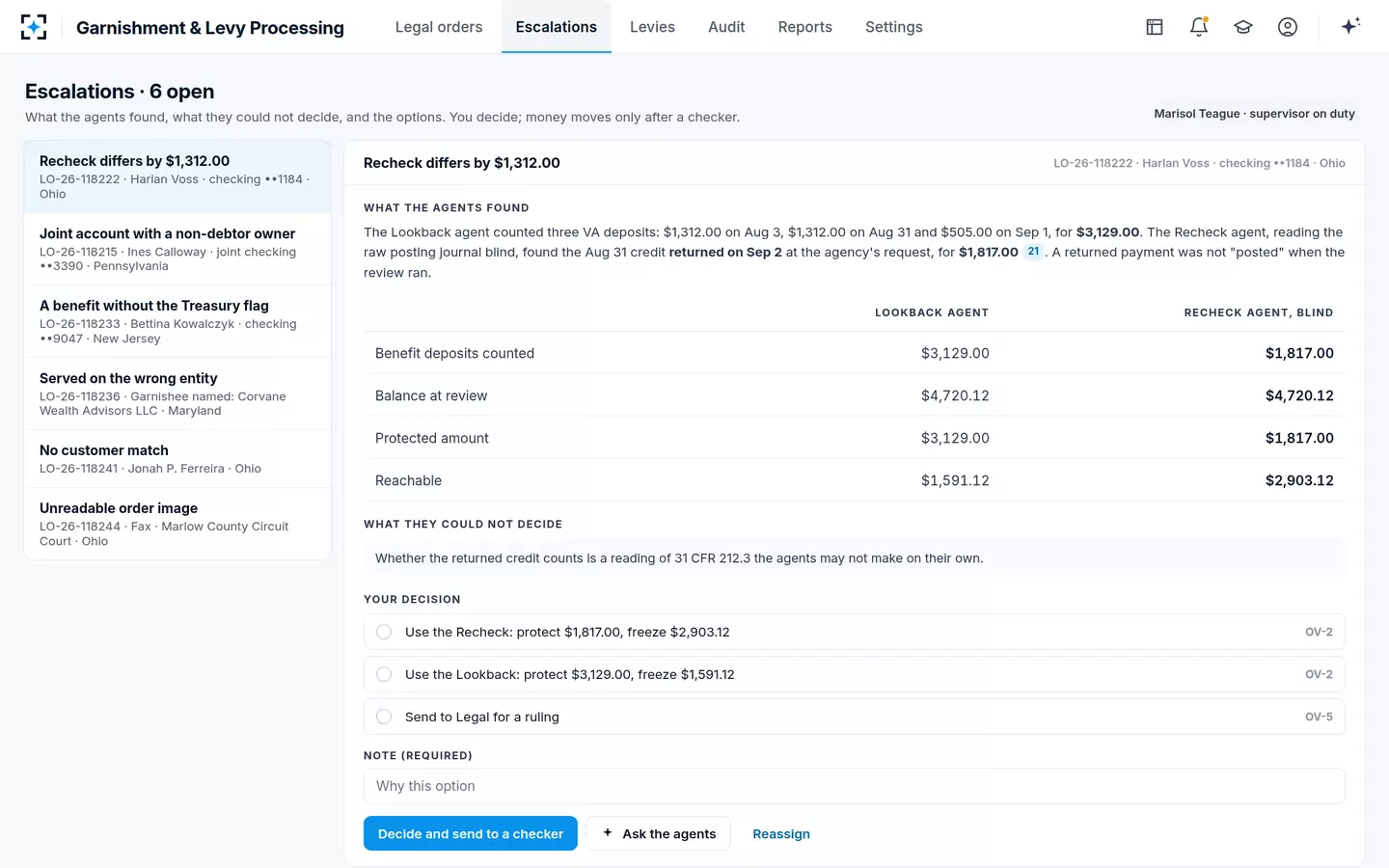
The returned credit is a good case to add to a planted set precisely because the answer is a policy decision, not arithmetic. A bank should decide it once, with counsel, write it into its procedures and test that the tool escalates it rather than deciding. 31 CFR Part 212 in plain words sets out the rest of the rule around the calculation, and Garnishment & Levy Processing shows the lookback and the recheck on a full order.
Questions people ask
Is the protected amount the same as the exempt amount?
No. The protected amount is what the bank must leave available automatically under 31 CFR Part 212: the lesser of coded benefit deposits in the two-month lookback and the balance at review. The exempt amount can be larger, because state law and other federal exemptions may protect more, but the account holder usually has to claim the rest through the court or the creditor.
Does the protected amount apply to every account the debtor has?
Each account gets its own review and its own protected amount, and the bank may not trace benefits moved between accounts. In the Fiscal Service's example, a $500 benefit deposited to one account and $300 of it moved to another the same day: the $500 is protected in the first account and nothing in the second.
Can the customer waive the protected amount?
Only by an express written instruction, dated and given after the order was served, to use protected funds to satisfy that order; the safe harbor covers a bank that honors one (31 CFR 212.10(d)(3)). A clause in the account agreement signed at opening does not do it, and the CFPB has treated garnishment waiver clauses in deposit agreements as unfair.
What if the balance is zero or negative when the bank reviews?
The review still has to determine whether benefits posted, but there is nothing to protect or freeze, and no notice is owed: a notice is required only when the balance was above zero, a protected amount was established and funds remain above it (31 CFR 212.7(a)).
How often should a bank re-run its planted cases?
Before go-live, after any change to the system or model that computes the amount, and at least yearly. Keep each run with its date and results; the rule asks for records sufficient to demonstrate compliance for at least two years from receipt of each order.