Garnishment processing at a bank falls to the garnishment specialist, often titled legal order specialist or legal process specialist: the person at a bank or credit union who handles court writs of garnishment, IRS notices of levy and state child support levies served against customers' deposit accounts. The job is to examine each order within two business days, protect federal benefit deposits under 31 CFR Part 212, place the hold, send the account holder the required notice, answer the court and, when the time comes, remit or release the funds. It is hard because each order type runs on a different legal clock and a mistake in either direction costs money: freeze protected benefits and the bank must restore them; release funds it was ordered to hold and it can owe the debt. Botminds' Garnishment & Levy Processing gives this desk six agents for the reading, the lookback arithmetic and the drafting, and keeps every freeze, release and remittance with two named specialists.
The seats and examples below come from a fictional sample bank, Corvane National Bank, as it runs through the solution; the rules are quoted from the regulations and the agencies that write them, linked where they appear.
The four clocks a garnishment specialist works to
2days
business, to examine a creditor order and review the account for federal benefits (31 CFR 212.4, 212.5)
3days
business, to send the account holder the notice after that review (31 CFR 212.7(f))
21days
calendar, that a bank holds deposits under an IRS levy before it surrenders them (26 U.S.C. 6332(c))
45days
to respond to a quarterly child support data match (HHS Office of Child Support Services)
What does garnishment processing involve? Four order types, four clocks
A garnishment specialist decides what happens to a customer's money when a legal order arrives, and decides it on a deadline. The work splits by who issued the order, because the issuer decides which rules apply. A creditor's writ from a state court triggers the federal benefits review. An IRS notice of levy does not: the Bureau of the Fiscal Service says plainly that IRS tax levies are outside the rule (Fiscal Service FAQ). A state child support levy that carries the agency's Notice of Right to Garnish Federal Benefits follows the bank's customary procedures instead (31 CFR 212.4(b)).
So the first duty in any role description is classification, and it has a deadline of its own. Treasury's rule says that "Prior to taking any other action related to a garnishment order issued against a debtor, and no later than two business days following receipt of the order," the bank must examine it for that notice. A specialist who opens the order on day three has already missed a clock that every other step depends on.
After classification the duties diverge. For a creditor writ: find every account the debtor owns, run the two-month lookback on each, set the protected amount, freeze only what sits above it under state law, send the notice within three business days, and answer the court's interrogatories by the date in the writ. For an IRS levy: freeze up to the levy amount, wait 21 days, watch for a release, then surrender. For a child support levy: check for the notice, hold the balance, remit on the agency's instruction, and answer the quarterly data match.
What is legal order processing, and what counts as a legal order on a bank account?
Legal order processing is the bank's handling of any instruction from a court or government body that reaches a customer's account. Treasury's rule defines a garnishment order broadly: "a writ, order, notice, summons, judgment, levy or similar written instruction issued by a court, a State or State agency, a municipality or municipal corporation, or a State child support enforcement agency, including a lien arising by operation of law for overdue child support or an order to freeze the assets in an account" (31 CFR 212.3). Subpoenas for records often land on the same desk; they ask for documents rather than money and run on different rules.
The names change by state: New York's civil practice law, for one, works through a restraining notice served on the bank (CPLR 5222). A role description that lists "processes garnishments" says almost nothing; one that lists the order types the desk receives, the states it covers and the clock each order starts tells a candidate what the work is.
The legal order desk, seat by seat
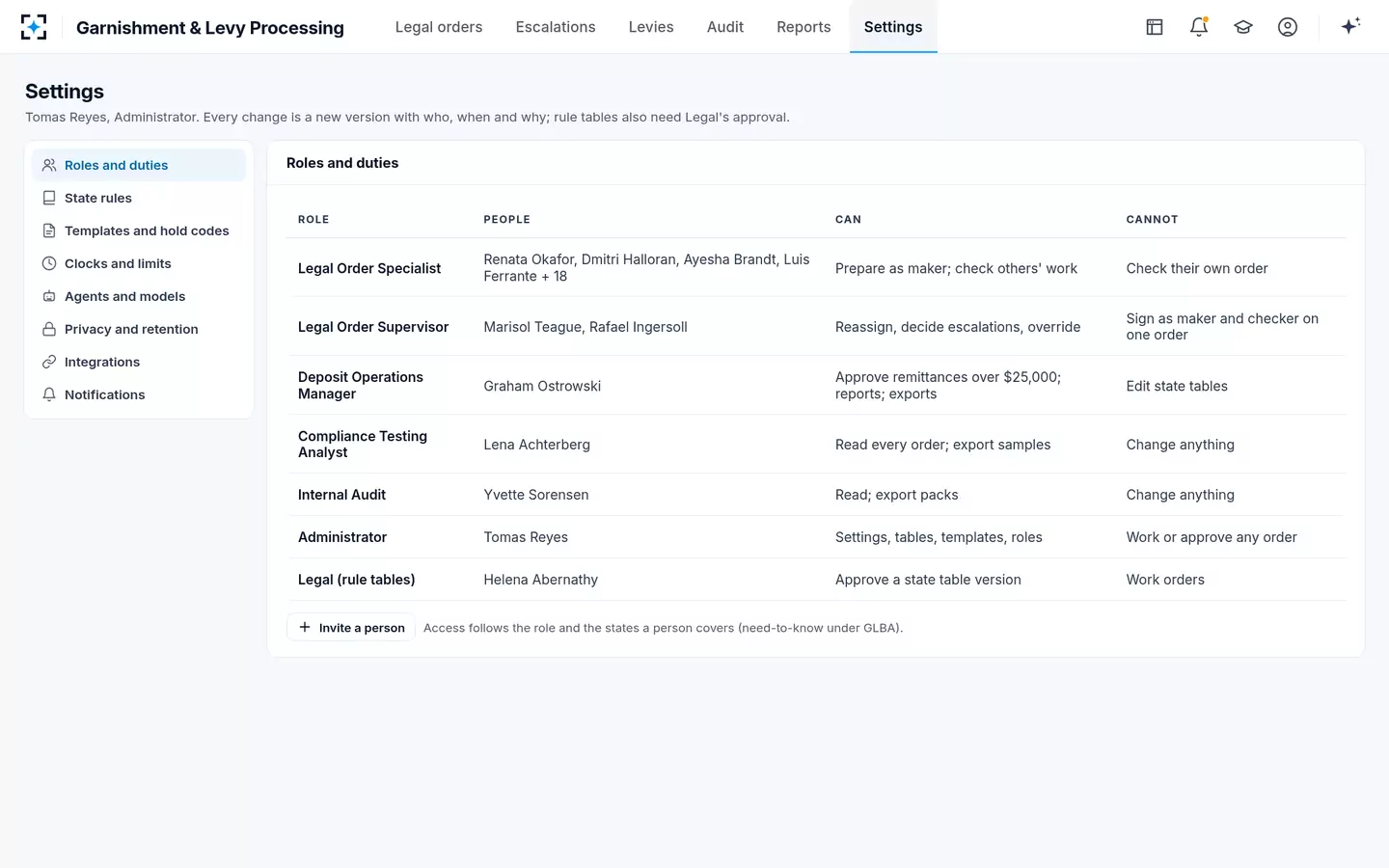
A legal order desk of any size has five seats, even when one person sits in two of them. The specialist who prepares the decision is the maker. A second specialist checks it. A supervisor owns the clocks and decides the cases nobody should decide alone. A deposit operations manager owns the service levels, the fees and the examiner file. An administrator keeps the state rule tables, notice templates and hold codes, and should never work an order.
Five seats on one legal order desk, before and after Garnishment & Levy Processing
Today
Keys each order into the case system, searches the core by name and SSN, scrolls two months of statements and adds up benefit deposits on a calculator.
With agents
Opens each order with the fields read, the lookback drawn and a plan in one sentence; approves, overrides with a reason code, or asks the order a question.
Still theirs: The decision to freeze, and every override.
Today
Spot-checks a sample of holds and notices after the fact.
With agents
Checks every freeze, release, notice and court answer on the same evidence, with a second computation beside the first.
Still theirs: The second signature. Never on an order they made.
Today
Watches every clock by hand and reassigns work as orders pile up.
With agents
Is warned two hours before a clock runs out and decides each escalation from what the agents found and could not decide.
Still theirs: Escalations: joint owners, returned benefits, wrong entity served.
Today
Pulls an order's file together from imaging, the core and the case system when an examiner asks.
With agents
Builds an examiner pack for any order from the audit trail and approves remittances over a set amount.
Still theirs: Service levels, fees, and large remittances.
Today
Keeps each state's exemption rules in a procedure binder that specialists look up by hand.
With agents
Keeps versioned state rule tables, each approved by Legal before it applies.
Still theirs: Settings only. Cannot work or approve an order.
The split between maker and checker is not decoration. Treasury's safe harbor protects a bank from liability for bona fide errors only when they happen despite reasonable procedures to prevent them (31 CFR 212.10(d)(1)). A second person checking the evidence, not just the arithmetic, is the most ordinary reasonable procedure there is, and the role description should say who may sign what.
Duties the garnishment desk must cover, rule by rule
The strongest role descriptions borrow their duty list from the regulations, because that is the list the examiner will test. The table below turns each obligation into a duty, with its clock and the seat that owns it.
Garnishment specialist duties, each tied to the rule that creates it
| Duty | Rule | Clock | Seat |
|---|---|---|---|
| Examine the order for a Notice of Right to Garnish Federal Benefits | 31 CFR 212.4(a) | 2 business days from receipt | Maker |
| Review each account for federal benefit deposits; set the protected amount | 31 CFR 212.5, 212.6 | 2 business days from receipt of the order and enough information to identify the account holder | Maker, then checker |
| Freeze only funds above the protected amount, under state law | 31 CFR 212.6(d) | With the review | Maker, then checker |
| Send the account holder the notice with its eleven required items | 31 CFR 212.7 | 3 business days from the review | Maker drafts, checker signs |
| Charge no garnishment fee against protected funds | 31 CFR 212.6(h) | Fee window closes 5 business days after review | Maker, policy set by manager |
| Hold IRS-levied deposits, honor any release, then surrender | 26 U.S.C. 6332(c); 26 CFR 301.6332-3 | 21 calendar days, surrender the next business day | Maker and checker |
| Answer the quarterly child support data match | 42 U.S.C. 666(a)(17) | Within 45 days | Specialist, often a named FIDM owner |
| Keep records sufficient to show compliance | 31 CFR 212.11(b) | At least 2 years from receipt of the order | Manager |
Two duties are often missing from posted role descriptions. The first is the account search itself. The IRS's levy form tells the recipient to "Make a reasonable effort to identify all property and rights to property belonging to this person. At a minimum, search your records using the taxpayer's name, address, and identifying number(s) shown on this form" (IRM 5.11.4.11.1). The second is the record: the rule asks for records "sufficient to demonstrate compliance" for at least two years, which means the specialist's working notes are part of the job, not an afterthought.
Who answers a writ of garnishment at a bank?
The bank answers as garnishee, and in practice a garnishment specialist prepares the answer and a second person signs it. Most state writs ask the garnishee to answer interrogatories: whether it holds property of the debtor, how much, in which accounts. Federal and IRS practice adds a point about who receives the order in the first place. The IRS manual says a notice of levy "may be served in person upon a person authorized to accept receipt" at a branch, and that the person who signs for it is expected to process it and freeze the accounts at once (IRM 5.11.4.11).
That makes branch staff part of the desk whether the org chart says so or not. A role description for the central team should include the routing duty: every branch that can be served must know where an order goes the same day, because the two-business-day clock starts at receipt, not when the legal order team first sees it.
The answer also has to say where the money is. The CFPB found that one large bank, in "at least 3,700" out-of-state orders from states that restrict out-of-state garnishment, answered the court without telling it that the customer's account sat outside the state that issued the order (CFPB consent order 2022-CFPB-0002). Which states those were, and what the order required afterwards, is set out in what states prohibit bank account garnishment.
Who may do what, written into the settings rather than the binder
How many garnishments does a bank process?
No agency publishes a count of garnishments served on banks, so volumes have to be read from the edges. The IRS reported 339,137 notices of levy on third parties in fiscal 2025, up from 313,792 the year before, counting levies from its Automated Collection System and field collection; those reach employers and other holders as well as banks (IRS Data Book 2025, Table 4-1). In its 2022 order against Bank of America the CFPB said the bank "processed hundreds of thousands of Garnishment Notices issued by courts across the country" between August 2011 and March 2022 (CFPB).
The same desk runs clocks of very different lengths, and the shortest decide the most
- Examine and review2 bd
- Notice to the account holder3 bd
- Freeze and hold; a release may arrive21 days
- Surrender, next business day+1
Inside a bank, the planning number is the daily intake by order type, and it is worth putting in the role description because it changes the work. At the fictional sample bank the desk received 4,186 orders in September 2026, and 31% touched an account with federal benefits; on one Wednesday, 204 arrived, and 63 of their accounts held federal benefit deposits. A desk where a third of orders need a lookback is a different job from one where most are levies that simply wait out a hold.
What skills should a bank hire and train for on the garnishment desk?
The skills that matter are reading, counting and judgment under a clock, in that order. Candidates who have worked deposit operations or collections often have the first two. The judgment comes from knowing where the rule stops and a person has to decide. The Treasury guidelines, for instance, warn that a commercial payment can carry the same "XX" by coincidence, so a specialist must confirm the "2" in the originator status field before treating a deposit as a protected benefit (Fiscal Service guidelines).
Skills to test for when hiring a garnishment specialist
- Reads an order and finds its type, issuer, amount, debtor and service date
Including whether a Notice of Right to Garnish Federal Benefits is attached. Give candidates two real-looking orders and a clock.
- Counts business days and calendar days correctly
Two business days for the review, three for the notice, five for the fee window, 21 calendar days for the IRS hold.
- Reads an ACH batch header
"XX" in positions 54 and 55 of the Company Entry Description and "2" in the Originator Status Code mark a federal benefit payment; the deposit's name does not.
- Applies the lookback dates
From the day before the review back to the same date two months earlier, or the last day of that month when the date does not exist.
- Knows the state's exemption rules for the states the desk covers
Including which state's law applies when the court and the customer are in different states.
- Writes a notice a customer can understand
The rule asks for "readily understandable language", and Appendix A gives a model.
- Escalates instead of guessing
Joint accounts, returned benefits, orders served on the wrong entity, and anything the rule does not settle.
- Keeps confidential what must stay confidential
Legal orders sit near suspicious activity reporting; nothing on a customer-facing screen should hint at one.
Separation of duties: maker and checker belong in the desk's procedure
Examiners test the work, not the title, and their tests read like a duty list. The OCC's examination worksheet for this rule asks, among eleven questions, whether the bank sends the notice "within three business days of account review" and whether it keeps garnishment fees off the protected amount. The same booklet tells examiners that in expanded procedures any no is a violation (OCC Comptroller's Handbook, Garnishment of Accounts, 2014). It also says the worksheet can be used for "training", which makes it a ready-made test for a new hire.
A second specialist checks the evidence, not the maker's arithmetic
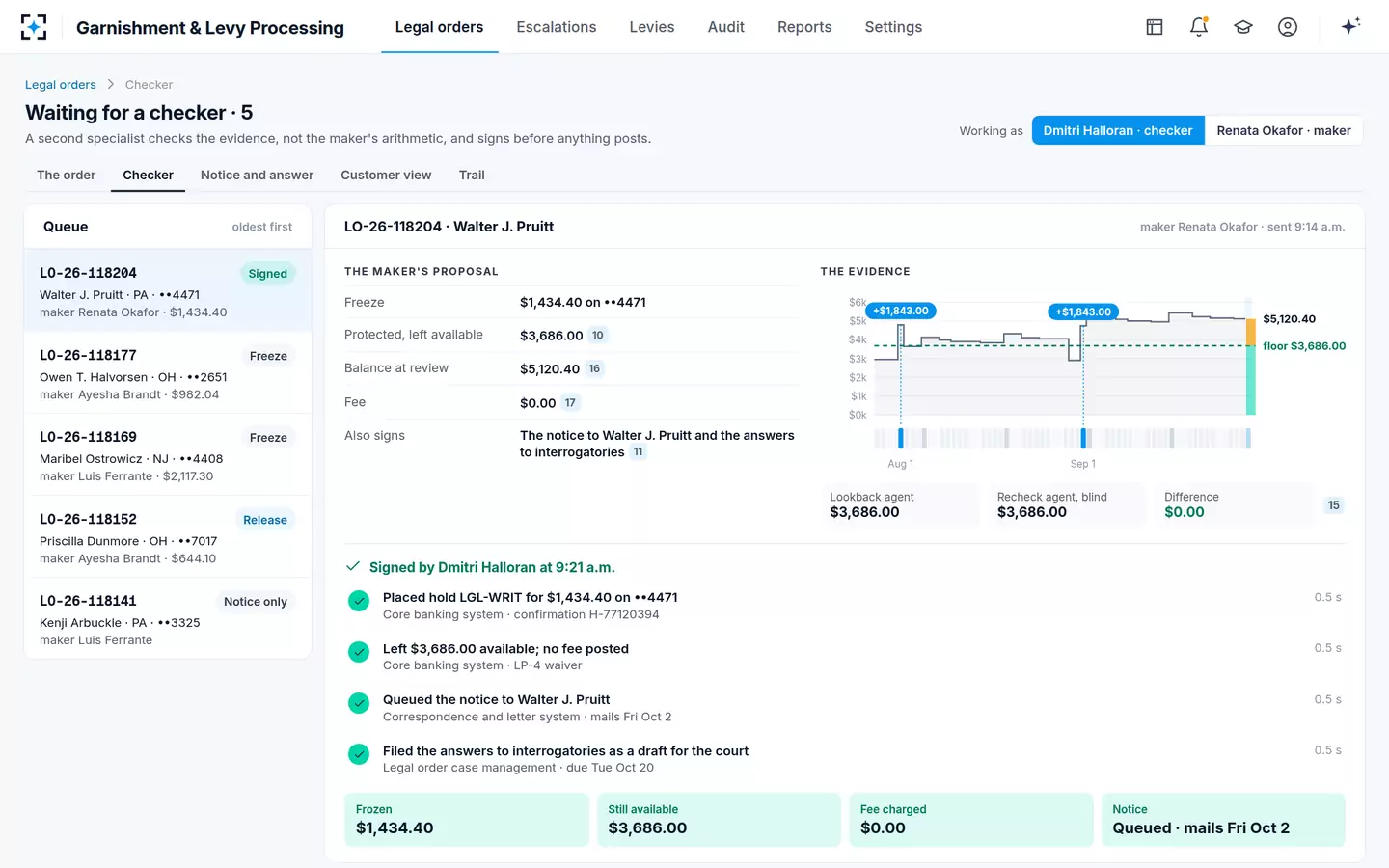
Writing maker and checker into the role also answers a staffing question. A desk that cannot spare a second person for every freeze will check a sample after the fact, which is how errors reach customers. If the reading and the lookback take most of a specialist's day, the check gets squeezed first; if they take minutes, the check is affordable. Legal order processing, traced follows one writ through every decision to show where those minutes go.
Where Garnishment & Levy Processing changes the desk, and where it does not
The solution takes the mechanical half of the role description and leaves the accountable half alone. Six agents read each order and score their confidence in each field, find the debtor's accounts by SSN or date of birth, never by name alone, draw the lookback from the ACH batch headers, apply the state's rule table, recompute the protected amount blind from the core's posting journal, and draft the hold, the notice and the court answer. Below 0.95 confidence on the amount, the debtor or the service date, the reading agent stops and asks a person.
What stays with people is everything that moves money or speaks for the bank. The agents never place or release a hold, send a notice, pay, or change a customer record, and nothing freezes until a maker approves and a second specialist checks. At the fictional sample bank the median specialist time per order in September was 7.6 minutes; our own estimate of the same work by hand is about 28 minutes. Neither is a customer's measured result, but the difference is the room a desk needs to check every order instead of a sample.
For a desk, that changes the role description's emphasis rather than its content: fewer hours keying and adding up, more on judgment, escalations and the checker's signature. The specialist still needs every skill on the checklist above, because the agents' work is only as good as the person who signs it. To see the seats working on one order, start from Garnishment & Levy Processing.
Questions people ask
What is a legal process department in a bank?
It is the team that receives and handles legal orders served on the bank: writs of garnishment, levies, restraining notices, child support orders and, often, subpoenas for records. It decides within the rules' clocks what to freeze, what to protect and what to answer, and keeps the file an examiner will test. Banks also call it legal order processing or the levy and garnishment unit.
Is a garnishment specialist the same as a payroll garnishment specialist?
No. A payroll garnishment specialist works for an employer and withholds from wages under the federal wage garnishment limits, generally the lesser of 25% of disposable earnings or the amount by which they exceed 30 times the federal minimum wage (Department of Labor Fact Sheet #30). A bank's garnishment specialist works on deposit accounts, where the federal benefits review of 31 CFR Part 212 and state account exemptions apply instead.
Does a garnishment specialist decide whether funds are exempt?
Partly. The specialist must protect the federal benefit amount the rule defines, and apply any exemption state law tells the bank to apply automatically. Further exemptions are claimed by the account holder through the court or the creditor; the notice tells them how, and the bank follows the court's ruling.
What training does a new legal order specialist need?
Start with the rule texts the desk works under, 31 CFR Part 212 and its Appendix C examples, 26 CFR 301.6332-3 for IRS levies, and the states the desk covers. The OCC's garnishment worksheet is designed partly for training and lists the eleven questions an examiner asks. Then shadow a checker for a few weeks before signing as maker.
Can one person be maker and checker on a small desk?
Not on the same order, if the control is to mean anything. A small bank can rotate the roles between two people or use a trained colleague from deposit operations as checker; what matters is that the person who signs second looked at the evidence independently.