The IRS levy 21-day rule says that a bank served with an IRS notice of levy on a customer's deposits must hold the money for 21 days before paying it to the IRS. The statute is one sentence: a bank "shall surrender ... any deposits (including interest thereon) in such bank only after 21 days after service of levy" (26 U.S.C. 6332(c)). The Treasury regulation fills in the rest: the 21 days are calendar days, the levy reaches only what was on deposit when it was served, no withdrawals are allowed during the hold, and if no release arrives the bank surrenders "on the first business day after the holding period" (26 CFR 301.6332-3). So day 1 is the freeze, day 21 is the last day of waiting, and day 22, or the next business day, is the payment. An IRS levy is also the one common order that sits outside the federal benefits rule; Botminds' Garnishment & Levy Processing routes it to its own path, where a remittance and release agent watches each hold and two specialists sign the surrender.
One IRS levy on a 2026 calendar: served on the 4th, held 21 days, paid on the 27th
Mon
Tue
Wed
Thu
Fri
Sat
Sun
- Levy served
- Hold, days 1 to 21
- Holiday
- Surrender
What is the IRS 21-day rule, and why does it exist?
It is a waiting period written into the tax code for banks alone. Most holders of a taxpayer's property must surrender it on demand; a bank, as defined in the code, surrenders deposits "only after 21 days after service of levy" (26 U.S.C. 6332(c)). The subsection was added by the Technical and Miscellaneous Revenue Act of 1988, Pub. L. 100-647, and the regulation that implements it applies to levies issued on or after January 4, 1993.
The IRS explains the purpose in its manual: the holding period was "established to settle disputes regarding ownership of bank accounts before money is remitted to IRS" (IRM 5.11.4.1). Three weeks gives the taxpayer time to call about an error, a co-owner time to claim the money is theirs, and the IRS time to release a levy that should not have been issued, before the money leaves the bank.
The IRS bank levy in numbers
21days
calendar, that the bank holds levied deposits before surrender (26 CFR 301.6332-3)
50%
penalty on top of personal liability for failing to surrender without reasonable cause (26 U.S.C. 6332(d)(2))
339,137
notices of levy the IRS requested on third parties in fiscal 2025, up from 313,792
1988
year the 21-day bank rule entered the tax code (Pub. L. 100-647)
Is the IRS levy 21 days or business days?
Calendar days for the hold, and a business day for the payment. The regulation says the bank surrenders "only after 21 calendar days after the date the levy is made", and then "on the first business day after the holding period, or any extension thereof, expires" (26 CFR 301.6332-3(c)(1)). The IRS manual puts it the same way: "On the next business day after the holding period expires, the bank must surrender the funds in the account, up to the amount of the levy" (IRM 5.11.4.2).
The regulation's first example settles the count. A levy served on April 2 is held through April 23, "the last day of the holding period", and surrendered on April 24, "the first business day after the 21-day holding period". Counting day 1 as the day after service, day 21 is the last day of the hold and day 22 is the earliest possible surrender. A weekend or holiday pushes it later, never earlier: a levy served on Wednesday, November 4, 2026 ends its hold on Wednesday, November 25, and since Thursday, November 26 is Thanksgiving, the surrender falls on Friday, November 27 for a bank open that day.
Getting this one day wrong is easy and it matters. A system that pays on day 21 has surrendered before the law allows and before a release that could still arrive that day. Whatever tool a desk uses, it is worth testing its computed surrender date against the regulation's own April example.
Day 1: what the bank does when the levy is served
The bank freezes the levied deposits at once, up to the amount on the levy, and searches for every account the taxpayer can draw on. The IRS expects the person who accepts service at a branch to "immediately process the levy and freeze the affected accounts" (IRM 5.11.4.11). The levy takes effect when it is made: for one served by certified mail, the IRS treats the delivery date on the return receipt as the date of levy.
Four rules shape what is frozen. The levy "applies to those funds on deposit at the time the levy is made, up to the amount of the levy", and "No withdrawals may be made on levied upon deposits during the 21-day holding period" (26 CFR 301.6332-3(c)(3)). It reaches any account the taxpayer has an unrestricted right to draw on, joint accounts included: in the IRS manual's example, a $2,000 levy on a joint account funded entirely by a third party lets the bank send the whole balance, because "the taxpayer's unrestricted right to withdraw the funds is an interest which is subject to levy" (IRM 5.11.4.3). The federal benefits review does not apply: the Fiscal Service's FAQ places IRS tax levies outside Treasury's garnishment rule (Fiscal Service FAQ; the rule itself is in 31 CFR Part 212 explained). And deposited benefits are not exempt from the IRS: no property is exempt from levy beyond the code's own list, "Notwithstanding any other law of the United States (including section 207 of the Social Security Act)" (26 U.S.C. 6334(c)).
An IRS levy and a creditor's writ, on the same account
IRS notice of levy: Does not apply.
Creditor's writ from a state court: Required within 2 business days unless a Notice of Right to Garnish is attached.
IRS notice of levy: Deposits on hand at service, up to the levy amount, including protected-looking Social Security.
Creditor's writ from a state court: Only funds above the protected amount, as state law allows.
IRS notice of levy: 21 calendar days, then the next business day.
Creditor's writ from a state court: Until the court orders turnover or release.
IRS notice of levy: Not reached; a new levy is needed.
Creditor's writ from a state court: Not reached; the bank may not keep garnishing.
IRS notice of levy: Not under 31 CFR 212.
Creditor's writ from a state court: Within 3 business days of the review, eleven items.
IRS notice of levy: May not reduce the proceeds.
Creditor's writ from a state court: Never against the protected amount.
IRS notice of levy: Personal liability and a 50% penalty without reasonable cause.
Creditor's writ from a state court: Liability to the creditor under state law.
Days 1 to 21: what can change during the hold
Three things can happen while the money waits, and the bank must react to each. The IRS can release the levy in whole or in part. The IRS can ask for more time. And the depositors can waive the wait. The IRS manual sums up why the hold exists in one line: "During the holding period, a levy might be released, or the amount owed could decrease" (IRM 5.11.4.2).
The bank does not decide a release itself. Under the regulation, during the hold "the levy shall be released only upon notification to the bank" by the IRS of its decision to release (26 CFR 301.6332-3(c)(1)). A taxpayer who believes there is an error is told to call the number on the levy, and a third party who says the money is theirs files a wrongful levy claim with the IRS; for a dispute over ownership the IRS may ask the bank to hold the funds past day 21 with "a specific extension date to forward the funds" (IRM 5.11.4.3). A waiver runs the other way: a depositor may give up the hold, but on a joint account "all depositors listed as owners of the account must agree," and the bank sends notice of the waiver with the funds (26 CFR 301.6332-3(c)(4)).
Can an IRS levy be released during the 21 days?
Yes, and the tax code tells the IRS when it must. The IRS "shall release the levy" when the liability is satisfied or has become unenforceable, when release will help collection, when the taxpayer has an installment agreement (unless the agreement says otherwise), when the levy "is creating an economic hardship due to the financial condition of the taxpayer", or when the property is worth more than the debt and a partial release would not hinder collection (26 U.S.C. 6343(a)(1)).
Economic hardship comes up often on bank levies because a whole paycheck can be caught. The IRS manual says that "When an entire paycheck is deposited, an economic hardship may exist because all of the money is levied," and tells its staff to release the levy in whole or in part to avoid it (IRM 5.11.4.6). For the bank, every release is a document to match: the release must name the same taxpayer and levy, and the desk must apply it to the right hold before day 22, not after.
Every hold, release and surrender carries a maker's and a checker's signature
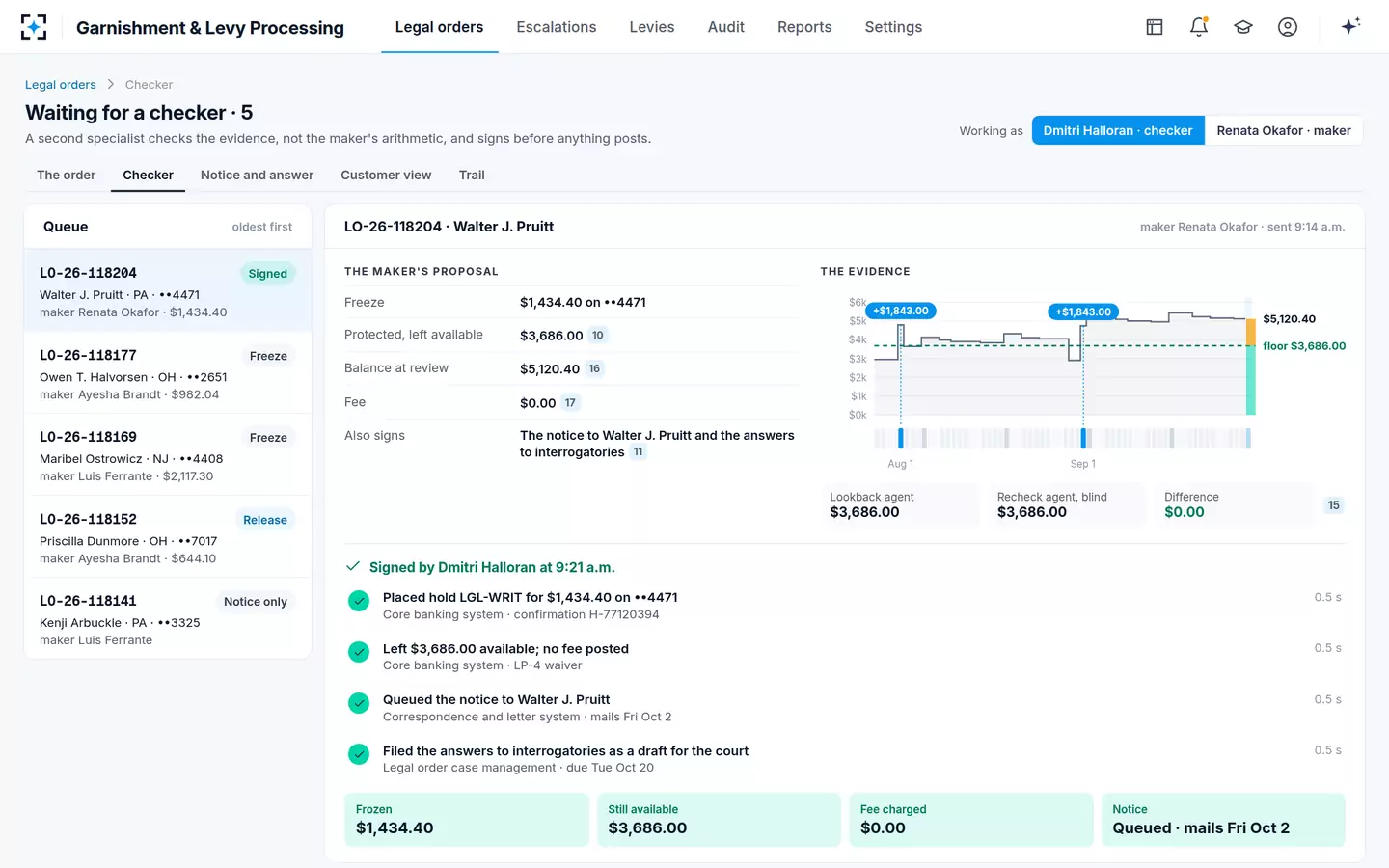
Day 22: the surrender, with interest, and without the fee
If no release arrives, the bank pays. "If the bank receives no release, it must surrender the funds in the account after the holding period. No additional notice is required" (IRM 5.11.4.2). The amount is the levied deposits plus the interest they earned before and during the hold under the account agreement, but never more than the levy. The regulation's examples settle the edge cases.
What the bank surrenders on an IRS levy: the regulation's six examples
| Example | Levy | On deposit when served | What is surrendered |
|---|---|---|---|
| 1. Balance below the levy | $10,000 | $5,000, interest-bearing | $5,000 plus interest through the last day of the hold |
| 2. A deposit the next day | $10,000 | $5,000, then $5,000 more | Still $5,000 plus interest: the later deposit is not reached |
| 3. Balance above the levy | $10,000 | $50,000 | $10,000; interest during the hold is not reached |
| 4. Levy slightly above balance | $5,002 | $5,000 | $5,002, with $2 of interest; the rest of the interest is not reached |
| 5. Certificate of deposit | $10,000 | $5,000 CD, early-withdrawal penalty | $5,000 plus interest, less the 30-day interest penalty |
| 6. CD maturing during the hold | $10,000 | $5,000 CD | $5,000 plus interest, with no penalty |
The bank's own fee cannot come out of the proceeds. The IRS manual's example has a $1,000 levy against $1,500 on deposit: the bank sends the full $1,000 and takes its fee from the remaining $500, and if only $800 is on deposit it sends all $800 with interest (IRM 5.11.4.4.3). The wider fee question, across creditor writs and state law, is in garnishment fee on a bank account.
What happens if a bank does not surrender on time?
The bank becomes liable for the money. A person who fails or refuses to surrender levied property "shall be liable in his own person and estate to the United States in a sum equal to the value of the property or rights not so surrendered", capped at the tax, with costs and interest; without reasonable cause, it also owes "a penalty equal to 50 percent of the amount recoverable" (26 U.S.C. 6332(d)). The other side of the bargain protects a bank that pays: honoring a levy discharges it "from any obligation or liability to the delinquent taxpayer and any other person with respect to such property" (6332(e)).
That pairing explains the IRS manual's joint-account example. The bank that sends the whole joint balance at the end of the hold "is not liable to the third party for any amount, even if the third party proves that the funds in the account did not belong to the taxpayer"; the third party's remedy is against the United States. For a legal order desk, the safe course is the one the code rewards: hold exactly what the levy reaches, honor any release the IRS sends, and pay on the right day.
Does an IRS bank levy take money deposited later?
No. A levy on deposits reaches what was in the account when it was made, and deposits made afterwards, including during the hold, are untouched. The regulation's second example has the taxpayer deposit another $5,000 the day after service; the bank still surrenders only the original $5,000 plus interest, "because the notice of levy ... attached only to those funds on deposit at the time the notice was served and not to any subsequent deposits" (26 CFR 301.6332-3). To reach new money, the IRS must serve another levy. This is the opposite of a wage levy, which the code makes continuous until released.
A day-by-day checklist for an IRS levy on deposits
- Day 0, at service: log the date the levy was made
For certified mail, the delivery date on the return receipt; route a branch-served levy to the desk the same day.
- Day 0: search by name, address and identifying number
The levy form asks for a reasonable effort to find all the taxpayer's property; call the number on the levy when a match is uncertain.
- Day 0: freeze deposits on hand, up to the levy amount
Every account the taxpayer can draw on, joint accounts included. No federal benefits review.
- Days 1 to 21: watch for a release, a reduction or an extension request
Apply each to the right hold, with a second person checking the match.
- Days 1 to 21: record any waiver
From every owner on a joint account, and send notice of it with the funds.
- Day 21: confirm the surrender date
The first business day after the 21st calendar day, later if a weekend or holiday intervenes.
- Surrender day: send deposits plus interest, up to the levy, without the fee
Collect any fee from money the levy did not reach.
- After: release the hold on anything above the levy
And do not freeze later deposits without a new levy.
Does the 21-day hold apply to credit unions?
Yes, to insured credit unions and to most deposit-taking institutions. The regulation's definition of a bank includes "Any credit union the member accounts of which are insured in accordance with the provisions of title II of the Federal Credit Union Act", as well as banks, trust companies, building and loan associations and state-supervised banking corporations (26 CFR 301.6332-3(b)). The IRS manual adds that "Bank" includes "credit unions, savings and loan associations, trust companies, and others described in IRC 408(n)".
Where Garnishment & Levy Processing fits on an IRS levy
In the solution, the Intake agent classifies an IRS notice of levy as such and keeps it out of the federal benefits review. A remittance and release agent watches every 21-day hold, matches any release against the order number and amount before drafting it, and drafts the surrender with its general ledger entry; it never pays or releases on its own. A specialist approves as maker, a second specialist checks, and at the fictional sample bank the deposit operations manager also approves any remittance over $25,000. Each step lands on an audit trail that an examiner or the IRS can follow.
The trail an examiner follows, for people and agents alike
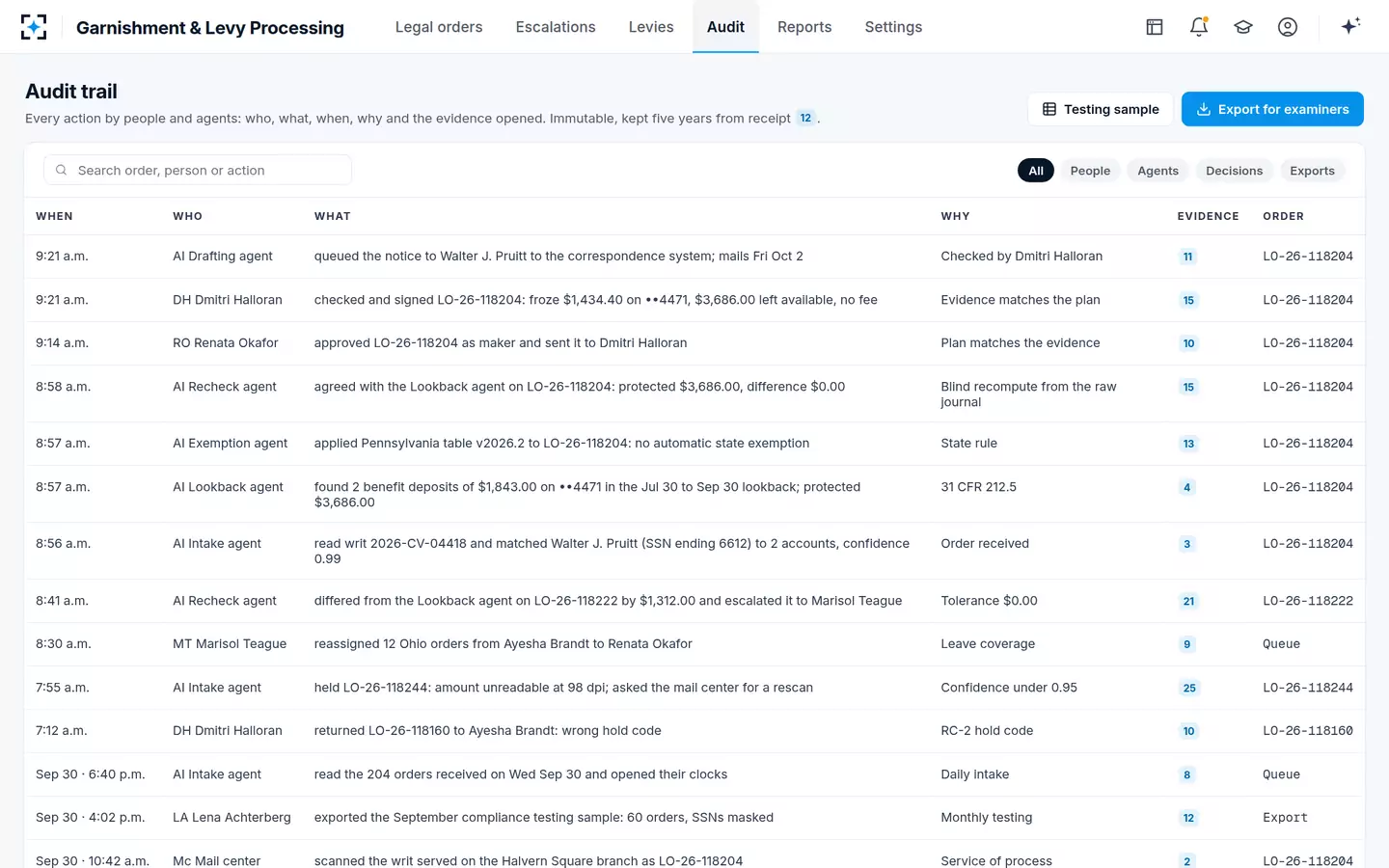
The solution's job on a levy is mostly timekeeping and matching, which is what goes wrong on a busy desk: a release applied to the wrong hold, a surrender sent early, interest left out, a fee taken from the proceeds. The decisions stay with the specialists. To see the federal benefits path the levy skips, read 31 CFR Part 212 in plain words, or start from Garnishment & Levy Processing.
Questions people ask
How long does a bank hold an IRS levy?
For 21 calendar days after the levy is made, then the bank surrenders the levied funds on the first business day after the hold ends. The IRS can release the levy during the hold or ask the bank to hold longer, for example while an ownership dispute is resolved.
What happens after an IRS bank levy is surrendered?
The IRS applies the payment to the taxpayer's account, generally to the oldest assessment first, and the taxpayer cannot designate how it is applied because a levy is not a voluntary payment. Money deposited after the levy was served stays with the customer unless the IRS serves a new levy.
Can the customer get IRS-levied money back from the bank?
Not from the bank, which is discharged once it surrenders. A taxpayer disputes the levy with the IRS by calling the number on the notice; a co-owner whose money was taken can file a wrongful levy claim with the IRS or sue the United States.
Are Social Security deposits protected from an IRS bank levy?
No. The federal benefits rule that protects two months of benefits from creditors does not apply to IRS tax levies, and the tax code says no property is exempt from levy beyond its own list, notwithstanding the Social Security Act's anti-assignment provision. A levy that causes economic hardship must be released, though.
Does the bank have to notify the customer of an IRS levy?
The federal benefits rule's notice does not apply. The tax code makes the IRS notify the taxpayer in writing of its intention to levy before it levies, generally at least 30 days ahead (26 U.S.C. 6331(d)). Anything the bank adds is its own policy under the account agreement, not a requirement of the levy rules.