Levy and garnishment procedures for banks are the steps a bank or credit union follows when a court writ, an IRS notice of levy or a state child support levy is served against a customer's account: examine the order within two business days, review the account for federal benefits, protect the amount the rule sets, freeze what state law allows, notify the account holder, answer the court, and remit or release. Most of those steps and their clocks are fixed by 31 CFR Part 212, the Internal Revenue Code and federal child support law; what differs between banks is everything around them, from fee policy to state exemption tables to who signs. That is also what a bank brings to a project to automate the desk. Botminds' Garnishment & Levy Processing is set up from a bank's own legal order procedures, state rule tables, notice templates, hold codes and a sample of closed orders, and its first run is on those closed orders, not on live ones.
Five things a bank brings to put Garnishment & Levy Processing to work
- Its written legal order procedures and policy
Order types, routing from branches, clocks, fee policy, out-of-state handling, escalations and who signs what.
- Its state exemption tables, approved by Legal
One table per state the bank serves, with what the bank must apply automatically and what the customer must claim.
- A sample of closed orders, with what the desk decided
Orders, the accounts' statements at the time, the holds, notices and answers. These become the first test.
- Read access to the data a review needs
ACH batch headers from the payments hub, the core's posting journal, balances, customer search and holds, and the order images.
- Named people for each seat
Makers, checkers, a supervisor for escalations, the approver for large remittances, and Legal for each table version.
What are the garnishment procedures for banks? The fixed part and the bank's part
The fixed part is the sequence and its clocks; the bank's part is the judgment inside each step. For a creditor writ, Treasury's rule sets the order of operations: examine the order for a Notice of Right to Garnish Federal Benefits within two business days of receipt (31 CFR 212.4(a)), perform the account review before taking any other step that could affect the account (212.5(e)), protect the benefit amount, and send the notice within three business days of the review (212.7(f)). For an IRS levy the regulation sets a 21-calendar-day hold and surrender on the next business day after it (26 CFR 301.6332-3). For child support, federal law requires the bank to "encumber or surrender" assets in response to a state agency's lien or levy (42 U.S.C. 666(a)(17)).
Levy and garnishment procedures for banks, by order type
| Step | Creditor writ (no federal notice) | IRS notice of levy | Child support levy with the federal notice |
|---|---|---|---|
| Examine the order | Within 2 business days; check for the Notice of Right to Garnish | Classify as IRS; the benefits rule does not apply | Within 2 business days; notice found |
| Review for federal benefits | Two-month lookback on each account | None | None: customary procedures |
| Hold | Only funds above the protected amount, under state law | Deposits on hand when served, up to the levy amount | As the agency's order directs |
| Notice to the account holder | Within 3 business days of the review, eleven items | Not under 31 CFR 212 | Not under 31 CFR 212; state practice |
| Answer | Interrogatories or answer by the court's date | Surrender, or honor the IRS's release | Response to the agency |
| Pay or release | On the court's turnover or release order | First business day after 21 calendar days, unless released | On the agency's instruction |
| Fee | Never against the protected amount | Never out of the levy proceeds | State law |
What are bank garnishment rules? Four layers, one desk
Bank garnishment rules come in four layers, and a procedure manual should name each. The federal benefits rule, 31 CFR Part 212, applies to "All financial institutions" and is enforced by the federal banking agencies (212.2(a), 212.11(a)). The tax code governs IRS levies. Federal child support law governs data matches and state agency levies. State law governs everything else: who may garnish, what is exempt, whether an out-of-state order can reach the account, and what the bank must tell the court.
A fifth layer sits over all four: consumer protection law. The CFPB's 2022 order against Bank of America found unfair and deceptive practices in how the bank handled garnishments, including a deposit agreement that told customers to "direct" the bank "not to contest the legal process" and disclaimed liability (CFPB consent order 2022-CFPB-0002). A procedure that complies with every garnishment statute can still fail if the account agreement or the customer letters misstate the customer's rights.
What should a bank legal order policy include?
A legal order policy should state every decision the bank has made where the law leaves a choice, and who may change it. The rules fix the clocks; the policy fixes everything a specialist would otherwise decide differently on Monday and on Friday. When the CFPB ordered changes at Bank of America, its list reads like a policy table of contents: compile and maintain "accurate up-to-date information about state-specific garnishment exemptions", follow it in written procedures, train staff on it, and keep records of each out-of-state notice and the bank's response (CFPB consent order, conduct provisions).
What a legal order policy should decide, so no specialist has to
- Which order types the desk accepts and how each is classified
Writs, restraining notices, IRS levies, child support levies and liens, federal agency orders, subpoenas for records.
- Where orders are served and how branches route them
The clocks start at receipt. Name a same-day route from every branch and mail room.
- How out-of-state orders are handled
Which issuing states restrict them, and what the answer to the court says about where the account is.
- Which state's exemptions apply
The CFPB found a bank applying the issuing state's exemptions where the consumer's own state law applied.
- The fee policy
Whether to charge at all; never against protected benefits or IRS levy proceeds; state bars.
- Escalations
Joint owners, returned benefits, benefits without the Treasury coding, orders served on the wrong entity, unreadable images.
- Who signs what
Maker and checker on every freeze, release, notice and answer; who approves large remittances; who approves a state table.
- What is kept, and for how long
At least two years from receipt under 31 CFR 212.11; many banks choose longer.
What is a state exemption table, and why does Legal approve it?
A state exemption table is the bank's written statement of what each state protects in a deposit account, by order and debt type, and what the bank must apply automatically rather than wait for the customer to claim. It needs Legal's approval because the amounts change by statute and are not always simple. Washington's law, as amended effective July 1, 2025, shows how much a single state can hold.
One state's table: Washington's automatic bank account exemptions, by type of debt
| Type of debt | Bank account exemption | Protected automatically |
|---|---|---|
| All debts except private student loan and consumer debt | Up to $500 | Yes, the full $500, however many accounts |
| Private student loan debt | Up to $2,500 | $1,000 |
| Consumer debt | Up to $2,000 | Yes, the full $2,000, however many accounts |
The legislature explained why it made the amounts automatic: it intended "to ease the burden on garnishees while protecting debtors from situations in which the entirety of their bank accounts are frozen before they have any opportunity to assert certain rightful exemptions" (Washington, 2021 c 50 s 1). New York does it by formula instead: a restraining notice does not apply to an amount tied to 240 times the federal or state minimum hourly wage, whichever is greater (CPLR 5222(i)). A table that holds Washington's three amounts and New York's formula, with effective dates, is the minimum a two-state desk needs.
The table also has to say which state's law applies. The CFPB found that one bank applied the exemptions of the state whose court issued the notice, not those of the state where the customer lived, when the two differed (CFPB). What states prohibit bank account garnishment follows that finding and the states it named.
Why bring closed orders? They are the first test
A sample of closed orders, with what the desk actually did, is the cheapest test a bank can run before going live. The solution reads each closed order, runs the lookback and the state table, drafts the plan, and the bank compares that plan with the hold, notice and answer its specialists produced at the time. Every difference is either an error in the solution's setup, an error the desk made, or a judgment the policy never wrote down, and all three are worth finding before a live order.
Closed orders cover the ordinary cases; planted cases cover the rare ones. A bank should bring both: its own history, and a set of test accounts built from the rule's own examples, as set out in how to test a garnishment protected amount. The solution applies the same discipline after go-live: a new prompt or model version runs on the previous month's orders first, and Compliance signs the comparison before it touches a live order.
From closed orders to a live desk with Garnishment & Levy Processing
A person decides
The bankProvides procedures, Legal-approved state tables, templates, hold codes and a sample of closed orders.
Agent
Agents on the closed ordersRead each order, run the lookback and the state table, draft the plan, notice and answer.
Never: Touch a live account.
A person decides
Legal order teamCompares each plan with what the desk did; classifies every difference.
A person decides
ComplianceSigns the comparison before any live order is touched.
Agent
Agents on live ordersPrepare every order; a maker approves and a second specialist checks before anything posts.
Never: Freeze, release, send or pay on their own.
What data access does a garnishment review need?
Read access to five systems covers almost all of it. The ACH batch headers matter most, because the benefit coding lives there: Treasury puts its benefit code in the Company Entry Description and the Originator Status Code of the batch header, and banks may rely on those fields to identify a benefit payment (Fiscal Service guidelines). A statement that shows "SOC SEC" is not the same evidence, and a review built on descriptions alone will miss coded payments with unusual names and catch commercial ones that are not benefits.
The data a review reads, in the rule's own terms
54–55positions
"XX" in the Company Entry Description of the batch header marks a benefit
79position
the Originator Status Code, which must read "2" for a federal payment
2months
of postings the review needs for each of the debtor's accounts
2years
minimum retention of records sufficient to show compliance (31 CFR 212.11)
The rest is ordinary: the core's customer search, balances, raw posting journal and hold function; document imaging for the orders; the case management system for clocks and answers; the general ledger for remittances; and the correspondence system for notices. The solution works with those systems rather than replacing them, and every value it reads or computes links back to its source in one of them.
Who signs on a legal order desk?
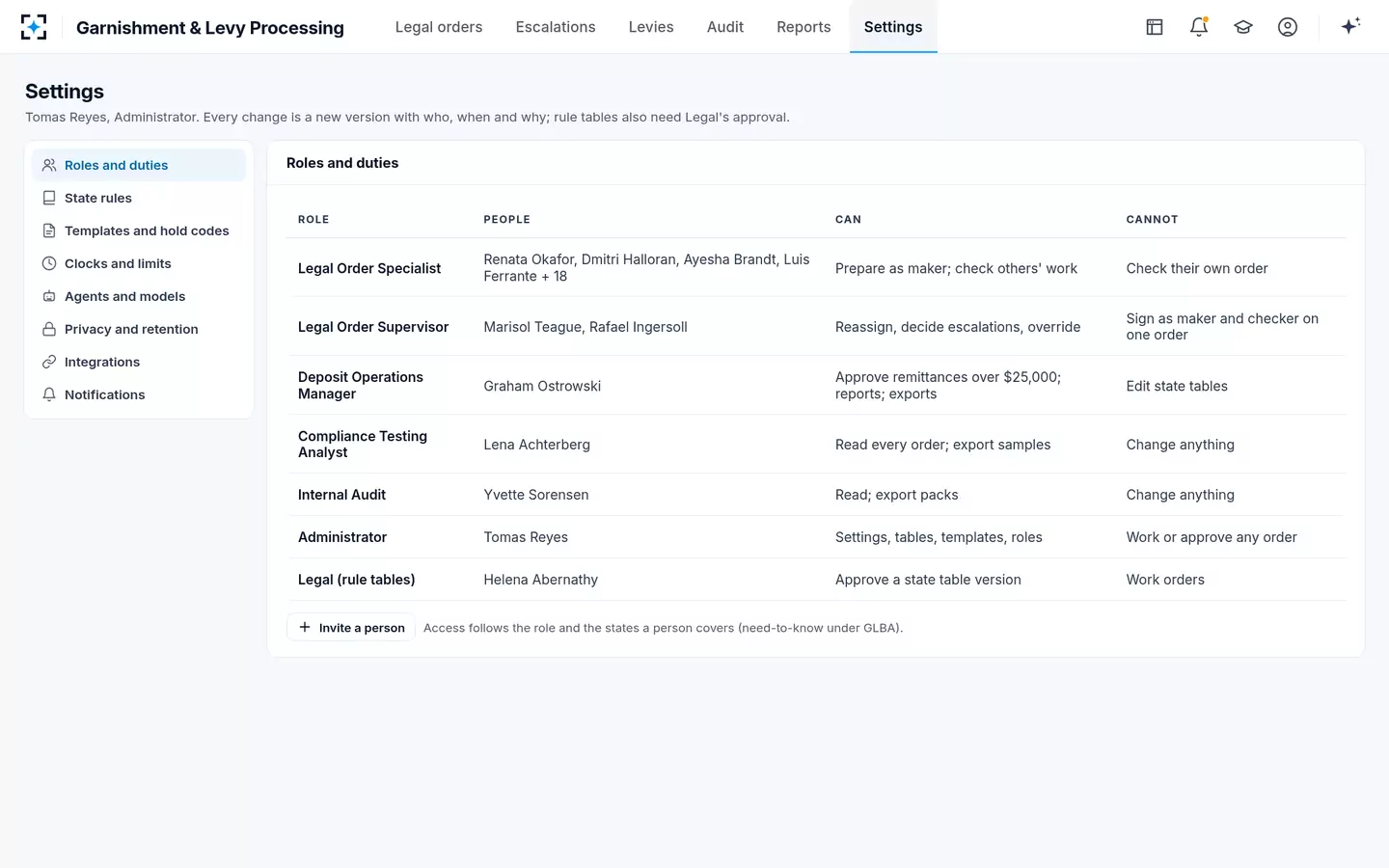
Every action that moves money or speaks for the bank needs two named people, and the policy should say who they are by role. The federal safe harbor protects a bank against bona fide errors made despite reasonable procedures (31 CFR 212.10(d)(1)); a documented maker and checker on each order is the clearest evidence of reasonable procedures a bank can show.
Who signs what on a desk running Garnishment & Levy Processing
Today
Prepares the order by hand, sometimes as the only signature.
With agents
Approves or overrides the agents' plan with a reason code.
Still theirs: The first signature on every hold, release, notice and answer.
Today
Checks a sample after the fact.
With agents
Checks every order on the same evidence, with two independent computations.
Still theirs: The second signature; never on an order they made.
Today
Decides exceptions when someone raises them.
With agents
Decides every escalation the agents raise, with options and reason codes.
Still theirs: Policy calls the rule does not settle.
Today
Assembles the examiner file by hand.
With agents
Exports any order's file and approves large remittances.
Still theirs: Remittances above the bank's threshold.
Today
Updates the procedure binder when someone asks.
With agents
Approves each state table version before it applies.
Still theirs: Which law applies, and what it says.
Roles and duties, enforced by the software rather than by memory
What records must a bank keep for garnishments, and for how long?
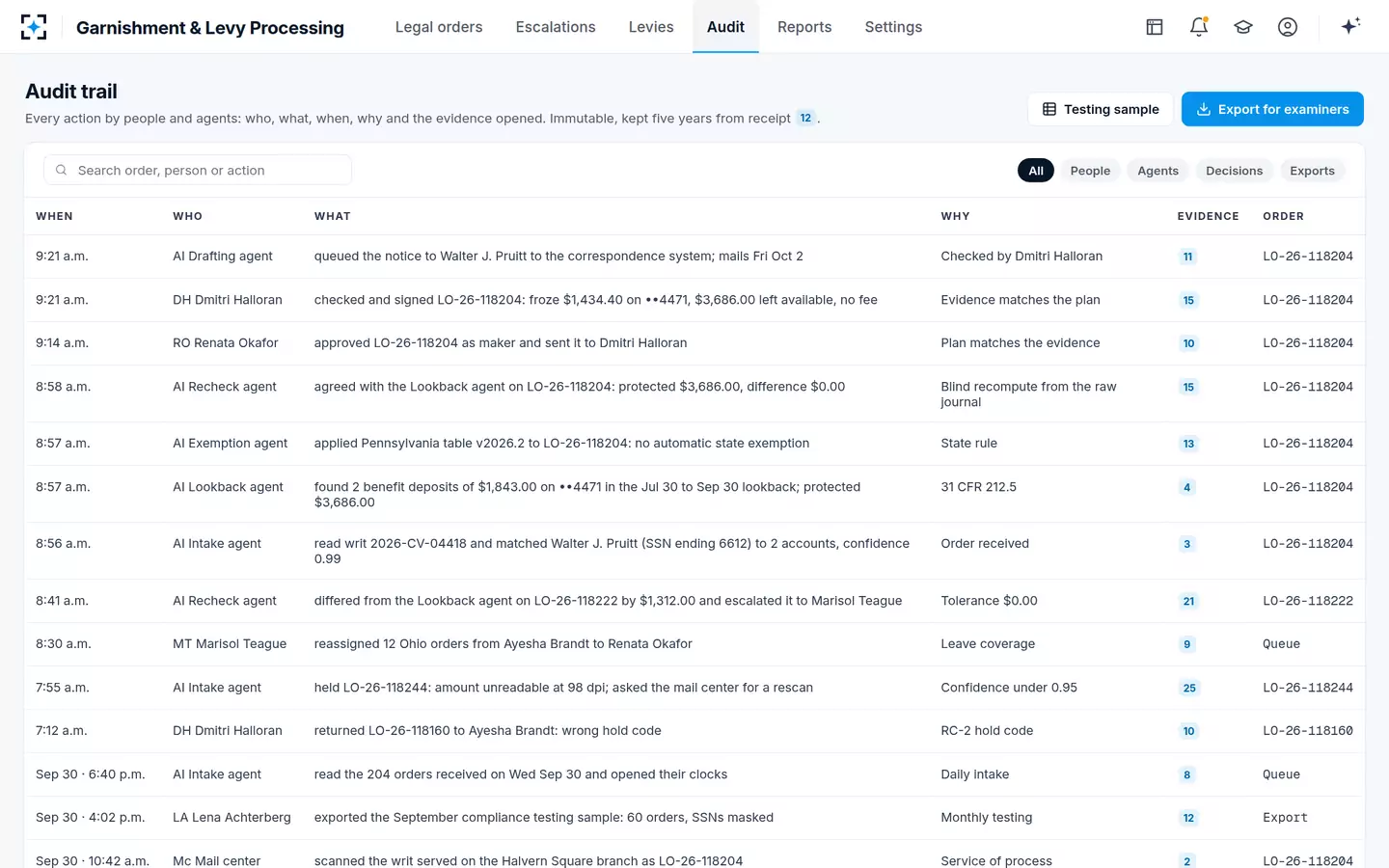
At least two years from the day the order arrives, and enough to prove each step. The rule requires a bank to "maintain records of account activity and actions taken in response to a garnishment order, sufficient to demonstrate compliance with this part, for a period of not less than two years from the date on which the financial institution receives the garnishment order" (31 CFR 212.11(b)). Banks that use the batch exception must also keep "records on such batches and creditor permissions" (212.5(a)(2)). The OCC notes that the bank "has discretion in deciding what documentation to retain" (OCC Comptroller's Handbook).
Two years is a floor, not a recommendation. The sample bank in the solution keeps every order's file for five years from receipt, a setting it chose; the solution also offers seven. Whatever the period, the file should hold the order image, the lookback with its batch headers, the computation and its check, the signatures, the notice and the answer, so an examiner can retrace any order without a specialist's memory.
Every action by people and agents on one trail, ready to export
How long does it take to automate legal order processing, and where does it not fit?
It takes as long as the five items take to assemble and the closed-order comparison takes to come out clean. A bank with written procedures and approved state tables starts from configuration; a bank whose rules live in a procedure binder starts by writing them down, which is worth doing whether it automates or not. The interagency guidance on third parties is the right frame for the buying decision: using a third party "does not diminish or remove" a bank's responsibilities, and new technologies "may present elevated risks ... including operational, compliance, and strategic risks" (Interagency Guidance on Third-Party Relationships, 2023).
The solution does not fit every desk or every task. It does not decide which state's law applies where Legal has not written a table; that state goes to a specialist. It does not give the customer legal advice, which the rule says a notice is not. It does not send, freeze or pay on its own. And its value depends on access to the batch headers and the posting journal; a desk that can only see statement descriptions will get a slower, weaker review from any tool. To see how the pieces work on one order, start from Garnishment & Levy Processing.
Questions people ask
Do credit unions follow the same garnishment procedures as banks?
For federal benefits, yes: 31 CFR Part 212 names credit unions alongside banks and savings associations in its definition of a financial institution. The IRS 21-day hold applies to insured credit unions too. The OCC notes one difference: a federal credit union keeps its statutory lien against the protected amount, as 31 CFR Part 212 explained sets out.
Can a bank use the model notice in Appendix A as is?
Yes. Appendix A says a bank that uses the model properly is treated as complying with the notice section. The model has bracketed choices to complete, such as freeze or remove, and the rule lets the bank amend the notice to fold in a state's garnishment rules for the states it serves.
What if a creditor serves hundreds of orders at once?
The rule lets the bank review a large batch by a later date the creditor permits, consistent with the orders' terms. The bank must keep records of the batch and of the creditor's permission, and the examiners' worksheet asks about both.
Should the procedures cover subpoenas for records?
Usually in the same manual but as a separate chapter: a subpoena asks for documents, not money, so 31 CFR Part 212 does not apply, and the confidentiality and response rules differ. Routing and intake can be shared; the decisions cannot.
Who should own the state exemption tables?
Legal or compliance should own the content and approve each version; operations should own applying it. A version should apply only to orders received after it is approved, so an examiner can see which rules governed each order.